Vermillion Insights
March 3, 2026 · Ken Vermeille · 20 min read
Build a Resilient Tech Team with a Software Developer Apprenticeship
Learn how a software developer apprenticeship helps startups build elite engineering teams. Our guide covers hiring, training, and scaling talent to win.
Let's be honest: trying to hire senior engineers right now feels like a losing battle. You're constantly outbid by tech giants with bottomless pockets, leaving you with stalled hiring cycles and a product roadmap that's gathering dust.
A software developer apprenticeship flips this entire script. Instead of fighting over the same small pool of expensive talent, you create your own.
Why Apprenticeships Are a Startup's Secret Weapon

Think of it like a pro sports team. You could spend your entire budget trying to sign a few all-star free agents, or you could build a farm system that consistently develops loyal, high-performing players who already know your playbook. An apprenticeship is your farm system for engineering talent.
You’re not just hiring - you’re investing in raw potential and molding it to fit your exact system, your culture, and your tech stack.
Build Loyalty and Reduce Churn
Engineers who grow with you from the ground up develop a type of loyalty you simply can't buy. They don't just understand the codebase; they understand the why behind it - the business pivots, the hard-won lessons, the vision for the future. That kind of institutional knowledge is gold.
This investment pays off massively in retention. When you give someone a clear path from apprentice to key contributor, you create an environment they won’t want to leave. The revolving door of talent slows down, and you stop burning cash on recruitment fees and onboarding new hires.
Practical Example: A fintech startup hired an apprentice who, over two years, grew into a junior engineer. A competitor offered her a 20% salary increase. She turned it down, stating that the investment the company made in her and the direct mentorship from the CTO created a sense of ownership she wouldn't find elsewhere. That loyalty saved the company over $30,000 in recruitment and replacement costs.
Gain a Sustainable Competitive Edge
The real game-changer here is learning how to build a talent pipeline. This is a massive strategic asset. Instead of panicking every time you need to hire, you’ll have a steady, predictable stream of talent that knows your product inside and out. You become insulated from the volatile hiring market.
This approach gives you a few key advantages:
- Perfectly-Trained Talent: Apprentices learn your way from day one. They adopt your coding standards, your tools, and your development process, which means way less friction than onboarding an experienced hire who has to unlearn old habits. Actionable Insight: Dedicate the first two weeks to building a "company way" bootcamp. This should cover your Git workflow, CI/CD pipeline, and key architectural patterns. This initial investment prevents months of re-work later.
- Smarter Scaling: The total cost to train an apprentice is almost always lower than the package for a senior engineer - recruiting fees, inflated salaries, signing bonuses, and all. It’s the most cost-effective way to grow your team.
- The Right Cultural Fit: You get to hire for aptitude and attitude. You can find people who genuinely share your company’s values and work ethic, which is a much better predictor of long-term success than a resume full of big names.
Starting a software developer apprenticeship isn't just about filling an empty seat. It’s a deliberate, long-term investment in your company's future - a powerful way to build a resilient, skilled, and deeply committed engineering team that will drive your product forward.
The Old Rules of Tech Hiring Are Broken
Let's be honest. The classic career path for software engineers - learn to code, get a junior job, climb the ladder - is falling apart. This isn't just a temporary market dip; it's a fundamental shift, and the two biggest wrecking balls are artificial intelligence and a completely new economic reality.
For a startup, trying to hire the perfect, ready-to-go senior developer has become a fool's errand. There are fewer of them available, every company is fighting over them, and the salary demands are just staggering.
At the same time, the very definition of "junior developer work" is evaporating. The simple tasks we used to give to new hires - writing boilerplate code, whipping up basic scripts, or handling simple unit tests - are now done in seconds by AI coding assistants.
This has carved out a dangerous canyon in the hiring landscape. The gap between what someone learns in a bootcamp and what a truly productive engineer needs to do on day one has never been wider. Junior roles are vanishing, leaving a generation of new talent with no bridge to cross into the industry.
The AI Squeeze on Junior Talent
Generative AI isn't just another productivity tool; it's rewiring how engineering teams are built. Big Tech has already reacted by gutting their entry-level hiring programs, stranding a massive wave of smart, hungry developers with no clear next step.
This isn't just a hunch. A recent Harvard study looked at 62 million workers and found that AI adoption directly cut junior developer jobs by 9-10% in just 18 months. Senior roles? They were untouched. Over the last three years, major tech companies have hired 50% fewer recent graduates, with many leaders openly stating that a junior hire is a tough sell when AI tools are so much cheaper. It’s a trend that backs up Gartner’s forecast that 80% of organizations will run on smaller, AI-powered engineering teams by 2030, a topic explored in this excellent analysis of software development's near future.
Practical Example: A mid-sized company automated the creation of their marketing website's React components using a custom GPT-4 prompt chain. This work, which previously occupied two junior developers, is now managed by one mid-level engineer in a few hours per week. This illustrates the exact squeeze on traditional junior tasks.
Build Your Own Private Talent Factory
Instead of duking it out in the wildly overpriced market for senior engineers, an apprenticeship lets you grow your own. Think of it as your private talent factory, designed from the ground up to produce developers who are already fluent in your tech stack, your company culture, and your product's mission.
This insulates you from a chaotic hiring market. You're no longer a victim of bidding wars or the high-stakes gamble of hiring an expensive senior developer who might not be the right cultural fit. You’re building a predictable pipeline of loyal, productive engineers.
- Dodge the Senior Hiring Hunger Games: Stop paying insane premiums for senior talent. Grow your own for a fraction of the cost.
- Build Deep Institutional Knowledge: Apprentices who grow up inside your company understand the why behind your product, not just the how. That context is pure gold.
- Create Custom-Fit Engineers: You shape their habits, their coding standards, and their skills to perfectly match your production environment. No more de-programming bad habits from a previous job.
The old talent pipeline is broken. That’s a problem for your competitors, but it’s an opportunity for you. While everyone else is complaining about the senior developer shortage, you can be quietly building a resilient, homegrown team. This isn’t a "nice-to-have" HR initiative anymore; it’s a core strategy for survival and growth. For more insights on sourcing great engineers, check out our guide on how to hire mobile app developers.
Choosing the Right Apprenticeship Model for Your Startup

Picking the right structure for your software developer apprenticeship is a big deal. It’s a decision that will ripple through your budget, product roadmap, and team’s day-to-day focus.
There’s no single “best” way to do it. The right model for a well-funded Series B company will likely crush a bootstrapped startup, and vice-versa. Your choice has to be a pragmatic balance between your financial reality and your need for high-quality, culturally-aligned engineers.
Let's break down the three most common models I've seen work in the wild.
The Direct Paid Apprenticeship Model
This is the classic, most hands-on approach. You hire apprentices as full-time employees from day one, paying them a salary and benefits while handling all of their training yourself.
- Who it’s for: Best for well-funded, later-stage startups (think Series B and beyond). You need to have senior engineers who can genuinely dedicate part of their week to mentoring without derailing your sprints.
- Pros: You get absolute control. You can tailor the curriculum to your exact tech stack, ingrain your engineering culture from the start, and mold apprentices to your specific standards.
- Cons: This model has the highest upfront cost and is a serious tax on your senior team’s time. If you’re a small, scrappy team, this can be a massive distraction.
Practical Example: A Series B fintech startup needs to expand its platform team. They launch a direct program, hiring four apprentices who spend 70% of their time pair-programming on internal tools with senior devs. The other 30% is spent on structured lessons covering the company’s specific microservices architecture and strict compliance standards. Actionable Insight: The mentor's time is blocked off on their calendar as "Mentorship Focus Time," ensuring it's treated as a primary responsibility, not an interruption.
The Earn-and-Learn Partnership Model
With this model, you don't go it alone. You partner with a formal educational institution, like a community college or university. Apprentices split their week between classroom instruction at the school and paid, on-the-job training at your startup.
This approach often unlocks access to government grants and hands you a pre-built academic curriculum, which can take a huge load off your internal team.
Practical Example: A health-tech startup partners with a local community college's cybersecurity program. Apprentices spend three days a week at the company implementing security protocols they learned in class that same week. The college curriculum provides the theory; the startup provides the immediate, practical application. Actionable Insight: Meet with the department head quarterly to align the curriculum with your upcoming tech needs, ensuring students learn relevant skills.
The Bootcamp-to-Apprentice Pipeline
This has become a go-to model for lean startups. You form a relationship with one or more coding bootcamps and create a direct pipeline for their top graduates to join your apprenticeship program. These candidates show up with a strong, modern baseline of practical skills.
- Who it’s for: Perfect for bootstrapped or seed-stage startups. You need pre-vetted talent with foundational skills but can’t afford to build a massive training program from scratch.
- Pros: The bootcamp handles the intensive, foundational training, which saves you a ton of time and money. You get passionate, project-ready candidates who have already proven they can learn at a rapid pace.
- Cons: The quality of bootcamp grads varies. A lot. You’ll need a really sharp interview process to spot true potential and be ready to bridge the gap between their generalist knowledge and your specific, production-level needs.
Practical Example: A bootstrapped B2B SaaS company partners with two local coding bootcamps. They set up a "fast-track" interview day for the top graduates, but instead of whiteboarding, they ask candidates to debug a small, intentionally broken feature in their actual product. This tests real-world problem-solving and coachability, not just academic knowledge, ensuring they hire people who can contribute quickly.
Comparison of Software Developer Apprenticeship Models
| Model | Best For | Pros | Cons |
|---|---|---|---|
| Direct Paid | Well-funded, later-stage startups (Series B+) with available senior engineers. | Maximum control over curriculum and culture; apprentices are molded to your exact needs. | Highest upfront cost; significant time commitment required from senior engineers. |
| Earn-and-Learn | Startups seeking structured partnerships and access to government grants. | Pre-vetted candidates from an academic pipeline; reduced internal training and administrative load. | Curriculum may be less flexible; coordination with an external institution can be slow. |
| Bootcamp-to-Apprentice | Early-stage or bootstrapped startups needing skilled candidates quickly. | Candidates have foundational, project-ready skills; lower initial training cost and time investment. | Graduate quality can be inconsistent; requires a strong vetting process and gap training. |
Ultimately, your decision should align with your company's immediate resources and long-term goals. A lean startup might start with a bootcamp pipeline and evolve into a direct paid model as it scales, while another might find the perfect long-term partner in a local college. The key is to be realistic about what you can support and what will deliver the best return for your team.
Designing Your Program for Maximum Impact
A successful software developer apprenticeship is built with intention. It's not about handing an aspiring developer a laptop and just hoping for the best; it’s a structured system designed to forge high-performing engineers who get your standards from day one. An unstructured program, on the other hand, is a recipe for failure.
The numbers don't lie. A staggering 47% dropout rate plagues apprenticeship programs, affecting about 115,000 apprentices every year. One of the biggest culprits? Poor training quality. This is exactly why a rigorous, production-focused program isn't just a nice-to-have, it's non-negotiable.
So, where do you start? Designing a program with real impact begins with a clear-eyed look at what your team actually needs. Before you even think about writing a curriculum, you have to pinpoint the specific skills and knowledge gaps you want the apprenticeship to fill. A thorough skills gap analysis template is your best friend here, helping you define exactly what a "win" looks like for both the apprentice and your company.
Crafting the Curriculum Your Startup Needs
Your curriculum is the heart of the entire program. It needs to be a practical mix of foundational computer science principles and hands-on, real-world work using your company's actual tech stack. Ditch the generic tutorials. The goal here isn't to create a jack-of-all-trades; it's to build an engineer who can ship code in your codebase.
Think of the curriculum as a balanced diet for a developing engineer. They need a mix of different "nutrients" to grow strong and avoid burnout. A practical weekly schedule is the best way to maintain this balance and ensure they're making steady progress.
A proven weekly structure we've seen work time and again looks something like this:
- 30% Structured Learning: This is dedicated time for apprentices to master core concepts. Think self-paced modules on data structures, workshops on your team's API design patterns, or deep dives into your testing philosophy. Practical Example: An apprentice spends Monday morning completing a pre-selected online course on SQL optimization. That afternoon, they apply that knowledge by refactoring a slow query in a non-critical internal dashboard.
- 50% Pair Programming on Real Features: This is where the magic happens. Apprentices should spend the bulk of their week paired with a senior engineer, working on real (but non-critical) tickets straight from your backlog. They get to see firsthand how production code is written, debated, and ultimately shipped.
- 20% Code Review and Mentorship: This block is reserved for one-on-one sessions, detailed code reviews, and honest career conversations. It's the dedicated space for feedback, course correction, and building that crucial mentor-mentee relationship.
The Power of Intentional Mentorship
Mentorship is the force multiplier for any great software developer apprenticeship. But simply assigning a senior engineer to an apprentice and calling it a day is not enough. The relationship has to be structured for success. A great mentor does more than just answer questions - they challenge assumptions, model professional behavior, and become an advocate for the apprentice’s growth.
Practical Example: Instead of just fixing an apprentice's broken code, a mentor asks, "What have you tried so far? What do you think the root cause is?" This Socratic method teaches the apprentice how to debug, a far more valuable skill than knowing the fix for one specific bug. Actionable Insight: Create a "Mentorship Playbook" for your senior engineers, outlining best practices like this and setting clear expectations for their role.
To make mentorship truly work, it has to be an official part of the senior engineer’s role, not an afterthought squeezed between meetings. Their contributions as a mentor need to be recognized and valued in performance reviews, period. For more on building the right technical foundation for your team to build upon, check out our guide on how to choose the right tech stack.
By designing a program with this level of intention - blending a targeted curriculum with structured mentorship - you're not just hiring. You're building a reliable system for transforming raw talent into the elite, production-ready engineers your startup needs to win.
Measuring Your Apprenticeship's ROI and Success
An apprenticeship program isn't a charity project; it's a strategic investment in your startup's long-term health. But like any smart investment, you can't just hope it works out. You need to track its performance with cold, hard data.
Forget fuzzy feelings of goodwill. Without clear metrics, your program is a cost center. With them, it becomes a powerful growth engine. You can justify the investment, sharpen your training, and draw a straight line from your apprentices to faster shipping velocity and a more stable team.
This is more important than ever. The global software developer shortage is set to explode from a deficit of 1.4 million roles in 2021 to a staggering 4.0 million by 2025. As this analysis of the software talent shortage points out, the demand for developers is creating hundreds of thousands of new jobs every year, making alternative talent pipelines a necessity, not a luxury.
Key KPIs to Track Your Program's Success
To figure out if your apprenticeship is actually paying off, you need to track a few key performance indicators (KPIs). These metrics show you the exact journey an apprentice takes from a net cost to a net-positive contributor to your bottom line.
- Time-to-Productivity: This is the most critical metric. It’s the precise moment an apprentice's output becomes more valuable than the cost of their salary and their mentor's time. You should be aiming for this to happen between 6 to 9 months. Actionable Insight: Track this by monitoring when the apprentice can independently complete a 3-point story (a small, well-defined feature) from the backlog without significant hand-holding.
- Cost-per-Hire: Do the math. Add up the total cost of hiring and training an apprentice - salary, benefits, mentor time, any training materials. Now compare that to what you’d spend to hire a mid-level engineer from the outside, including recruiter fees, a higher salary, and a potential signing bonus. A well-run program should deliver a 40-60% lower cost-per-hire.
- Retention Rate: This is the real test of your program's long-term value. Track how many apprentices are still with you two years after graduation. A high retention rate - I'm talking 85% or higher - is proof you're not just hiring, you're building loyalty and avoiding the crippling costs of engineer churn.
- Feature Velocity: As an apprentice ramps up, watch your team’s output. You should see a measurable increase in the number of story points completed or features shipped per sprint as they start taking on more work independently.
A 12-Month Roadmap to Autonomy
Setting expectations is everything, both for the apprentice and for your engineering team. This roadmap isn’t just a schedule; it’s a deliberate plan for building skills and handing over ownership, piece by piece.
A well-structured week is the foundation for this journey, balancing dedicated learning time with practical, hands-on collaboration and feedback.
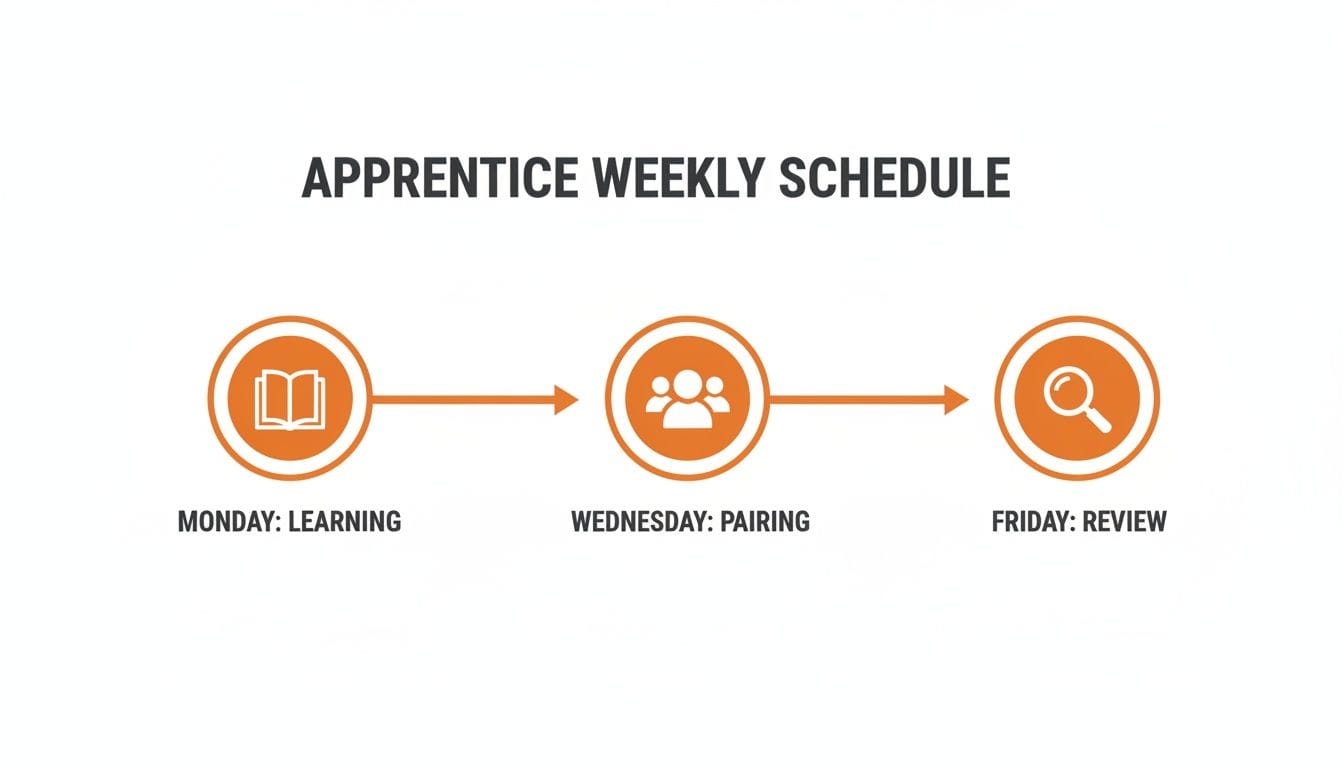
This rhythm ensures new knowledge is put into practice almost immediately through pairing, then polished through dedicated review sessions.
Here’s how that weekly structure plays out over the course of a year:
Months 1-3: Foundational Skills The entire focus is on learning the fundamentals. Your apprentice gets up to speed on your specific tech stack, your development environment, and your core coding standards. They ship small, low-risk bug fixes to get comfortable with your deployment pipeline and build confidence. Practical Example: By the end of month 1, the apprentice should be able to independently fix a typo in a UI, get the PR approved, and see it deployed. Months 4-9: Mentored Contribution This is where they graduate to contributing real value. The apprentice starts pair programming on non-critical features, working directly on tasks from the product backlog. They are now actively contributing code under the close eye of their mentor, shifting from a pure learning cost to a contributing team member. Practical Example: In month 6, the apprentice and their mentor tackle a feature to add a new filter to a search results page. The mentor designs the overall approach, but the apprentice writes the majority of the code. Months 10-12: Emerging Autonomy In the final stretch, the apprentice begins to take ownership of small, well-defined features. They are writing code, creating tests, and drafting documentation with minimal supervision. This is where you see clear proof they are ready to transition into a full-time, independent engineering role. Practical Example: In month 11, the apprentice is assigned a ticket to add a "copy to clipboard" button to an important data field. They are expected to handle the entire lifecycle: implementation, testing, documentation, and deployment, only asking for help if they get completely stuck.
Mini Case Study: A Startup's Success Story
Let’s imagine a SaaS startup, we’ll call them "Velocity," that was struggling. They were burning through cash on expensive contractors and their senior engineers were getting dangerously close to burnout from a constant bug-squashing cycle.
They decided to launch a software developer apprenticeship program. They hired two apprentices and paired them with senior mentors, following the 12-month roadmap we just outlined.
The results after a year were impossible to ignore. The apprentices were confidently handling all incoming bug fixes and building out small features, which freed up the senior engineers to finally tackle the complex architectural debt that was slowing everyone down.
By the 18-month mark, both former apprentices were fully integrated junior engineers. Velocity had increased its feature shipping velocity by 40%, completely cut its spending on contractors, and saw a huge boost in team morale. It’s a classic example of how this model delivers financial wins - wins that can sometimes even come with tax advantages. In fact, you can learn more about R&D tax credits for software development in our guide on the topic.
Your Actionable Hiring and Onboarding Checklist

So, you’re ready to launch your software developer apprenticeship. A great decision. But turning that idea into a productive team member requires a solid, repeatable playbook for hiring and onboarding.
This isn't just about filling a seat. It's about finding raw potential and nurturing it from day one. Here’s the process we use to get it right.
Stage 1: Crafting the Role and Finding Talent
Before you can find the right person, you have to define what "right" actually looks like for an apprentice. This stage is all about setting clear expectations and writing a job post that attracts motivated learners, not just people with polished resumes.
- Define Legal and Compensation: First things first, talk to a lawyer. You need to classify the role correctly (apprentice vs. intern has legal implications) and set a fair, competitive salary. Being transparent about pay from the start builds immediate trust.
- Write a High-Potential Job Description: Stop listing technologies they need to know. Instead, focus on what they will learn and who they will become. Talk about the mentorship, the real projects they’ll ship, and the path to a full-time role. You're hiring for coachability, curiosity, and a passion for problem-solving - not a laundry list of frameworks.
- Source Candidates Creatively: Forget just posting on the big job boards. The best candidates are often hiding in plain sight. Build relationships with coding bootcamps, community colleges, and local tech meetups to find people who are hungry to learn and prove themselves.
Stage 2: The Interview Process
Your goal here is simple: find someone who has the drive and capacity to learn anything, not someone who already knows everything. The interview needs to test for aptitude and mindset above all else.
Practical Example: Design an interview that reveals how a candidate thinks, not just what they know. A take-home project or a pair-programming session on a real, small-scale problem is far more insightful than abstract whiteboard challenges. A great prompt is: "Here's a small, open-source command-line tool we use. Your task is to add a new flag to it. You have 90 minutes and can use the internet, ask me questions, and read the existing code."
A solid process looks like this:
- A Practical Coding Challenge: Give them a small, self-contained project that feels like a real task. A great example is asking them to build a simple front-end component that fetches and displays data from a public API. This shows you how they learn and apply concepts on the fly.
- A Behavioral Interview: Ask questions that dig into resilience, curiosity, and collaboration. My personal favorite is, "Tell me about a time you got stuck on a difficult problem and what you did to get unstruck." Their answer tells you everything about their problem-solving grit.
- Meet the Mentor: This is a two-way street. Have candidates chat with their potential mentor to check for chemistry. It also gives the apprentice a clear picture of who will be guiding them, making the role feel much more real.
Stage 3: The First-Week Onboarding Plan
The first week is all about building momentum. You want your apprentice to feel welcomed, capable, and plugged into the team. Your plan should be built around small, achievable wins that build confidence.
- Day 1: Setup and Welcome: The number one goal for day one? Get their development environment 100% configured. Nothing kills momentum like spending three days fighting with setup scripts. Actionable Insight: Create a single, well-documented onboarding script that automates the entire setup. Have a mentor sit with them while they run it to troubleshoot in real-time.
- Days 2-3: The First Small Win: Give them a tiny, low-risk task. Fixing a typo in the documentation, correcting a minor CSS bug, anything. The goal is to let them ship something to production. That feeling is a massive confidence booster.
- Days 4-5: Establish Communication Rhythms: Get their first official one-on-one with their mentor on the calendar. Introduce them to key people on the team. Most importantly, set up daily check-ins and walk them through your process for code reviews and asking for help. Make it clear that asking questions is not only okay, but expected.
The Three Big Questions Every Founder Asks
You've got the roadmap, but let's be real - a few big questions are probably still nagging you. Starting an apprenticeship program is a major commitment, and it's natural to have doubts.
We hear the same concerns from founders all the time. Let's tackle them head-on so you can move forward with a clear head.
Apprentice, Intern, Junior Dev... What's the Real Difference?
I see these terms get mixed up constantly, but they represent completely different strategic hires. Getting this wrong is a recipe for frustration.
An intern is a tourist. They're typically students exploring the industry for a few months, mostly observing and working on isolated, low-risk tasks. The goal is exploration, not long-term contribution.
A junior developer is expected to hit the ground running. You hire them assuming they have a solid foundation and can start contributing to your codebase with some guidance. They're already on the team, not training for it.
An apprentice, on the other hand, is a deliberate investment. They are a full-time employee hired specifically to be molded into a productive engineer for your team. Their job isn't just to do tasks; their job is to learn.
Practical Example: An intern might spend the summer building a standalone prototype that never gets shipped. A junior dev is expected to pick up a ticket for a bug in the production login flow. An apprentice would pair with a senior to fix that same bug, with the focus being on learning the authentication system.
How Much Is This Actually Going to Cost Me?
The cost is more than a salary, and anyone who tells you otherwise is selling you a fantasy. A real budget needs to cover the apprentice's salary and benefits, plus the hidden - but most important - cost: your senior team's time.
A good rule of thumb is to dedicate 15-20% of a senior engineer's week to the program. That time is spent on focused mentorship, code reviews, and pair programming. It's not lost time; it's an investment.
But here’s the other side of that coin. When you factor in the insane recruiter fees and sky-high salary demands of the open market, a successful apprenticeship can slash your cost-per-hire by 40-60% compared to landing a mid-level engineer. You're building talent, not just buying it.
What's the Real Time Sink for My Senior Engineers?
Mentorship is the make-or-break element here, but it doesn't have to derail your product roadmap. A good program doesn't create chaos; it creates a predictable rhythm.
Forget random shoulder-taps and endless questions. A structured mentorship schedule looks something like this:
- Daily Stand-ups: A quick 15-minute check-in each morning. What’s the plan? Any blockers? Move on.
- Weekly 1-on-1s: One solid hour for real feedback, career talks, and digging into bigger challenges.
- Pair Programming: Around 4-6 hours a week. This isn't busy work; it's focused time spent building real, non-critical features together.
This approach turns mentorship from a constant distraction into a scheduled, productive activity. It’s a completely manageable commitment that builds you the exact engineer you'll need in 12 months.
At Vermillion, we help founders build resilient engineering teams and scale their products without costly missteps. We combine senior technical leadership with hands-on development, ensuring what you build today is ready for what comes next.
Learn how our fractional CTO and product development services can help you ship faster with confidence by visiting us at https://vermillion.agency.
Keep reading
See all →
March 22, 2026
Unlocking Revenue Your Guide to Price Tier Strategy

March 21, 2026
Your Guide to Flawless Stripe Subscription Management

May 14, 2026
Fractional Mobile Engineering vs. Full-Time Hiring in 2026
The mobile engineering talent market has shifted dramatically over the past two years. Budgets are tighter, AI tools have changed what a sin...
March 20, 2026
Recurring Billing With Stripe a Guide for Subscription Apps
Master recurring billing with Stripe. This guide covers everything from setup and server logic to webhooks and churn reduction for subscript...

March 19, 2026
Unlocking Growth with Mobile App Retention Metrics
Discover the mobile app retention metrics that directly fuel MRR growth. This founder's guide offers actionable strategies to track, analyze...