Vermillion Insights
March 17, 2026 · Ken Vermeille · 15 min read
A Founder's Guide to Mobile Development Hybrid for Subscription Apps
Learn why mobile development hybrid is crucial for subscription app success. Build faster, reduce costs, and scale your app with a single, efficient codebase.

Think about the cost and time it takes to build a mobile app. Now, imagine doing it twice. That’s the reality for many founders who need to build separate, native applications for both iOS and Android. It’s expensive, slow, and doubles your maintenance headache.
This is where hybrid development comes in. Instead of building two distinct apps from the ground up, you write a single, primary codebase that works on both platforms. It's about efficiency, plain and simple.
What Is Hybrid Mobile Development?
At its core, hybrid mobile development is a strategy to build one app that runs everywhere.
Traditional native development is like hiring two specialized chefs - one who only cooks French cuisine (iOS) and another who only cooks Italian (Android). You get perfect, authentic dishes, but you're paying two full-time salaries and managing two separate kitchens. It delivers flawless performance but at a high cost.
Hybrid development, on the other hand, is like hiring one versatile chef who has mastered fusion cooking. They use a common set of ingredients and techniques (your single codebase) to create dishes that appeal to both French and Italian palates (iOS and Android users). This approach drastically cuts down the effort and cost required to serve everyone.
The whole idea is "write once, run anywhere," as shown below.
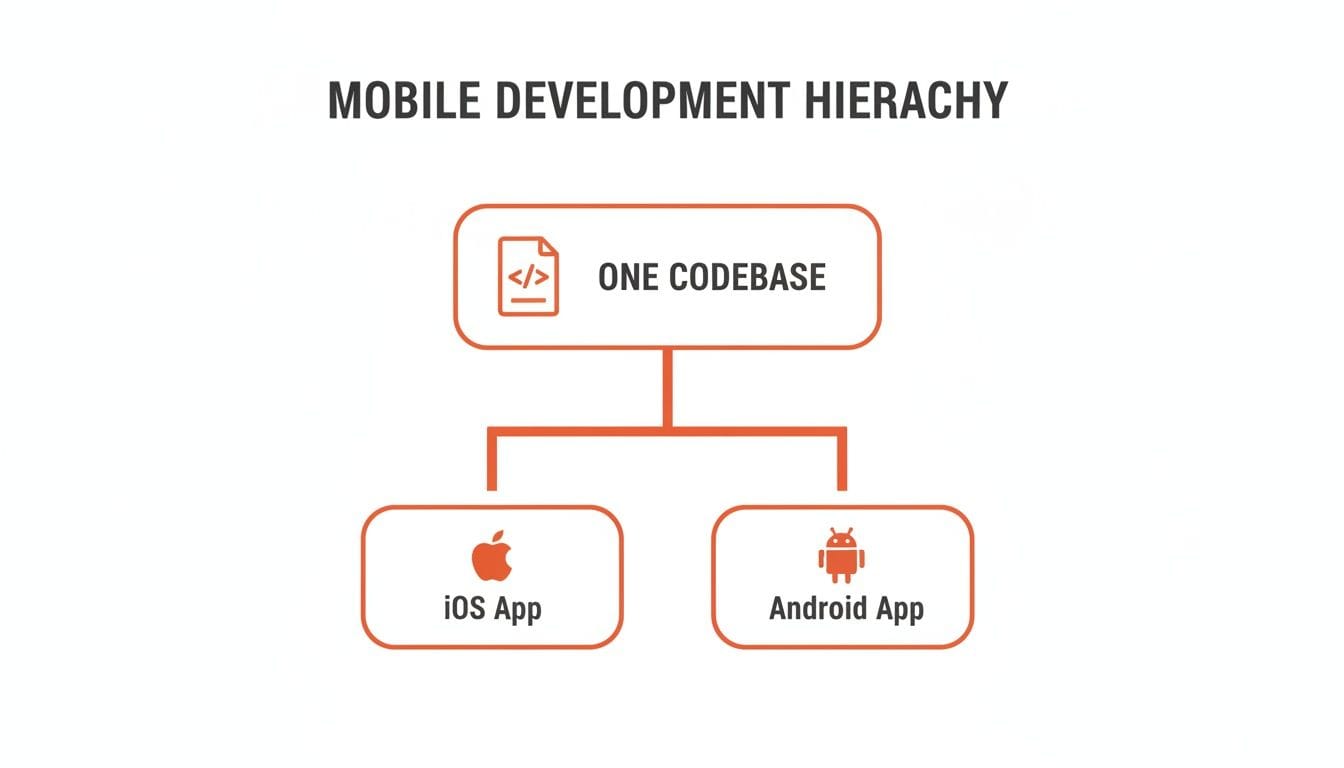
As you can see, a single development effort produces apps for both major mobile ecosystems, streamlining the entire build and maintenance process.
How Frameworks Make This Possible
This isn't just magic; it’s made possible by powerful frameworks like React Native or Flutter. These tools act as interpreters, translating a single set of instructions written in a language like JavaScript into commands that both iOS and Android devices natively understand.
Practical Insight: A hybrid framework acts as a "bridge," allowing a single codebase to access native device features - like the camera, GPS, or push notifications - on both iOS and Android. For example, your developer writes code to access the camera once. The framework then translates that command into the specific API calls required by both the iOSAVFoundationframework and the AndroidCameraXlibrary.
This gives you a user experience that feels completely native without needing two separate engineering teams. It’s a huge leap from older methods that just stuffed a website into an app-shaped box. Modern hybrid apps have responsive UIs and smooth performance that’s often indistinguishable from their native counterparts.
We cover some of the finer points in our guide on what cross-platform app development is and how the different approaches stack up.
Why Is Everyone Talking About It?
The market has caught on fast. Hybrid frameworks now power over 40.8% of all mobile applications worldwide. Flutter has taken a significant lead, with 46% of developers choosing it, while React Native remains a strong contender with 32% adoption.
This approach is especially popular with subscription app teams who need to move quickly. For founders and marketing teams, it means they can test new features, update paywalls, and respond to market feedback faster than ever before.
A Quick Comparison
To put it all in context, let's break down how these development paths compare from a business perspective.
Development Approaches at a Glance
| Attribute | Native Development (iOS/Android) | Hybrid Development | Cross-Platform Native (React Native) |
|---|---|---|---|
| Codebase | Separate for each platform | Single shared codebase | Single shared codebase |
| Performance | Highest possible, direct access to OS | Good, but can be slower for intensive tasks | Near-native, compiles to native UI |
| Development Cost | High (two teams, two codebases) | Low to Medium (one team) | Medium (one team, some platform-specific work) |
| Time to Market | Slower (sequential or parallel builds) | Fastest (simultaneous deployment) | Fast (simultaneous deployment) |
| UI/UX | Best, follows platform-specific conventions | Good, can mimic native but may feel generic | Excellent, uses native UI components |
| Access to Native APIs | Full and immediate | Relies on plugins/bridges, may have delays | Excellent, direct access via bridging |
| Best For | Performance-critical apps, complex graphics | MVPs, content apps, business utilities | Most business and subscription apps |
This table gives you a snapshot, but the best choice always depends on your specific product, budget, and long-term goals. For many subscription apps, the balance of speed, cost, and performance offered by cross-platform native frameworks like React Native hits the sweet spot.
Why Hybrid Is Your Subscription App's Secret Weapon

As a subscription app founder, you live and die by your monthly recurring revenue (MRR). Every decision you make, from marketing to product, traces back to that number. Choosing how your app is built isn't just a tech detail for your engineers to figure out - it's a core business strategy that directly impacts your bottom line.
This is where a mobile development hybrid approach becomes your secret weapon.
Let's skip the theory. I want to connect this technical choice to three things that actually matter to your business: launching faster, spending less, and running a much tighter ship.
Accelerate Your Time to Market
In the subscription game, speed is everything. You need to test new paywalls, features, and onboarding flows constantly. With a single, unified codebase, you can run those experiments on both iOS and Android at the same time. This simple fact effectively cuts your time-to-market in half.
Imagine you want to A/B test a new annual plan against your monthly offer.
- The old way (native): You’d have to brief two separate teams. One builds it in Swift for iOS, the other in Kotlin for Android. Even if they work in parallel, you’re stuck managing two development cycles, two QA processes, and two App Store submissions. The total effort could be 40-60 developer hours.
- The hybrid way: Your engineer codes the new paywall once. It gets tested and deployed to both platforms from a single codebase. What might have taken two weeks is now done in one, potentially in under 20 developer hours.
This is exactly why cross-platform development has become the default for most successful subscription apps. It completely changes the velocity of your engineering. Using frameworks like React Native, teams we've worked with are launching on both iOS and Android in weeks, not months. This agility is what allows you to relentlessly optimize your paywalls, onboarding, and core features. If you're interested in the data, you can learn more about the trends shaping mobile development statistics.
Dramatically Reduce Development Costs
The financial argument for hybrid is simple and powerful. When you use one codebase and one team, you don't need to hire, manage, and pay two separate groups of highly specialized developers.
Practical Insight: You're not just saving on salaries; you're reducing complexity in project management, communication, and quality assurance. A single, unified team is nimbler and more cost-effective. For example, a single daily stand-up meeting covers progress for both platforms, one project manager tracks a unified backlog in Jira, and one QA engineer tests a single feature set.
Just think about the hiring costs. Finding a great senior iOS developer is hard and expensive. So is finding a great senior Android developer. Now you have to do both. Or, you could focus on finding one expert team that's fluent in a hybrid framework like React Native. It's a much more efficient use of your capital.
Drive Unmatched Operational Efficiency
Beyond just speed and cost, a hybrid approach makes your whole company more efficient. When you have one engineering team, you get rid of the communication gaps and bottlenecks that always seem to pop up between separate iOS and Android teams.
Suddenly, your marketing, product, and engineering departments can actually move in sync. A new campaign idea from marketing doesn't get stuck in a tangled backlog split between two teams. It flows through one streamlined process, turning a business idea into a live feature that much faster.
This alignment is the secret to turning a technical choice into a healthier bottom line.
Choosing Your Tech Stack: The React Native Advantage

So, you’ve settled on a mobile development hybrid approach for your subscription app. Smart move. Now comes the decision that will shape your budget, hiring, and speed for years to come: the tech stack.
While there are a few options out there, the real contest for most founders comes down to three frameworks: React Native, Flutter, and Ionic. This isn't just a technical detail for your engineers to debate. It's a business decision with massive consequences.
For subscription apps specifically, I've seen one framework consistently deliver the right mix of performance, developer availability, and ecosystem support needed for fast growth. That framework is React Native. Let me show you why.
The Unbeatable Talent Pool Advantage
Here’s a simple truth that saves founders a lot of headaches: React Native is built on JavaScript, the most popular programming language on the planet. This isn't just trivia; it’s a huge strategic advantage. It means you’re fishing in a global ocean of developers, not a small, expensive pond.
Flutter, its main competitor, uses a language called Dart. While it's a solid language, the Dart talent pool is a fraction of the size. Finding and hiring experienced Flutter developers is almost always harder and more expensive. And while Ionic uses web tech, its performance often can't deliver the smooth, native feel that gets users to pull out their credit cards and keep paying.
Actionable Insight: Choosing React Native is a strategic move to de-risk your hiring pipeline. You're not just picking a technology; you're tapping into a mature and accessible talent market. When you post a job for a "React Native Developer," you get a flood of qualified candidates. Post for a "Dart/Flutter Developer," and you'll get far fewer, making your hiring cycle longer and more competitive.
This is how you scale an engineering team without getting bottlenecked by a niche skill set. We cover this in more detail in our guide on getting started with React Native.
A Pixel-Perfect Native Experience
For any subscription app, the user experience is everything. A glitchy interface or a slow, clunky feel is a one-way ticket to uninstalls and lost revenue. This is where older hybrid frameworks like Ionic stumble. They often rely on "WebViews" - basically a tiny web browser shoehorned into an app - which feels disconnected and sluggish.
React Native is entirely different. It’s what we call a "cross-platform native" framework. Instead of faking the UI, it renders real, native UI components.
- Feel and Performance: The buttons, menus, and animations in your app are the exact same components a native iOS or Android app would use. It feels right because it is right.
- User Retention: The result is a fluid, snappy experience that feels 100% authentic to the device. This is absolutely critical for convincing users your app is a high-quality product worth paying for every month.
Flutter also delivers great performance, but it takes a different route, drawing every single pixel on the screen itself. This can occasionally cause small visual inconsistencies when iOS or Android updates their design language. Because React Native uses the OS's own building blocks, your app always looks and feels perfectly up-to-date.
The Unmatched Subscription Toolchain
This is the closer. For a founder building a subscription business, the single most compelling reason to choose React Native is the ecosystem. The entire modern subscription toolchain was built with React Native as a first-class citizen.
The essential platforms you need to monetize and grow have bet heavily on it:
- **RevenueCat:** The go-to platform for managing in-app subscriptions has a best-in-class React Native SDK.
- **Superwall:** A top-tier tool for A/B testing paywalls, with deep and powerful React Native integration.
- **Adapty:** Another major player in the subscription and paywall space with excellent React Native support.
This means your team can integrate the most powerful growth tools on the market quickly and reliably. It’s this rich ecosystem that lets you ship paywall experiments and optimize funnels at the speed your marketing team needs. For any serious subscription app, this makes React Native the clear winner.
Integrating Your Subscription Monetization Tools
This is where choosing a mobile development hybrid approach, especially React Native, really pays off. A slick app is a great start, but the real business gets built when you can actually make money from it. The good news is that the entire modern subscription toolkit was practically designed to play nice with React Native.
You don't have to bolt on a clunky payment system. The best-in-class tools - think RevenueCat, Superwall, and Adapty - all have dedicated software development kits (SDKs) specifically for React Native. For your engineering partner, this means they can wire up all your in-app purchases, subscription logic, and even complex paywall experiments without reinventing the wheel.
From Idea to Live Experiment in an Afternoon
Let's make this real. Imagine your growth team has an idea: "What if we test a 'lifetime access' offer against our usual annual plan? Maybe it'll boost our immediate cash flow."
In a traditional setup, that’s a multi-week project. With a React Native app connected to Superwall, you can get this experiment live before your afternoon coffee gets cold. Here's how that actually works:
- Configure the Offer: Your marketing lead opens up the Superwall dashboard - no code needed - and creates the new lifetime offer, sets the price, and picks a design template.
- Deploy the Campaign: They then create a new A/B test. 50% of users see the standard paywall, and the other 50% get the new lifetime deal.
- Push It Live: They click a button. That's it. The campaign is live. The Superwall SDK inside your React Native app instantly starts showing the right paywall to the right users, across both iOS and Android, with no app update required.
Actionable Insight: This whole thing happens without a single new build or getting stuck in the App Store review line. That’s the speed you get. Your engineers build the plumbing once by integrating the SDK, and your growth team gets to run experiments independently and whenever they want.
How SDKs Streamline Monetization
These SDKs handle all the messy, frustrating parts of in-app purchases for you. Your team doesn't have to spend weeks wrestling with the notorious complexities of Apple's StoreKit and Google's Play Billing. They just plug in one SDK that handles both.
This single integration takes care of the mission-critical stuff:
- Unified Purchases: A single piece of code triggers a purchase on both iOS and Android. For example, calling
RevenueCat.purchasePackage()works seamlessly on both platforms. No platform-specific madness. - Subscription Status: Reliably checking if a user is active, in a trial, or has canceled. This sounds simple, but it's incredibly complex to manage across two platforms.
- Receipt Validation: Securely checking with Apple and Google to make sure purchases are legitimate and prevent fraud.
- Analytics: Automatically tracking the metrics that matter, like trial conversions, renewal rates, and churn, without extra setup.
This tight fit between mobile development hybrid frameworks and monetization tools isn't a coincidence. It's the direct result of what modern subscription apps need to survive: the ability to move fast and test ideas without getting bogged down by technical overhead. When you build on a React Native foundation, you're setting yourself up to optimize revenue from day one.
Finding the Right Engineering Partner Model

Choosing a mobile development hybrid approach sorts out the “what” and “why.” Now comes the hard part: the “how.” The most brilliant strategy on paper is worthless without the right team to actually build the thing. Your choice of engineering partner is every bit as critical as your tech stack.
For a fast-moving subscription app, the traditional routes for finding talent are either too slow or too risky. You need a partnership model that can keep up. Let’s look at the usual suspects and where they fall short.
The Pitfalls of Traditional Hiring
Hiring full-time employees feels like the default move, but it’s loaded with hidden costs. The hunt for a specialized React Native developer can drag on for months, killing your momentum before you even start. Once you finally land someone, you’re on the hook for ramp-up time, benefits, overhead, and all the fun of HR management.
On the other end of the spectrum, you have freelancers. They offer flexibility, sure, but they often lack the deep commitment and reliability you need for a core product. A freelancer juggling five clients isn’t going to drop everything when you need to ship a critical update. That divided focus can lead to missed deadlines and inconsistent work.
Then there are project-based agencies. They’re great for building a specific, one-off feature. But their engagement ends when the project is "done." They rarely stick around to build the deep, long-term context about your business that’s essential for continuous growth and iteration.
A Better Model for Subscription Apps
This is where the embedded partner model really shines. It’s a hybrid in its own right, combining the dedicated focus of an in-house team with the specialized expertise of a top-tier consultancy. Instead of a temporary hire or a project vendor, an embedded partner becomes a genuine extension of your company.
Practical Example: An embedded partner operates like your in-house engineering lead, living in your Slack and Jira, shipping code every week, and building a deep understanding of your business goals over time. They join your daily standups, participate in planning meetings, and provide code reviews, just like a senior full-time hire would - but without the lengthy recruitment process.
This model is built for the unique demands of a subscription app. You get a team that’s already an expert in the mobile development hybrid ecosystem, fluent in tools like RevenueCat and Superwall, and ready to ship features from day one. You skip the sluggish hiring process and high overhead, gaining immediate engineering velocity that can actually keep pace with your marketing team's ambition.
To make an informed decision about your engineering partnership, it's essential to understand the distinction between a Fractional CTO and an IT consultant, as each offers unique benefits and engagement models.
For founders who need both strategic technical guidance and hands-on execution, an embedded partner strikes the perfect balance. You get a team that not only builds your app but also helps you make smarter technical decisions along the way. If you're curious how this works in practice, you can learn more about what a dedicated React Native development company can offer.
Common Questions About Hybrid Development
Even with all the benefits laid out, founders I talk to usually have a few nagging questions before they commit to a mobile development hybrid approach. Let's tackle the most common ones head-on, focusing on what this all really means for your subscription app.
Will a Hybrid App Feel Cheap or Slow to My Users?
This is a totally fair question, but it’s rooted in some seriously outdated tech. The first wave of hybrid apps were little more than websites stuffed into a mobile shell, and yeah, they felt clunky. Modern frameworks like React Native are a different beast entirely.
They’re what we call "cross-platform native." This means they use the device's actual UI building blocks - the same buttons, animations, and transitions as a purely native app.
Practical Insight: For 99% of subscription apps, such as meditation, fitness, or content-based platforms, the user experience is virtually indistinguishable. Your users will never know the difference, but your budget and your time-to-market definitely will.
Is It Hard to Find Developers for Hybrid Frameworks?
This completely hinges on the framework you choose, which is why it’s such a make-or-break decision. If you go with something like Flutter, you’re signing up to hire for a less common language called Dart. That can make finding experienced developers tougher and more expensive.
React Native, on the other hand, is built on JavaScript and React. This is, without a doubt, one of the most massive and popular programming ecosystems on the planet.
Actionable Insight: Choosing React Native isn't just a tech decision; it's a strategic move to de-risk your hiring. You're tapping into a global talent pool so vast that it gives you a massive advantage when it’s time to scale your team. This means you can often fill a role in 2-4 weeks instead of 2-4 months.
Can I Switch My Existing Native App to a Hybrid Model?
Yes, and this is a smart and common way for companies to scale. It doesn't mean you have to hit pause and do a risky, all-at-once rewrite of your entire app. An experienced engineering partner can walk you through an incremental migration to React Native.
It usually looks something like this:
- Pick a starting point: We start by replacing a single, non-critical screen or feature, like the "Settings" or "FAQ" page, with a new React Native version.
- Build all new features: From that point on, all new development, like a new community tab or journaling feature, happens within the hybrid framework. Your team’s velocity immediately picks up.
- Replace over time: Piece by piece, more of the old native app gets systematically swapped out during regular development cycles.
This phased approach causes almost no disruption to your live app and lets you start reaping the speed and efficiency benefits right away.
What Are the Real Limitations of Hybrid Development?
Look, while a mobile development hybrid approach is perfect for most subscription businesses, it's not a silver bullet for every single use case. You’ll start to see its limits when you get into highly specialized apps that push the boundaries of performance or hardware.
For example, a hybrid framework probably isn't the right tool for the job if you're building:
- Graphically intense apps like high-fidelity 3D games (e.g., Genshin Impact).
- Apps that need complex, low-level integration with custom Bluetooth hardware (e.g., a medical device monitor).
- Anything doing advanced background audio processing or heavy on-device computations (e.g., a real-time voice modification app).
But for the overwhelming majority of subscription apps built around content, community, or commerce, these limitations almost never come into play. If your app’s magic happens in the user interface and with data, a hybrid approach is the most strategic path forward.
Ready to match your engineering speed to your growth ambition? Vermillion is an embedded React Native engineering partner that acts as a dedicated extension of your team, shipping production-ready features every week. Book a call to see how we can help you scale.
Keep reading
See all →
March 22, 2026
Unlocking Revenue Your Guide to Price Tier Strategy

March 21, 2026
Your Guide to Flawless Stripe Subscription Management

May 14, 2026
Fractional Mobile Engineering vs. Full-Time Hiring in 2026
The mobile engineering talent market has shifted dramatically over the past two years. Budgets are tighter, AI tools have changed what a sin...
March 20, 2026
Recurring Billing With Stripe a Guide for Subscription Apps
Master recurring billing with Stripe. This guide covers everything from setup and server logic to webhooks and churn reduction for subscript...
March 19, 2026
Unlocking Growth with Mobile App Retention Metrics
Discover the mobile app retention metrics that directly fuel MRR growth. This founder's guide offers actionable strategies to track, analyze...