Vermillion Insights
February 18, 2026 · Ken Vermeille · 17 min read
Marketplace App Development Cost: A Practical Budget Guide
Explore marketplace app development cost with a clear budget breakdown, key drivers, timelines, and tips to launch a scalable product without overspending.
So, what’s the real cost to build a marketplace app? The honest answer is it falls somewhere between $40,000 for a lean MVP and $400,000+ for a feature-rich, enterprise-level platform. The final number on the invoice depends entirely on what you decide to build, which platforms you target, and who you hire to bring it to life.
Your Marketplace App Development Cost at a Glance
For any founder, figuring out the financial commitment is step one. Think of it like building a physical market: a simple pop-up stand has a completely different budget than a sprawling shopping mall. The same logic applies here. A stripped-down Minimum Viable Product (MVP) is your pop-up, designed to test the core concept with real users, while a full-featured platform is the mall, built for scale.
The scope of your project is, without a doubt, the single biggest driver of cost. A basic app with core vendor-and-buyer features requires a foundational investment, but as you layer on complexity, the budget will naturally scale up.
Breaking Down Costs by Complexity
Marketplace apps are one of the more capital-intensive corners of the software world. They have a lot of moving parts. Research shows that costs can swing from $40,000 to north of $400,000, all hinging on the platform's scale and the intricacy of its features.
To give you a clearer picture, let's break these numbers down into practical tiers. This should help you get a quick read on where your project might land.
Estimated Marketplace App Cost by Complexity
Here’s a quick overview of development cost ranges based on the scope and complexity of the marketplace application.
| Complexity Level | Key Features | Estimated Cost Range | Best For |
|---|---|---|---|
| Simple (MVP) | Single vendor type, core user profiles, basic search/filter, direct messaging, simple payment integration. | $40,000 - $80,000 | Seed-stage startups validating a core idea with a specific niche audience. |
| Mid-Range | Multi-vendor management, advanced search algorithms, booking/scheduling systems, in-app reviews, multiple payment options. | $80,000 - $150,000 | Series A companies with proven market fit looking to expand features and scale their user base. |
| Complex (Enterprise) | AI-powered matching, multi-platform support (iOS, Android, Web), advanced analytics, compliance features, third-party API integrations. | $250,000 - $400,000+ | Established businesses aiming for market leadership with a sophisticated, highly scalable platform. |
Each tier represents a strategic step. You don't build the mall on day one; you start with a single, high-performing storefront and expand from there.
Key Takeaway: Don't think of your marketplace as one giant, monolithic project. See it as a series of strategic phases, each with its own budget and goals. Kicking things off with a focused MVP is the most capital-efficient way to prove your idea works before you pour money into a bigger build.
If you're looking for a more exact number tailored to your specific feature list, our interactive app development cost calculator can be a huge help. It lets you model different scenarios and see exactly how adding or removing certain features moves the needle on your budget.
The Hidden Cost Drivers Behind Every Feature
That final number on your development proposal isn't just a list of features with a price tag on each. It’s a reflection of the complexity hiding inside every single one of them. Two marketplace apps can both have "payment processing," but one might cost $5,000 to build while the other costs $50,000. The key to controlling your budget is understanding why.
Think of it like building a car. A basic sedan engine and a Formula 1 engine both make the car move, but the engineering, materials, and precision involved are worlds apart. The exact same principle applies to software. Your architectural choices - the how behind the what - are the real cost drivers.
This breakdown shows how those costs scale from a simple MVP to a complex, enterprise-grade build.
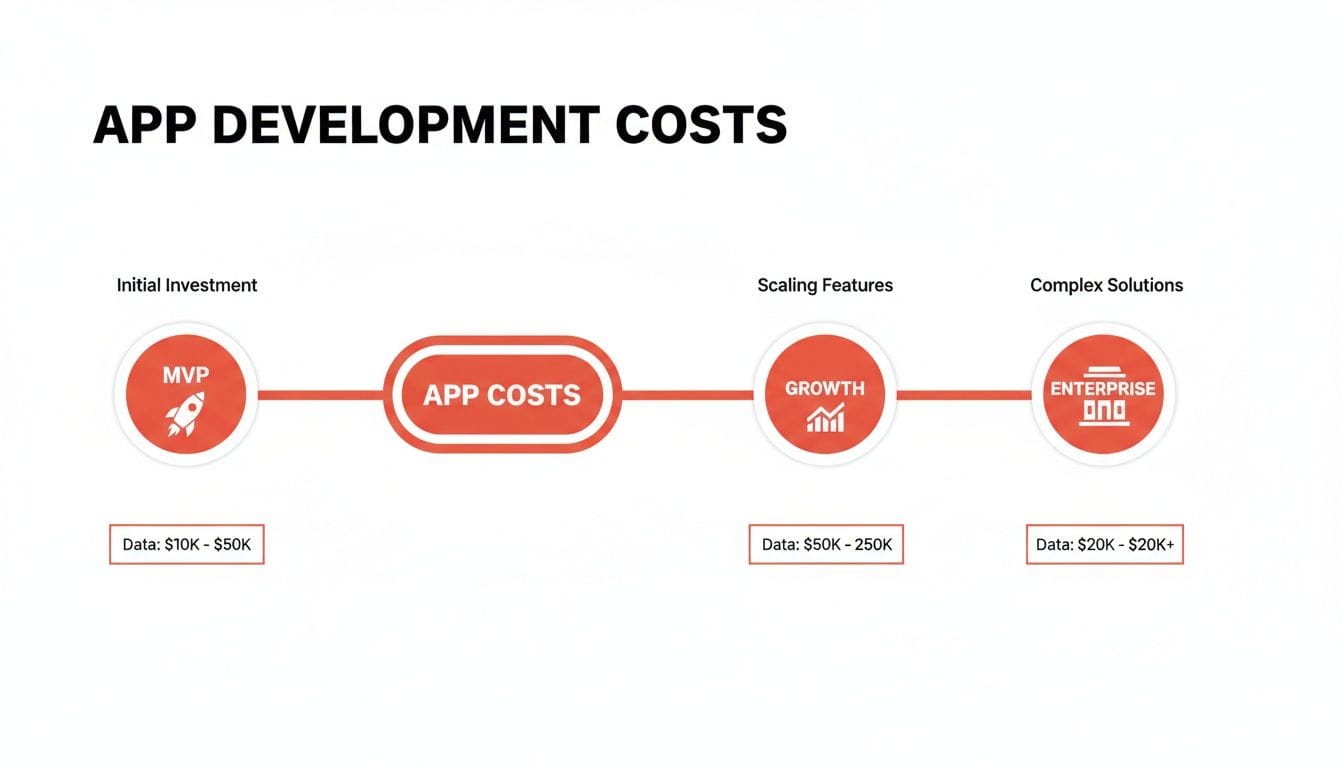
As you can see, the investment ramps up quickly as you move from just validating an idea (MVP), to scaling for growth, and finally to building a platform that can lead the market.
Platform Choice and Its Ripple Effects
Your first big decision is where your app will live: iOS, Android, or the web. This isn't a minor detail; it has massive cost implications that extend far beyond the initial launch.
- Native (iOS or Android): Building separately for each platform gives you the absolute best performance and a buttery-smooth user experience. The catch? It nearly doubles your development, testing, and maintenance costs because you're wrangling two completely separate codebases.
- Cross-Platform (React Native, Flutter): This approach lets you use a single codebase for both iOS and Android, often slashing initial development costs by 30-40%. The trade-off can be some minor performance hits and a dependency on how the frameworks evolve.
- Web App (PWA): A Progressive Web App runs in a browser, which means no App Store fees and no platform-specific code. It’s a fantastic way to get started, but you might miss out on the deep device integrations (like advanced camera features or flawless push notifications) that users have come to expect from a native app.
Actionable Insight: If you're building a marketplace for high-end photography services, a native iOS app might be non-negotiable to leverage the iPhone's advanced camera APIs. But for a B2B marketplace where users are mostly at their desks, a Progressive Web App (PWA) could be the most cost-effective and efficient way to reach your entire audience on day one.
Feature Complexity: The Devil in the Details
This is where budgets get torched. Let's pull back the curtain on a few common marketplace features to see how "simple" requests can hide deep, expensive engineering problems.
Payment Systems:
A "simple" payment integration is almost never simple.
- Basic Integration: Using a standard Stripe or Braintree checkout is pretty straightforward. A customer pays, you get the money. This is the fastest and cheapest route.
- Complex Multi-Vendor System: A real marketplace has to juggle payments for countless sellers. This demands a much more sophisticated system with split payments, escrow services (holding funds until a job is done or an item is delivered), seller identity verification (KYC), and automated payouts. This is a huge engineering lift with serious security and compliance hurdles.
Real-Time Functionality:
Features that need to feel "live" add a whole other layer of cost.
- Standard Messaging: A basic chat where users have to pull-to-refresh to see new messages is relatively simple to build.
- Real-Time Chat: A slick, WhatsApp-style experience with typing indicators, read receipts, and instant message delivery requires a constant, open connection to the server (using WebSockets). This is far more expensive to build, host, and scale. The same goes for real-time GPS tracking on a map versus just showing a pin at a static location.
Actionable Example: For an MVP of a food delivery marketplace, instead of building costly real-time GPS tracking for delivery drivers, you could implement a simpler status update system (e.g., "Preparing," "On the way," "Delivered"). This provides enough information for the user to feel in control while saving tens of thousands in development and scaling costs. You can add the live map feature later, once the business model is proven.
The Unseen Costs of AI and Admin Panels
Two of the most consistently underestimated money pits are AI integrations and the humble admin panel.
AI-Powered Recommendations:
Adding an "AI recommendation engine" sounds impressive, but it’s not a plug-and-play feature. It requires serious work in data collection, model training, and API integration. When you're planning, it's critical to look past the build cost and account for the the ongoing operational expenses of third-party services. A good guide on OpenAI API pricing and cost management can shed light on the long-term budget impact.
The Admin Panel:
This is your marketplace's mission control. It's where you manage users, moderate content, handle disputes, and see how the business is doing. A barebones panel might just be a list of users. A truly functional one, however, is a complex application in its own right, complete with dashboards, powerful moderation tools, and financial reporting. Investing in a solid admin panel from day one will save you thousands of hours of soul-crushing manual work later on.
How Development Timelines Directly Affect Your Budget
In the startup world, time isn’t just a resource - it’s your budget in another form. Every single week your development team is working, you're burning capital. This is why getting a real handle on the relationship between your project timeline and the total marketplace app development cost is completely non-negotiable.
The longer the build, the higher the final bill. It’s that simple.
Your timeline isn't arbitrary, either. It’s a direct result of three key variables: the size of your team, the complexity of your backend systems, and the development methodology you choose. A bigger team might seem faster, but it also costs more per week. A complex backend with a dozen integrations will inevitably stretch out the schedule, pushing up expenses.
Think of your timeline as the roadmap for your investment. A longer, more winding road just requires more fuel to travel.
Mapping Timelines to Marketplace Scope
The scope of your marketplace is what really dictates the development schedule. A lean, focused Minimum Viable Product (MVP) has a much shorter path to launch than a sprawling enterprise platform. This is why we almost always recommend a phased approach - it’s a powerful tool for de-risking your investment.
These days, the timeline is tightly coupled with feature complexity and platform strategy. Projects can run anywhere from 6 to 18+ months depending on the scope and engineering approach.
- A basic marketplace focused on the core vendor-buyer loop, built with cross-platform tools, usually lands in the 3 to 5-month range.
- More complex, enterprise-grade marketplaces demanding native development for both iOS and Android, plus a sophisticated backend, often take 20 to 36 weeks.
- For a full-scale enterprise platform with advanced features like AI-powered recommendations or deep analytics, you’re looking at 9 to 18+ months.
You can see more examples of how these timelines play out over at novaedgedigitallabs.tech.
Here’s what that looks like in practice:
- Lean MVP (3-4 Months): The entire focus is on a single, core transaction for a very specific niche. The goal here is pure validation, not perfection.
- Growth-Stage Platform (6-9 Months): This is where you build on a validated MVP. You start adding features like advanced search, multiple payment options, and a more robust admin panel to manage it all.
- Enterprise Build (9-18+ Months): This is for a full-scale, multi-platform rollout. It typically includes deep integrations with other systems, AI features, and heavy compliance requirements.
By breaking the build into distinct phases, you create checkpoints to validate your assumptions before you commit more capital.
A Practical Example: Phasing Your Launch
Let's say you're building a marketplace for freelance graphic designers. Your initial research shows that your target audience - the designers - overwhelmingly uses iPhones. Instead of trying to build for both iOS and Android at the same time, you use a phased strategy.
Phase 1: iOS MVP (4 Months)
You pour all your resources into creating a flawless iOS app. This gets you to market faster and with less initial cash burn. Your only goal is to prove that designers will sign up and clients will book them through your app.
Phase 2: Market Validation (2 Months)
Once you're live, you're not building - you're listening. You gather user feedback, squash bugs, and obsessively track key metrics. You’ve successfully validated the core concept without doubling your upfront investment.
Phase 3: Android Build (4 Months)
With a proven model and real revenue coming in, you now have the confidence - and likely the funding - to build the Android version.
This phased approach protects your budget. It ensures you don't spend a dollar building a feature nobody wants or an entire app for an audience that doesn't exist.
Rushing the development process to meet an arbitrary deadline often creates technical debt - poorly written code and shaky architecture that will absolutely need to be fixed later. This "fix" is often a full rewrite, costing you far more in the long run than if you'd just taken the time to build it right the first time.
Ultimately, a well-planned timeline aligns your development efforts with your business goals. It makes sure every dollar spent is a deliberate step toward building a marketplace that can actually last.
Choosing The Right Development Team For Your Budget
The features you build are only one half of the marketplace app development cost equation. The other, equally important half, is who builds them. Your choice of development team is one of the most significant financial decisions you'll make, and the true cost goes far beyond a simple hourly rate.

It’s tempting to compare proposals based on price alone. That’s like buying a car by only looking at the sticker price, completely ignoring insurance, maintenance, and fuel. Each team model comes with hidden expenses and strategic trade-offs that can quietly make a "cheaper" option far more expensive in the long run.
The In-House Team Model
Building your own in-house team gives you maximum control. These are your people. They live and breathe your marketplace every single day. The trade-off? This model carries the highest upfront and ongoing costs by a wide margin.
The real cost isn't just salaries. It's a whole bundle of expenses that add up fast:
- Recruitment Costs: Fees for recruiters, plus hundreds of hours your own team spends interviewing.
- Onboarding and Training: The ramp-up period where new hires are a net cost, learning your system instead of building it.
- Benefits and Equipment: Healthcare, 401(k) matching, high-end laptops, and pricey software licenses.
- Management Overhead: The fully-loaded cost of a CTO or engineering manager required to lead the team.
This model makes perfect sense for well-funded companies that have already found product-market fit. They need a dedicated team to iterate and scale a proven platform. For an early-stage startup, though, it's often a premature and incredibly capital-intensive move.
The Freelancer Model
Hiring freelancers looks like the most budget-friendly path on the surface. You pay a direct hourly or project rate without the overhead of a full-time employee. This can be a great fit for small, well-defined tasks, like designing a logo or building out a single, isolated feature.
But when you try to assemble an entire marketplace from a team of disconnected freelancers, the hidden costs start to bleed you dry. Suddenly, you’re the project manager. You’re responsible for coordinating everyone, mediating technical disagreements, and enforcing quality. That management overhead is a very real cost to your own time and focus.
Actionable Insight: Imagine you hire separate freelancers for your iOS app, Android app, and backend. If a bug appears in the payment flow, the iOS developer might blame the backend API, the backend developer might blame the Android implementation, and you're stuck in the middle trying to diagnose a problem you don't understand. A cohesive team eliminates this finger-pointing, saving you time and money.
The Agency or Technical Partner Model
Working with a technical partner like Vermillion strikes a balance. You get immediate access to a complete, pre-vetted team - strategists, designers, engineers, and project managers - without the long-term financial commitment and overhead of hiring.
This is more than just outsourced coding. A true partner provides strategic technical leadership. They’ll challenge your assumptions, flag risks you don’t see, and guide you toward smart architectural decisions that prevent expensive rewrites down the road.
While the blended hourly rate looks higher than a freelancer's, the total project cost is often lower because of the massive gains in efficiency, speed, and reduced risk of catastrophic failure. To learn what to look for, check out our guide on how to hire mobile app developers.
Your choice of development team directly impacts not just your initial budget but the long-term health and scalability of your marketplace. The goal isn't just to get code written; it's to build a defensible asset.
To help you weigh the pros and cons, here’s a breakdown of how these models stack up against each other.
Comparing Development Team Engagement Models
| Model | Upfront Cost | Long-Term Cost | Strategic Value | Best For |
|---|---|---|---|---|
| In-House Team | Very High | Highest | Maximum | Well-funded, post-PMF companies scaling a proven product. |
| Freelancers | Low | Variable (High Risk) | Low | Small, discrete tasks or supplementing an existing team. |
| Technical Partner | Medium | Predictable | High | Seed & Series A startups needing speed, expertise, and a scalable MVP. |
Choosing the right model is about aligning your team structure with your startup's current stage and strategic goals, not just finding the lowest initial bid.
The geographical location of your team also plays a massive role. Developer rates vary wildly across the globe, creating huge opportunities for cost optimization. Hourly rates can span from $20 to $70 depending on the region. While areas like Eastern Asia offer rates between $20 and $60 per hour, premium regions like Australia can command $40 to $70.
But for startups gearing up for a fundraise, the cheapest option is rarely the best. Lower-cost development can introduce significant technical debt that becomes a massive liability later. Premium teams, on the other hand, deliver cleaner, more maintainable codebases that actually reduce your long-term costs and look much better during technical due diligence.
Ultimately, the right choice depends on your stage, your budget, and whether you need pure execution or a true strategic partner.
How to Actually Reduce Your Development Costs
Knowing what drives your marketplace app cost is one thing. Knowing how to control those drivers is where you get a real edge.
Smart cost reduction isn't about cutting corners or shipping a buggy product. It's about making ruthless, strategic decisions that squeeze every drop of value from your budget. It’s about building efficiently, spending capital only on what truly matters now, and pushing everything else down the road until you’ve proven your core concept.
Get lean, get to market faster, and get real feedback before you over-invest.
Embrace Ruthless MVP Scoping
The single most effective way to control your budget is to be absolutely brutal about your Minimum Viable Product (MVP) scope. An MVP isn't a cheaper, crappier version of your final product. It’s a laser-focused experiment designed to test one critical assumption with the fewest possible features.
Ask yourself: what is the absolute, most basic transaction my marketplace enables? For a tutoring app, it's a student finding and booking a single session with a tutor. That’s it. Everything else is a "nice-to-have."
Here’s a practical example:
Instead of building a slick, complex in-app calendar with automatic time-zone conversions and push notification reminders, your MVP could just trigger a simple email notification for bookings. The platform makes the connection, an email goes out, and the tutor and student schedule it manually.
That one decision could easily save you $15,000 - $25,000 in upfront development. That's capital you can now deploy after you've validated people actually want to book tutors on your platform in the first place.
An MVP's only job is to provide validated learning. Every feature you add beyond the core transaction dilutes its focus, inflates your budget, and delays the moment you get feedback from the real world.
Leverage Technology to Defer Costs
Your tech stack choices have a massive ripple effect on both your initial burn and your long-term operational costs. Building everything from scratch gives you ultimate control, but for an early-stage startup, it's often a terrible use of capital.
Here are a few ways to make smarter technical choices:
- Cross-Platform First: Unless you have a compelling, undeniable reason for native-only features, start with a framework like React Native. You build from a single codebase that works on both iOS and Android, which can slash your initial development cost by 30-40%. It's a massive win.
- Use a Backend-as-a-Service (BaaS): Building backend infrastructure - servers, databases, user authentication - is a huge, expensive distraction. A BaaS provider like Firebase handles all that heavy lifting for you. This lets your team focus their precious time on the unique, user-facing features that actually define your marketplace.
- Buy, Don't Build (for a while): Don't reinvent the wheel for solved problems. Use battle-tested, off-the-shelf services for standard features. Plug in Sendbird for chat, Stripe for payments, and Algolia for search. The monthly subscription fees are a tiny fraction of what it would cost to build, test, and maintain these complex systems yourself.
Focus on Long-Term Financial Health
Smart budgeting isn't just about the initial build. Your marketplace app development cost is just the first check you'll write; ongoing operational expenses can sneak up on you and kill your runway.
Once you're live, you need to be thinking about things like efficient cloud cost optimization best practices to keep your server bills from spiraling out of control.
It’s also critical to think about integrating revenue-generating features early on. This not only helps offset costs but also proves your business model to investors and, more importantly, to yourself. For a deeper dive, check out our guide on how to use your development budget efficiently.
By obsessing over a lean MVP and making savvy technology choices, you ensure every dollar spent is a strategic investment in your marketplace's future.
So, What's Next? Building a Marketplace That Lasts
Understanding what it costs to build a marketplace app isn't just about budgeting. It's about recognizing that this is a major business investment. The architectural and strategic calls you make in the first few months will stick with you for years, defining your ability to scale and your company’s long-term financial health. Every choice matters.
The path forward is actually pretty simple: build a lean, high-quality MVP that does one thing exceptionally well - prove your core business assumption. This isn't about building less; it's about building smarter. You're focusing your capital on learning what the market actually wants, not on features you think they want. This saves cash and gets you into the real world faster, where five minutes of real user feedback is worth more than five weeks of internal brainstorming.
Picking Your Partner and Planning for Day 1,000
Your choice of a development partner is one of the most important decisions you'll make. Don't just look for a team to check boxes off a feature list. Find a partner who will argue with you - someone who will push back on expensive "nice-to-haves" and steer you toward an architecture that won't crumble the moment you start to grow. Budgeting for scale means laying a solid foundation from the get-go, even if you only build one room on top of it initially.
A successful marketplace is a marathon, not a sprint. The goal is to build a defensible, scalable business. Your initial investment should be structured to survive first contact with the market, adapt based on real data, and grow without requiring a costly rewrite down the line.
For founders who are serious about building an asset, not just an app, the next step is a strategic gut-check. You need to make sure your investment is aimed at solving a real problem with a product that's engineered to win. That’s how you turn a budget from an expense line into an engine for growth.
A Few Questions We Hear All The Time
Navigating the financial side of building a marketplace often brings up some common, high-stakes questions. Here are the quick, direct answers to the concerns we hear most from founders trying to square their budget with their vision.
How Much Does It Cost to Maintain a Marketplace App After Launch?
This is the ongoing expense that catches too many founders by surprise. The most reliable rule of thumb is to budget 15-20% of your initial development cost, every single year, just for maintenance.
That isn't a "nice to have" number. It’s what you’ll spend on the absolute essentials:
- Server and Hosting Fees: The raw cost of keeping your app online.
- Third-Party Subscriptions: Those recurring bills for payment gateways, analytics tools, and chat APIs.
- Essential Updates: Pushing out new versions just to stay compatible with the latest iOS and Android releases.
- Bug Fixes and Security: Actively patching vulnerabilities and fixing the inevitable issues that pop up once real people start using your app.
So, if your marketplace cost $100,000 to build, you need to have $15,000-$20,000 earmarked annually just to keep it secure, functional, and available. This isn't an add-on; it's a non-negotiable part of your total cost of ownership.
Can I Build a Marketplace App for Under $20,000?
Honestly? No. Building a truly scalable and secure marketplace with a professional development team for under $20,000 is completely unrealistic.
Sure, you could use a no-code platform to stitch together a simple prototype at that price point, but it will come with massive limitations. A real, custom-coded application requires a serious investment to get the core functions right - things like user profiles, listings, secure payments, and messaging. Anything less than that gets you a fragile shell, not a solid foundation that can attract users or impress investors.
A low initial price often just hides massive future costs. A poorly architected app built on a shoestring budget will almost certainly require a full, expensive rewrite the moment it gets any real user traction.
Should I Build for iOS or Android First?
This decision should be 100% driven by data about your target audience, not developer preference. The only question that matters is: where do your first ideal customers live, and what phones are in their pockets?
- North America: iOS still holds a slight edge in market share, and its users have historically shown higher spending habits. For many US-focused marketplaces, it's a safe bet to start here.
- Europe, Asia, and South America: Android completely dominates these markets. Launching on iOS first here means you're intentionally ignoring the vast majority of your potential users.
Do the research before a single line of code is written. A strategic, single-platform launch is one of the smartest ways to prove your business model and de-risk your investment before you double down on a second platform.
At Vermillion, we help founders navigate these critical early decisions, ensuring your investment builds a scalable asset, not just a deployed app. Schedule a consultation to discuss your marketplace vision.
Keep reading
See all →
March 22, 2026
Unlocking Revenue Your Guide to Price Tier Strategy

March 21, 2026
Your Guide to Flawless Stripe Subscription Management

May 14, 2026
Fractional Mobile Engineering vs. Full-Time Hiring in 2026
The mobile engineering talent market has shifted dramatically over the past two years. Budgets are tighter, AI tools have changed what a sin...
March 20, 2026
Recurring Billing With Stripe a Guide for Subscription Apps
Master recurring billing with Stripe. This guide covers everything from setup and server logic to webhooks and churn reduction for subscript...
March 19, 2026
Unlocking Growth with Mobile App Retention Metrics
Discover the mobile app retention metrics that directly fuel MRR growth. This founder's guide offers actionable strategies to track, analyze...