Vermillion Insights
February 23, 2026 · Ken Vermeille · 18 min read
How to Reduce Customer Acquisition Cost A Startup Guide
Learn how to reduce customer acquisition cost with our startup guide. We cover funnel optimization, product-led growth, and AI to scale efficiently.
Let's be honest: just throwing more money at ads to get users isn't a strategy - it's a slow-motion train wreck. For most mobile startups I talk to, a rising Customer Acquisition Cost (CAC) feels like a tax they just have to pay for growth. But it’s not.
The old playbook of outspending your competitors on paid channels is officially broken. The returns are diminishing, and what worked last year is bleeding cash this year. The only sustainable way forward is to build a smarter, more efficient growth engine from the ground up.
This isn't about finding one magic marketing hack. It's about a fundamental shift in thinking. You need a complete framework that pulls together your product, engineering, and growth teams to stop leaking money and start building real, profitable momentum. It’s time to turn CAC from an unpredictable expense into a manageable, strategic investment.
Your Blueprint for Lowering Customer Acquisition Costs
To get this right, you need a clear, repeatable process. I've found the most effective way to think about this is a continuous cycle: you audit your data, optimize your funnels based on what you find, and then scale the channels and tactics that actually work.
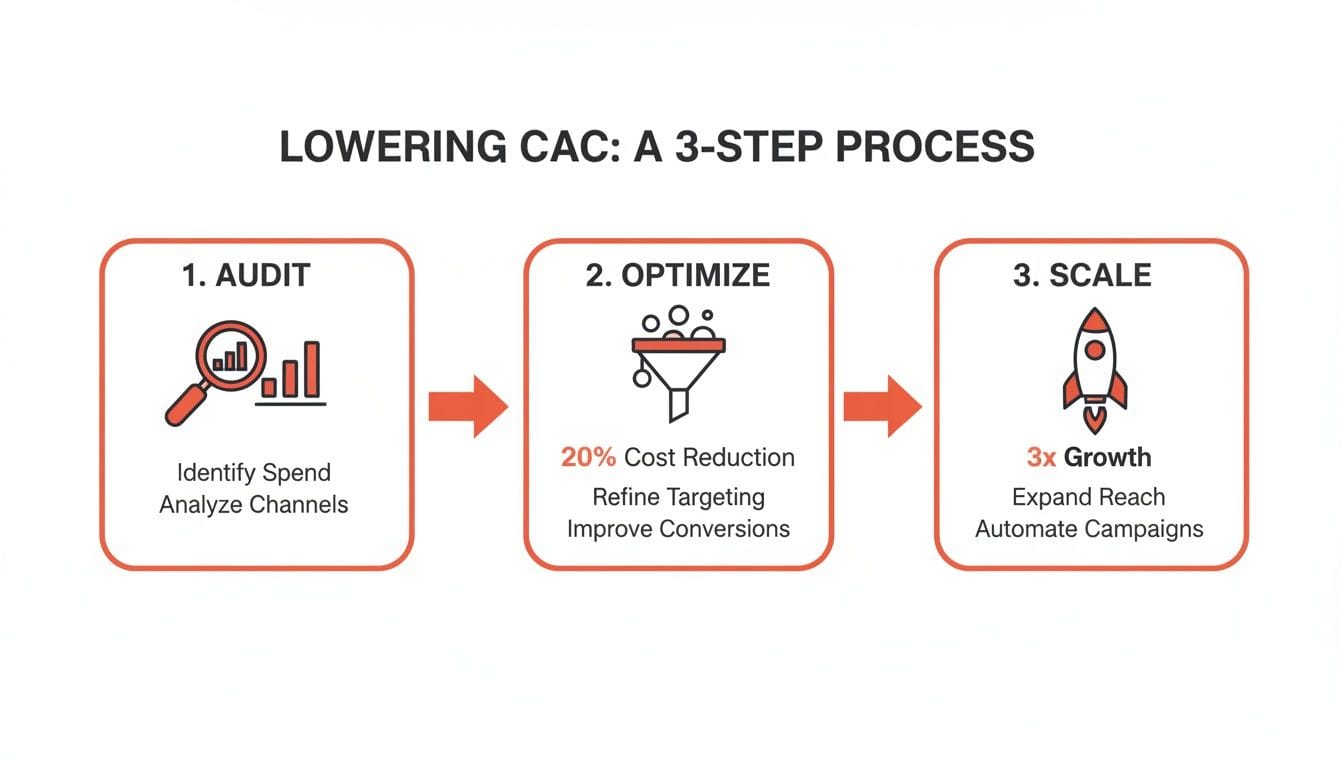
This Audit, Optimize, Scale loop is your new foundation. It forces you to make decisions based on real data, not just gut feelings or what you read in a blog post.
Mastering Your Core Growth Levers
A truly effective CAC reduction strategy isn't built on one pillar; it’s built on several interconnected ones that support each other. When you get them all working together, they create a powerful growth loop that gets more efficient over time.
Here are the key areas you absolutely have to master:
- Unit Economics and Attribution: You can't fix what you can't measure. This means getting brutally honest about your fully loaded CAC - including salaries, tools, and overhead, not just ad spend. You also need an attribution model that gives you a clear, honest picture of which channels are actually driving value.
- Funnel and Conversion Optimization: Every single user who drops off between an ad click and becoming an active, happy customer is driving your CAC up. Your job is to systematically plug the leaks in that funnel, from your App Store page (ASO) all the way through your onboarding flow.
- Retention and LTV Maximization: Getting a user is just the beginning. A user who sticks around is infinitely more valuable. Boosting your retention rate directly improves your LTV:CAC ratio, making every dollar you spend on acquisition more profitable.
- Product-Led Growth: The cheapest and most effective acquisition channel is your product itself. When you build things like referral programs, viral loops, or collaborative features, you turn your existing users into a free, highly effective sales team.
Actionable Insight: Start by focusing on the biggest leak. If your App Store install rate is low, optimize that first. If installs are high but users churn after one day, your onboarding is broken. Use your data to find the single biggest point of failure and fix it before moving on. This prevents you from wasting effort on micro-optimizations that don't move the needle.
To put it all together, here’s a quick summary of the core strategies we'll be diving into.
Key Strategies to Systematically Reduce CAC
A quick look at the core pillars for reducing Customer Acquisition Cost, from foundational audits to advanced product-led growth tactics.
| Strategy Pillar | Primary Focus | Expected Outcome |
|---|---|---|
| Foundational Audits | Accurate attribution, fully-loaded CAC, and LTV calculation. | A clear, data-driven understanding of your current growth economics. |
| Channel Optimization | Prioritizing high-ROI channels and cutting underperforming ad spend. | Improved marketing efficiency and lower blended CAC. |
| Conversion Funnel Improvement | Optimizing App Store pages, onboarding flows, and activation points. | Higher conversion rates from install to active user. |
| Retention & LTV Maximization | Enhancing user engagement, reducing churn, and optimizing monetization. | Increased customer lifetime value, making acquisition spend profitable. |
| Product-Led Growth | Building viral loops, referral programs, and other organic growth mechanisms. | A self-sustaining growth engine that reduces reliance on paid channels. |
These pillars aren't just a checklist; they represent a holistic approach to building a sustainable growth model. By focusing on these interconnected areas, you move from short-term tactics to long-term strategic advantage.
Establishing Your Baseline With Unit Economics And Attribution
Before you trim any ad budgets, you need a crystal-clear picture of what you’re actually spending. Too many mobile-first startups track only ad costs - a vanity metric that masks the real bleed. To tackle CAC, you must ground yourself in honest unit economics.
That means working out your fully-loaded CAC. It’s not just Meta or Google spend. It covers every dollar it takes to bring a paying customer on board.
Calculating Your True, Fully-Loaded CAC
Start by adding up all sales and marketing outlays over a set period - say a quarter. No guesses. Get granular:
- Marketing Spend: Every ad campaign, creative fees (freelancers or agencies) and tools (analytics platforms, design apps).
- Team Costs: Don’t skip this. Include prorated salaries, benefits, bonuses for everyone on growth, sales and marketing.
- Overhead: Any other expenses tied directly to acquisition efforts.
Once you have that total, divide it by the number of new customers gained. The result is your genuine CAC - a number you can’t argue with.
Practical Example – Fintech Startup A seed-stage fintech app celebrated a $50 CAC - they spent $50,000 on ads and signed up 1,000 users. But they’d overlooked $30,000 in team salaries and $5,000 in tooling. Their real spend was $85,000, pushing CAC to $85 and burning cash far faster than expected. Actionable Insight: Create a shared spreadsheet for your finance and marketing teams to track these costs quarterly. This transparency prevents the "ad spend only" CAC trap and ensures everyone is working from the same, accurate number.
Untangling Your Attribution Mess
Knowing total CAC is only half the battle. You also need to pinpoint where your best customers come from. Relying on last-touch attribution - giving 100% credit to the final click - can send your budget off the rails.
Imagine a user sees a TikTok ad, Googles your brand, then taps an App Store ad. Last-touch assigns all the credit to App Store installs. In reality, that TikTok impression and Google search built the funnel. Slash your TikTok spend, and suddenly your “top” search channel goes dry.
For a deeper look at how these metrics interact, see our guide on customer acquisition cost vs lifetime value.
Building A Single Source Of Truth
You need an attribution model that honors the full customer journey. Here’s how to level up:
- Multi-Touch Attribution: Tools like AppsFlyer or Kochava can spread credit across touchpoints. Linear, time-decay or U-shaped models each offer a more balanced view.
- Organic Lift Analysis: Flip paid campaigns on and off, and watch your organic installs and direct traffic. That “halo effect” reveals how much unpaid channels benefit from your ad spend.
- Geo-Based Holdout Tests: Exclude a region from your campaign and compare its conversion rate against active markets. The gap shows your campaign’s incremental impact.
By marrying a fully-loaded CAC with a sophisticated attribution model, you create a single source of truth. From there, every strategy to lower acquisition costs will rest on solid ground.
Optimize Your Acquisition Funnel for Higher Conversion
Every dollar you spend to get a user who never actually uses your app is just wasted money - a direct hit that inflates your CAC. To bring that cost down, you have to systematically plug the leaks in your acquisition funnel. This is about turning more of that hard-won traffic into genuinely engaged customers.
Forget A/B testing button colors for a minute. This is a deep dive into the entire user journey.
That journey doesn't start when they open your app. It starts on the app store, where you have just a few seconds to make your case.
Nail Your App Store First Impression
Think of your app store page as the front door to your product. If it’s messy or unconvincing, people will just walk right by, never seeing the great stuff you’ve built inside. Good App Store Optimization (ASO) isn’t just about stuffing keywords; it’s about crafting a narrative that compels people to tap "Install."
You need to get these elements right:
- Screenshots and Previews: These are your best sales tools, hands down. Don't just show off features. Use them to tell a story about the value your app provides. Show the outcome, not just the UI.
- App Icon: It has to be clean, memorable, and pop in a crowded search result. Test a few different designs to see which one grabs the eye and signals what your brand is all about.
- Reviews and Ratings: Social proof is everything here. You have to actively encourage happy users to leave reviews and make a point to publicly respond to feedback, both good and bad. A 4.5-star rating can boost conversion significantly compared to a 3.5.
A well-optimized store page directly improves your install rate. That means more users for the exact same ad spend. It's your first - and cheapest - shot at lowering your CAC.
Kill the Friction in Your Sign-Up Flow
Once a user installs your app, the clock starts ticking. Your only job is to get them to their "aha!" moment as fast as humanly possible. Every extra field, every confusing step, every slow-loading screen is another reason for them to bail.
Take a fintech app that needs to verify a user's identity. The old way might be a clunky, multi-step form with manual data entry and document uploads - a perfect recipe for high drop-off.
Practical Example: A meditation app we worked with initially asked new users to create a full account, set goals, and choose notification preferences before they could listen to a single session. Drop-off was over 60%. They changed the flow to offer a guest-access "7-Day Intro Course" immediately after download, only prompting for account creation after the user completed day one. This simple change increased their Day 1 retention by 40% and drastically lowered the effective cost per engaged user.
Map out your entire sign-up flow and be ruthless. Question every single step. Do you really need their phone number on the first screen? Can you wait to ask for push notification permissions until it makes sense? Every piece of friction you remove directly boosts your activation rate.
Personalize the Path to the "Aha!" Moment
A one-size-fits-all onboarding experience feels lazy and rarely shows off your app's true value. The quickest way to get a new user to stick around is to tailor their first few moments to what they actually need.
This could be as simple as:
- Asking one key question during sign-up to segment them (e.g., "What's your main goal with our app?").
- Using that answer to show them a customized first-run experience or dashboard.
- Triggering contextual tooltips or short guides based on their first couple of actions.
Actionable Insight: For a language learning app, ask "What's your current skill level?" (Beginner, Intermediate, Advanced). A beginner sees a simple "Hello" lesson, while an advanced user is taken straight to a placement test. This small tweak prevents user frustration and gets them to value faster.
This kind of strategic personalization helps users discover the product's value on their own terms, which massively increases the odds they'll become active, long-term customers. For a closer look at the bigger picture, check out our guide on user acquisition for mobile apps.
Bring Back Drop-offs with Smart Retargeting
Let's be real: not every user will convert on their first try. People get distracted. They'll download your app, open it once, and then forget all about it. That's where smart retargeting comes in.
Instead of paying top dollar to acquire a brand-new user from scratch, you can spend a fraction of that to bring back someone who has already shown they're interested.
Plugging the leaks from that first ad impression all the way to activation is how you slash your CAC without just throwing more money at ads. We see this work time and time again. Even small improvements add up. Retargeting campaigns, for instance, often convert at 2-3x the rate of cold traffic, while a solid inbound strategy can cut the cost per lead by over 60%.
When you combine sharp ASO, a frictionless sign-up, personalized onboarding, and smart retargeting, you create a system that squeezes the maximum value out of every single user you bring in. This isn't a tactic; it's the foundation for sustainable growth.
Use Your Product to Create Sustainable Growth
While optimizing ad spend is a necessary part of the equation, it's a short-term fix. The most powerful, sustainable way to lower your customer acquisition cost is to build a product that markets itself. This is the whole idea behind product-led growth (PLG) - where your app becomes its own engine for acquisition, conversion, and expansion.
Instead of just pouring more money into paid channels, you build growth loops directly into the user experience. This creates a flywheel effect, turning your current users into your best and cheapest sales force.
Build an Unbeatable Referral Program
The single most effective PLG tactic I've seen work time and again is a well-designed referral program. This isn't about slapping a "share" button in a menu and hoping for the best. It's about weaponizing word-of-mouth and turning happy customers into active evangelists.
Referral programs are an absolute powerhouse for crushing CAC. The data is clear: referred customers can cost $23.12 less to acquire and drive a 20-40% lower CAC overall. And when you consider that 92% of consumers trust recommendations from people they know over any other form of advertising, it’s a no-brainer. This is the most reliable channel for founders trying to scale.
To build a program that actually moves the needle, you need to nail a few key mechanics:
- Dual-Sided Incentives: Reward both the person sharing and the new user they bring in. It's a classic win-win. The existing user feels good about giving a gift, and the new user gets instant value.
- Frictionless Sharing: Integrate the referral flow right where users are finding value. Don't bury it in a settings menu. Prompt users to share at their happiest moments - right after they complete a key action, hit a milestone, or get that "aha!" moment.
- Clear, Compelling Value: The reward has to be something users actually want and can understand in a split second. Whether it's app credits, a free month, or an exclusive feature, the benefit of referring a friend needs to be obvious.
Practical Example: The investing app Robinhood offered a free share of stock (like Ford or Apple) to both the referrer and the new user. The incentive was directly tied to the product's core value (investing), the outcome was exciting and unpredictable, and it created a powerful viral loop that was central to their early user acquisition strategy.
Dropbox is the textbook example of this done right. Their interface was brilliantly simple: "Invite a friend and you’ll both get 500 MB of bonus space." This product-centric reward gave users exactly what they wanted more of - storage. It was baked into the core experience and was absolutely instrumental in their early, explosive growth.
Engineer Virality Into Your Core Features
Beyond a formal referral program, you can design your app's features to have virality built right in. These are parts of your product that naturally encourage users to invite others just to get the full value out of the experience. The goal is to make sharing an integral part of using the app, not some tacked-on marketing task.
Start thinking about how to create network effects.
- Collaboration: A project management app is useless alone but a lifesaver for a team. A feature like "Assign a task to a colleague" or "Share this project board" becomes a natural, built-in invitation loop.
- Social Proof: Think of a fitness app that lets users share their workout stats on social media. This not only keeps the user engaged but also serves as free, organic advertising to their entire network.
- Multiplayer Experiences: A mobile game with a co-op mode or a personal finance app with shared savings goals makes inviting friends essential to the product itself.
Actionable Insight: If you have a B2B SaaS tool, instead of just a generic "invite user" button, create a feature like "Share this report with your manager for approval." This contextualizes the invitation, making it a necessary workflow step rather than a marketing ask. The user is solving their own problem while simultaneously acquiring a new user for you.
The key is to find those moments where your product's value is multiplied by adding more people. That’s your golden opportunity to build a viral loop. It transforms a single-player experience into a multi-player one, systematically driving down your reliance on expensive paid acquisition.
How to Prioritize PLG Opportunities
So, how do you decide what to build? Not every "viral" idea is a good one. It has to align with your business goals and deliver real, tangible value to the user.
Here's a simple framework I use to prioritize:
- Identify Potential Loops: Brainstorm features that get better with more users. Think collaboration, competition, sharing, or social validation.
- Estimate Impact: Be realistic. How much could this feature actually increase your viral coefficient (the number of new users each existing user brings in)?
- Assess Engineering Effort: How complex is this to build and maintain? Is it a quick win or a massive project?
- Analyze User Value: Is this feature genuinely making the app better, or is it just a cheap marketing gimmick? Gimmicks don't create sticky users.
By focusing on high-impact, low-effort features that actually improve the product, you can start building an app that grows itself. This shift doesn't just slash your customer acquisition cost; it also boosts retention. After all, a user base that's interconnected is much harder to leave. For more on that, check out our deep-dive on how to increase user retention.
Using AI and Automation to Slash Acquisition Costs
Let's be blunt: if you're not using AI and automation in your growth stack, you're willingly giving your competition a massive advantage. This isn't about some far-off future concept; it's about practical tools you can implement right now to fundamentally change your unit economics and cut your customer acquisition costs.
Think of AI not as a replacement for your team, but as a force multiplier. It automates the soul-crushing, repetitive data work, freeing up your people to focus on what they do best: strategy, creative thinking, and understanding your customers on a deeper level.
When you get this right, you build a growth engine that's not just more efficient, but one where every single dollar you spend on acquisition works harder, directly boosting your LTV:CAC ratio.
Stop Wasting Money on the Wrong People
Predictive audience segmentation is one of the most powerful levers here. We've all been there - burning cash on paid acquisition campaigns that target a massive, vaguely-defined audience, just hoping a tiny sliver of them convert. It's a massive money drain.
Predictive AI completely flips that script. It analyzes your existing customer data - their in-app behaviors, demographics, and initial actions - to build a profile of what your absolute best, highest-LTV users look like. Then, it goes out and finds more people just like them before you spend a dime.
Practical Example: An e-commerce app selling high-end skincare products used an AI tool to analyze their top 5% of customers. The AI found these customers weren't defined by age or location, but by a specific behavior: they all used the "skin quiz" feature within their first session. The company created a lookalike audience based on this behavioral signal, resulting in a 35% lower CAC because the ads were now reaching people who were predisposed to engage deeply, not just browse.
This is the shift from broad, demographic targeting to surgical, behavior-based acquisition. Instead of telling Meta to find "men aged 25-40 in California," you're telling it to find "users who act like my top 10% of payers in their first 30 days."
This laser-focused approach means your ad spend is concentrated only on prospects with the highest statistical probability of becoming valuable, long-term customers. Your blended CAC drops almost immediately.
Automate Your Creative Testing into Oblivion
Finding the perfect ad creative is usually a slow, painful grind. Your team comes up with a few ideas, runs them for a couple of weeks, pores over spreadsheets, and maybe finds a winner. AI can compress that entire cycle from weeks into a matter of hours.
Modern ad platforms and specialized creative tools use AI to do the heavy lifting:
- Create Endless Variations: They can automatically mix and match hundreds, even thousands, of ad variations - different headlines, images, CTAs, and copy.
- Test and Learn at Lightning Speed: The system allocates a tiny bit of your budget to test all these combinations against each other, rapidly identifying which ones actually resonate.
- Shift Budget to Winners Automatically: In real-time, the AI dynamically moves the bulk of your ad spend to the top-performing creative, ensuring your budget is always backing the most effective ads.
Actionable Insight: Use a tool like Pencil or Marpipe. Upload 10 images, 5 headlines, and 3 calls-to-action. The AI will generate 150 unique ad variations and test them for you. Within 72 hours, you'll have data-backed proof of which combination works best, a task that would take a human marketer weeks of manual setup and analysis.
This isn't about replacing human creativity. Your team still provides the strategic direction and the raw creative ingredients; AI just handles the monumental task of finding the perfect recipe.
The Bottom-Line Impact on Your CAC
These efficiency gains aren't just theory. In the brutally competitive world of B2B SaaS, companies that have properly integrated AI are cutting their acquisition costs by up to 50%. For a seed or Series A startup where every dollar of runway counts, that is an absolute game-changer. Recent benchmarks show that 88% of marketers are already weaving AI into their workflows, primarily to drive the kind of deep personalization that boosts conversion and to automate the manual work that kills efficiency. You can see more data on AI's impact on B2B customer acquisition over at martal.ca.
By applying AI to both who you target and what you show them, you create a powerful, self-optimizing system. Your campaigns get smarter with every dollar spent, pushing your CAC down while building a sustainable moat your competitors can't easily cross.
Common Questions About Reducing CAC
As you start putting these strategies into practice, some questions always seem to surface. It's totally normal. Getting the nuances of unit economics and channel performance right can be tricky, and it's where a lot of founders get stuck.
Here, I'll break down the most common questions we hear from founders and product leaders who are serious about getting their acquisition costs under control.

Think of this as a tactical FAQ, full of straight-up answers to help you sidestep common pitfalls and make smarter moves on the path to a lower CAC.
What Is a Good LTV to CAC Ratio for a Startup?
A healthy Lifetime Value (LTV) to Customer Acquisition Cost (CAC) ratio is the bedrock of any sustainable business. It's the core signal that you've built a machine that works. For most mobile startups, the industry-standard benchmark to aim for is a 3:1 ratio or higher.
Simply put, for every dollar you spend to acquire a customer, you should expect to get at least three dollars back over their lifetime.
A ratio dipping below 3:1 is a flashing red light. It usually means your business model is on shaky ground - you're likely spending too much to acquire customers who churn too quickly or don't monetize enough to justify the cost.
But what about the other end of the spectrum? An extremely high ratio, like 5:1 or more, sounds amazing on the surface, but it can also be a warning sign. It often means you have an incredibly efficient acquisition engine but you aren't investing aggressively enough in growth. You're probably leaving money on the table.
Actionable Insight: If your LTV:CAC is 5:1 or higher, take 10% of your marketing budget and dedicate it to experimenting with a new, unproven channel. This allows you to explore new avenues for growth from a position of strength without jeopardizing the core business economics.
Beyond the ratio, you also need to look at your CAC payback period - the time it takes to earn back what you spent to acquire a customer. For subscription apps, a payback period under 12 months is a powerful signal to investors that your growth is both efficient and capital-friendly.
How Often Should I Review My Acquisition Channels?
There's no single right answer here. The cadence for reviewing your channels depends entirely on their speed and how quickly you get data back. A one-size-fits-all approach just doesn't work.
- Fast-Moving Paid Channels: For platforms like Meta, TikTok, or Google Ads, performance can change overnight. Data pours in constantly. You should be checking these campaigns weekly or even bi-weekly, at a minimum. This pace lets you react quickly - optimizing creative, tweaking bids, and shifting budget to what’s working right now.
- Long-Term Organic Channels: For efforts like SEO, content marketing, or ASO, progress is a slow burn measured over a much longer horizon. A monthly or quarterly review makes more sense. You'll be tracking leading indicators like keyword rankings, organic traffic growth, and backlink velocity, not daily conversions.
Practical Example: Set up a recurring 30-minute meeting every Monday called "Paid Channel Check-in." In this meeting, the team reviews a simple dashboard showing spend, installs, and CAC for each paid channel from the previous week. For your SEO efforts, create a separate monthly review that looks at keyword ranking changes, new backlinks acquired, and organic install growth. This separates the tactical, fast-moving review from the strategic, slow-moving one.
Regardless of individual channel check-ins, it's critical to conduct a comprehensive, top-down review of your entire acquisition portfolio at least once per quarter. This is your chance to assess every channel's performance against your baseline CAC, make the hard decisions to cut what isn't working, and strategically test new opportunities.
Can Better Product Onboarding Really Lower My CAC?
Absolutely. In fact, improving your product onboarding is one of the most powerful, high-leverage things you can do to lower your effective CAC. The key insight here is that you're not just paying for a download; you're paying for an activated customer.
If a user signs up but bails before they experience that critical "aha!" moment, the entire cost to acquire them is wasted. That money is just gone, with zero return.
A smooth, intuitive, and personalized onboarding experience directly increases your activation rate - the percentage of new users who truly see the product's core value. By converting more of the users you've already paid for, you directly lower your cost per activated customer.
Here’s a simple way to think about it: if you double your activation rate by redesigning your onboarding flow, you have effectively cut your CAC in half without spending another dime on marketing. This is why focusing on the in-product experience is so fundamental. For anyone wanting to dig deeper, a common question we get is what is Cost Per Acquisition and how to lower it, and improving onboarding is always a huge part of our answer.
At Vermillion, we partner with founders to build and scale software that wins. If you need a senior technical team that challenges assumptions and ships with confidence, let's connect and discuss your roadmap.
Keep reading
See all →
March 22, 2026
Unlocking Revenue Your Guide to Price Tier Strategy

March 21, 2026
Your Guide to Flawless Stripe Subscription Management

May 14, 2026
Fractional Mobile Engineering vs. Full-Time Hiring in 2026
The mobile engineering talent market has shifted dramatically over the past two years. Budgets are tighter, AI tools have changed what a sin...
March 20, 2026
Recurring Billing With Stripe a Guide for Subscription Apps
Master recurring billing with Stripe. This guide covers everything from setup and server logic to webhooks and churn reduction for subscript...
March 19, 2026
Unlocking Growth with Mobile App Retention Metrics
Discover the mobile app retention metrics that directly fuel MRR growth. This founder's guide offers actionable strategies to track, analyze...