Vermillion Insights
March 14, 2026 · Ken Vermeille · 18 min read
Fractional cto services: A guide to leveraging fractional cto services
Explore how fractional cto services deliver strategic tech leadership without the full-time cost, helping you choose the right partner and plan ahead.
Imagine having a master architect for your tech, but without the $250,000 salary and year-long hiring process. That’s the core idea behind fractional CTO services - a model that gives growing companies on-demand access to C-suite technical leadership. It’s how you get elite guidance to compete with much bigger players, precisely when you need it.
The Rise of On-Demand Tech Leadership
Is your engineering team struggling to keep up with your marketing plans? It’s a story I hear all the time. For many founders who are brilliant at product or growth, technology often becomes the bottleneck. You have a crystal-clear vision, but your app’s architecture, development speed, or technical roadmap just can't seem to match that ambition.
This is exactly where a fractional CTO changes the game.

They bring the high-level strategic oversight of a full-time executive to your business, but on a flexible, part-time basis. It’s about getting the right expertise at the right time.
What Is a Fractional CTO, Really?
A fractional CTO is a seasoned technology executive who splits their time across a few companies, usually on a monthly retainer. Think of them not as another coder, but as the strategic partner who owns your entire technology vision. They don't replace your developers; they make them better by providing clear direction, mentorship, and a solid plan to follow.
For a growing app, this means finally having an expert who can:
- Build a scalable tech roadmap: Aligning your technology plan with your actual business goals, ensuring you're building for the future, not just for today. For example, a fractional CTO will ensure your plan for international expansion includes technical tasks like localizing content, handling multiple currencies, and deploying servers closer to new users to reduce latency.
- Mentor and manage your engineering team: Boosting developer productivity, improving code quality, and getting the whole team pulling in the same direction. An actionable insight here is creating a "pull request" template that forces developers to explain the "why" behind their code changes, fostering better communication and a shared understanding of the product.
- Oversee cloud architecture and infrastructure: Making sure your app is secure, cost-effective, and ready for that wave of new users you’re about to land.
- Translate your tech for investors: Confidently presenting a compelling tech strategy during those make-or-break funding rounds.
This move toward on-demand expertise isn't some niche trend. The market for fractional executives has exploded, with a massive 5,400% jump in LinkedIn profiles showing 'fractional' C-suite titles. Demand for fractional CTOs alone spiked 68% between 2023 and 2024, pushing the market toward a projected $5.7 billion valuation by 2026.
This growth shows a fundamental shift: businesses are choosing strategic, flexible talent over the high cost and long hiring cycle of a full-time exec. You can dig into more data on this executive gig economy trend from recent industry analyses.
Why This Model Is Gaining So Much Momentum
Startups and scale-ups are under immense pressure to move fast without burning through their runway. Committing to a full-time CTO salary, which often tops $250,000 plus equity, is a massive financial drain for a company that doesn't need 40 hours of strategic leadership every single week. Fractional CTO services offer a much smarter alternative.
A fractional CTO delivers the strategic value of a senior tech leader at a fraction of the cost, letting ambitious teams build a rock-solid technical foundation without killing their cash flow.
This model is a lifesaver for founders who excel at marketing, sales, or product design but don't come from a deep technical background. Instead of making risky tech decisions based on guesswork or a developer's gut feeling, you get a proven leader to guide you. It's about getting the right advice at the right time, ensuring your engineering efforts actually drive growth and stability.
What a Fractional CTO Actually Delivers

The idea of "strategic leadership" sounds great, but what do you actually get when you hire a fractional CTO? This isn't about getting vague advice over a coffee. It’s about concrete, tangible results that push your startup forward.
A good fractional CTO's value is measured by what they leave behind - the documents, systems, and plans that your team can execute on. Their work isn’t a one-and-done deal, either. The engagement is built around what you need right now, whether that’s a quick project to fix a single problem or a longer-term partnership to guide your team.
From Strategy to Action: Common Deliverables
A fractional CTO’s job is to turn high-level goals into real-world artifacts. They don't just talk about scalability; they hand you a report that shows exactly where your app will break and how to fix it. They don't just suggest better workflows; they build the plan to implement them.
Here are a few practical examples of what you should expect:
- Scalability Audit Report: A no-nonsense document that pinpoints future performance killers in your code, database, and infrastructure. It might show you a specific database query that will grind your app to a halt once you cross 10,000 concurrent users and give you a clear, actionable plan to resolve it. Actionable insight: The report should include the exact SQL to rewrite the query and a cost/benefit analysis of implementing a caching layer like Redis to take pressure off the database.
- AI-Assisted Engineering Workflow: This isn't just theory. It's a specific plan outlining how to weave AI tools like GitHub Copilot into your development cycle to make your team faster. It includes prompt libraries for generating boilerplate, templates for automated tests, and a playbook for using AI to refactor old code, potentially boosting feature output by 20-30%.
- Vendor Evaluation Scorecard: When you’re stuck choosing between two cloud providers or three analytics tools, a fractional CTO provides a data-driven framework to make the right call. The scorecard compares options on cost, features, integration complexity, and security, saving you from a costly long-term mistake. Practical example: A scorecard evaluating Stripe vs. Braintree would rank them on factors like "Ease of international payment setup," "Developer API documentation quality," and "Cost per transaction at 10,000 transactions/month."
These aren't just pieces of paper. They're tools designed to give you immediate clarity and a solid plan for the future.
Finding the Right Fit: Common Engagement Models
Fractional CTO services are flexible by design. You can bring in a leader for a short-term project to solve one burning issue or establish a longer partnership for continuous guidance. Understanding these models helps you get the right level of support without overpaying.
To help you decide, let's break down the most common structures.
Comparing Fractional CTO Engagement Models
This table compares common engagement models for fractional CTOs, helping founders decide which structure best fits their immediate needs and budget.
| Engagement Model | Best For | Typical Deliverables | Common Cost Structure |
|---|---|---|---|
| Project-Based | Startups with a single, urgent problem (e.g., tech audit, funding prep, a major architectural decision). | A specific, time-bound outcome like a Tech Audit Report, Investor-Ready Roadmap, or a Scalability Plan. | Fixed Project Fee |
| Monthly Retainer | Startups needing consistent, ongoing guidance for a growing team without the cost of a full-time hire. | Weekly strategy sessions, developer mentoring, roadmap management, and ad-hoc expert advice. | Monthly Retainer Fee |
| Interim CTO | Companies filling a gap between a departing CTO and a new full-time hire, needing someone to keep the ship steady. | Team management, maintaining development velocity, strategic planning, and hiring support. | Higher Monthly Retainer or Weekly Rate |
Choosing the right model is about matching the solution to your immediate problem. Sometimes you need a deep, focused dive for a few weeks. Other times, you need a steady hand on the tiller every week.
For example, a startup heading into a funding round might hire a fractional CTO for a one-month "Due Diligence Prep" project. The main goal? Produce a comprehensive tech roadmap and a presentation that answers every tough investor question about scale and security.
On the other hand, a company with a great product but a junior engineering team might go for an ongoing monthly retainer. Here, the fractional CTO acts as a consistent mentor and guide. They might spend 10 hours a week leading sprint planning, mentoring developers, and being the final word on critical tech decisions. This also includes defining and implementing solid security practices, like integrating security into every step of development with DevSecOps, ensuring the team not only stays on track but also grows its skills over time.
Critical Signs Your App Needs a Fractional CTO
How do you know when it’s time to stop winging it with the tech and bring in an expert? The signs are usually subtle at first. A missed deadline here, a confusing answer there. But they quickly snowball into major roadblocks that can stall your growth, burn through cash, and exhaust your team.
Many founders hit a wall where their brilliant product and marketing ideas get stuck in an engineering bottleneck. If any of this sounds painfully familiar, it’s a flashing red light that you need the kind of strategic firepower a fractional CTO brings to the table.
Your Tech Is a Black Box
Even if you don’t code, you should have a gut-level understanding of your app’s health and where it’s headed. The biggest red flag is when you can no longer get a straight answer to a simple question.
Think about this scenario: You ask your lead developer, "Can our servers handle 20,000 new sign-ups from that PR push next month?" and the answer is a vague, "Uh, I think so... probably." That's not an answer; that's a massive business risk. A fractional CTO is your translator, turning complex technical realities into plain English so you can make decisions with confidence.
They’re there to give you concrete answers to questions like:
- What is our actual user capacity right now, not just a guess?
- What are our biggest, most glaring security holes?
- How much will it really cost to support our next 100,000 users?
Development Velocity Is Stalling
Do your marketing plans feel like they're constantly waiting on the engineering team to catch up? This is a classic sign of a broken development process. Your team might be working their tails off, but without the right systems, they’re just spinning their wheels.
A fractional CTO doesn’t just show up and tell your team to "code faster." They dig in and diagnose the root cause. They'll analyze the entire workflow and find the real bottlenecks, whether it's a lack of automated testing, a clunky deployment process, or just chaotic sprint planning.
Actionable Insight: They don't just point out problems; they build solutions. A common move is setting up a CI/CD pipeline, which automates the testing and deployment process. This one change can take your feature release time from a couple of weeks down to a couple of days, giving you a direct and immediate boost in speed.
You're Preparing for a Funding Round
Investors don't write checks for a good idea. They write checks for a solid, believable plan for execution. Walking into a pitch meeting without a data-backed technology roadmap is a recipe for disaster. VCs will grill you on scalability, security, and your technical budget - and "we'll figure it out as we go" is the fastest way to get a "no."
A fractional CTO is your secret weapon in these high-stakes conversations. They build the exact documents that create investor confidence. To get a feel for what they’ll be looking for, you can start by reviewing a **technical due diligence checklist**. Showing up this prepared proves you’re a mature founder with a serious plan for using their capital.
Cloud Costs Are Climbing Without Clear ROI
Are your monthly bills from AWS or Google Cloud creeping up, but you have no idea why? This is a silent killer for startups. Unchecked infrastructure spending burns through your runway without adding any real value for your customers.
This is a direct symptom of having no one in charge of high-level technical strategy. A fractional CTO starts by running a full audit of your cloud infrastructure, hunting down waste, and putting real cost-optimization strategies in place.
- Real-World Example: We've seen startups using oversized database instances for a low-traffic internal tool, wasting $800/month. A fractional CTO spots this in an hour, downsizes the instances, and immediately cuts your burn. That's almost $10,000 a year you can pour back into growth.
The Financial Case for a Fractional CTO
When you’re a founder staring at your runway, every big hire feels like a bet-the-company decision. The choice to bring on a CTO often feels like a catch-22: burn through cash on a full-time executive or try to scale your tech without a captain at the helm. This is exactly where a fractional CTO stops being a compromise and starts looking like the smartest move you can make.
It's not just about saving money on a six-figure salary. It’s about investing that capital efficiently to prevent the kinds of expensive tech mistakes that can sink a startup before it ever finds its footing.
These warning signs - an exhausted team, features that never ship, and costs that seem to have a life of their own - aren't just growing pains. They're symptoms of a leadership gap.
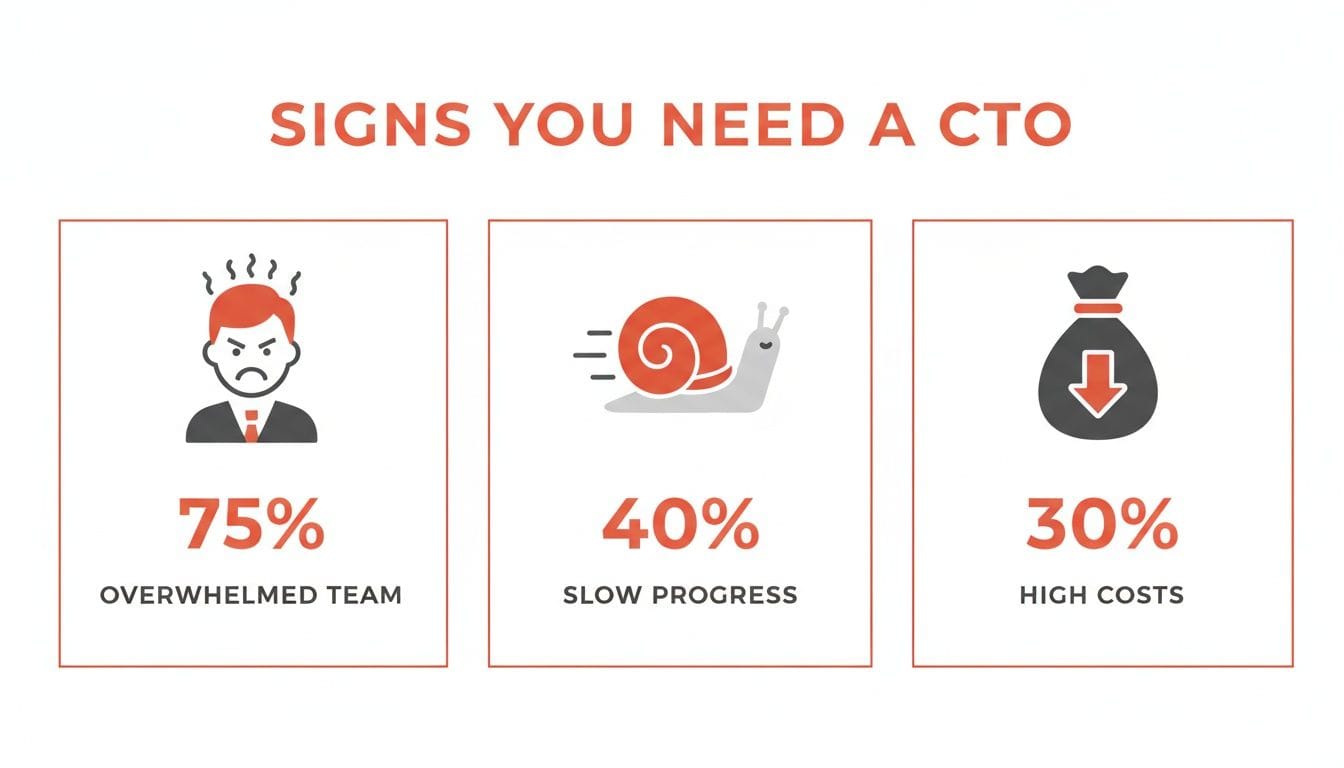
These are the exact problems a fractional CTO is designed to solve, turning a financial liability into a strategic advantage almost overnight.
The True Cost of a Full-Time CTO
Hiring a full-time CTO isn't just a line item on your budget; it’s one of the biggest financial commitments you'll make. The salary is just the tip of the iceberg. The "fully loaded" cost is a number that makes most early-stage founders wince.
Let’s look at the real math. A full-time CTO in a major tech hub will easily run you $250,000–$400,000 per year. In stark contrast, engaging fractional CTO services typically lands between $60,000–$120,000 annually. You get the top-tier strategic thinking you need, often delivering 80% of the value for just 20% of the price. But it gets worse. A full-time hire also demands a 1–5% equity stake, a 3–6 month search and ramp-up period, and recruiter fees that can hit $50,000–$100,000, bloating your first-year costs significantly. You can learn more about how fractional CTO pricing models offer a leaner alternative on uxcontinuum.com.
The core financial benefit isn't just the lower retainer. It's about getting an immediate impact without the months-long hiring process, hefty recruiting fees, and significant equity dilution associated with a full-time executive search.
Beyond Salary: The Hidden Costs a Fractional CTO Avoids
A great fractional CTO’s value isn’t just measured in salary savings. It's measured in the disasters they help you dodge - the hidden costs that quietly kill promising startups.
- The Cost of a Security Breach: A single security incident isn’t just a technical problem; it’s a trust catastrophe. Practical example: A fractional CTO implements mandatory two-factor authentication (2FA) for all internal systems and sets up automated dependency scanning to catch vulnerabilities before a hacker does. This simple, proactive step can prevent a breach that would cost months of developer time and reputational damage to fix.
- The Opportunity Cost of Delayed Features: When your engineers are spinning their wheels, every week a crucial feature is delayed is a week you're not growing your MRR. A fractional CTO unblocks your team and refines your development process so you can ship value to customers faster.
- The Expense of Technical Debt: Bad architecture and quick-and-dirty code act like a tax on every feature you build in the future. A fractional CTO ensures your technical foundation is solid, saving you from a costly and painful rewrite down the road.
This kind of proactive leadership transforms your technology from a money pit into a growth engine.
A Practical Example of Fractional CTO ROI
Let's make this real. Imagine a subscription app doing $25K MRR. The founder, a marketing wiz, knew something was wrong. Cloud costs were out of control, and it took the dev team a painful six weeks to ship a simple paywall tweak.
They brought in a fractional CTO for a $5,000/month retainer.
- In the first week: The CTO ran an infrastructure audit, found over-provisioned servers and sluggish database queries, and cut their AWS bill by $1,500/month. The engagement paid for itself in less than two weeks.
- In the first month: They introduced a proper agile workflow with automated testing. The feature release cycle dropped from six weeks to one. This speed allowed them to run three different paywall experiments in a single month.
- The result: One of those experiments increased the trial-to-paid conversion rate by 15%. This added an extra $3,750 in new MRR that month alone. The fractional CTO didn't just save money - they directly unlocked revenue growth, proving a clear and immediate return on investment.
How to Find and Hire the Right Partner
Choosing a fractional CTO is one of the most critical decisions you’ll make for your company. This isn’t just about hiring a consultant; it’s about finding a part-time partner who will own your technical vision and execution. A methodical process ensures you find someone who gets up to speed fast and delivers real value from day one.
The market for this kind of expertise is booming for a reason. The CTO-as-a-Service (CTOaaS) space is set to grow from $280 million in 2024 to an estimated $557 million by 2031. For founders, the math is simple: a fractional CTO at $5,000–$20,000 a month is a fraction of a full-time CTO’s $200,000–$400,000 annual salary.
As you can see from Gart Solutions' breakdown, plenty of options are out there. The key is separating the true experts from the pretenders.
Your Evaluation Checklist
Finding the right fractional CTO goes way beyond a resume. You need a leader who gets your business stage, your specific tech stack, and your team’s culture. Use this checklist to vet candidates systematically.
- Define Your Core Problem: Before you even start looking, write down the top 3-5 technical headaches you have right now. Are you trying to get your tech ready for a funding round? Is your cloud bill out of control? Is your engineering team shipping slow? Having this clarity lets you filter for candidates who have solved your exact problem before.
- Verify Relevant Experience: Look for a track record that actually mirrors your goals. If you're building a B2C subscription app, a CTO whose entire background is in enterprise SaaS probably isn't the right fit. Don't be shy about asking for specific examples.
- Conduct a "Working Session" Interview: Ditch the standard questions. Give them a real (but small) problem you're currently facing and see how they tackle it. Practical Example: Say "Our user sign-up process has a 50% drop-off rate. Here's a link to our staging environment. Spend 20 minutes looking at it and tell us the top 3 things you'd investigate." This “mini-consulting” session shows you how they think far better than any hypothetical Q&A ever could.
- Check for Culture and Communication Fit: Remember, this person will be mentoring your team and talking to investors. Their ability to explain complex technical ideas in simple terms isn't just a nice-to-have; it's a must-have.
Crucial Questions to Ask Every Candidate
The interview is your chance to dig into their philosophy and working style. Don't just ask about past wins; ask about their process and how they handle it when things go wrong.
- On Technical Strategy: "This is our current tech stack. From a high level, what are its biggest limitations, and what would be your first moves to address them?"
- On Team Integration: "Our engineering team is feeling pretty burnt out. How would you spend your first 30 days to boost morale and improve velocity without adding more chaos?"
- On Communication Style: "Imagine our main feature just went down in production. Walk me through exactly how you would communicate this to me, the engineering team, and our users."
The First 90 Days: A Clear Onboarding Plan
A structured onboarding plan eliminates guesswork and sets clear expectations for what success looks like. It’s what turns a consultant into an integrated leader.
The goal of the first 90 days isn't to solve every single problem. It's to build trust, create a clear roadmap, and score a few quick wins that build momentum for the entire team.
Here’s a template you can adapt for your first 90 days:
Phase 1: Audit & Align (Days 1-30)
- Goal: Absorb as much context as possible and flag immediate risks.
- Milestones:
- Conduct a full technical audit of the codebase, infrastructure, and security posture.
- Hold 1-on-1s with every engineer to understand their biggest frustrations and ideas.
- Present a "State of the Tech" report to the leadership team. No sugarcoating.
Phase 2: Plan & Prioritize (Days 31-60)
- Goal: Build a roadmap that’s grounded in data, not just wishful thinking.
- Milestones:
- Deliver a prioritized 6-month technical roadmap that directly supports business goals.
- Establish a clean agile workflow and communication cadence (e.g., sprint planning, weekly tech check-ins).
- Implement one "quick win," like a tangible infrastructure cost-saving measure or a CI/CD pipeline fix that makes everyone's life easier.
Phase 3: Execute & Mentor (Days 61-90)
- Goal: Shift from high-level strategy to hands-on execution and team empowerment.
- Milestones:
- Oversee the first major feature or architectural improvement from the new roadmap.
- Start regular developer mentoring or pair-programming sessions.
- Establish key performance indicators (KPIs) to track engineering velocity and system health.
This framework gives you a clear path from hiring to value. The vetting process shares a lot of DNA with hiring other key technical roles; you can **check out our guide on how to hire mobile app developers** for more tips on finding top-tier technical talent.
From Strategy to Execution With a Partner

A world-class strategy is useless if it just sits in a slide deck. After hiring a fractional CTO, you finally have the architectural blueprints for a scalable, secure product. But many founders get stuck right here. You have the plans, but no one to actually build the house.
This is the classic strategy-execution gap. An experienced fractional CTO sets the technical direction, but they aren't the one shipping code every day. This creates the perfect opportunity to bring in a dedicated execution partner - a team whose only job is to turn that strategy into reality.
When you pair strategic oversight with a dedicated building crew, your engineering velocity can finally keep up with your ambition.
The Power of an Embedded Engineering Partner
An embedded engineering partner does the "hands-on-keyboard" work required to bring the fractional CTO’s vision to life.
Think of it this way: your fractional CTO is the director of a film. They create the vision, set the scenes, and guide the narrative. The embedded team is the film crew - they operate the cameras, set up the lighting, and make sure every single shot is captured perfectly according to the director's plan.
We see this model work wonders for marketing-first subscription apps. A fractional CTO might design a brilliant paywall experiment, but you need a team like Vermillion to build, ship, and iterate on that experiment week after week. We don’t just take orders; we live in your codebase, join your sprints, and operate as a true extension of your team.
This synergy creates a powerful feedback loop:
- The fractional CTO defines a clear, prioritized roadmap.
- The embedded partner executes that roadmap with speed and quality.
- The results and data from that execution feed directly back to the CTO, informing the next strategic move.
From Blueprint to Shipped Features
A great partnership starts with a plan that connects your business goals to your technical reality. This often involves leveraging Fractional CTO Services for Tech Roadmaps to outline the priorities for the next few quarters. An embedded partner takes that high-level document and turns it into tangible product improvements.
A fractional CTO provides the 'what' and the 'why,' while an embedded engineering team delivers the 'how' and the 'when.' This dual approach closes the gap between strategy and execution, preventing your roadmap from becoming just another document.
For example, a fractional CTO might audit your app and identify a 40% drop-off rate during onboarding. They’ll recommend a complete redesign. An embedded React Native team can take that insight and ship a completely new onboarding flow in a matter of weeks, turning strategic advice into immediate business impact.
The best partners also bring their own deep expertise to the table. When building a mobile app, for instance, making the right architectural choices from day one is critical for long-term success. You can see our thinking on this in our guide on **how to choose the right tech stack for your project**.
This kind of specialized knowledge ensures the fractional CTO’s vision isn't just implemented, but implemented using best practices that won't have to be torn down and rebuilt in a year.
A Few Lingering Questions
Even when the benefits seem clear, it's smart to have a few last questions. Bringing on a strategic leader is a big move. Let's tackle the most common ones we hear from founders so you can move forward with confidence.
What Is the Difference Between a Fractional CTO and a Freelance Developer?
This is a common point of confusion, but the roles operate on completely different levels. A freelance developer is a set of hands - a task-oriented pro you hire to write code for specific, well-defined features. They’re fantastic for execution.
A fractional CTO, on the other hand, is a strategic brain. They're a part-time executive who owns your entire technology vision, from architecture and team leadership to security and process.
A freelancer builds a single wall exactly as instructed. A fractional CTO provides the architectural blueprint for the entire house, ensuring it's built to last and won't collapse when you add a second story.
Can a Part-Time CTO Really Help My App Scale?
Absolutely. A great fractional CTO’s value isn’t measured in hours logged, but in the leverage they create. Their job is to unblock your full-time team and multiply their effectiveness.
In just 10-15 hours a week, a seasoned fractional CTO can:
- Design a scalable cloud architecture that cuts your monthly bill by thousands.
- Implement a development process that doubles your team's velocity.
- Build a tech roadmap that gets investors excited and secures your next round.
They aren’t there to write code day-to-day. They’re there to solve the big, systemic problems holding your growth back, creating a massive ripple effect across the entire company.
At What MRR Should I Consider a Fractional CTO?
There's no magic number, but the pain usually becomes undeniable somewhere between $10K and $50K MRR. By this point, you've likely hit product-market fit, and growth is starting to take off.
This is also when technical debt starts to feel like an anchor. The shortcuts you took to get here are now slowing everything down. The founder who was juggling the business and the tech can't do both anymore.
Bringing in a fractional CTO at this stage stops engineering from becoming a bottleneck. It lays a solid foundation to scale to $100K MRR and beyond, making sure your tech can actually handle the success you're building.
A fractional CTO provides the strategic blueprint, but you still need a dedicated crew to build the house.
At Vermillion, we're the embedded React Native engineering partner that turns that strategy into shipped features. We work on a monthly retainer, living in your Slack and your sprints, to make sure your engineering velocity matches your ambition.
Keep reading
See all →
March 22, 2026
Unlocking Revenue Your Guide to Price Tier Strategy

March 21, 2026
Your Guide to Flawless Stripe Subscription Management

May 14, 2026
Fractional Mobile Engineering vs. Full-Time Hiring in 2026
The mobile engineering talent market has shifted dramatically over the past two years. Budgets are tighter, AI tools have changed what a sin...
March 20, 2026
Recurring Billing With Stripe a Guide for Subscription Apps
Master recurring billing with Stripe. This guide covers everything from setup and server logic to webhooks and churn reduction for subscript...

March 19, 2026
Unlocking Growth with Mobile App Retention Metrics
Discover the mobile app retention metrics that directly fuel MRR growth. This founder's guide offers actionable strategies to track, analyze...