Vermillion Insights
February 28, 2026 · Ken Vermeille · 20 min read
Artificial Intelligence Personalization: Boost App Growth
Learn how artificial intelligence personalization can boost mobile app growth with proven tactics, KPIs, and scalable tech stacks.
Think of your mobile app as a personal concierge. One that doesn't just greet every user with the same generic "Hello," but instead anticipates their needs before they're even spoken.
That's the real promise of artificial intelligence personalization. It’s a huge leap past basic rules, like showing someone products from a category they once browsed. We're talking about a dynamic system that uses behavioral data to predict what a user will want next, crafting a truly one-of-a-kind experience for every single person.
What Is AI Personalization and Why It Matters Now

This isn't about just slotting a user's first name into a push notification. True AI personalization transforms a static, one-size-fits-all app into a bespoke service. It actively learns from every click, swipe, purchase, and moment of hesitation to make intelligent decisions about what to show that user in their next session.
This could be anything from reordering the content on the home screen to match their interests, to sending a perfectly timed push notification about a price drop on an item they’ve viewed multiple times. The app stops being a tool and starts feeling like an intelligent partner.
Connecting Personalization to Business Growth
Here's where it gets interesting for founders and product leaders. The real power of AI personalization is its direct, measurable impact on the metrics that define a healthy business.
When an app gets a user, that user sticks around. They come back more often, they engage more deeply, and they spend more money. This creates a powerful growth engine for your app.
Here’s a quick breakdown of the business wins with practical examples:
- Increased User Retention: A personalized app feels indispensable. For instance, a news app that learns you prefer 5-minute tech summaries in the morning and surfaces them on your home screen becomes a critical part of your daily routine. You have a powerful reason to return day after day.
- Higher Conversion Rates: Showing the right user the right product at the right moment is the fastest way to lift conversions. A fashion app can use AI to recommend a specific pair of shoes that pairs perfectly with a dress a user just added to their cart, removing friction and increasing the average order value.
- Improved Customer Lifetime Value (LTV): Happy, engaged users don't just stay longer - they're also more receptive to upsells. A fitness app that personalizes a user's workout plan might suggest a premium nutrition add-on once the user consistently hits their goals, boosting the total value they bring to your business.
To see how these tactics directly influence your bottom line, let’s look at the correlation between specific personalization efforts and the KPIs they improve.
How AI Personalization Impacts Key App KPIs
This table shows the direct correlation between specific AI personalization tactics and measurable improvements in core business metrics.
| Personalization Tactic | Primary KPI Impacted | Practical Actionable Insight |
|---|---|---|
| Recommendation Engine | Conversion Rate, ARPU | Action: Implement a "You Might Also Like" carousel on product pages. Insight: An e-commerce app can see a +15% increase in Average Order Value (AOV) by suggesting complementary items based on browsing history. |
| Personalized Onboarding | Day 1 & Day 7 Retention | Action: Customize the first-run experience. Insight: A language app can ask users their goals (e.g., travel, business) and serve relevant lessons first, boosting users completing a key first action by +25%. |
| Dynamic Content Ranking | Session Duration, Engagement | Action: Reorder the home feed based on user interests. Insight: A media app can prioritize video content for users who watch videos, increasing time spent in-app per session by +20%. |
| Triggered Push Notifications | Retention, Re-engagement | Action: Send behavior-based alerts. Insight: An e-commerce app sending a "price drop" alert for an abandoned cart item can see +30% higher open rates than generic promotional pushes. |
| Dynamic Pricing | Customer Lifetime Value (LTV) | Action: Offer targeted discounts to at-risk users. Insight: A subscription app can offer a 20% discount to users who show signs of churning, lifting their overall LTV by +10%. |
As you can see, each strategy is designed not just to "improve the experience" in a vague sense, but to drive a specific, quantifiable business outcome. This is how you build a product that grows sustainably.
From Buzzword to Business Imperative
Ultimately, implementing AI personalization is about building a stickier, more profitable product. It's the difference between an app that serves everyone and an app that serves someone - perfectly. To truly get a handle on what's possible, it’s worth digging into the core concepts behind Unlocking Knowledge in Artificial Intelligence for Your Apps.
The market data backs this up. The AI-based personalization market is already a massive industry, with forecasts showing huge growth by 2025. For founders and CTOs, this sends a clear signal: users don't just appreciate personalized experiences anymore; they expect them. It’s no longer a "nice-to-have" feature; it's a critical capability for survival and growth.
By making every interaction feel relevant and uniquely crafted, you’re not just improving the user experience; you’re building a defensible competitive advantage. The businesses that master this will be the ones that win their market.
Seeing AI Personalization in Action
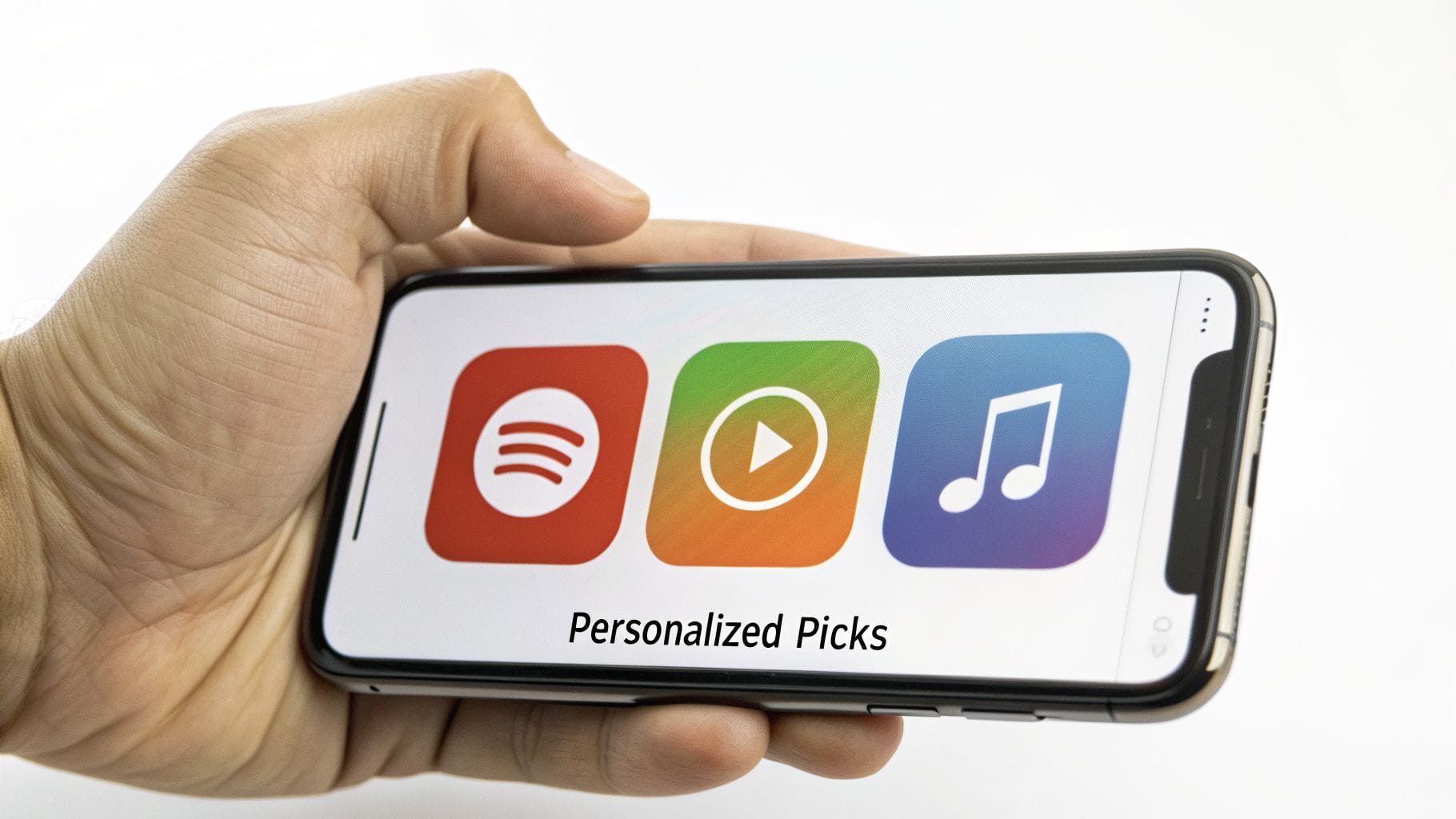
The best way to really get what artificial intelligence personalization can do for a business is to look at the apps we use every day. This tech is the secret sauce behind the magnetic experiences that keep us hooked. By pulling back the curtain on how the big players use it, we can find a practical blueprint for our own apps.
Think of it like a great neighborhood barista who remembers your order. The first time, you tell them what you want. After a few visits, they start making your drink the moment you walk in. That’s exactly what the top mobile apps do - just for millions of people at once.
Netflix: The Master of Content Ranking
Netflix has basically perfected the art of keeping you glued to the couch. Their recommendation engine is a textbook example of AI-driven content ranking. When you open the app, you’re not seeing a generic library; you’re looking at a personalized storefront built just for you.
The system crunches a staggering amount of data: what you’ve watched, what you started but didn't finish, the time of day you watch, and even which actors you seem to like. It uses this to create rows like "Top Picks for You" or "Because You Watched..." It even customizes the thumbnail art for a show to make it more likely you'll click.
Actionable Takeaway: A wellness app could use this exact same play. Instead of a static list, it could rank guided meditations based on a user’s reported stress levels, past session lengths, and favorite instructors. An anxious user might see short, calming sessions pop up first on their home screen, making the app immediately more useful.
Duolingo: Adaptive Learning Paths for Engagement
Duolingo makes learning a language feel less like a rigid class and more like a personal coaching session. The app leverages AI to build adaptive learning paths. If you keep messing up verb conjugations, the algorithm will feed you more exercises to help you master that skill. On the flip side, if you breeze through a section, it moves you ahead faster.
This is a powerful use of artificial intelligence personalization because it respects the user's time and skill. It keeps advanced learners from getting bored and beginners from getting frustrated. By adjusting the difficulty in real-time, the app creates a perfectly tuned challenge that's optimized for both learning and long-term stickiness.
Actionable Takeaway: A fintech or stock trading app can learn a ton from this. Instead of a one-size-fits-all onboarding, it could adjust the flow based on a user's financial literacy. A brand-new investor would get simple, step-by-step tutorials, while an experienced trader could jump straight to advanced features. This simple change can dramatically boost Day 1 retention for both groups.
Spotify: The Art of Algorithmic Discovery
Spotify's "Discover Weekly" is legendary. It feels like magic, but it’s really a brilliant mix of collaborative filtering and natural language processing. The AI studies everything about your listening habits - the playlists you build, the songs you skip, and the tracks you love.
It then finds other users with tastes just like yours and recommends songs they love that you haven't heard yet. The result is a weekly playlist that feels like it was hand-picked by a friend with impeccable taste. This constant stream of discovery is a huge reason over 70% of Spotify's users stay on the platform.
Tools like the Google Personal Assistant also show how AI can adapt to what an individual wants, creating interactions that feel genuinely helpful and intuitive.
Actionable Takeaway: An e-commerce app can easily copy this discovery model. Instead of just showing "related products," it could create a personalized "Curated for You" collection each week. By analyzing purchase history, browsing patterns, and even what a user has in their cart, the app can surface unique items from smaller brands that perfectly fit the user’s style, driving both sales and loyalty.
How to Actually Measure the ROI of Your Personalization Work
Rolling out artificial intelligence personalization is a major investment in your app’s future, but it shouldn't be a leap of faith. If you can't measure the impact, you can’t prove its value or justify spending more time and money on it. The good news is that a well-executed personalization strategy isn't abstract - its effects show up directly in your key business metrics.
To really get a grip on the return on investment (ROI), you have to look past vanity metrics. It’s all about connecting every personalized feature to tangible growth. This requires a sharp, focused analytics setup that lets you isolate the impact of your work and have real, data-driven conversations about what's succeeding.
Key Performance Indicators That Actually Matter
When you're trying to measure the ROI of personalization, you need to zero in on the KPIs that directly affect your bottom line. These are the numbers that tell a clear story about whether your personalized experiences are making the app stickier and more profitable.
- User Retention Rate: This is the ultimate test. Are users who get a personalized experience more likely to come back? Actionable Insight: Track Day 7, Day 30, and even Day 90 retention for users who interact with your personalized feed versus a control group. This will give you a definitive answer on its long-term value.
- Conversion Lift: Whether your goal is a purchase or a subscription, personalization should give it a boost. Actionable Insight: Measure the conversion rate for users who click on a personalized recommendation versus those who see a generic "popular items" list. A 5-10% lift is a strong signal that you're on the right track.
- Customer Lifetime Value (LTV): This metric ties retention and monetization together. Actionable Insight: Compare the LTV of a user cohort that received personalized offers against one that didn't. A rising LTV in your personalized cohorts is a powerful sign of long-term value creation.
How to Isolate the Impact of Personalization
So, how do you know for sure that your shiny new recommendation model is behind that 15% increase in retention, and it wasn't just a market trend or a fluke? The answer is rigorous testing and analysis. You have to create a clean comparison between the personalized experience and the generic one.
The core principle is simple: to prove that personalization works, you must scientifically compare it against a world where it doesn't exist. This is where A/B testing and cohort analysis become your most valuable tools.
A/B Testing Your Models
This is the gold standard for measuring immediate impact. When you launch a new personalization model - like a "For You" content feed - don't just roll it out to everyone at once.
- Define Your Groups: Split your users into at least two groups. Group A (the control) gets the old, non-personalized experience. Group B (the variant) gets the new, AI-driven one.
- Measure the Difference: Track your key KPIs for both groups over a set period, usually two to four weeks. Are users in Group B converting more often? Is their average session time longer?
- Analyze the Results: If Group B shows a statistically significant improvement in your target metric, you have clear proof that your artificial intelligence personalization effort is paying off.
Actionable Insight: For an e-commerce app, A/B test a personalized "Recommended for You" row on the homepage against a static "Best Sellers" row. Track the click-through rate and conversion rate from each row. The results will give you hard data on which approach drives more revenue.
Using Cohort Analysis for Long-Term Insights
While A/B tests are fantastic for measuring short-term lift, cohort analysis is where you'll spot long-term behavioral changes. A cohort is simply a group of users who started using your app around the same time. By comparing cohorts from before and after you launched a personalization feature, you can see lasting trends in retention and engagement.
For instance, you could compare the 90-day LTV of a cohort that joined in January (before you launched personalized offers) with a cohort from April (after the launch). If the April cohort's LTV is consistently higher, you have strong evidence of real ROI. To dig deeper into this, check out our guide on how to get started with data-driven insights.
A Practical Roadmap for Implementing AI Personalization
So, you're ready to bring AI personalization into your app. Where do you even start? It's not a single, giant leap but a series of manageable steps. This isn't about getting lost in abstract theory; it's a practical guide for your development team, focused on the real-world decisions and trade-offs you'll face.
Think of it like building a custom suit. You don't just grab scissors and start cutting. First, you take precise measurements (data collection). Then, you create a pattern from those measurements (feature engineering). Next, you choose the right fabric and thread (select models). Finally, you stitch it all together, making sure it fits perfectly (inference and scaling).
Let's walk through that process, one stage at a time.
Stage 1: Data Collection and Instrumentation
The entire foundation of your personalization engine rests on one thing: high-quality data. Without it, your AI has nothing to learn from. Your first, most critical task is to start tracking clean, structured event data from your app.
This isn't about hoovering up every single byte of data. It's about being strategic. You need to track the user interactions that signal intent and preference.
Actionable Insight: For a media app, don't just track article_viewed. Instead, track article_viewed, article_shared, comment_posted, and time_spent_on_article. Each event adds a layer of understanding about the user's true level of interest. A share is a much stronger signal than a simple view.
- User Actions: What are users actually doing? Think clicks, views, adds-to-cart, likes, or saves.
- Item Metadata: What are the properties of the things they're interacting with? This could be the category, brand, price, or topic.
- User Attributes: What do you know about the user themselves? Things like their location, device type, or subscription status can be powerful signals.
- Session Information: How long are they spending in the app? What path do they take?
This "instrumentation" phase means integrating an event-tracking library into your app. This library will send all this rich behavioral data to a central data warehouse, creating the historical record your AI will use to uncover patterns in user behavior.
Stage 2: Feature Engineering
Raw data, on its own, is often noisy and meaningless to a machine learning model. A log that says "User 123 viewed Product ABC at 10:05 PM" isn't very helpful. Feature engineering is the art of turning that raw data into meaningful signals - or "features" - that a model can actually use to make predictions.
This is arguably where the magic happens and where much of the value is created. That raw event log can be transformed into powerful features like:
user_most_viewed_category= "Electronics"user_preferred_time_of_day= "Late Night"product_view_count_last_7_days= 12
These engineered features are the distilled wisdom from user behavior. A model can't really understand a series of random clicks. But it can understand that a user who frequently views "Electronics" late at night is a great candidate for a new gadget recommendation.
Actionable Insight: For a food delivery app, you can engineer a feature called is_weekend_evening. Combining this with a user's order history can reveal that they tend to order pizza on Friday nights. Now your model can proactively suggest their favorite pizza place in a push notification at 6 PM on a Friday.
This process turns abstract behavior into concrete attributes that make your personalization algorithms smarter and far more accurate.
Stage 3: Choosing the Right Models
With clean features ready to go, it’s time to pick the machine learning models that will do the heavy lifting. You don't need a team of PhDs to get started here. Many powerful and accessible techniques can solve common personalization problems.
Here are three foundational models you'll likely encounter:
- Collaborative Filtering: This works just like a real-world recommendation. It finds other users who have similar tastes to you and then suggests things they liked that you haven't seen yet. Actionable Example: If User A and User B both love Bands X, Y, and Z, and User B also loves Band W, the model recommends Band W to User A. It’s fantastic for discovery.
- Content-Based Filtering: This approach is more straightforward. It recommends items that are similar to things a user has already liked. Actionable Example: If you've been binge-watching sci-fi shows, it will recommend more sci-fi shows based on shared attributes like genre, director, or actors. This is great for serving niche interests.
- Embeddings and Ranking: This is a more sophisticated approach. It uses embeddings - dense numerical fingerprints - to represent users and items. The model then learns to predict the most relevant items for a specific user at a specific time. Actionable Example: It can learn that you prefer short, funny videos in the morning but long-form documentaries on weekends, creating a smart balance between relevance and discovery.
The model you choose depends entirely on your goal. Are you trying to broaden a user's tastes or deepen their engagement with what they already love? The best systems often blend multiple models to get the best of all worlds.
Stage 4: Scaling and Real-World Tradeoffs
Once you have a model that can make predictions, you need to figure out how to get those predictions to your users. This is where you face a critical trade-off between batch processing and real-time inference.
- Batch Processing: With this setup, you pre-calculate recommendations for all your users on a set schedule - say, every night. It's computationally cheap and relatively simple to implement. Actionable Example: Creating Spotify's "Discover Weekly" playlist. It's generated once a week and is the same all week, making it a perfect use case for batch processing.
- Real-Time Inference: Here, recommendations are generated on the fly, the instant a user opens the app or navigates to a new screen. This creates a hyper-responsive experience but is far more complex and expensive. Actionable Example: As you browse products on Amazon, the "Customers who viewed this item also viewed" section changes instantly based on the product you're currently looking at.
A pragmatic approach is often best. Start with batch processing for things like personalized push notifications or weekly email digests. As your team and infrastructure mature, you can move toward a hybrid or fully real-time system for things like in-app content feeds. This lets you deliver value fast while building toward a more advanced future.
Stage 5: Privacy and Compliance
No personalization project is complete without a rock-solid approach to privacy. It's simple: users have to trust you're using their data responsibly. This means being crystal clear about what data you collect and how you're using it to improve their experience.
Actionable Insight: Add a "Personalization Settings" section in your app. Allow users to see the interest categories the AI has assigned to them (e.g., "sci-fi movies," "vegan recipes") and give them the option to remove categories they feel are inaccurate. This transparency builds trust and improves model accuracy.
Your system must comply with regulations like GDPR and CCPA. This isn't optional. It means building in the ability for users to view, export, and delete their data on request. Anonymizing data wherever possible and implementing strong security controls are table stakes for building an ethical and sustainable personalization engine.
It's also worth noting that while North America currently leads in AI personalization adoption, the fastest growth is in the Asia-Pacific region. This highlights the need for adaptable strategies that respect different regional expectations and privacy norms. You can learn more about these market dynamics in this detailed analysis.
Choosing Your Personalization Tech Stack
So, how do you actually build this stuff? Turning the idea of AI personalization into a real, working system requires a technical blueprint. For many mobile apps, a common starting point is a React Native front-end talking to a server-side backend. Let’s walk through what a sample architecture looks like for that setup and the key decisions you’ll need to make along the way.
Think of this less as a dry diagram and more as a plan for turning raw user behavior into features that drive revenue. The flow is pretty logical when you break it down: you collect data from the app, you use that data to train models, and then you serve those model's predictions back to the user as a personalized experience.
This simple, three-step loop is the engine behind all effective personalization.
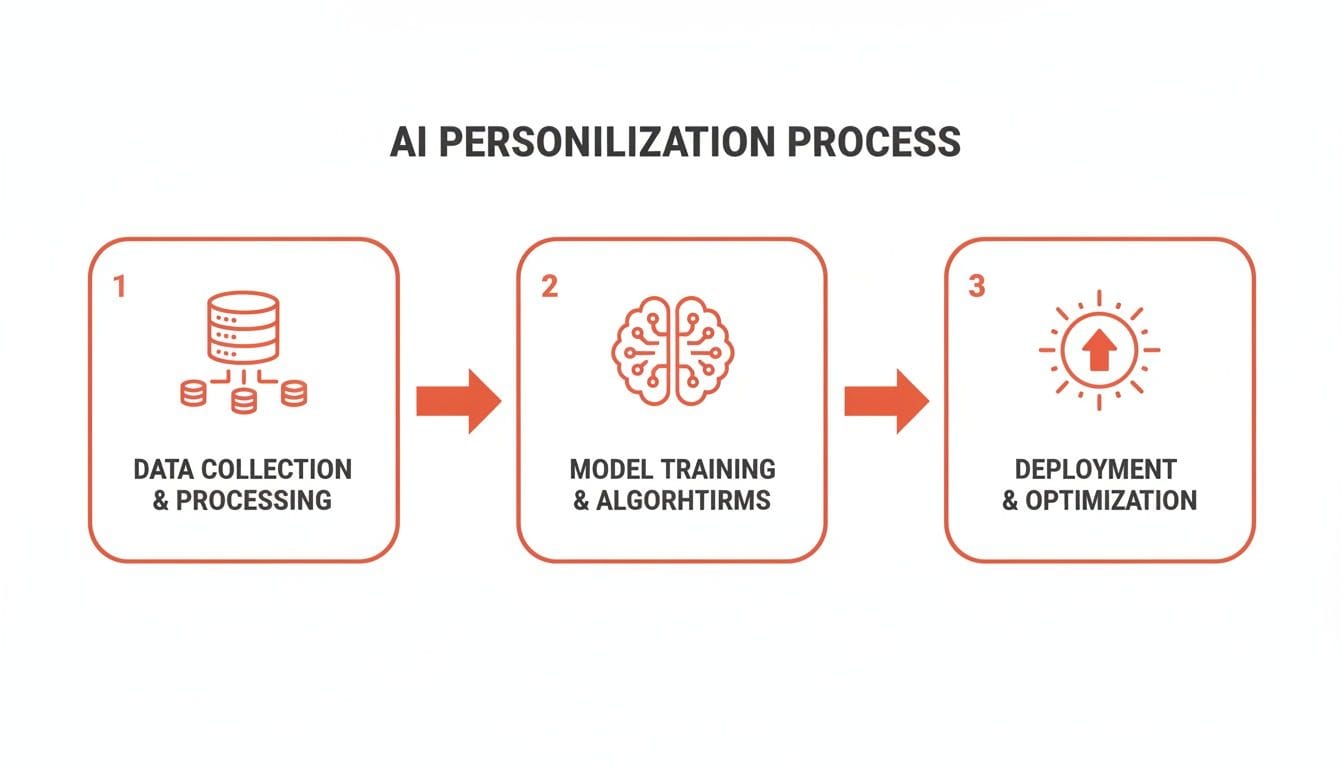
It’s a powerful cycle: raw user events get systematically refined into intelligent, scalable outputs that make the app experience better for every single user.
A High-Level Blueprint for React Native
Let's trace the journey. A user opens your React Native app. Every tap, swipe, and view is an event. The first piece of your stack is an event tracker - something like Segment or a simple custom SDK - that captures these actions and fires them off to your backend.
Once the events arrive, a data pipeline takes over. This is where tools like Apache Kafka or AWS Kinesis stream that firehose of events into a data warehouse like Google BigQuery, Snowflake, or Amazon Redshift. This warehouse is now your single source of truth for all user behavior. It’s the foundation your machine learning models will be built on.
From there, your data science or engineering team gets to work. They build models that read from the warehouse and, once trained, deploy them to a model inference service. This is just a fancy name for an API endpoint your backend can call to get recommendations. When a user opens their personalized feed, your backend simply asks this service, "What should I show User X?" The service responds with a ranked list of items, and voilà - personalization in action.
The Build Versus Buy Decision
This is one of the biggest forks in the road you'll face: do you build this entire system from scratch or use a managed, off-the-shelf service? The answer has huge implications for your budget, your team's focus, and how fast you can get a feature into users' hands.
To help you decide, let's look at the trade-offs.
Build vs. Buy: A Decision Framework for Your AI Engine
Deciding whether to build your own personalization engine or use a managed service is a critical strategic choice. Here’s a breakdown of the key factors.
| Factor | Build Custom Solution | Use Managed Service (e.g., AWS Personalize) |
|---|---|---|
| Control & Flexibility | Total control over models, features, and business logic. Perfect for truly unique needs. | You're limited to the platform's capabilities. Less wiggle room for custom algorithms. |
| Time to Market | Much longer. You need a dedicated data science and ML engineering team. Think months, not weeks. | Dramatically faster. You can get a baseline model running in weeks, sometimes even days. |
| Initial Cost | High. You're paying for significant engineering time and infrastructure setup costs upfront. | Low. Most operate on a pay-as-you-go model, so you start small and scale your spend. |
| Maintenance | It's all on you. Maintaining infrastructure, retraining models, and fixing bugs is an ongoing job. | Minimal. The provider handles all the infrastructure, scaling, and baseline model maintenance. |
Managed services like AWS Personalize or Google Cloud Recommendations AI are incredible accelerators. They handle the undifferentiated heavy lifting - the complex plumbing of model training and serving - so a small team can deliver sophisticated personalization without needing a Ph.D. in machine learning. For most startups, this makes the "buy" option a fantastic starting point.
A custom-built solution gives you ultimate control, but it's a long and expensive road. Starting with a managed service lets you prove the ROI of personalization quickly, de-risking a much larger investment in a custom engine down the line.
Actionable Insight: If you're a startup with a small engineering team, start with a "buy" solution like AWS Personalize. You can feed it your user interaction data and have a working recommendation API in a matter of days. This lets you A/B test the value of personalization immediately without derailing your product roadmap for months.
This isn't just a technical decision; it's a strategic one. If you want to go deeper into making these foundational choices, our guide on how to choose the right tech stack can help you frame the problem. Your final call should always come back to your team's current capabilities and your company's most immediate goals.
Common Pitfalls and How to Avoid Them
Building AI personalization is an exciting frontier, but it's a path littered with traps that can burn through your budget and schedule before you see a single dollar of ROI. Even sharp engineering teams fall into them. The key is knowing where the landmines are buried so you can walk right around them.
The single biggest mistake? The classic "garbage in, garbage out" problem. If your personalization models are fed a diet of messy, incomplete, or just plain wrong data, they're going to spit out irrelevant, unhelpful recommendations. This doesn't just fail to lift the user experience - it actively hurts it, pushing users away.
The Problem of Bad Data
You can't build a strong house on a shaky foundation. In AI, your data is that foundation. Too many teams get excited about modeling and jump the gun, only to realize their data pipelines are a mess.
How to Avoid It:
- Instrument Early: Don't treat data tracking as an afterthought. From day one, implement clean, structured event tracking. Define a clear schema for user actions and properties.
- Validate and Monitor: Set up automated checks to catch bad data before it pollutes your system. Actionable Insight: Create a dashboard that tracks key data metrics, like the number of events per day or the percentage of events with missing user IDs. Set up alerts for sudden drops or spikes, which often signal a tracking bug.
Another all-too-common pitfall is reaching for a complex deep learning model when a much simpler solution would do. The siren song of using the "latest and greatest" in AI is strong, but it often leads to projects that are expensive to build, a nightmare to maintain, and painfully slow.
Over-engineering and Latency Blindness
Sometimes, a basic collaborative filtering model is more than enough to deliver a huge win. Choosing a model that's too complex for the job doesn't just waste engineering cycles; it kills the user experience with latency. If your personalized home screen takes three seconds to load because the model is chugging away, you've already lost. The user is gone.
The best personalization is instant and invisible. Any delay the user can feel shatters the magic. Latency isn't a technical metric; it's a user experience metric.
How to Avoid It:
- Start Simple: Always begin with the simplest model that can get the job done. Actionable Insight: For a first pass at e-commerce recommendations, start with a simple "most purchased in this category" model. It's easy to implement and provides a solid benchmark to beat if you decide to try something more sophisticated later.
- Benchmark Performance: Model inference time should be a primary KPI, not a "we'll fix it later" problem. Set a strict latency budget - say, under 100ms - and build your architecture to hit it.
This is where having an experienced partner can make all the difference. They've seen these mistakes before and can help you navigate around them and other common AI build money pits. An expert guide helps de-risk your investment, pushing you toward pragmatic solutions that work in the real world - ensuring your personalization efforts actually move the needle on your business goals without expensive detours.
Your AI Personalization Questions, Answered
Every founder and product leader I talk to has the same practical questions when they start thinking about AI personalization. Let's cut through the noise and get straight to the answers you need to plan your next move.
"How Much Data Do I Really Need to Start?"
Less than you think. You don't need a Google-sized dataset to get going. A few weeks of structured event data from a couple of thousand active users is often enough to train a baseline model that proves the concept. The most important thing is to start collecting clean user interaction data now.
Focus on the fundamentals first. Start tracking:
- Clicks on specific items or content.
- Views of product pages or articles.
- Session duration and how users navigate your app.
This initial dataset is usually all you need to get your first personalization model off the ground and show it's worth the investment.
The biggest mistake I see startups make with personalization isn't technical - it's strategic. They jump into building without a clear business goal. Before you write a single line of code, decide if you're trying to boost retention, increase conversions, or lift session time. A specific KPI is the only way to measure ROI and keep your team from building features that don't move the needle.
"Can I Do This Without a Dedicated Data Science Team?"
Yes, you absolutely can. This is where the classic "build vs. buy" decision comes into play. You don't need a PhD in machine learning to get started.
Managed platforms like AWS Personalize or Google Recommendations AI let your existing engineering team deploy powerful personalization without getting bogged down in the complex modeling and infrastructure. They handle the heavy lifting, and your team focuses on integrating the personalized recommendations into your app's UI.
This is a fantastic way to test the waters, prove the ROI quickly, and justify a bigger investment down the road. It dramatically lowers the barrier to entry.
Ready to get artificial intelligence personalization right without the costly missteps? Vermillion is the technical growth partner that helps you build, protect, and scale your software. We bring the senior technical leadership and hands-on delivery to make sure your product foundation is solid and your features drive real business outcomes. Learn more about how we can accelerate your roadmap at https://vermillion.agency.
Keep reading
See all →
March 22, 2026
Unlocking Revenue Your Guide to Price Tier Strategy

March 21, 2026
Your Guide to Flawless Stripe Subscription Management

May 14, 2026
Fractional Mobile Engineering vs. Full-Time Hiring in 2026
The mobile engineering talent market has shifted dramatically over the past two years. Budgets are tighter, AI tools have changed what a sin...
March 20, 2026
Recurring Billing With Stripe a Guide for Subscription Apps
Master recurring billing with Stripe. This guide covers everything from setup and server logic to webhooks and churn reduction for subscript...
March 19, 2026
Unlocking Growth with Mobile App Retention Metrics
Discover the mobile app retention metrics that directly fuel MRR growth. This founder's guide offers actionable strategies to track, analyze...