A Guide to Subscription Management Platforms

For subscription app founders with monthly recurring revenue between $10K and $500K, the game starts to change. The initial scramble to get users in the door gives way to a much harder, more important challenge: getting them to stay. This is where subscription management platforms stop being simple billing tools and become the central nervous system of your entire business—a true engine for growth.
Your Blueprint for Scaling Subscription Revenue

If you've hit the $10K MRR milestone, congratulations. You've officially proven you have a product people want. But the hard truth is that the scrappy tactics that got you here won't get you to the next level.
The next phase of growth is all about your ability to keep subscribers, test different pricing strategies, and plug the leaks that cause churn. All without bogging down your development team. This is exactly where subscription management platforms become non-negotiable. They aren’t just payment processors; they’re the operational backbone that manages the entire subscriber lifecycle from start to finish.
The market reflects this reality. The global subscription and billing management space was valued at roughly USD 8.5 billion in 2025 and is on track to hit a staggering USD 27.6 billion by 2034. This boom isn't just about more companies offering subscriptions; it’s about the critical need for solid billing infrastructure that can actually keep up with marketing-led growth.
Beyond Basic Billing
Think of these platforms as a specialized layer of software that sits between your app and the app stores (Apple and Google). They automate the complex, messy tasks that would otherwise eat up hundreds of engineering hours.
For example, without a platform, a simple plan upgrade requires your developers to write custom code for prorations, updating permissions, and validating receipts. It's a surprisingly deep rabbit hole.
With a good subscription management platform, this becomes a single, clean API call. That frees up your engineers to focus on what they do best: building features that your users love, not wrestling with brittle billing code. To really scale, your blueprint has to include a solid plan for mastering customer retention management.
Core Functions of a Subscription Management Platform
So, what do these platforms actually do? They give you the tools to manage the most critical parts of the subscriber journey.
A solid platform will handle a few core functions that are essential for any growing subscription app. Think of it as your command center for revenue operations.
| Function | What It Does | Why It Matters for Growth (Practical Example) |
|---|---|---|
| **Subscriber Lifecycle Events** | Automates renewals, upgrades, downgrades, pauses, and cancellations. | Ensures a smooth, bug-free user experience, which is critical for retention. **Example:** A user upgrades to an annual plan. The platform handles the proration, updates their access, and sends the correct data to your CRM without any manual work. |
| **Unified Revenue Data** | Normalizes data from Apple and Google into one single source of truth. | Gives you clean, accurate metrics like **MRR**, **churn**, and **LTV** without manual spreadsheet hell. **Example:** You can build a single dashboard that shows total MRR across both iOS and Android, which is impossible without a unified data layer. |
| **Churn Reduction Tools** | Implements dunning (retrying failed payments) and grace periods automatically. | Recovers revenue you would otherwise lose from involuntary churn due to payment failures. **Example:** When a credit card fails, the system automatically retries the payment 3, 5, and 7 days later, recovering the customer before they even know there was an issue. |
| **Entitlement Management** | Manages which features and content each user tier has access to. | Lets you experiment with new plans and paywalls without writing complex permission logic. **Example:** Launch a "Pro Plus" tier with exclusive content by just adding the new plan in the dashboard; the platform tells your app which users should get access. |
Ultimately,これらのプラットフォームは、購読者ジャーニーの主要な側面を管理する力を与えます.
We see it all the time: marketing-first teams hit a growth ceiling because their engineering capacity can't keep up with new ideas. The right platform, paired with an agile engineering partner, lets you ship paywall experiments and test new onboarding flows at the speed your business demands. You can also get creative with your pricing by looking at these 10 subscription business model examples.
Essential Features Every App Founder Needs

When you’re first building a subscription app, just getting recurring payments to work feels like a win. But as you scale, you quickly realize that simply collecting money isn't enough. The real challenge is keeping that money coming in automatically, without your engineers spending half their time on billing logic.
A basic subscription tool is fine for a handful of users. But to support real growth, you need a system that does the heavy lifting for you. Let’s break down the non-negotiable features you should be looking for.
Dunning Management and Smart Retries
Failed payments are the leaky bucket of subscription revenue. A credit card expires. A bank flags a transaction. The user’s account is temporarily low on funds. Without a system to deal with this, that customer just churns out, and you might not even notice until it's too late.
This is what dunning management is built to solve. It’s an automated process for chasing down failed payments. Instead of giving up after the first decline, a smart platform retries the charge at strategic intervals.
Practical Example: A user's payment for your meditation app fails on the 1st of the month. A smart dunning system doesn't just cancel their access. It retries the payment on the 3rd (a common payday), and if that fails, again on the 5th. It might also trigger an in-app message: "Please update your payment info to keep your meditation history." This proactive approach recovers revenue you would otherwise lose. We've seen platforms recover up to 15% of what would be lost revenue from involuntary churn.
Automated Prorations for Plan Changes
Your users won't stay on the same plan forever. They’ll want to upgrade, downgrade, or switch between different tiers. If your engineers have to manually calculate the prorated charges for every mid-cycle change, you’ve created an accounting nightmare and a constant source of bugs.
A top-tier subscription platform handles all of this automatically.
- Actionable Insight (Upgrades): A user on a $10/month plan decides to upgrade to your $25/month plan halfway through their billing cycle. The platform instantly calculates the $7.50 difference owed for the rest of the month and charges them correctly. No manual math, no support tickets.
- Actionable Insight (Downgrades): A user on a premium $20/month plan downgrades to a $5/month plan. The platform automatically calculates a credit for the unused time on the more expensive plan and applies it to their next bill, creating a positive customer experience instead of a frustrating one.
This creates a seamless experience for your users and, more importantly, frees up your engineering team from building and maintaining what is surprisingly complex billing logic. We see similar complexities when founders try to manage in-app purchases on Apple's platform themselves.
Flexible Coupon and Trial Management
Your marketing team needs the freedom to experiment. If launching a simple "25% off" promotion requires a new JIRA ticket and an engineering sprint, you’re killing your own growth. Agility in marketing is critical, and your subscription platform should enable it, not block it.
Look for a platform that lets your non-technical team members easily create and manage promotions.
Practical Example: Your marketing lead wants to run a "Black Friday" campaign offering 50% off for the first six months. Instead of filing an engineering ticket, they log into the subscription management platform's dashboard, create a new coupon code named "BLACKFRIDAY50," set the discount percentage and duration, and hit save. The code is now live and can be used in marketing emails immediately. This is the kind of speed that lets you capitalize on opportunities without creating an engineering bottleneck.
The platform should support:
- Percentage-based discounts (e.g., 25% off for 3 months)
- Fixed-amount discounts (e.g., $5 off the first invoice)
- Custom free trials (e.g., a 30-day trial for a specific marketing campaign)
How Different Platform Architectures Impact Your App
Choosing a subscription management platform isn't just about picking features off a list. It’s a fundamental architectural decision that will have a massive impact on your app's speed, scalability, and—most importantly—your engineering team's sanity. The way a platform talks to the app stores and your backend dictates how much code your team has to write, and how much they'll be stuck maintaining.
There are really only two ways these platforms are built: the proxy/middleware model and the direct-integration SDK. Getting the trade-offs right is absolutely critical, especially if you’re running a lean engineering team and can't afford to get bogged down.
The Proxy Model: The Universal Translator
Proxy platforms, like the incredibly popular RevenueCat, act as a "universal translator" between your app and the app stores. Your app doesn't talk directly to Apple’s StoreKit or Google’s Billing Library. Instead, it talks to the proxy’s SDK, and the proxy handles all the messy, store-specific communication from there.
This approach has one massive advantage: simplicity.
- Unified API: Your developers get to work with one clean, consistent API. It doesn't matter if the user is on iOS or Android; the proxy handles the platform-specific chaos behind the scenes.
- Normalized Data: It automatically cleans up and standardizes subscription events and receipt data from both stores into a single, reliable format. Your backend gets predictable webhooks for events like
subscription_startedorrenewal_failed, not a jumbled mess. - Reduced Boilerplate: This is the big one. Your team avoids writing—and maintaining—thousands of lines of code just for receipt validation, state management, and the countless edge cases that pop up with each store.
For a React Native app, this is a game-changer. You can manage all your cross-platform subscription logic from a single codebase without ever having to touch the native-specific headaches.
Practical Example: You want to give a user access to "Pro" features. Without a proxy, your developers would need to write separate code for iOS (checking an Apple receipt) and Android (checking a Google Play purchase token). With a proxy model, they just make one call, like CustomerInfo.isProUser(), and the proxy's SDK handles the platform-specific logic. This cuts development time for new paywalled features in half.This model is a lifesaver for teams that need to move fast. If your main goal is to ship paywall experiments and iterate on your monetization strategy quickly, a proxy architecture lets you do it with a fraction of the engineering overhead.
The Direct Integration Model: The Direct Line
The other option is the direct-integration model. Here, your app uses an SDK that creates a "direct line" to Apple's and Google’s native billing libraries. This is the path you'd also take if you decided to build all your subscription logic from scratch.
This approach gives you total control. If you have a truly unique or complex billing requirement that a proxy can't handle out-of-the-box, this might be your only choice.
But that control comes at a steep price. Your engineering team is now on the hook for everything:
- Writing Store-Specific Code: Juggling separate, complex logic for both StoreKit and the Google Billing Library.
- Receipt Validation: Building and maintaining a secure server-side system to validate every single receipt from Apple and Google. This is a huge, ongoing job.
- State Management: Wrestling with the infuriatingly complex state machine of subscriptions—grace periods, account holds, retries, and resubscriptions.
No matter which architecture you lean toward, implementing modern data collection methods like server-side tracking will give you more accurate and resilient data in a privacy-focused world.
For most subscription apps, especially those in the $10K to $500K MRR range, the engineering hell of a direct integration just isn't worth it. Every hour your team spends wrestling with billing code is an hour they aren't spending on building the features your users actually pay for.
Why Cloud Platforms Are a No-Brainer for Modern App Businesses
Not long ago, founders had to debate whether to build their infrastructure on-premise or in the cloud. That debate is over. For any serious app business today, the cloud is the only real answer.
If you’re an indie developer or a small marketing-first team just hitting $10K MRR, the idea of buying, managing, and patching your own servers is a non-starter. It's a distraction from what actually grows your business: building a great app and getting users. The appeal is simple—the cloud lets you focus.
Built-in Scalability and Zero Headaches
Imagine your app gets a surprise feature on the App Store. Traffic explodes overnight. If you were running on your own physical servers, they’d almost certainly crash. You'd lose sales, get hammered with bad reviews, and spend weeks scrambling to order and set up more hardware.
A cloud-based subscription platform just handles it. It scales up automatically to meet the demand without you lifting a finger. This "zero-maintenance" reality is why the old on-premise model is dying out.
We’re seeing a massive shift in the market. Cloud-based subscription management is on track to grab 75% market share by 2026, leaving on-premise setups in the dust. For the indie developers and small studios we see using tools like Superwall or RevenueCat—often in the $10K–$500K MRR range—this means they can launch global subscription offers in days, not months. Small and medium-sized businesses are the fastest-growing segment here, with a blistering 20.25% CAGR, because mobile-first consoles and preset tax rules are finally letting them compete worldwide. You can dig into these subscription management market trends to see the full picture.
Ship Faster, Grow Faster
The real magic of the cloud is speed. It turns what used to be massive, multi-month engineering projects into a few clicks in a dashboard.
Let’s get practical. Say your US-based fitness app wants to expand into Europe. This means you suddenly need to handle new currencies like the Euro and navigate complex local tax laws like VAT.
- The Old Way (On-Premise): This is a huge engineering lift. Your team would spend months building custom logic for currency conversion, integrating new payment gateways, and coding a tax engine from scratch.
- The Cloud Way (Actionable): In your cloud subscription platform, you go to the settings panel. You check a box to enable "EUR" as a currency. Then you navigate to the tax settings and enable automated VAT collection for EU countries. The platform handles all the calculations and compliance. You've just gone international in an afternoon.
This is what lets marketing-first teams move at the speed of the market. Want to A/B test a new price point in Brazil? It takes a few clicks. Need to roll out a holiday promotion in Japan? You can have it live in minutes.
Cloud-based subscription management platforms aren't just a convenience; they're an equalizer. They give small app businesses the same powerful, reliable, and global infrastructure that was once reserved for massive corporations. It's how you compete—and win—on a global stage.
Picking the right subscription management platform is one of those decisions that feels technical but ends up defining your app's future. Get it right, and you unlock faster growth. Get it wrong, and you're stuck with engineering headaches, missed revenue, and a system that can’t keep up as you scale.
This isn't just about choosing a tool; it's a strategic move that directly impacts your revenue, your team's speed, and your ability to grow. Before you even think about looking at a pricing page, you need to get brutally honest about your team, your goals, and what your business will actually need when you hit your next revenue milestone.
The Right Questions to Ask Before You Choose
Don't get distracted by a long list of shiny features you'll never use. Your evaluation needs to be anchored to the realities of your business today—and where you plan to be tomorrow.
- What’s our real React Native expertise? Be honest. If you're a small team or a marketing-focused founder, a platform with a proxy or middleware architecture like RevenueCat is a no-brainer. It saves hundreds of hours of complex engineering work by cleaning up and standardizing app store data.
- How often are we going to test paywalls? If your growth plan hinges on constant A/B testing of prices, designs, and offers, you need a tool built for it. Platforms like Superwall or Adapty are designed for exactly this, letting your marketing team run experiments without needing an engineer for every change.
- What can we afford at $50K MRR vs. $500K MRR? That cheap revenue-share plan might seem like a great deal now, but it can become a massive, painful expense as you scale. On the flip side, a platform with high fixed fees might be too much of a burden early on. You have to model the costs at different revenue stages to avoid a nasty surprise.
One of the first forks in the road is deciding between a cloud-hosted platform or building it all yourself on-premise. This chart breaks it down.
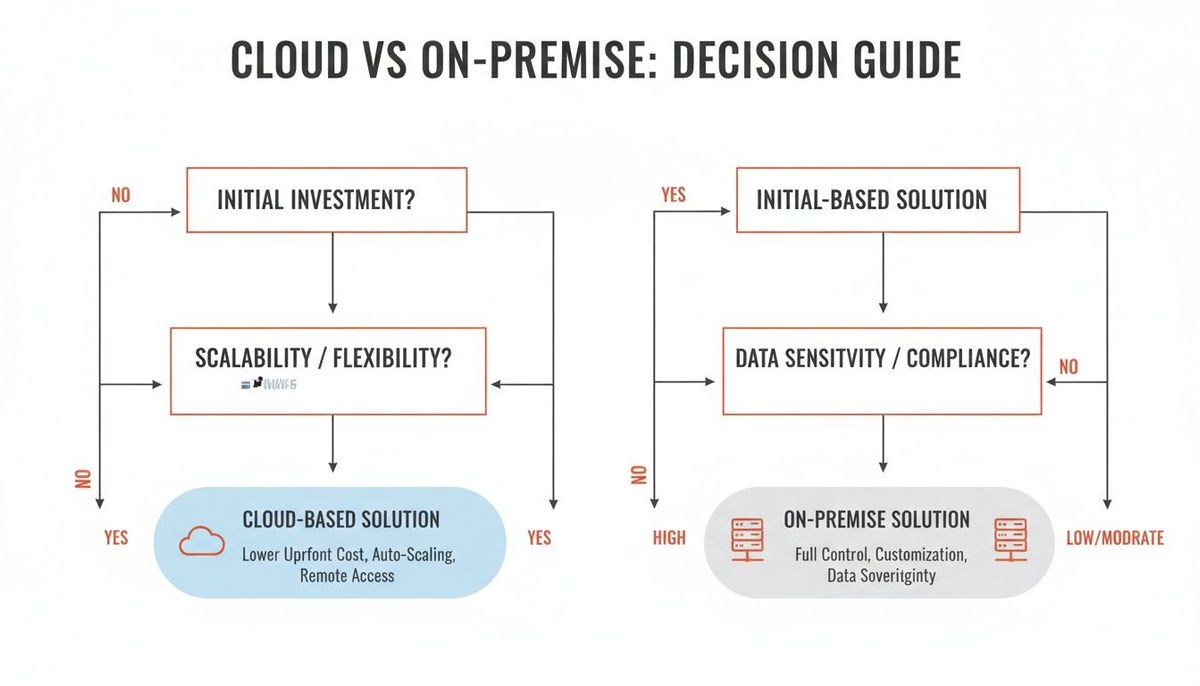
For virtually every modern app business, especially those scaling in the $10K–$500K MRR range, the answer is clear. The operational burden of on-premise solutions just doesn't make sense, so the path almost always leads to the cloud.
Platform Comparison for React Native Subscription Apps
To make this a bit more concrete, here's how some of the most popular subscription management platforms stack up for teams building with React Native. We've evaluated them based on what really matters to a high-growth app team.
| Platform | Best For | Pricing Model | React Native Support | Key Feature (Practical Use Case) |
|---|---|---|---|---|
| **RevenueCat** | Teams needing a reliable single source of truth for subscription data. | Revenue Share (plus enterprise plans) | Excellent, with a widely used official SDK. | Rock-solid data normalization and backend integrations. **Use Case:** Automatically sending clean `Subscription Cancelled` events to your CRM to trigger a "win-back" email campaign. |
| **Adapty** | Teams focused on aggressive paywall A/B testing and analytics. | Revenue Share (plus enterprise plans) | Strong, with an official SDK and good documentation. | Powerful paywall builder and analytics suite. **Use Case:** Testing an "Annual Plan First" paywall against a "Monthly Plan First" version to see which one drives higher LTV. |
| **Superwall** | Marketing-first teams who need to iterate on paywalls without engineers. | Fixed Fee (based on impressions/users) | Good, though newer than others. | A no-code visual editor for building and testing paywalls. **Use Case:** The marketing manager single-handedly designs and launches a new paywall with a video background in 20 minutes. |
This choice isn't just about code; it's a strategic investment that dictates how fast you can move. It also directly impacts the efficiency of any engineering partner you bring on. A well-documented, developer-friendly platform like RevenueCat means an embedded partner like Vermillion can start shipping features from day one, not spend weeks untangling a messy implementation.
The numbers back this up. While large enterprises still hold a 59.3-65% revenue share in the subscription market, it's the small and medium-sized businesses (SMEs) that are really driving the growth. They're growing at a staggering 20.25% CAGR, largely because cloud platforms have made it possible for founders to scale from $10K to $500K MRR without a massive in-house team.
With 68% of North American SMEs using these tools to manage 82% of their recurring contracts, the pressure is on to stay agile. For solo founders and small teams, the ability to ship paywall tests weekly isn't a nice-to-have; it's a requirement to stay competitive. You can dig deeper into the growth of the subscription management market and see just how critical these platforms have become.
Ship Faster, Grow Faster: Why an Engineering Partner Beats a Bottleneck

You’ve picked the perfect subscription platform. Great. But that’s only half the story. The real driver of growth isn't the platform you choose—it's your engineering velocity. If your marketing ideas move at 100 mph but your dev team is stuck in first gear, that fancy platform is just dead weight.
This is a pain point I see all the time, especially with marketing-first founders. You know exactly what you need to build: slick new paywalls, A/B tests on your onboarding flow, a killer promotional offer. The problem is, you’re completely hamstrung by slow, unreliable, or nonexistent engineering.
Hiring freelancers feels like a roll of the dice. Bringing on a full-time engineer is a huge financial and administrative leap. There has to be a better way.
And there is. It's called the embedded engineering partner model, and it's built to give you the dedicated expertise of an in-house team without the long-term overhead.
What an Embedded Engineering Partner Actually Does
Forget the idea of an "external contractor." An embedded partner is a true extension of your team. They don't just take tickets; they integrate directly into your workflow.
In our model, this means they:
- Live in your team's Slack or Teams channels for instant communication.
- Join your daily stand-ups and weekly sprint planning calls.
- Work right inside your codebase, pushing production-ready features.
This isn't about farming out work. It’s about closing the gap between your growth strategy and your ability to actually execute it. Instead of waiting weeks for a simple change, you get a dedicated team shipping new features and experiments on a predictable, weekly cycle.
Actionable Insight: The whole point is to turn your marketing team’s whiteboard sketches into working code, fast. When you can iterate on your app at the speed of your ideas, you create a powerful flywheel for both growth and retention. This means the idea of "let's test a paywall with a testimonial video" goes from a month-long project to a task in next week's sprint.
A Real-World Example: The Paywall Test
Let's make this concrete. Your marketing lead wants to test three completely different paywall designs this month to find a new conversion winner.
- The Freelancer Route: You'd spend a week finding and vetting a developer, another week getting them onboarded, and then cross your fingers they deliver something usable on time. The entire process is bogged down by uncertainty and delays.
- The Embedded Partner Route: This becomes a set of clear tickets in the current sprint. Your partner’s engineers, who already know your codebase and your subscription management platform inside and out, get to work immediately. You see the first test go live in days, not weeks.
That’s the difference engineering velocity makes. It's not just about building stuff—it’s about building the right stuff at the right time. For founders running apps on tools like RevenueCat, this agility is non-negotiable. If you want to see how this works in practice, check out our guide on how a dedicated team can supercharge your RevenueCat integration.
For a marketing-first founder, this model is a total game-changer. It smashes the engineering bottleneck, letting you focus on strategy while a trusted partner handles the technical execution.
Frequently Asked Questions About Subscription Platforms
When you're a founder trying to scale your subscription app, you eventually hit a wall of questions about the tech stack. I've heard them all. Here are the straight-up, no-nonsense answers to the questions that pop up most often.
How much do these platforms typically cost?
Most platforms play in one of two sandboxes. The first is a revenue-share model, where they take a small slice of the revenue they process. This is the approach you'll see with platforms like RevenueCat and Adapty. It's great when you're just starting out because the cost grows as you do.
The other camp uses a fixed monthly fee. This is usually based on something like your active user count or how many times your paywall gets shown. Superwall is a good example here. This model can be a lot cheaper once you hit scale, but it means a bigger bill right from day one. You absolutely need to model both against your growth forecasts.
Actionable Insight: At $10K MRR, a 3% revenue share is $300/month, which is likely cheaper than a fixed fee. But at $200K MRR, that same 3% becomes a whopping $6,000/month. Run the numbers for your projected 12-month and 24-month revenue to see where the crossover point is. Don't just solve for today's costs.
Can I migrate from one platform to another later?
Yes, but anyone who tells you it's a simple flip of a switch is lying. Migrating means ripping out the old SDK and putting in a new one, painstakingly mapping your existing subscriber data, and testing everything to make sure you don't accidentally churn your entire user base overnight.
Actionable Insight: The smartest thing you can do is de-risk this from the start. Build an abstraction layer in your own code—a simple "wrapper" around the platform's SDK. Instead of callingRevenueCat.purchase()everywhere in your app, you callMyBillingManager.purchase(), which then calls RevenueCat. If you need to switch later, you only have to update yourMyBillingManager, not hunt through dozens of files.
How much engineering effort is required to integrate a subscription platform?
A good React Native developer can get a basic integration with a proxy platform like RevenueCat done in a few days, maybe a week. The SDKs do a lot of the heavy lifting for you, which is the whole point.
But the real work isn't the integration. It's building and testing the paywalls, wiring up user permissions on your own backend, and making the platform talk to all your other tools. For a small team, this is a constant drain, which is exactly why so many founders bring in an embedded partner who's already mastered these systems.
Ready to accelerate your app's growth without the engineering bottleneck? Vermillion is an embedded React Native engineering partner that ships production-ready features for subscription apps on a weekly cadence. Learn how we can help you ship faster.