Your Guide to Subscription Billing Software in 2026

Think of subscription billing software as your app's central nervous system for making money. It’s the automated engine that handles every single financial interaction with your subscribers—from their first payment and trial period to every recurring charge, plan upgrade, and failed payment afterward.
For a growing app, this isn't a "nice-to-have." It's the core infrastructure that keeps billing chaos from choking your growth.
Understanding Your App's Financial Engine
At its heart, this software automates the entire subscriber payment lifecycle. Instead of a spreadsheet and a prayer, you have a system that does the heavy lifting, ensuring you get paid on time, every time.
Imagine going from 100 to 10,000 subscribers. Manually creating invoices, chasing down expired credit cards, and trying to calculate prorated charges for plan changes would become a full-time job. It’s an operational nightmare. That’s the exact pain a real billing system solves.
Beyond Simple Recurring Payments
Just taking a payment every month is table stakes. Modern subscription billing software does a lot more than that. It’s what gives you the agility to actually run a subscription business effectively.
This tech is what lets you:
- Experiment with pricing on the fly. Practical example: A fitness app could offer a "New Year's Resolution" plan for January only, giving a 30% discount on the first three months. With good software, this is a 10-minute setup. Without it, it’s a coding project.
- Slash involuntary churn. The system automatically handles dunning—the process of chasing overdue payments from things like expired credit cards. Actionable insight: Instead of a generic "payment failed" email, you can configure your software to send a sequence: a friendly reminder on day 1, a more urgent one on day 3, and a final "access suspended" notice on day 7, recovering revenue without manual work.
- Get real answers from your data. Instantly see your Monthly Recurring Revenue (MRR), churn rate, and customer lifetime value (LTV) without wrestling with spreadsheets. Practical example: Your dashboard shows that users who upgrade within their first month have a 3x higher LTV. This is an actionable insight to create a targeted in-app prompt encouraging upgrades during that initial period.
This isn't some niche tool; it’s a massive market shift. The subscription billing software space was valued at $9.04 billion in 2025 and is on track to hit $19.66 billion by 2030. That growth is happening because founders are realizing they can't build this stuff themselves and scale.
For an app founder, this is the difference between being a CTO bogged down by billing logic and a CEO focused on product and growth. A good system abstracts away the complexity of payments, compliance, and revenue management.
Ultimately, this software is the foundation for scaling your app’s revenue. It's not just about collecting cash; it's about building a resilient financial operation that can grow with you. To help you see the connection more clearly, here’s a quick breakdown of what these core functions do for your business.
Core Functions vs. Business Benefits for Subscription Apps
| Core Function | What It Does | Why It Matters for Your App's Growth |
|---|---|---|
| **Subscription Plans** | Manages different pricing tiers (e.g., Basic, Pro), trial periods, and add-ons. | **Actionable Insight:** Lets you A/B test a "Pro Plus" tier with a new feature to 10% of users to gauge demand before a full rollout. |
| **Recurring Billing** | Automatically charges subscribers on a set schedule (monthly, annually). | Creates predictable, stable revenue and frees up your team from manual invoicing. |
| **Proration** | Automatically calculates partial charges or credits when a user upgrades or downgrades mid-cycle. | **Practical Example:** A user on a $10/mo plan upgrades to a $30/mo plan halfway through. The system automatically charges them $15 for the rest of the month, ensuring a fair and seamless experience. |
| **Dunning Management** | Automatically retries failed payments and sends customized reminder emails to customers. | Recovers revenue that would otherwise be lost to involuntary churn (e.g., expired cards). |
| **Revenue Analytics** | Provides a real-time dashboard with key metrics like MRR, Churn Rate, and LTV. | Gives you the critical data you need to make smart decisions about marketing, product, and growth. |
As you can see, each feature directly ties to a crucial business outcome, turning a complex operational task into a strategic advantage. When you're managing payments, it's also helpful to explore the key differences between various subscription management platforms. A solid system lets you focus on building a great product, knowing your revenue engine can keep up.
Must-Have Features for a Seamless Subscriber Experience
Your subscription billing software isn't just a glorified cash register. It's the engine driving your revenue and, more importantly, keeping the customers you worked so hard to acquire. The right platform automates growth; the wrong one creates a constant drag on your resources and pisses off your users.
Think of it this way: a solid subscription system is built on a few interconnected pillars. Get these right, and you have a scalable foundation. Get them wrong, and the whole thing crumbles under pressure.
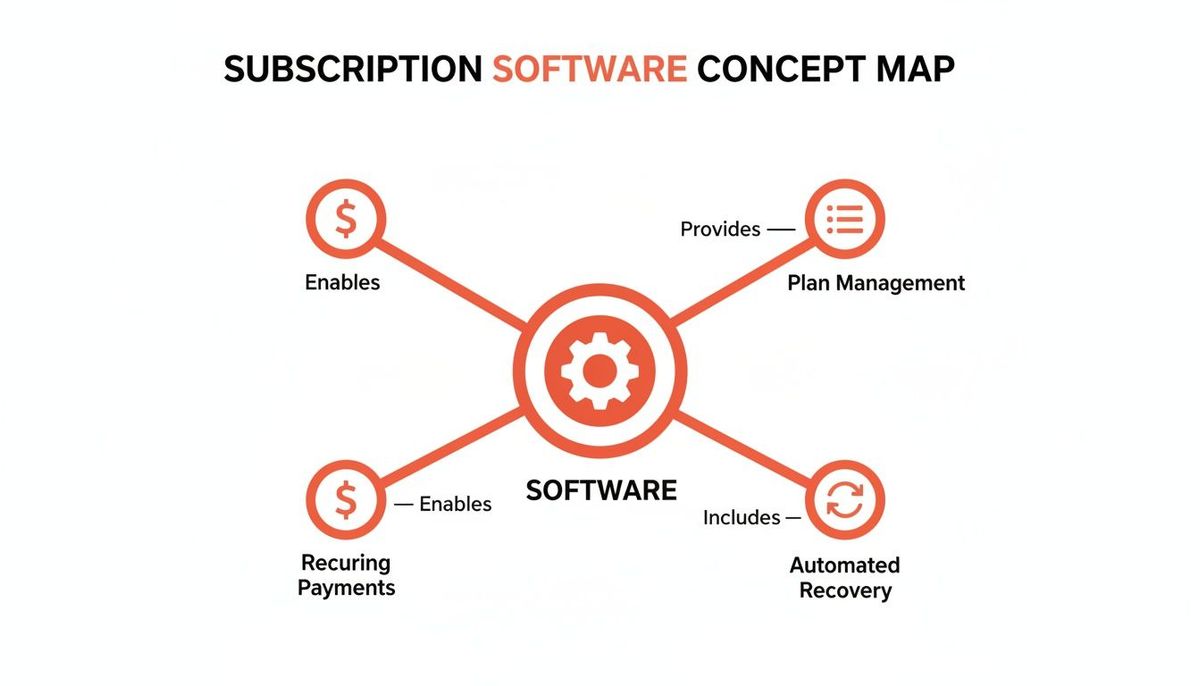
These aren’t just features on a checklist. They are the core functions that directly determine whether your subscription model thrives or dies.
Flexible Plan Management
You're going to want to experiment with your pricing. A lot. What works on day one won't work on day one thousand. Flexible plan management isn't about having a "Basic" and "Pro" tier; it's about having the power to test new monetization ideas without begging your engineers for a three-week coding project.
Practical example: A project management app might want to test a "Pay Per Project" add-on for their standard monthly plan. Good software allows the product manager to create this add-on, set the price, and link it to the existing plan through a simple web interface, ready for testing in hours, not weeks.
Proration and Fair Billing
Here’s a common scenario: a customer on your monthly plan decides to upgrade to the annual plan halfway through the month. How do you charge them? This is where proration saves the day. It automatically calculates the fair, partial charge for the upgrade and the credit for the unused time on their old plan.
Actionable Insight: Use this to your advantage. You can actively market mid-cycle upgrades with clear messaging like, "Upgrade to Annual now and we'll apply your remaining monthly balance as a credit!" This transparency removes friction and makes the upgrade decision easier for the customer.
Dunning Management to Fight Churn
Involuntary churn is the silent killer of subscription apps. It's when a customer's payment fails—not because they want to leave, but because their card expired or got declined. This isn't a customer service problem; it's a systems problem.
Dunning management is your automated defense. It intelligently retries failed payments at optimal times and sends smart, customized reminders to users, prompting them to update their billing info before their subscription gets cut off. Practical example: Configure your system to automatically retry a failed payment 3 days later, then 5 days after that, because different banks process declines at different times. This simple, automated sequence can recover up to 15% of failed payments.
Good dunning is about more than just sending "your payment failed" emails. Your software needs to support effective representment strategies to fight illegitimate chargebacks and recover revenue from failed transactions that would otherwise be lost for good.
Webhooks and Actionable Analytics
Finally, your billing platform can't be a black box. It needs to talk to the rest of your tech stack. That’s where webhooks and analytics come in. Webhooks are simply automated alerts that your billing system sends out when something happens—a new subscription, a failed payment, a cancellation.
Actionable Insight: Set up a webhook for the subscription_canceled event. Connect it to your CRM to tag the user as "Churned" and trigger an automated email from your marketing platform offering a 50% discount to come back. This turns a negative event into an automated re-engagement opportunity.
The demand for this kind of intelligent tooling is exploding. A shocking 42% of consumers admit to paying for subscriptions they forgot they had, fueling an average spend of $133 per month. This behavior has supercharged the subscription billing market, which was valued at $8.47 billion in 2025 and is on track to hit a staggering $37.36 billion by 2035. You can dig into the numbers in this subscription billing market analysis.
Navigating the Mobile App Subscription Ecosystem

While the core ideas of recurring revenue are the same everywhere, the mobile app world is a completely different ballgame. You can’t just take your standard subscription billing software and expect it to work inside your iOS or Android app. The entire system is controlled by Apple and Google, who act as mandatory gatekeepers for every single dollar you earn.
This creates a massive headache. Your app has to talk directly to both the App Store and Google Play billing libraries, and these two systems couldn’t be more different. If you decide to handle this in-house, you’re signing up to build and maintain two entirely separate pipelines just to get paid. It's a huge, continuous drain on engineering resources.
This is exactly why a new layer of specialized subscription tools—like RevenueCat, Superwall, and Adapty—has emerged.
The Rise of Subscription Infrastructure Platforms
Think of these platforms as universal translators for mobile billing. They sit between your app, the app stores, and your own backend, creating a single, clean way to manage every subscription. Instead of your engineers wrestling with two different, messy systems, they only have to integrate with one.
These platforms don't replace the app stores; they streamline your interaction with them. They abstract away the painful, low-level details of purchase validation, receipt management, and cross-platform entitlement tracking.
Practical example: A user subscribes to your "Pro" plan on their iPhone. RevenueCat verifies the purchase with Apple, then automatically grants them "Pro" access. When that same user logs into your app on a Google Pixel tablet, RevenueCat recognizes their account and instantly unlocks the "Pro" features there too—without your team writing any complex cross-platform entitlement logic.
We break down just how messy this can get in our guide on implementing in-app purchases on Apple devices. This unified approach is a game-changer for your engineering team, freeing them up to build features that users actually care about instead of getting bogged down in billing logic.
Empowering Marketing with No-Code Paywall Tools
But it's not just about making life easier for engineers. This new breed of tools also gives your marketing and product teams superpowers. Platforms like Superwall and Adapty are built to separate your paywall from your app's core code, which means non-technical team members can finally run monetization experiments on their own.
Let’s look at a real-world scenario:
- The Goal: Marketing wants to test if a new annual plan with a 25% discount will get more people to convert.
- The Old Way: You'd file a ticket with engineering. They’d add it to their sprint, eventually code the new paywall, and then you’d have to submit a brand-new app version for review. The whole process could easily take weeks.
- The New Way: With a tool like Superwall, your marketer logs into a web dashboard, builds a new paywall with the annual plan, and deploys it to 10% of your user base. Instantly. No code changes, no app update, no waiting.
This kind of agility is how you win. It means you can iterate on your pricing, test new offers, and tweak your paywall designs at the speed of your business—not at the speed of your app release cycle. By decoupling your monetization strategy from your engineering backlog, you can turn A/B testing into a continuous process and transform your subscription model into a real growth engine.
Choosing Your Stack and Avoiding Costly Pitfalls
Picking your subscription billing software is one of those early decisions that will quietly shape the future of your app. Get it right, and you have a financial engine that scales with you. Get it wrong, and you're signing up for a future of painful migrations, lost revenue, and engineering headaches.
This isn't just about solving today's billing problem. It's about building a financial backbone that won't shatter the moment your app starts to take off.
The market for this is exploding. What was a $4.18 billion market in 2023 is on track to hit $19.87 billion by 2033, growing at a staggering 16.87% CAGR. You can see the full picture in this recent subscription billing software market report.
That growth tells you one thing: everyone is figuring out that getting this right from day one is critical.
Pricing Models and Scalability
One of the first forks in the road you'll hit is pricing. It almost always boils down to two paths: paying a flat monthly fee or giving up a percentage of your revenue.
Actionable Insight: Create a simple spreadsheet. Model your projected revenue for the next three years. Calculate the total cost for a revenue-share provider (e.g., Stripe Billing at 0.5%) vs. a flat-fee provider (e.g., a platform charging $299/month for up to $50k in monthly revenue). This will show you exactly where the break-even point is and which model is more cost-effective for your specific growth trajectory.
Here’s how to think about it:
- Revenue Share: You pay a small cut (often 0.5% - 1%) of every transaction. This model aligns the platform's success with yours, but that percentage can start to feel very heavy once you're processing serious volume.
- Flat Fees: A predictable monthly cost, usually tiered by how much revenue you process or how many subscribers you have. It's easy to budget for, but you might find yourself locked out of the advanced features you’ll need later.
- Hybrid Models: Some platforms mix it up, charging a base fee plus a smaller percentage. It’s a middle ground that can offer the best of both worlds.
This is where you need to do the math. A detailed Stripe vs Square comparison can show you how different pricing structures play out in the real world. The key is to run the numbers not just for today, but for a future where you’re at 10x your current revenue. What’s cheap now could become your biggest expense tomorrow.
The Hidden Dangers of Outgrowing Your System
I've heard this story from founders more times than I can count. A startup picks a simple, cheap invoicing tool to manage its first hundred subscribers. It works fine. Then they hit a few thousand subscribers, and the whole thing falls apart. The tool can’t handle prorated billing, dunning is a manual nightmare, and changing a user’s plan is a recipe for disaster.
Practical Example: "The migration to a real subscription management platform was an absolute nightmare. We had customers who weren't billed for months because of gaps in the data. We lost historical records during the export. Our engineers spent weeks just trying to detangle the mess we’d created. That "cheap" tool ended up costing us tens of thousands in lost revenue and nearly burned out our best developer."
This isn’t a rare occurrence. It's the natural consequence of choosing a system for where you are, not where you're going.
Actionable Insight: Before choosing a platform, ask their sales team for a case study of a company that is 10x your current size. If they can’t provide one, it’s a major red flag that their system may not scale with you. Look for a platform with a robust API, clear documentation, and a proven track record of supporting companies at your target scale.
A Practical Implementation Checklist for Founders

Alright, let's get from the big idea to the actual implementation. This isn't a technical guide. It's a business-first roadmap designed to help you define your subscription model before a single line of code gets written.
Getting this right upfront is the single best way to avoid expensive miscommunications with your engineering team. When you think through these business decisions first, you ensure the subscription billing software is built to support your growth from day one, not hold it back.
Phase 1: Define Your Monetization Model
This is the absolute foundation of your revenue engine. You need total clarity on what you’re selling and how customers will pay for it. Don’t just think about today; try to anticipate how your pricing might need to evolve a year from now.
Actionable Insight: Create a one-page "Billing Spec" document. Don't use technical jargon. Write it in plain English and have your non-technical co-founder review it. This ensures everyone is aligned.
- What are the exact pricing tiers? Be specific. For example, Free, Pro at $9.99/mo, and Business at $49.99/mo.
- Will you offer monthly and annual plans? If you do, what’s the discount for paying upfront? A 20% discount is pretty common.
- Is there a free trial? How long is it? Critically, does it require a credit card to start? (Card-upfront trials often have higher conversion rates but lower sign-ups).
- Will you use metered billing? Practical Example: A video hosting service might offer a base plan plus charge $0.10 for every GB of bandwidth over a 100 GB limit. This needs to be defined upfront.
Nailing down these details prevents scope creep and makes sure the billing logic actually matches your go-to-market strategy.
Phase 2: Map the Subscriber Lifecycle
Your relationship with a subscriber is a journey, and every single step needs to be planned out. Mapping this journey ensures a smooth user experience and, just as importantly, tells your developers exactly what logic to build for each stage.
A subscriber’s journey doesn't end after they input their credit card. You must account for upgrades, downgrades, pauses, cancellations, and resubscriptions. A poorly handled lifecycle event can instantly create a churn risk.
Actionable Insight: Use a simple flowchart tool (like Miro or Lucidchart) to visually map out each step. For each "box" in the flowchart, define what the user sees and what the system does.
- A user upgrades or downgrades? The proration rules here have to be crystal clear.
- A payment fails? This is dunning. How many times will you retry the charge? What do your reminder emails say? Practical Example: Define the email copy for each dunning step: "Heads up, we couldn't process your payment for [App Name]" vs. "Final attempt to update your billing for [App Name]."
- They want to cancel? Do you offer to pause their subscription instead? Practical Example: Show a "Pause for 3 months" button next to the "Cancel" button. This can retain customers who just need a temporary break.
- A former subscriber wants to come back? Make it easy for them to reactivate with a single click.
Phase 3: Plan for Integrations and Edge Cases
Your billing system doesn't live on an island. It has to talk to your other tools to give you a complete picture of the business. You also have to plan for all the little exceptions that, trust me, will definitely come up.
- Integrations: Which CRM, like HubSpot, needs to know when a user subscribes? What analytics tool, maybe Mixpanel, will you fire subscription events to? Actionable Insight: Create a list of "events" (e.g.,
subscription_started,payment_failed) and map which tool needs to receive each one. - Edge Cases: How will you handle refund requests? Will you need to support regional pricing and multiple currencies? What about managing sales tax or VAT? Practical Example: Define a clear refund policy. For instance, "Full refunds are available within 14 days of the initial purchase, no questions asked." This policy should be a setting in your billing software, not a manual process.
Thinking through these elements is mission-critical. To get a broader sense of what it takes to launch smoothly, it’s worth reviewing a comprehensive production readiness checklist. This kind of prep work turns what feels like a messy technical project into a series of clear business requirements your team can actually build.
The Big Questions Every Founder Asks About Subscription Billing
When you get into the weeds of subscription billing, the same handful of questions always pop up. Founders are smart—they want practical answers, not a bunch of technical fluff.
Let's cut through the noise and tackle the questions I hear all the time.
Should We Offer Monthly or Annual Plans?
This is a classic. And the answer is almost always: offer both.
Monthly plans are all about lowering the barrier to entry. They make it easy for someone to try your app without a huge, scary commitment. Think of it as your low-friction entry point for new users.
But annual plans? That's your secret weapon for locking in cash flow and slashing churn. By giving a real discount—usually in the 15-25% range—you give users a compelling reason to commit for a full year. That cash hits your bank account upfront, ready to be poured back into growth.
Actionable Insight: A user on an annual plan makes one renewal decision a year. A monthly user makes twelve. That simple math dramatically cuts your churn risk and builds a far more stable, predictable revenue base. Don't just offer an annual plan; actively promote it with in-app messages after a user has been active for 30 days.
Can't We Just Build This Ourselves to Save Money?
Technically, yes. But this is a notorious trap for early-stage teams. What starts as a "simple" task to charge a credit card every month quickly snowballs into a full-blown engineering nightmare.
Practical Example: You build a simple Stripe integration yourself. Six months later, Europe introduces new tax legislation. Now your engineering team has to drop everything to build a VAT calculation and invoicing system, delaying your product roadmap by a full quarter. A dedicated billing platform would have handled this automatically.
Your team isn't building your product anymore. They're bogged down trying to handle:
- Proration for plan upgrades and downgrades.
- Securely storing payment data (hello, PCI compliance).
- Building an automated dunning system to chase failed payments.
- Generating invoices and figuring out global sales tax.
- Creating a customer portal so users can manage their own subscriptions.
Using dedicated subscription billing software is almost always the smarter, more scalable move.
When Is the Right Time to Switch to a Better System?
The moment your current tool starts causing friction.
Actionable Insight: Start a "Billing Friction Log." Any time a team member has to do something manually that software should handle (like calculating a prorated refund or chasing a failed payment), they add an entry. Once you hit 5-10 entries a month, it's time to start seriously evaluating a new system.
These aren't just annoyances; they are giant red flags telling you that you've outgrown your system. Waiting just makes the migration exponentially more painful. You risk losing data, dropping subscribers, and leaking significant revenue. The right time to upgrade is before the pain becomes unbearable.
At Vermillion, we specialize in providing the embedded React Native engineering that fast-growing subscription apps need to thrive. If your billing integrations and monetization experiments are stuck in a development bottleneck, we can help you ship features at the speed your business demands. Find out how we can become an extension of your team.