A Founder's Guide to Generating Revenue From Apps
Making money from your app isn't something you figure out later. It's a choice you make on day one that dictates how you build everything. Getting this right is the difference between an app that takes off and one that stalls out, and it touches everything from your user experience to whether investors will take you seriously.
This isn't just another guide for founders. It’s a playbook for building revenue streams that can actually scale without drowning you in technical debt down the road.
Building Your App Revenue Blueprint
Most articles on app monetization start and end with choosing a model—subscriptions, ads, whatever. That's a good conversation, but it skips the most important part: building the technical and strategic foundation that can actually support your revenue.
Without a solid foundation, even the "perfect" monetization model will crumble. You'll end up with costly rewrites, lost momentum, and a system that can't keep up with your growth. This isn't just about collecting cash; it's about engineering a system for sustainable revenue. A smart blueprint also has to be efficient, which includes finding ways to reduce software development costs by using the right tools without cutting corners on quality.
Thinking Beyond the Paywall
The opportunity here is massive. The global mobile app market is on track to blow past $600 billion by 2025, thanks to huge growth in gaming, entertainment, and a wave of new AI-powered apps. Inside that massive number, in-app purchases (IAPs) make up almost half of all revenue, which tells you how critical it is to have a rock-solid system for capturing value.
To get your piece of the pie, your blueprint needs to nail a few core things:
- Architectural Choices: How will your backend handle who gets what? For example, if you offer a "Pro" and "Business" tier, your system needs to know which features to enable for each user. This has to be baked in, not bolted on.
- Strategic Model Selection: Does your app offer continuous, evolving value? That screams subscription. Is it a one-time unlock or a consumable? That's a better fit for IAPs.
- Technical Implementation: What tools are you using for payment processing? How are you managing subscriptions and fighting off fraud?
The single biggest mistake I see founders make is treating monetization like a feature they'll "add later." That approach almost always creates a tangled mess of client-side logic, inaccurate revenue reports, and security holes that are a nightmare to fix.
A winning blueprint weaves revenue logic directly into your product's core. This means that when you start to scale, your system can handle promotions, refunds, and all the compliance headaches without derailing your entire development roadmap. A great starting point is to make sure your technical strategy lines up with your broader goals, which we cover in our guide on building a successful mobile app business plan.
Picking Your App Monetization Model
Choosing how your app makes money is one of those foundational decisions that echoes through its entire lifecycle. It's not just about slapping a price tag on something; it defines how users perceive value, what your product roadmap looks like, and ultimately, whether you build a sustainable business.
The whole thing boils down to a single, crucial question: what kind of value are you offering? Is it an ongoing service that gets better over time? A one-time tool that solves a specific problem? Or a platform people use to kill time? Your answer here is the first real step toward figuring out which of the proven revenue models for app monetization actually fits.
People often wonder if they should build monetization in from day one or just focus on growth and add it later. This flowchart gives you a simple way to think through that decision.
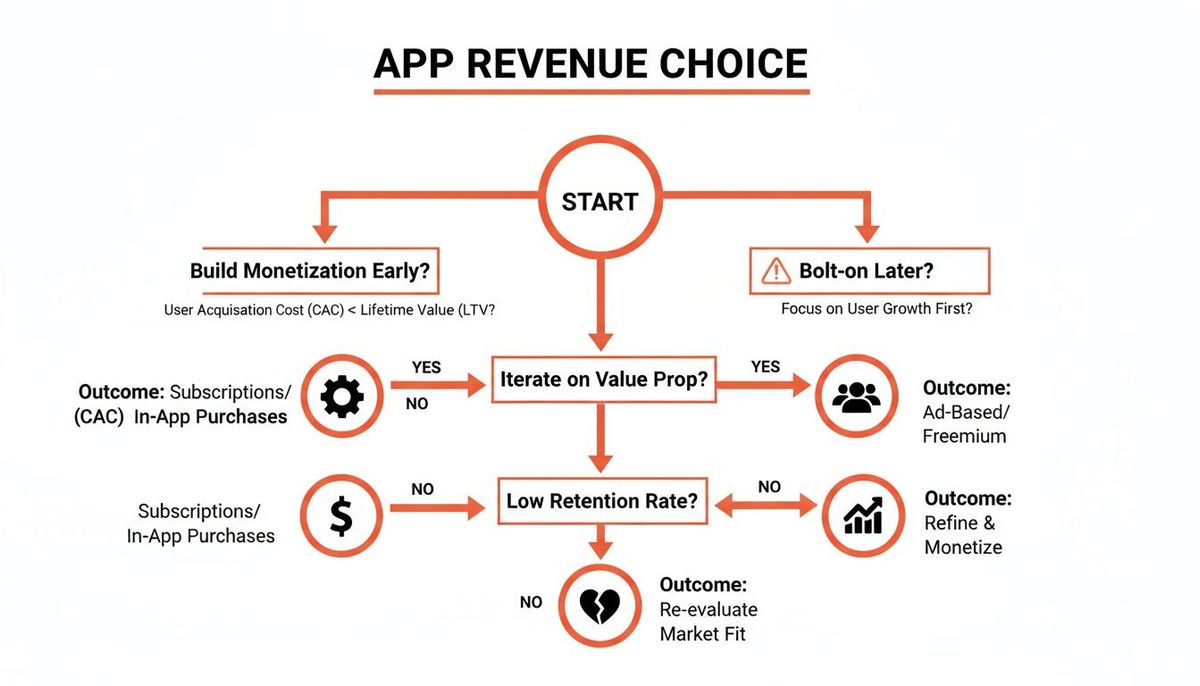
Here's the hard truth: delaying monetization isn't just a business strategy. It's a way of accumulating technical debt that you'll have to unwind later, and that process can be painful.
Subscriptions for Ongoing Value
The subscription model is king for a reason: it creates predictable, recurring revenue (MRR). It’s the perfect fit when your app delivers continuous, evolving value. Think of apps that become part of a daily or weekly routine—productivity tools, content libraries, or services that get more useful the more you use them.
Take Calm, for example. People don't subscribe for a single meditation session; they pay for constant access to a library of sleep stories and music that's always growing. The value is the ongoing utility. Same with Strava. Its subscription unlocks advanced analytics and route planning—features that serious athletes will use again and again.
- Best For: Apps with regularly updated content (fitness, media), essential services (security, productivity), or community access.
- Actionable Insight: If you choose subscriptions, your product roadmap must have a clear plan for delivering new features or content every quarter. Users need to see tangible proof their money is going toward an evolving product.
In-App Purchases for Specific Unlocks
In-app purchases (IAPs) are all about a clear, immediate exchange of value. A user gives you money for a specific, tangible benefit. This could be a "consumable" item, like extra credits in a game, or a "durable" one, like permanently removing ads or unlocking a pro feature set.
Duolingo is a master of this "freemium" approach. The core learning is free, which gets millions of people in the door. But dedicated users can buy "Gems" to refill their "Hearts" (lives) or take tests. It's brilliant because it monetizes the most engaged segment of a massive user base without alienating casual learners.
The choice between a subscription and a one-time IAP often boils down to user psychology. A subscription feels like a commitment. An IAP is an impulse buy that solves an immediate problem or grants an instant wish.
Advertising for Mass-Market Apps
The ad model works best when your main goal is capturing the largest possible audience, especially for apps where the barrier to entry needs to be zero. This is the world of simple games, news aggregators, and certain social platforms. Your revenue comes from impressions and clicks, so success is entirely dependent on having a huge, active user base.
The tricky part is balancing revenue with user experience. Get too aggressive with intrusive ads, and you'll drive people away in droves. A common—and often smart—play is to offer an IAP to remove ads, which turns your ad model into a hybrid that serves two different user types. For example, a popular weather app might show banner ads but offer a $4.99 one-time purchase to remove them forever. This captures revenue from users who hate ads while still monetizing everyone else.
To give you a clearer picture, here’s a quick breakdown of how these models stack up against each other in the real world.
App Monetization Model Comparison
| Monetization Model | Best For | Revenue Predictability | Technical Implementation | Key Metric |
|---|---|---|---|---|
| **Subscriptions** | Apps with ongoing value, updated content, or essential services. | **High** (recurring) | **Complex** | Monthly Recurring Revenue (MRR) |
| **In-App Purchases** | Unlocking specific features, content, or virtual goods (freemium). | **Low** (transactional) | **Moderate** | Average Revenue Per Paying User (ARPPU) |
| **Advertising** | High-volume utility apps, casual games, or content platforms. | **Moderate** | **Simple** | Average Revenue Per Daily Active User (ARPDAU) |
| **Commerce / Physical Goods** | Apps that are a direct sales channel for physical products (e.g., e-commerce). | **Variable** | **Complex** | Conversion Rate / Average Order Value (AOV) |
Each model has its place. The key is to match the model to the value you provide, not the other way around.
Hybrid Models: The Best of Both Worlds
Honestly, the most successful apps rarely stick to just one model. They blend different approaches to maximize lifetime value (LTV) across their entire user base. A fitness app, for instance, might have a core subscription for workout plans but also sell one-time nutrition guides as separate IAPs.
This strategy gives you flexibility. You can capture revenue from users who want the all-access pass and from those who just want to buy one specific thing. It creates multiple monetization paths, which is a powerful way to insulate your business and drive growth. For a much deeper look at these different strategies, check out our complete guide on https://vermillion.agency/insights/how-to-monetize-mobile-app/.
Designing Your Technical Stack for Scalable Revenue
Monetization isn't just a business strategy you dream up in a meeting; it's a technical system you have to build, maintain, and scale. The choices you make here are critical. They determine whether generating revenue from your app is a smooth, automated process or a constant source of bugs, fraud, and engineering nightmares.
A well-designed tech stack is the engine that actually drives your revenue model.
So many founders, in a rush to launch, opt for a quick-and-dirty, client-side setup for their in-app purchases. I get it, it seems faster for an MVP. But this approach almost always creates massive technical debt. It leaves your app wide open to fraud and gives you unreliable data, making it impossible to know who has actually paid for what.
The Core Components of a Revenue Stack
A solid revenue stack has a few key layers that work together to handle payments, manage user access, and—most importantly—provide clean, trustworthy data. Getting these components right from the start will save you countless hours of rework and protect your bottom line down the road.
Think of it like building a house. The payment gateway is your foundation, the subscription management platform is the framing, and server-side validation is the security system that keeps everything safe. You wouldn't build a house on sand, so don't build your revenue system on flimsy, client-side logic.
A modern stack usually has three critical parts:
- Payment Gateway: This is the service that actually processes credit card transactions for web-based purchases. **Stripe** is the undisputed king here, known for its killer APIs and developer-friendly docs.
- Subscription Management Platform: This is the brain of your monetization system. Tools like **RevenueCat or Qonversion** act as a middleman between your app and the app stores (Apple and Google), managing the entire subscription lifecycle.
- Server-Side Logic: This is your own backend that talks to these services, validates every purchase, and acts as the single source of truth for who gets access to what.
Why Server-Side Receipt Validation Is Non-Negotiable
When a user makes a purchase on iOS or Android, the app store gives them a digital "receipt." The single biggest mistake you can make is trusting this receipt on the client side—that is, on the user's device—to unlock premium features. This is a massive security hole.
A savvy user with a jailbroken phone can easily fake a purchase confirmation, tricking your app into granting them paid access for free. This doesn't just cost you direct revenue; it completely corrupts your user data, making it impossible to accurately analyze the behavior of your actual paying customers.
The only correct approach is server-side receipt validation. Here’s the play-by-play:
- A user taps "buy" in your app.
- Your app gets the purchase receipt from the app store.
- Instead of unlocking features right away, your app sends this receipt to your own server.
- Your server then communicates directly with Apple or Google's servers to verify that the receipt is legit and hasn't been tampered with.
- Only after getting the green light from the app store does your server update the user's account and grant them access to paid features.
This process creates an authoritative, fraud-proof record of every single transaction. It’s your system of record for who has paid, what they bought, and when their access expires.
Abstracting Complexity with Subscription Management Platforms
Look, building and maintaining all the logic for server-side validation, cross-platform subscriptions, grace periods, and renewal events is incredibly complex. The app stores are constantly changing their rules and APIs. This is exactly where a subscription management platform becomes your best friend.
A tool like RevenueCat is one of the highest-leverage decisions a startup can make. It abstracts away thousands of lines of complex, error-prone code, giving your engineers a clean API to work with. This lets them focus on your core product instead of becoming app store billing experts.
These platforms act as a go-between, providing a unified backend to manage subscriptions from both the App Store and Google Play. They handle all the messy receipt validation for you, provide clean data through webhooks and APIs, and even offer out-of-the-box dashboards for tracking key metrics like MRR and churn.
Choosing a platform like RevenueCat over building your own system from scratch is a strategic trade-off. You trade a monthly fee for a massive boost in development velocity and a huge reduction in risk. For over 99% of apps, this is the right call. The cost of building and maintaining a custom solution far, far outweighs the platform's subscription fee.
This architectural blueprint—combining a payment gateway for web, a subscription management platform for mobile, and your own server-side logic to tie it all together—creates a foundation that is both scalable and secure. It's a system that can handle promotions, refunds, and compliance without derailing your product roadmap, letting you grow your app revenue with confidence.
You’ve picked a monetization model and your tech stack is solid. Now comes the real challenge: putting a price on it.
This isn't just about picking a number that feels right. It’s about getting inside your users' heads, understanding what they truly value, and then crafting a paywall experience that makes upgrading feel like the most obvious decision they’ll make all day. This is where pricing psychology and conversion rate optimization (CRO) become your most powerful levers for revenue growth.
A great paywall doesn’t just ask for money. It sells a transformation. It makes the decision to subscribe or buy feel less like a cost and more like a smart investment.
This is a game of inches. Small, data-backed tweaks here can lead to massive jumps in your monthly recurring revenue (MRR).
Price on Value, Not on Your Costs
The single biggest mistake I see founders make is cost-plus pricing. They add up their expenses, slap on a margin, and call it a day. This completely misses the point. The price should have nothing to do with your costs and everything to do with the value your app delivers.
It's all about value-based pricing. You have to anchor your price to the outcome your customer gets.
For instance, say your B2B app saves a sales team 10 hours a month. If their blended hourly rate is $50, your app is creating $500 in value for that user every single month. Suddenly, pricing it at $49/month doesn't feel like an expense—it feels like an absolute steal. This simple reframe changes the entire conversation.
Users don't pay for features; they pay for a better version of themselves. Your pricing and paywall copy should reflect the transformation you offer, not the list of things your app can do.
To get this right, you have to know your customer inside and out. What deep, painful problem are you solving? How much is that solution worth to them? Answering that is the key to unlocking your pricing.
The Power of Smart Packaging
Showing a user a single price forces a binary choice: yes or no. But offering a few well-designed tiers—like Basic, Pro, and Business—changes the question entirely. It's no longer "Should I buy this?" but "Which one is right for me?" This is a massive psychological shift that can dramatically lift conversions.
Good tiers aren't random; they're engineered to guide decisions.
- The Decoy Effect: You can use a middle tier to make your top tier look like a fantastic deal. If "Pro" is $15/month and "Business" is $19/month but adds three killer features, a lot of people will jump for "Business" because the perceived value is so much higher for just a few extra dollars.
- Feature Gating: Build each tier for a specific user persona. "Basic" is for the casual individual. "Pro" is for the power user. "Business" is for teams. The features unlocked at each level should directly map to the core needs of that persona.
- Highlight the "Most Popular" Plan: This is a classic for a reason. By drawing a user's eye to a specific option, you reduce their decision fatigue. It’s a powerful use of social proof that nudges them toward the package that’s likely the best balance of value for them and profit for you.
A productivity app might offer a free plan for basic notes, a $9.99/month "Pro" plan for cloud sync and advanced tools, and a $14.99/month "Business" plan for team collaboration. This creates a clear upgrade path and segments your user base perfectly.
Turning Your Paywall into a Conversion Machine
Your paywall is arguably the most important screen in your entire app. Every word, every color, every layout choice can either make you money or cost you money. This is where you have to be relentless with A/B testing.
Here are a few high-impact tests you can run right now:
- Test Your Call-to-Action (CTA): "Subscribe" is boring. Try something that screams value, like "Start My Free Trial" or "Unlock All Features." Phrasing the CTA as a benefit instead of a command can give you a surprising lift.
- Experiment with Trial Length: Is 7 days better than 14? A shorter trial creates urgency, but a longer one might give users enough time to get hooked and form a habit. The only way to know what works for your app is to test it.
- Play with Price Points: Don't just assume $9.99/month is the magic number. What happens at $12/month? You might find that a slightly higher price barely impacts your conversion rate but significantly boosts your average revenue per user (ARPU) and lifetime value (LTV).
How to Change Prices Without a User Revolt
As your app gets better, you'll eventually need to raise your prices. This is a moment of truth for your relationship with your users. The golden rule is simple: grandfather your existing users.
This means your loyal, early customers keep their original price forever, or for as long as they stay subscribed. Yes, you might be leaving some money on the table in the short run. But the goodwill you generate by respecting your earliest supporters is priceless. It prevents a public backlash and builds a reputation for being fair—and that's a long-term competitive advantage.
Using Data to Fuel Your App Revenue Growth
There’s an old saying: you can't grow what you don't measure. In the world of app monetization, this isn't just a cliché—it’s the fundamental law separating apps that scale from those that stagnate and die.
Too many founders get hooked on vanity metrics like total downloads. But that number tells you almost nothing about the health of your business. It’s a measure of initial interest, not sustained value.
To really understand what’s going on, you have to dig deeper. The goal is to move from just tracking what happened to understanding why it happened. That's where the real insights are hiding.
Moving Beyond Vanity Metrics
The real story of your app's financial health is told by a handful of core, actionable key performance indicators (KPIs). These numbers expose the true relationship users have with your product.
- Monthly Recurring Revenue (MRR): For any subscription app, this is your North Star. It’s the predictable revenue you can expect every single month. Tracking MRR isn't about the final number; it's about seeing the immediate impact of new sign-ups, upgrades, downgrades, and cancellations.
- Customer Lifetime Value (LTV): This metric tells you the total revenue you can expect from a single customer before they churn. A high LTV is a sign of a sticky product—something people find indispensable.
- Churn Rate: This is the silent killer of subscription businesses. It’s the percentage of subscribers who cancel in a given period. A seemingly small 5% monthly churn might not sound scary, but it means you're losing half of your customers every year.
Your analytics setup is the central nervous system of your revenue strategy. If you have garbage data coming in, you'll get garbage insights coming out. Invest in clean, reliable tracking from day one.
Focusing on these KPIs forces you to ask much better questions. Instead of, "How do we get more downloads?" you start asking, "How do we convince more subscribers to stick around for just one more month?" That second question is infinitely more valuable for building a real business.
Setting Up Your Analytics Pipeline
To track these KPIs well, you need a dedicated analytics pipeline. The basic dashboards from the app stores are fine for a high-level glance, but they lack the granularity you need for serious growth work.
This is where product analytics tools like **Amplitude** or **Mixpanel** come in. They’re built for this exact job. They let you go way beyond simple event tracking to understand entire user journeys. You can pinpoint exactly where users drop off during onboarding, see which features your power users live in, and find out what actions correlate with a user converting from a trial to a paid plan.
Getting your pipeline set up involves a few critical steps:
- Define Your Events: Map out the user actions that actually matter. This isn't just
SignUpCompleted. It’sTrialStarted,SubscriptionPurchased, and even super-specific things likeFeatureUsed_XYZ. Get granular. - Instrument Your App: This means integrating the analytics SDK into your codebase to fire those events. Consistency across iOS and Android is non-negotiable if you want clean, unified data.
- Validate Your Data: After the code is in, you have to test. Rigorously. Make sure every event is firing correctly and the data hitting your dashboard is accurate. This part is tedious but absolutely essential. Don't skip it.
If you need a hand picking the right platform, we've broken down the pros and cons in our guide to the best analytics tools for mobile apps.
Running Structured Growth Experiments
Once you have clean data flowing in, you can finally stop guessing and start experimenting. A structured growth experiment isn’t about throwing ideas at the wall to see what sticks. It's a disciplined, scientific process for improving a specific metric.
Here’s a simple framework for running experiments to boost your app revenue.
Example Experiment: Fixing a Leaky Trial Funnel
Let's imagine your data shows a low trial-to-paid conversion rate. People are signing up for trials but very few are sticking around to pay.
- Observation: Our analytics show that only 15% of users who start a free trial actually convert to a paid subscription. But we also see that users who engage with "Feature X" during their trial convert at a whopping 40%.
- Hypothesis: We believe that by creating a new onboarding step that guides trial users to discover and use "Feature X" within their first session, we can increase the overall trial-to-paid conversion rate from 15% to 20%.
- Implementation: We'll build the new onboarding flow and use an A/B testing tool to show it to 50% of new trial users (the "variant" group). The other 50% will see the old flow (the "control" group).
- Analysis: Let the test run until you have a statistically significant result. Measure the conversion rate for both groups. If the variant group's conversion rate is significantly higher, we roll the change out to 100% of users.
This methodical process—observe, hypothesize, implement, analyze—is how you systematically tune your monetization engine. It turns revenue growth from a game of chance into a science, letting you make small, incremental gains that compound into massive results over time.
Answering Your App Revenue Questions
When you're trying to make money with your app, a few high-stakes questions always come up. Getting these wrong can stall your growth or lock you into a technical mess that’s expensive to fix. Let's get straight to the answers for the most common ones we hear from founders.
What Is the Biggest Technical Mistake With In-App Purchases?
The single most common—and costly—mistake is building your purchase logic entirely on the client-side. It feels faster when you're rushing to get an MVP out the door, but it leaves gaping security holes. Anyone with a jailbroken device can easily spoof a purchase, and you'd be none the wiser.
This approach gives you no single source of truth for who’s paid for what. It’s a data integrity nightmare waiting to happen as you scale. The right way to do this is with server-side receipt validation. When a user buys something, your app sends the receipt to your server. Your server then checks with Apple or Google to confirm it's legit before unlocking the feature. This is the only way to protect your revenue and keep your user data clean and trustworthy.
How Soon Should I Think About App Monetization?
Day one. Period. Even if you don't put up a paywall for months, your monetization strategy dictates your app's architecture, user experience, and even your database structure.
Waiting to "bolt on" monetization later is a recipe for a costly, time-consuming rewrite. It’s not just a feature; it’s a foundational part of your app’s design that impacts everything from user accounts to access levels.
Think about it: a subscription model needs logic for tiers and renewal states right from the start. A usage-based model requires a rock-solid metering system from the get-go. Figure out your strategy early so you can build the right technical foundation to support it, not fight it.
Should I Build My Own Subscription System or Use a Tool?
For 99% of startups, this isn't even a question. Use a third-party subscription management platform like RevenueCat or Qonversion.
Trying to build your own system to handle cross-platform subscriptions, receipt validation, grace periods, dunning, and analytics is a massive undertaking. The app stores constantly change their APIs, and the edge cases will drive your engineering team insane. It’s a full-time job just to keep up.
A tool like RevenueCat handles all that complexity for you, giving you a unified backend and reliable data right out of the box. This frees up your engineers to focus on your actual product—the features that users pay you for. That’s a far better use of their time and your money. Only even consider building this yourself if you have such a unique billing requirement that no existing tool can possibly handle it.
At Vermillion, we help founders navigate these critical decisions every day. We make sure your app is built on a scalable, secure foundation that’s designed to make money from the start. If you need a technical partner to help you build, protect, and scale your software without the costly mistakes, let's talk.