How to Reduce Customer Churn: Actionable Ways to Retain Customers
To slash customer churn, you first have to figure out why it's happening. It’s a two-front war: you've got involuntary churn (think payment failures) and voluntary churn (users actively choosing to leave). The game plan involves nailing payment recovery, creating a killer onboarding experience, and digging into user behavior to fix problems before people even think about canceling.
A Practical Guide to Slashing Mobile App Churn
Customer churn is the silent killer of growth. It quietly eats away at your revenue and customer lifetime value (LTV). When your churn rate is high, you're stuck constantly refilling a leaky bucket—all your hard work acquiring new users gets undermined by customers you could have kept.
For mobile and subscription apps, keeping churn low isn't just a nice-to-have. It's the bedrock of a sustainable business.

This guide isn't about theory. It’s a hands-on playbook for founders and product leaders who are ready to put real, measurable retention strategies into action. We’re moving past generic tips and giving you a roadmap based on what actually works when scaling high-retention apps.
Pinpointing the Root Causes of Churn
Before you can patch the leaks, you have to find them. Churn isn't just one problem; it splits into two very different categories, and each one demands its own unique solution.
For a deeper dive, this guide on customer churn analysis is a great starting point. Getting this distinction right is the first real step toward building a retention plan that works.
Here are the two main types of churn you'll be fighting:
- Involuntary Churn: This is when a customer drops off by accident, usually because of a payment issue. The classic culprits are expired credit cards, processor declines, or just not enough funds. It’s a technical problem that needs a technical fix.
- Voluntary Churn: This happens when a user consciously decides to hit "cancel." The reasons here are all over the map—it could be a confusing onboarding flow, pricing that feels off, a competitor's shiny new offer, or they just never figured out how to get value from your app.
A critical mistake I see all the time is businesses lumping all churn into one big pile. If you separate involuntary and voluntary churn, you can aim your resources precisely. Engineering can focus on payment recovery tech, while your product team can zero in on improving the user experience. You'll get double the impact for the same effort.
The Two Faces of Churn a Quick Diagnostic
To really learn how to reduce customer churn, you need a clear way to diagnose what's going wrong. This table breaks down the two types, their usual causes, and your first move for each.
| Churn Type | Common Causes | Your First Move |
|---|---|---|
| **Involuntary Churn (The Silent Killer)** | Expired credit cards, insufficient funds, processor declines, outdated billing info. | Implement automated dunning and smart payment recovery systems through your payment provider. |
| **Voluntary Churn (The User's Choice)** | Poor onboarding, not finding value, pricing issues, a bad user experience, competitive offers. | Analyze user behavior, improve the onboarding experience, and run exit surveys to gather feedback. |
Properly diagnosing your churn is the foundation for making smart, data-driven decisions, which is exactly where you want to be.
Stop Revenue Leaks with Smart Involuntary Churn Reduction
Some of the most painful churn doesn't come from unhappy customers. It comes from your biggest fans whose payments simply fail. This is involuntary churn, and it’s a silent revenue killer.
The good news? This is a technical problem, not a satisfaction problem. That means we can fix it with a clear, actionable system that delivers an immediate revenue bump. You don't need to reinvent your product; you just need to stop the leaks.
Plugging this hole means building a smart dunning management system. Dunning is just a fancy word for the process of collecting failed payments. Tools like Stripe Billing or RevenueCat have this baked in, but simply flipping the switch isn't enough. The real magic is in the details—the timing, the messaging, and the channels you use.
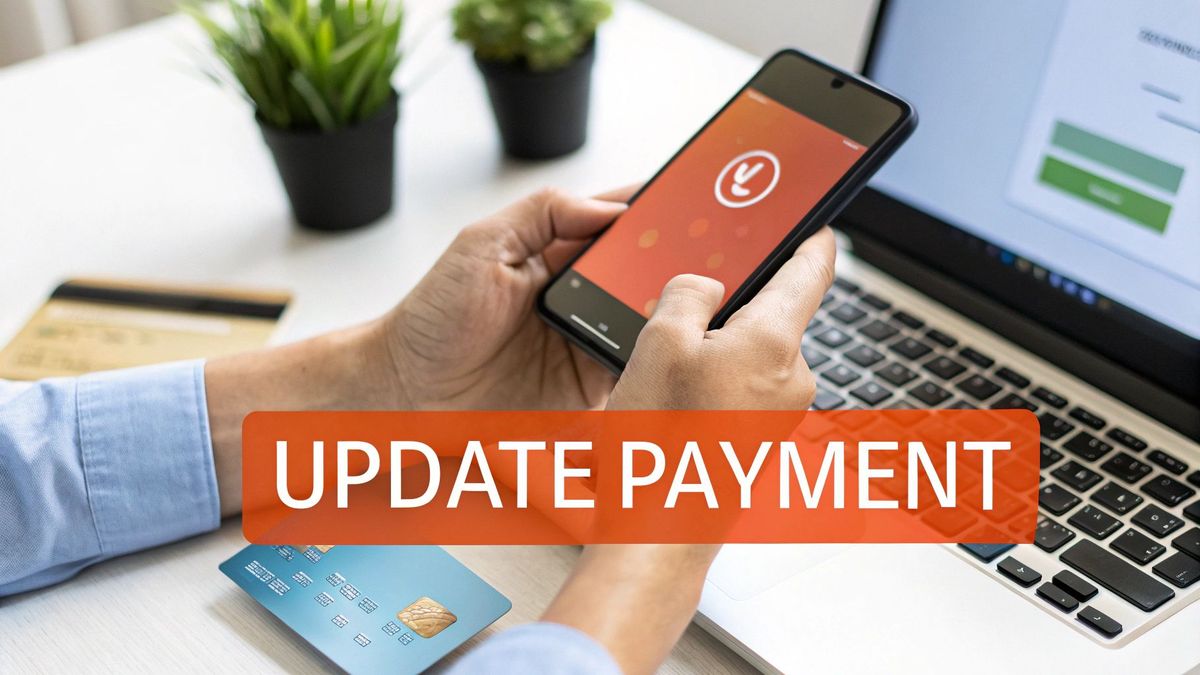
The impact of "silent" churn is staggering. A seemingly modest 5% monthly churn rate snowballs into a 46% annual loss, wiping out nearly half your user base in a year. But a solid dunning process—automated emails, in-app prompts, and even SMS—can claw back a huge chunk of that. It’s why integrating RevenueCat or Stripe dunning from day one is non-negotiable for our clients. You can dig deeper into these powerful retention statistics and see how they impact your bottom line.
Crafting a Multi-Channel Dunning Sequence
A single, lonely "payment failed" email just won't cut it anymore. People are busy. Inboxes are crowded.
You need a sequence that reaches users where they are, mixing email, in-app notifications, and even SMS. The goal is to make updating their payment info completely frictionless.
Here’s a proven communication sequence you can set up right now:
- Pre-Dunning (Before the Failure): Get ahead of the problem. Send an email 30 days before a card expires, and another reminder 7 days out. Actionable Insight: Use a subject line like "Action Required: Update your card for [Your App Name]" to create urgency without being alarming. This proactive step prevents a surprising number of failures from ever happening.
- Day of Failure (Immediate): The instant a payment fails, trigger both an email and an in-app notification. The message needs to be clear, calm, and direct. Practical Example: The email subject should be "Payment Issue for Your [App Name] Subscription," and the in-app modal should pop up immediately upon app open.
- Post-Failure Follow-Ups: Send follow-up emails on days 3, 7, and 14 after the initial failure. With each message, you can gently dial up the urgency. Example: The Day 14 email can mention, "We'll need to pause your premium access soon. Update your details to keep everything running."
A huge mistake I see all the time is using generic, robotic language in dunning emails. Your tone should be helpful, not accusatory. Frame it as "We're here to help you keep your access," not "Your payment is overdue." This small shift in tone makes a world of difference in conversion rates.
Effective Messaging Templates and Timing
Your messages must be dead simple. The user needs to understand the problem and the solution in about three seconds. Anything more complex gets ignored.
Here’s a simple template for an in-app modal that can recover a surprising number of failed payments on its own:
In-App Modal Example:
- Headline: Update Your Payment Method
- Body: It looks like there was an issue with your recent payment. To ensure uninterrupted access to your premium features, please update your billing details.
- CTA Button: Update Payment Now
- Secondary Link: Remind Me Later
This modal should pop up the very next time the user opens the app after a payment failure. It’s impossible to miss and gives them a direct path to fix the problem.
Another powerful lever is smart retries. Instead of just hammering the card randomly, platforms like Stripe use machine learning to retry the payment at the most optimal times—like right after payday or when network traffic is low. Actionable Insight: Enable this feature in your Stripe or RevenueCat dashboard. It's often a single toggle that can recover 5-10% of failed payments without you writing a single line of code.
By combining proactive pre-dunning, a clear multi-channel sequence, and intelligent retry logic, you create a safety net that catches customers who would have otherwise churned without a second thought. This isn't just about reducing churn numbers; it's about protecting the revenue you've already worked so hard to earn.
Switching to Offense: Proactive Retention and the Customer Experience
Happy customers don't churn. It’s that simple.
The single most powerful way to slash your churn rate is to stop thinking about retention reactively. Don't wait until a user hits "cancel" to try and win them back. Instead, build a proactive retention engine fueled by an incredible customer experience.
This is a fundamental shift in thinking. You're moving from saving customers at the exit door to making sure they never even think about walking toward it. The goal is to create so much value and such a seamless experience that leaving feels like a genuine downgrade.
From Reactive Support to Proactive Intervention
The old model of customer support was to wait for a complaint, then solve it. That's table stakes now. Today, you have to find the friction points and spot at-risk users before they even consider opening a support ticket.
This is where your analytics become your secret weapon.
By tracking the right engagement metrics, you can build a "customer health score" for every user. This isn't just one number; it's a collection of signals that tell a story about how invested someone is in your app.
Think about tracking things like:
- Session Frequency: Are they opening the app daily? Weekly? Or have they gone ghost for a month?
- Feature Adoption: Have they found and used the core, "sticky" features that make your app indispensable? Practical Example: For a photo editing app, this would be "using advanced filters" or "saving their first edited photo," not just opening the app.
- Time-to-Value: How fast did they get to their first "aha!" moment after signing up?
When a user's health score drops—maybe they haven't logged in for 14 days or haven't touched a key feature after a week—that's your red flag. It’s your cue to step in.
Building Automated, Proactive Interventions
Once you've identified a user who's drifting away, you can use automated interventions to gently guide them back. This isn't about sending generic "we miss you!" emails. It's about delivering targeted, genuinely helpful content at the perfect time.
Let's walk through a real-world example.
Imagine a user in your fitness tracking app hasn't logged a workout in 10 days. Instead of just letting them fade away, an automated trigger could fire off a helpful push notification.
- Trigger: User inactivity for 10 days.
- Action: Send a push notification: "Feeling stuck? Here are 3 quick 15-minute workouts you can do at home to get back on track."
This small nudge accomplishes two critical things: it shows you're paying attention and provides a direct, low-friction path back into the app. For a deeper look at this, our guide on push notification best practices has tons of actionable strategies for crafting messages that pull users back in.
The Power of Responsive Social Support
Proactive retention isn't just about what happens inside your app. It extends to how you show up everywhere, especially on public platforms like X (formerly Twitter) or Facebook.
When a user complains on social media, they’re not just talking to you—they’re broadcasting to all of their followers. Your response is, quite literally, a public performance.
Handling these moments quickly and effectively can turn a potential PR fire into a powerful demonstration of amazing customer care. And the data backs this up: customers are known to spend 20-40% more with brands that respond quickly on social media. On the flip side, companies that ignore these channels can see a 15% higher churn rate.
A total game-changer is integrating social support channels directly into your main workflow, like a dedicated Slack channel or your helpdesk software. Actionable Example: Use a tool like Zapier to automatically route any tweet mentioning your app's handle and a keyword like "problem" or "broken" into a #social-support Slack channel. It guarantees social complaints get the same urgency as a high-priority support ticket, turning would-be critics into your biggest fans.
This kind of rapid response stops frustration from building and shows potential customers you take service seriously. It transforms your support function from a reactive cost center into a proactive retention machine.
For a deeper dive into preventing customer attrition, check out this comprehensive **actionable guide to reducing churn**, which is packed with more strategies for building a customer-first experience. By mastering proactive engagement, you're not just fighting churn—you're building a brand that customers actually want to stick with for the long haul.
Winning Back Customers at the Point of Cancellation
When a user taps that "cancel subscription" button, it’s easy to feel like it's game over. But it’s not. In fact, this is one of the most critical moments you have—it’s your single best opportunity to find out why they’re leaving and your last chance to change their mind.
Don't just build a dead-end cancellation page. Transform it into an intelligent retention tool. It’s about turning what feels like an exit into a genuine conversation.
Think of it like this: your retention efforts shouldn't just be a blanket strategy. You need to know when to monitor happy users and when to step in for those who are at risk.
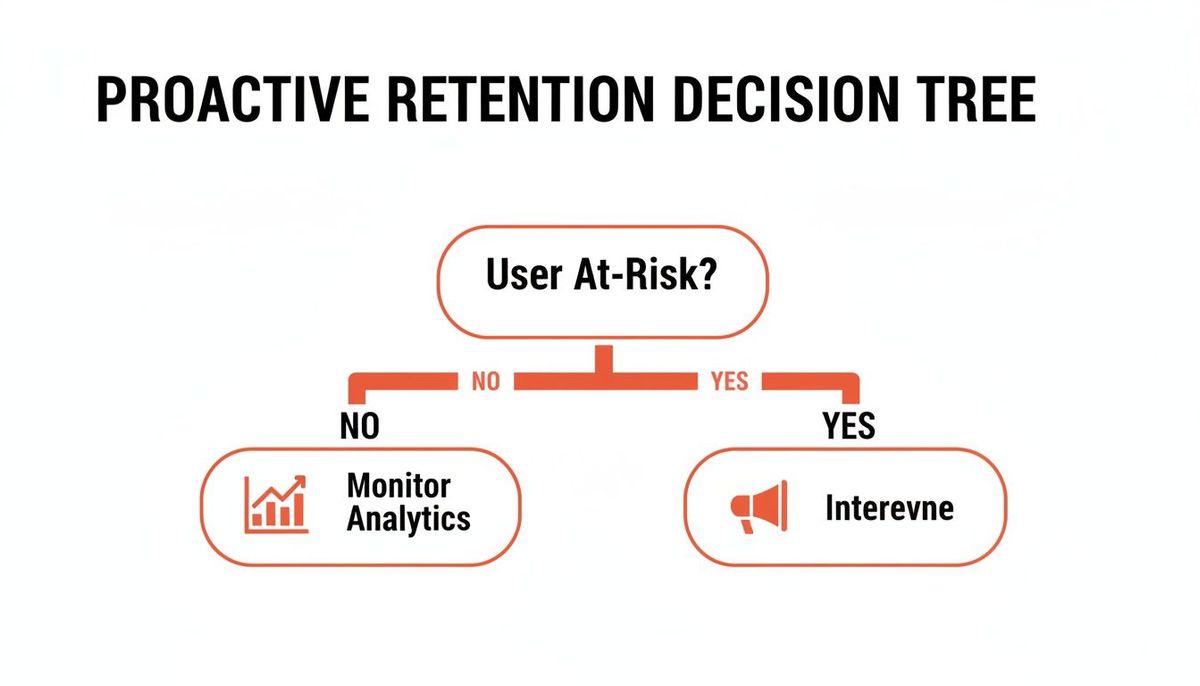
The real insight here is that you can't treat every user the same. You have to segment them based on their risk level and then apply the right tactic at precisely the right time.
The Power of the Exit Survey
The cornerstone of any smart cancellation flow is the exit survey. And I don’t mean one of those long-form surveys that just gathers dust in a report somewhere. This is a real-time diagnostic tool designed to trigger immediate, automated actions based on what the user tells you.
Keep it simple. Your survey should be a single, multiple-choice question to keep friction to a minimum. The whole point is to get an answer quickly so you can act on it instantly.
Here are a few essential questions that get straight to the root cause:
- It's too expensive. This is almost always the most common one.
- I'm missing a key feature. This is direct, actionable feedback for your product roadmap.
- I had a poor experience or a technical issue. This flags critical UX or stability problems you need to fix.
- I'm not using it enough to justify the cost. A clear sign that you haven't successfully demonstrated your app's value.
- I'm switching to a competitor. Pure gold. This is direct competitive intelligence.
The magic is that each of these answers can unlock a completely different, personalized path for that user.
Building Dynamic and Personalized Win-Back Offers
Once you know why they're leaving, you can hit them with a highly targeted offer to change their mind. This is where your cancellation flow stops being a passive form and becomes an active negotiation tool. Forget the generic "Please stay!" pop-ups—they're useless. Your offers have to solve the specific problem the user just told you they have.
A recent analysis of over three million cancellation sessions found that budget concerns are the reason behind 33% of all voluntary churn. But the same report showed that smart, personalized offers can successfully win back a huge chunk of those subscribers. Other major drivers include poor onboarding (23%), weak customer relationships (16%), and bad service (14%), which just reinforces the need for tailored solutions. You can dive deeper into these findings on the state of retention to really fine-tune your approach.
So, how does this actually work? Simple. The user’s survey response triggers a dynamic offer right there on the spot.
If they select "It's too expensive":
- The Offer: Don't beat around the bush—give them a discount. "We'd love for you to stay. How about 50% off your next three months?" This directly addresses their pain point and gives them a compelling reason to stick around.
If they select "I'm missing a key feature":
- The Offer: Show them you're listening and give them an update. "Thanks for that feedback! We're actually planning to release that feature in Q3. As a thank you, here's a $20 credit to stick with us until it's ready." This validates their feedback and makes them feel heard.
If they select "I'm not using it enough":
- The Offer: Give them a flexible option, like pausing their subscription. "We get it. Instead of canceling, why not pause your subscription for up to 3 months? You can come back whenever you're ready." This keeps them in your ecosystem without forcing them to pay while they're inactive.
A critical tip from the trenches: make accepting your offer a one-click action. If they have to re-enter their credit card or navigate through multiple screens, you've already lost them. The goal is to make saying "yes" to your offer even easier than confirming their cancellation.
By implementing an intelligent cancellation flow, you create an incredibly powerful feedback loop. You gather priceless data on why people are leaving, and you use that data to save them in real-time. This turns a point of failure into one of your most effective tools for reducing customer churn.
How to Measure Success and Build Your Retention Roadmap
You can't fix what you don't measure. After you've deployed your first round of retention experiments, the real work begins: building a rock-solid framework to track what’s working and what isn't. This is how you shift from guesswork to a data-driven system for keeping your customers happy and your business growing.
Just watching your overall churn rate isn't going to cut it. It’s a decent top-level health metric, sure, but it’s a lagging indicator. It doesn't tell you which of your initiatives are actually moving the needle or which customer segments are finally sticking around longer. To get real answers, you have to dig deeper.
Move Beyond a Simple Churn Rate
To really get a feel for the impact of your work, you need a more granular view of user behavior. This means swapping that single, simplistic churn percentage for metrics that show you trends over time and across specific user groups.
My favorite tool for this is cohort analysis. It's way simpler than it sounds. A cohort is just a group of users who signed up around the same time, like the "January 2024 Cohort" or the "March 2024 Cohort." By tracking each group's retention separately, you can see if the changes you're making are actually improving things for new users.
For instance, let's say you rolled out a brand-new onboarding flow in March. You can compare the 90-day retention of your March cohort against the February cohort. If the March group is sticking around longer, that's a powerful signal that your new onboarding is a winner. This is exactly how you prove ROI to your boss or your investors.
This method transforms your analytics from a historical report card into a forward-looking guide. You can get a better sense of which tools are best for this in our breakdown of the **best analytics tools for mobile apps**.
Connect Retention to the KPIs That Matter
Fighting churn isn't just a product team's pet project; it's a core business objective. Every single improvement you make has to tie back to the key performance indicators (KPIs) that the entire company—especially the finance team and investors—cares about.
There are two big ones you absolutely must connect your retention efforts to:
- Customer Lifetime Value (LTV): This is the total cash you expect to bring in from a single customer over their entire time with your app. Actionable Insight: If you reduce monthly churn from 5% to 4%, a user's average subscription lifetime increases from 20 months to 25 months. For a $10/month subscription, that's a direct increase in LTV from $200 to $250.
- Monthly Recurring Revenue (MRR): Better retention is the bedrock of stable MRR growth. It plugs the holes in your revenue bucket, meaning every new customer you acquire contributes to net growth instead of just replacing the ones who left last month.
When you start framing your experiments in terms of their impact on LTV and MRR, you change the conversation from "fixing a leaky bucket" to "building a more valuable, profitable business."
A/B Testing: Your Hypothesis-Killing Machine
Every great retention idea is just a hypothesis until you prove it. A/B testing is the clearest, most data-backed way to validate whether a change actually improves user behavior. It’s how you build a roadmap based on what works, not just what you think might work.
Here’s a practical A/B test template for a classic retention experiment: swapping out a boring, static onboarding flow for something more interactive.
| A/B Test Component | Details |
|---|---|
| **Hypothesis** | By replacing our static 3-screen onboarding with an interactive checklist where users complete one key action, we will increase Day 7 retention by **15%**. |
| **Primary Metric** | Day 7 User Retention (Did the user open the app on the 7th day after signup?) |
| **Secondary Metrics** | - **Time to First Key Action:** How long does it take for a new user to complete that checklist item?<br>- **Onboarding Completion Rate:** What percentage of users actually finish the new checklist?<br>- **Conversion to Paid:** Does this new flow lead to more subscriptions? |
| **Target Audience** | **100%** of new signups. |
| **Traffic Split** | - **Variant A (Control):** 50% of users get the old static onboarding.<br>- **Variant B (Test):** 50% of users get the new interactive checklist. |
| **Test Duration** | Run for **4 weeks** or until we hit **10,000** new users to ensure the results are statistically significant. |
| **Success Criteria** | Variant B must show a statistically significant lift in Day 7 retention with at least **95%** confidence. No guessing. |
This kind of structured approach kills ambiguity. It gives you a clear "win" or "lose" outcome so you can iterate on your product with genuine confidence.
Build a Continuous Feedback Loop
The secret to a lasting retention strategy isn't one big win; it's creating a continuous feedback loop. This system ensures your team is constantly learning from churn data and feeding those insights right back into the product.
Here’s a simple checklist to get this loop running at your company:
- Automate Your Churn Data: Set up your systems to automatically tag and segment users who cancel based on why they said they left (e.g., exit survey responses).
- Hold Monthly Retention Reviews: Carve out time every month for product, marketing, and engineering to sit down together. Review the cohort data, the latest A/B test results, and the qualitative feedback from those exit surveys.
- Prioritize the Next Experiment: Based on that review, identify the single biggest opportunity for improvement. What's the next A/B test you need to run? Define it.
- Update the Roadmap: Add the new experiment to a shared retention roadmap. Document the hypothesis, metrics, and timeline so everyone is on the same page.
- Share What You Learned: Whether an experiment was a huge success or a total flop, document the results and share them widely. Every test is a lesson learned.
When you follow this process, you stop seeing churn as a failure. Instead, it becomes a leading indicator of where your next big opportunity lies. You build a culture of continuous improvement focused on the single most important driver of sustainable growth: keeping the customers you worked so hard to get.
The Churn Questions Every Founder Asks
When you start digging into churn, a handful of questions always bubble up. I’ve heard them from dozens of founders and product leaders. Let’s get you some straight answers based on what we see in the trenches.
What’s a "Good" Monthly Churn Rate for a New Subscription App?
For a brand-new subscription app, a solid target for monthly churn is between 3-5%.
But that number isn't gospel. Context is everything. Consumer apps (B2C) will almost always have higher churn, sometimes floating in the 5-7% range, and that’s perfectly normal. On the other hand, B2B SaaS products should be aiming for something under 2%.
Honestly, the most important benchmark is your own trend line. Your first real goal is just to get churn under 10%. After that, it's all about pushing that line down, month after month, as you ship retention features. Progress is the only metric that matters early on.
How Soon Should We Start Focusing on Churn Reduction?
Yesterday.
It’s tempting for early-stage startups to be completely obsessed with acquisition, but retention is what builds a real business. Don't wait until you have a "churn problem." By then, you're already behind.
Think of it this way: building the mechanics to prevent churn from day one is far easier than trying to patch a leaky bucket later.
This means foundational retention features need to be in your Minimum Viable Product (MVP). At a minimum, that includes:
- Basic Analytics: You need to know what your very first users are doing.
- A Smooth Onboarding Flow: Guide people to their "aha!" moment fast.
- Simple Dunning: Have a basic system in place to handle failed payments. It happens more than you think.
What's the Single Most Impactful Strategy to Reduce Voluntary Churn?
If I had to pick one thing, it's this: nail your user onboarding experience.
While every app is different, a shocking amount of churn happens in the first few days. Why? Because users never experience the core value of your product. They don't get that "aha!" moment where it all clicks.
If a user doesn't quickly understand how your app makes their life better, they're gone. A focused, guided onboarding that helps them accomplish one key task in their first session is paramount. This one action dramatically increases the odds they’ll stick around long enough to get hooked.
For a project management app, don't just show off features. Guide the user to create their first project and add their first task. That small win creates immediate momentum and proves your app’s value right out of the gate.
At Vermillion, we build revenue-ready mobile apps with retention baked in from day one. If you need a product development partner that ties our success to your KPIs, let's talk about building an app that customers love and stick with. Learn more at https://vermillion.agency.