A Founder's Guide to Agile in Design for Faster Shipping

Agile in design isn't some rigid framework or complicated process. At its core, it's a simple idea: design and development should happen in quick, iterative cycles, constantly fueled by real user feedback.
Instead of spending months perfecting a flawless blueprint upfront, your team builds, tests, and refines small pieces of the product over and over again. This ensures you're building what users actually need, not just what you planned for six months ago.
Why Agile in Design Matters for Founders
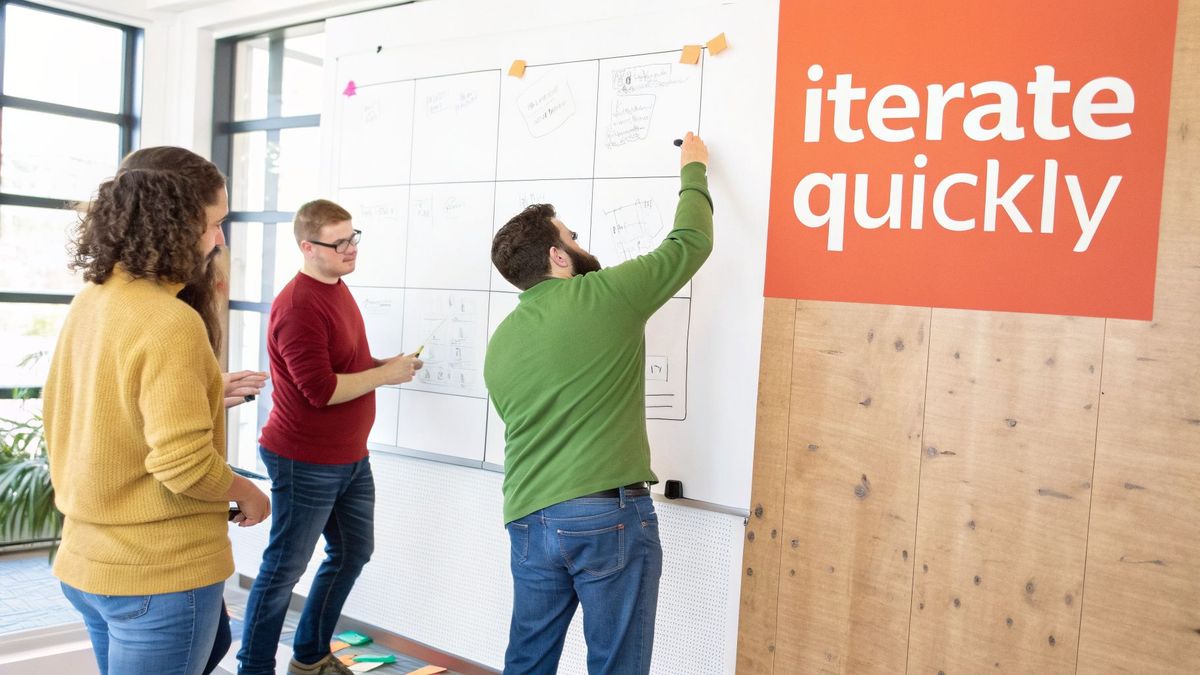
Imagine this all-too-common scenario: you spend six months and a huge chunk of your runway building an app based on a fixed plan. You launch, only to discover a critical assumption about your users was dead wrong. Engagement flatlines. This is the classic, costly risk of the traditional "waterfall" approach.
Agile flips this model on its head. Think of it like tuning a race car lap after lap instead of building a perfect-looking show car locked away in a garage. Every single lap—or sprint—gives you data to make the next one faster and more efficient.
To make this crystal clear, let's break down the fundamental differences between the old way and the modern agile approach.
Waterfall Design vs Agile in Design At a Glance
The table below highlights the practical differences for a startup founder. It's not just about process; it's about survival.
| Aspect | Waterfall Design (The Old Way) | Agile in Design (The Modern Way) |
|---|---|---|
| **Planning** | Everything is planned upfront in a massive document. | High-level goals are set, but details emerge over time. |
| **User Feedback** | Gathered at the very end, after the entire product is built. | Collected continuously in short, rapid cycles. |
| **Risk** | Extremely high. A wrong assumption isn't found until launch. | Low. Small bets are tested constantly, minimizing waste. |
| **Flexibility** | Very rigid. Changes are difficult, expensive, and disruptive. | Highly adaptive. Pivoting is built into the process. |
| **Time to Value** | Long. Nothing ships until everything is "finished." | Short. Functional pieces of the product are shipped early and often. |
Seeing them side-by-side, it's obvious why one approach is a relic and the other is a modern startup's superpower. The waterfall method is a gamble; agile is a strategy.
Reduce Wasted Effort and Ship Faster
For a founder, the biggest win here is speed to value. By breaking massive projects into small, digestible chunks, you get functional pieces of your product into users' hands way faster. This isn't just about moving quickly; it's about learning quickly.
- Validate Ideas Quickly: Test a core feature with real users in weeks, not months. For example, instead of building a full-featured social media integration, ship a simple "Share to Twitter" button. See if anyone even uses it before you invest more.
- Prevent Costly Redesigns: Catch a design flaw early before it's baked into your codebase and becomes a nightmare to fix. You might discover from user testing that nobody understands an icon you've used. Changing it in a Figma file takes minutes; changing it after it’s been coded across 10 screens can take days.
- Focus on Impact: Prioritize the features that directly solve user pain points and drive your key business metrics. If user data shows customers are dropping off at checkout, an agile team can immediately prioritize fixing that flow in the next two-week sprint instead of working on a less critical new feature.
This cycle creates a powerful feedback loop. You stop relying on assumptions and start using real-world data to steer your product roadmap. Every development cycle adds real, tangible value.
"Agile isn’t just a process; it's a risk mitigation strategy. It answers the most dangerous question for a startup—'Are we building something people actually want?'—long before you’ve run out of cash."
Adapt to a Changing Market
For any startup, the ability to pivot is a superpower. An agile approach hardwires this adaptability directly into your workflow. It's no surprise that projects using Agile methodologies have a 75% success rate, a massive leap from the 56% rate of traditional waterfall methods.
For founders, this is life or death. Research shows 64% of organizations using agile report they can handle changing priorities better—a key factor in building a product that can scale without expensive, time-consuming rewrites. You can read the full research about these agile statistics to see the data for yourself.
This flexibility means you can react to new competitors, shifting user expectations, or a sudden market opportunity without throwing your entire product plan into chaos. It's about building a resilient product and a resilient company, one informed iteration at a time.
The Core Principles of High-Performing Agile Design Teams
Getting started with agile design isn’t about memorizing a bunch of new jargon. It’s about truly internalizing a few powerful ideas that completely reshape how your team builds products. These aren’t abstract theories; think of them as actionable rules for high-performing startups, turning fuzzy concepts into daily habits that drive both speed and focus.
The first and most critical shift is to stop treating your roadmap as a rigid contract and start seeing it as a series of testable hypotheses.
A traditional roadmap says, "We will build Feature X in Q3." An agile roadmap asks, "We hypothesize that building Feature X will increase user retention. How can we test this assumption as quickly and cheaply as possible?" This one change in mindset changes everything. It forces your team to think in small, verifiable steps rather than betting the entire quarter on one big idea.
Respond to Change Over Following a Plan
This principle is the absolute lifeblood of agile design. It’s about prioritizing learning and adaptation over blindly sticking to an outdated plan. A static plan is just a snapshot in time; an agile approach is like a continuous live stream of insights.
Practical Example: A fintech startup we worked with was tackling their checkout flow. Instead of mapping out a massive, six-month redesign project, they implemented small changes every single week. One week they tested a simplified payment button. The next, a progress bar. Each tweak was a mini-experiment, giving them immediate data on its impact. This incremental process led to a 15% boost in conversions without the massive risk of a single, catastrophic redesign.
An agile team’s greatest strength is its ability to be wrong early and cheaply. The goal isn't to perfectly predict the future but to build a system that can rapidly adapt to it.
Value Collaboration Between Designers and Engineers
In a traditional workflow, design hands off a polished file to engineering, and a wall goes up between them. In agile, designers and engineers are partners from day one. This tight-knit collaboration isn't just nice to have; it's essential for both speed and quality.
To make this happen, high-performing teams bake certain practices into their routine:
- Joint Sketching Sessions: Designers and engineers grab a whiteboard and brainstorm solutions together. This is where you catch technical constraints before a single pixel ever gets pushed. Actionable Insight: Before designing a new dashboard, have your designer and lead engineer spend 30 minutes sketching layouts together. The engineer might point out that a certain chart type would be very slow to load, saving weeks of wasted design and development effort.
- Paired Design/Dev: A designer and an engineer sit side-by-side to implement a small UI component. This ensures the final result matches the design intent perfectly, avoiding that frustrating back-and-forth.
- Shared Ownership: Both disciplines are jointly responsible for the user experience and the feature’s success metrics. This completely kills the "us vs. them" mentality.
This deep collaboration collapses feedback loops from weeks into minutes. For more guidance on structuring these interactions, exploring proven methods for effective app development project management can provide a solid framework. By building these principles into your team's culture, you create an environment where rapid learning and high-quality execution just become the default way of working.
Essential Agile Design Workflows and Frameworks
Okay, let's move past the theory. Principles are great, but they don't ship features. To make agile in design actually work, you need specific, battle-tested workflows.
These aren't just buzzwords; they're the engines that turn good intentions into a repeatable process for shipping high-impact work. Faster.
Dual-Track Agile: The Two-Engine System
At the heart of most successful agile design teams is Dual-Track Agile. The easiest way to think about it is running two engines at the same time, each with a different job.
- The Discovery Track: This is where designers, product managers, and maybe a lead engineer live. Their job is to look ahead, explore future user problems, and quickly test potential solutions. Actionable Insight: The discovery team for a project management tool might spend a week interviewing users about reporting needs. They could build a simple, non-functional prototype in Figma to test three different report layouts. They're figuring out what to build next.
- The Delivery Track: This engine takes the validated, de-risked ideas from the Discovery track and gets to work. Their focus is on building, testing, and shipping high-quality, production-ready code. They’re focused on building it right.
This system is brilliant because it prevents the most common agile failure: the engineering team running out of well-defined, validated work to do. You’re always learning what’s next while consistently shipping value today.
The Power of Design Sprints
A Design Sprint is a hyper-focused, five-day process for answering a huge business question. It forces you to shortcut the endless debate cycle and get to a tangible prototype tested by real users.
Imagine you want to launch a completely new onboarding flow—a major undertaking. Instead of spending an entire quarter building it only to find out it doesn't work, you run a one-week sprint. By Friday, you'll have a realistic prototype in front of five real users, giving you crystal-clear data on whether you’re on the right track or need to pivot. Hard.
When to Use This: Pull this tool out for the big, scary challenges. It's perfect for kicking off a new product, totally redesigning a core user journey, or tackling a risky feature that could make or break a quarterly goal.
Building Consistency with Design Systems
As your app grows, so does the mess. Different designers and developers working on different things inevitably leads to a fragmented, inconsistent user experience. This is a classic form of design debt.
Your best defense is a living Design System. It's a central library of reusable UI components, patterns, and clear guidelines. Instead of reinventing a button, a modal, or a date picker every single time, the team just pulls the approved, pre-coded version from the library.
This diagram shows how the core agile principles—collaboration, iteration, and feedback—are the fuel for all these workflows.
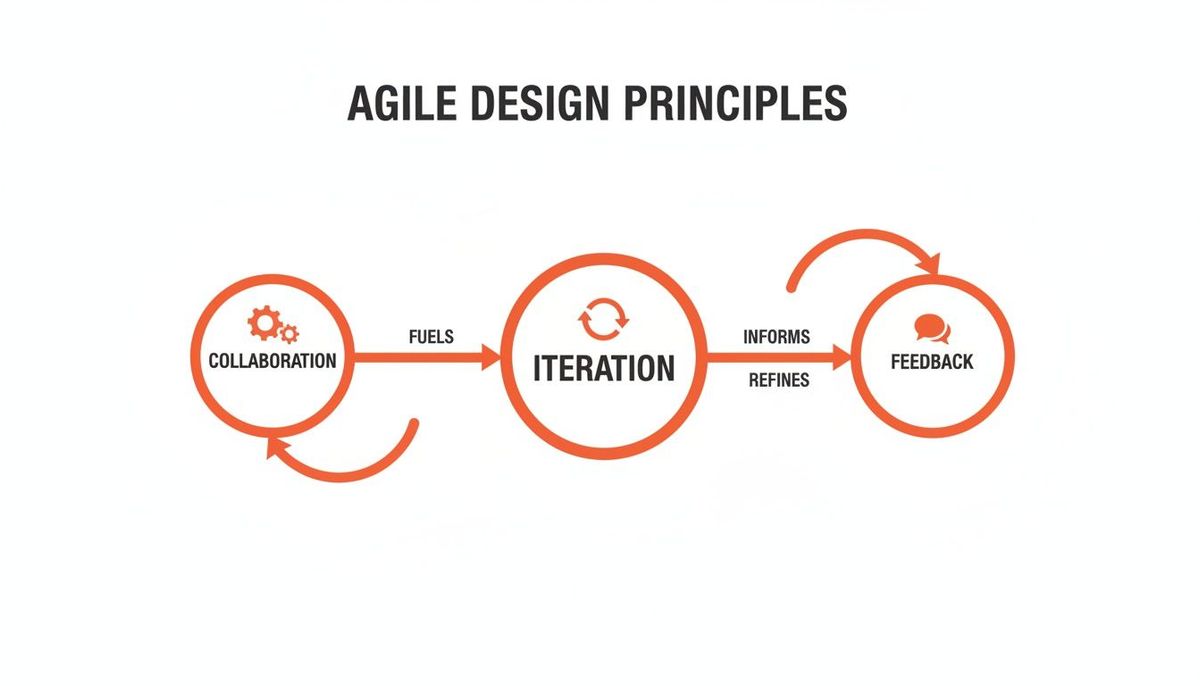
You can see that none of these frameworks succeed without constantly cycling through these three pillars. It’s what keeps the team aligned and anchored to the user.
When to Use This: Start building one the moment you catch yourself designing the same component for the third time. Even a simple component library in Figma is a massive win for an early-stage startup.
A Design System isn’t just a fancy style guide. It’s a shared language between design and engineering that dramatically speeds up development and protects your brand as you scale.
Of course, putting these workflows into practice is much easier when you understand the broader agile methodology best practices. By 2026, trends show engineering teams will make up 48% of Agile adopters, a massive 16% jump since 2022, and they're often the ones driving innovation. Frameworks like Scrum, which is used by a staggering 87% of teams, and Kanban (56%) provide the backbone that makes workflows like Dual-Track Agile possible.
A Step-by-Step Guide to Implementing Agile in Your Design Process
Jumping into an agile design workflow doesn't mean you need to drown in corporate red tape. For a lean startup, it's about making a series of smart, small changes that build on each other. Think of this as your practical playbook for getting started.
Step 1: Secure Founder and Engineer Buy-In
Before you touch a single process, you need your team on board. The secret is to frame the change as a move away from big, risky launches toward smaller, faster wins. You're not selling "agile"; you're selling results.
- For Founders: Talk their language—risk reduction. Explain that small, rapid cycles mean you stop building the wrong thing sooner, which saves a ton of time and money. Actionable Insight: Use this line: "Instead of one $100k bet, let's make ten $10k bets. We'll find the winner faster and waste less cash."
- For Engineers: Frame it as a way to eliminate wasted work. When design and development collaborate continuously, there's less rework and fewer soul-crushing "surprise" changes right before a deadline. Actionable Insight: Promise them this: "No more 100-page design docs dropped on you a week before coding starts. You'll be in the conversation from day one."
Focus on the goals everyone shares—speed, quality, and not betting the farm on one big idea—and you’ll get enthusiasm instead of eye-rolls.
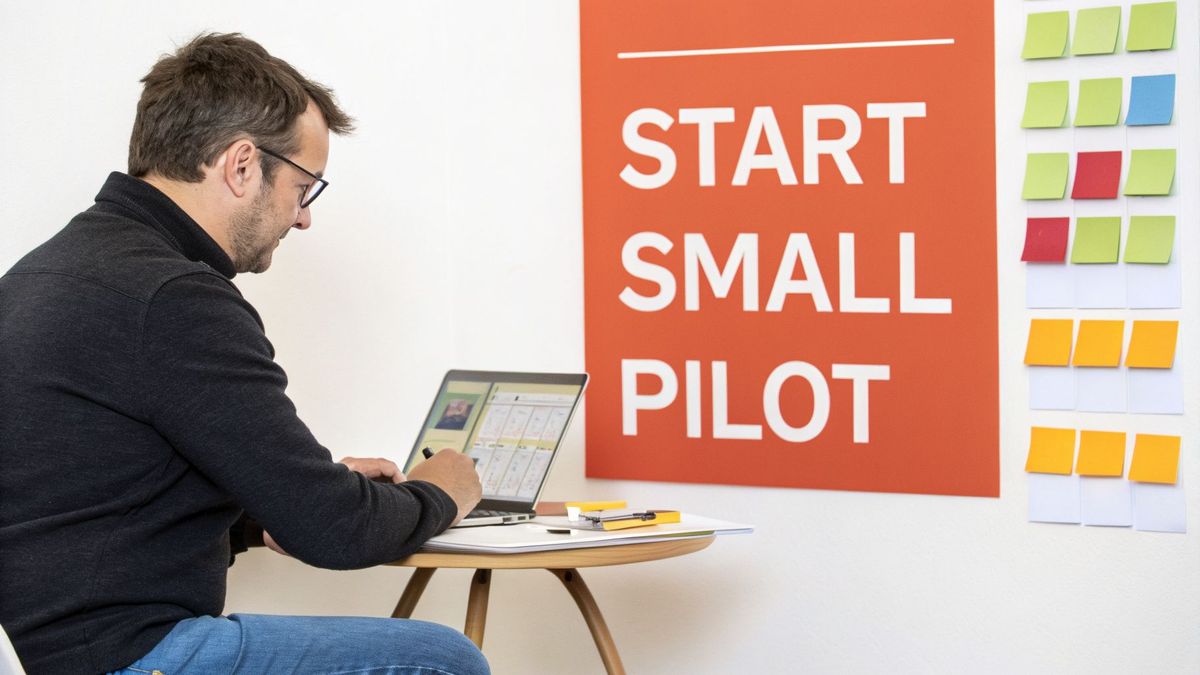
Step 2: Start Small with a Pilot Project
Don't try to overhaul your entire company overnight. That's a recipe for chaos. Instead, pick one specific, well-defined project to test the waters. This gives your team a safe space to learn and builds confidence.
A perfect candidate for a pilot is often redesigning user onboarding. It's a self-contained flow with obvious success metrics, like your activation rate. A clear win here is undeniable proof that the new process works.
The goal of your first pilot isn't perfection; it's momentum. A small, visible win is the most powerful tool for driving wider adoption of any new process.
Step 3: Choose a Basic Toolkit
You don't need a bloated, enterprise software suite. Just start with the essentials to get your workflow moving.
- Task Management: A tool like Jira or Linear is perfect for creating, assigning, and tracking user stories as they move from discovery to delivery.
- Design & Prototyping: Figma is the obvious choice here. It’s built for collaborative design, creating interactive prototypes, and starting a basic component library.
That simple stack is more than enough to get your agile design engine running. Don't overcomplicate it.
Step 4: Establish Essential Rituals
Agile thrives on a predictable rhythm. These aren't just meetings for the sake of meetings; they're critical checkpoints that keep everyone aligned and the work flowing.
- Daily Stand-ups: Keep it quick. 15 minutes max. Each person shares what they did yesterday, what they'll do today, and anything blocking them. Actionable Insight: If an engineer says, "I'm blocked waiting for an icon from design," the designer is right there to say, "I'll get that to you in the next hour." Problem solved instantly, not in a day.
- Weekly Design Reviews: This is a dedicated time for designers to show work-in-progress to the wider team, including engineers and product leads. This is where you get that crucial early feedback before you’ve gone too far down the wrong path.
Step 5: Create a Sustainable Feedback Loop
Ultimately, none of this matters if you aren't talking to real users. For bootstrapped founders, this is where agile really delivers. Research shows small businesses find Agile 52% more effective than enterprises, largely because of this direct customer connection.
Once you get it running, the results speak for themselves. 47% of companies report huge boosts in communication between tech and business teams, and 42% see significantly improved product quality. These aren't accidents; they're the direct result of a tight feedback loop.
If you want to dig deeper into market trends, this report offers more insights on the Agile methodology market. For a more detailed look at the specifics, you can also explore our comprehensive guide to agile design processes.
How to Measure the Success of Your Agile Design Strategy
In a startup, if you can't measure it, it might as well not exist. An agile design strategy is only worth the whiteboard it’s drawn on if it actually moves the needle on the business metrics investors and founders lose sleep over.
This means we have to connect our team’s day-to-day work directly to tangible outcomes, moving way past vanity metrics.
While agility is all about speed and adaptation, success isn't just about shipping faster. It's about shipping the right things faster and seeing a measurable kick in the numbers. To get this right, we need to track two kinds of metrics: the ones that measure how well our engine is running, and the ones that measure business results.
Tracking Key Process Metrics
Process metrics are like the gauges on your dashboard. They tell you how healthy and efficient your agile design machine is, giving you a heads-up on bottlenecks before they start wrecking your bottom line.
A couple of crucial ones to watch are:
- Time to Value: This is the big one. It measures the clock from the moment an idea is born to the second it’s live and delivering actual value to users. A shorter time to value means you're learning and outmaneuvering competitors faster.
- User Story Cycle Time: Think of this as the time it takes for one specific task—a user story—to get from the "to-do" list to "done." When this number is consistently low, it's a sign you have a smooth, predictable flow.
These numbers tell you if your engine is running smoothly enough to get you to your destination. Of course, turning this data into real improvements is where the magic happens. A deep dive into the principles of data-driven design can help turn that raw data into a real strategy.
Connecting Agile Design to Core Business KPIs
At the end of the day, a smooth process only matters if it drives the core Key Performance Indicators (KPIs) that define your startup’s survival. The real genius of agile in design is its power to directly influence the numbers that dictate your company's success. Your mission is to draw a straight, undeniable line from design activities to business growth.
Practical Example: A SaaS startup we know was struggling with its trial-to-paid conversion rate. The old way would have been a massive, six-month overhaul of the entire pricing page. Instead, their agile team ran a series of two-week design sprints.
One sprint focused on clarifying the feature comparison table. Another tested a new CTA button. Each tiny change was a rapid, data-backed experiment. After just one quarter, these small iterations stacked up to a 10% increase in conversions.
That’s the kind of connection you need to make. Agile design isn't just about process for process's sake; it's a direct input into your company's growth engine.
To show how this works in practice, here's a quick look at how specific agile activities map directly to the KPIs that matter most.
Connecting Agile Design Activities to Business KPIs
| Agile Design Activity | Process Metric | Business KPI Impact |
|---|---|---|
| **Weekly User Interviews** | # of Insights Generated | **+** User Retention |
| **A/B Testing CTAs** | Test Velocity | **+** Conversion Rate |
| **Rapid Prototyping** | Time to User Feedback | **-** Development Rework Cost |
| **Design Sprints** | Time to Value | **+** LTV / **+** MRR |
This table isn't just theory—it’s a framework for accountability. It forces a conversation about why you're doing what you're doing and ties every design decision back to a tangible business result. It’s how you prove that good design isn't a cost center; it's a growth driver.
For a deeper look at this, check out our guide on using data-driven insights to fuel product growth.
Got Questions About Agile Design?
Moving to an agile design process always sparks a few good questions. Founders, especially, want to be sure they’re signing up for structured speed, not creative chaos. Let’s cut through the noise and tackle the most common myths head-on.
Each answer here is straight to the point, practical, and reinforces the main goal: using agile to build better products, faster.
"Does Agile Just Mean No Planning and Constant Changes?"
This is the biggest myth about agile in design, and it’s just not true. Agile isn't chaos; it's a system of structured, rapid learning. Instead of one massive, rigid plan you create upfront and hope is right, you work in short, focused planning cycles. We call them sprints, and they usually last one or two weeks.
Actionable Insight: The plan for a two-week sprint is highly detailed and respected. For instance, the team commits to delivering three specific user stories, like "User can reset password." The long-term plan, however, remains flexible. If user feedback shows password resets aren't the main issue, the next sprint can pivot to focus on a more pressing problem without derailing the team. Every change isn't a random whim—it's a deliberate adjustment based on fresh data.
"How Do You Manage Scope Creep in an Agile Process?"
Scope creep gets tamed by two powerful tools: a prioritized backlog and time-boxed sprints. For a startup, the founder typically steps into the Product Owner role, which means you own the backlog—a living list of every feature, idea, and fix.
Think of the backlog as a dynamic to-do list where every new idea has to earn its spot. The Product Owner is constantly ranking it based on customer value and business impact, making sure the team is always working on what matters most.
The team commits to delivering a specific chunk of work from the top of that list within a fixed sprint. New ideas don't just jump the line; they go into the backlog to be prioritized for a future sprint. This creates a buffer that lets the team focus while still giving you the flexibility to adapt.
"Can Agile Work for a Major Redesign Project?"
Absolutely. In fact, it’s a much safer way to handle a big redesign. Instead of a high-stakes, "big bang" launch where one bad assumption can sink the whole project, you break it down into smaller, manageable releases.
For example, a mobile app redesign could be rolled out in pieces:
- Release 1: Ship the new navigation and tab bar.
- Release 2: Introduce the redesigned user dashboard.
- Release 3: Update the settings and profile screens.
This phased approach lets you get real user feedback at each stage. You get to validate your most critical design decisions with actual data, de-risking the entire project and avoiding a single, make-or-break launch day.
"What Is the Founder's Role in an Agile Design Team?"
The founder's role is absolutely critical. You are the ultimate Product Owner—the keeper of the vision. Your job is to set the strategic goals and constantly communicate the "why" behind the work. This empowers the design and engineering teams to figure out the "how."
Actionable Insight: At the start of each two-week sprint, your job is to articulate a clear goal like, "This sprint, we are focused on reducing user friction in the signup process." You don't dictate the exact button color or field layout. Instead, you provide the direction and the metric for success (e.g., a 5% increase in signup completions), then empower your team to find the best design solution to hit that goal.
At Vermillion, we help founders put these agile processes into practice to build, protect, and scale software without the costly missteps that sink startups. If you need a technical growth partner who brings senior judgment and high-output execution, learn how Vermillion can help you ship faster and with confidence.