What is monthly recurring revenue: A Complete Beginner's Guide

Monthly Recurring Revenue (MRR) is the lifeblood of any subscription business. It’s the predictable, normalized measure of your monthly revenue—the financial pulse you can count on.
Think of MRR as your company's baseline salary. It’s the reliable income hitting your account every month from active subscriptions. This is completely different from one-time payments like setup fees, consulting projects, or special deals. Those are more like project bonuses—great to get, but you can't build your financial future around them.
For founders and product leaders, MRR is more than just a number on a spreadsheet. It’s proof that you’ve built something people find valuable enough to pay for again and again. It gives you, your team, and your investors the confidence to make smart bets on hiring, marketing spend, and new features.
That predictability is everything.
What Counts Toward MRR (And What Doesn't)
To get a clean MRR number, you have to be disciplined about what you include. The golden rule is simple: if it's not a recurring charge, it doesn't count.
This isn’t just about being a stickler for accounting rules. A clean MRR calculation gives you a true, standardized picture of your company’s health and momentum. It also sets the stage for other critical metrics, like calculating your customer lifetime value.
MRR At a Glance: What Counts vs. What Does Not
Use this quick reference to understand which revenue streams contribute to your MRR calculation and which common payments should be excluded.
| Included in MRR | Excluded from MRR |
|---|---|
| All recurring monthly subscription fees | One-time setup or implementation fees |
| Recurring charges for add-ons, features, or extra seats | One-off purchases (e.g., credit packs, consulting hours) |
| Upgrades to higher-tier plans | Credit card processing fees and transaction costs |
| The net amount after a recurring discount is applied | Paused or delinquent subscriptions (until they become active again) |
| Any other charge that automatically repeats monthly | Any revenue that isn't guaranteed for the next month |
Getting this right is non-negotiable for understanding the real health of your subscription model.
Mastering this metric is more critical than ever. The subscription economy has exploded, growing by over 435% in the last decade. It’s on track to become a $1.5 trillion market by 2025, which shows just how much value is being placed on predictable, recurring revenue streams.
Calculating The Different Types of MRR
Your total Monthly Recurring Revenue is more than just a single number on a dashboard; it’s the heartbeat of your business, telling a dynamic story about its health.
At its simplest, the calculation is a back-of-the-napkin affair: multiply your total number of active subscribers by their average monthly payment. So, if you have 1,000 subscribers each paying an average of $10 a month, your MRR is $10,000. Easy.
But that top-level number is a bit like looking at the final score of a game without watching any of the plays. It tells you who won, but it doesn't tell you how. A healthy subscription business doesn't just track the total; it dissects the movements within that number to understand what’s really going on.
This is where breaking down MRR into its different types becomes your most powerful diagnostic tool. It’s the difference between knowing your revenue went up and knowing why it went up.
The whole point of tracking MRR is to separate the predictable, recurring income from one-off payments. This is the bedrock of a sustainable subscription model.
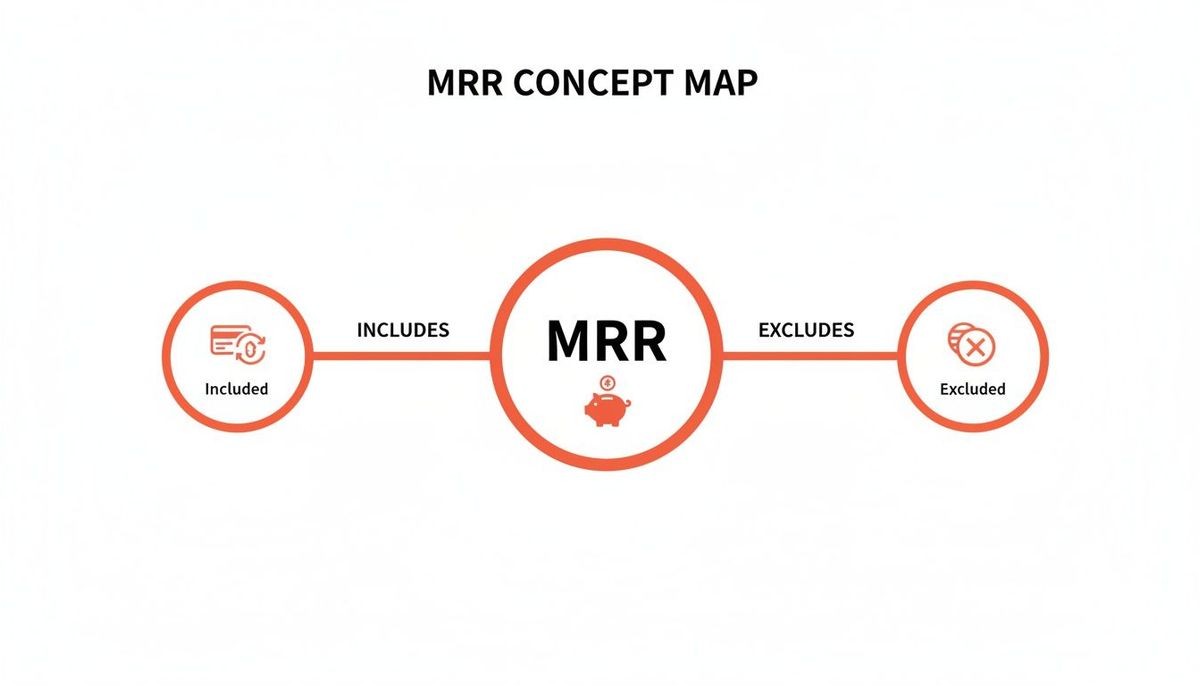
This distinction ensures you’re measuring the repeatable, core engine of your business, not just temporary revenue spikes.
The Core Components of MRR
To really get a grip on what's driving your growth (or decline), you need to track four key MRR movements. Each one answers a very specific question about your customers.
Let's use a fictional fitness app with a $10/month "Pro" plan to see how this works in the real world.
- New MRR: This is the lifeblood of growth—the additional monthly revenue from brand-new customers. If 50 new users sign up for your Pro plan this month, your New MRR is $500 (50 users × $10). It's a direct measure of how well your acquisition efforts are working.
- Actionable Insight: If your New MRR is flat, it's a signal to re-evaluate your top-of-funnel marketing. Are your ads converting? Is your App Store Optimization (ASO) effective? This number tells you if you need to fix acquisition.
- Expansion MRR: Also called upgrade MRR, this is where the magic really happens. It’s the extra revenue you get from existing customers who upgrade or buy recurring add-ons. Say 20 current users on a free plan upgrade to the Pro plan. That’s $200 in Expansion MRR. This is one of the strongest signals you have that your customers are happy and see real value in what you offer.
- Actionable Insight: To boost this, identify power users on lower tiers and target them with in-app messages highlighting the specific features they'd benefit from in a higher plan.
Your ability to generate Expansion MRR is a direct reflection of your product’s value. When customers willingly pay more over time, it’s the ultimate validation that you're solving a real problem for them.
- Contraction MRR: This is the revenue you lose when existing customers downgrade to a cheaper plan. If 10 Pro users switch to a $5/month "Lite" plan, you've lost $5 from each of them. That's -$50 in Contraction MRR. This can be an early warning sign of issues with pricing, features, or the perceived value of your higher-tier plans.
- Actionable Insight: When a user downgrades, trigger an automated survey asking why. Did the price increase? Is a key feature not working as expected? This feedback is gold for preventing future downgrades.
- Churned MRR: This is the gut punch—the total revenue lost when customers cancel their subscriptions entirely. If 15 users cancel their $10 Pro plan, your Churned MRR is -$150. This is the most critical metric for measuring retention and shines a spotlight on potential gaps in your product or service.
- Actionable Insight: Analyze the behavior of users who churned in the 30 days before they canceled. Did their usage drop? Did they stop using a key feature? Identifying these patterns helps you build a predictive model to intervene before other at-risk users cancel.
Tracking the Metrics That Give MRR Context
Seeing a big, fat MRR number on your dashboard feels great. But on its own, it doesn't tell you much about the health of your business. It's like knowing a car's top speed without any clue about its fuel efficiency, maintenance costs, or how much it cost to build in the first place.
To really understand if your growth is sustainable—or just a flash in the pan—you need to look at the metrics that orbit your MRR. These are the numbers that add the crucial context. They tell the "how" and "why" behind your revenue, painting a complete picture of your app's financial health. This is what savvy founders and investors really care about, because these numbers signal long-term viability.

Customer Lifetime Value (LTV) and Acquisition Cost (CAC)
Let's start with the classic duo. Think of them as the fundamental equation for profitability.
Customer Lifetime Value (LTV) is your best guess at the total amount of money you'll make from a single customer over their entire time using your app. It answers a simple but vital question: "How much is one customer actually worth to us?"
Customer Acquisition Cost (CAC) is the flip side. It tells you exactly how much you spend, on average, to get that new customer. This includes every dollar spent on marketing, sales, ads—you name it.
The magic happens when you put them together. The LTV:CAC ratio is the ultimate stress test for your business model. A healthy ratio is widely considered to be 3:1 or higher. This means for every dollar you spend acquiring a customer, you get at least three dollars back over their lifetime.
- Practical Example: If your CAC is $50 (from ad spend and marketing) and your average customer pays $15/month for 12 months, your LTV is $180. The LTV:CAC ratio is $180:$50, or 3.6:1. This is a healthy, profitable acquisition channel. If your ratio is 1:1, you're essentially lighting money on fire with every new sign-up.
MRR Churn Rate
MRR Churn Rate is the percentage of your revenue that vanishes each month because customers cancel or downgrade their plans. It’s the financial sting of customer attrition.
A high churn rate is a silent killer for growth. You can be crushing your new user acquisition goals, but if your churn is high, you’re just pouring water into a leaky bucket.
- Practical Example: A meditation app has $10,000 MRR at the start of the month. During that month, it loses $500 from customers canceling. The MRR Churn Rate is ($500 / $10,000) * 100 = 5%. While seemingly small, a 5% monthly churn means losing over 46% of your revenue in a year. Getting this number as close to zero as possible is non-negotiable.
For a subscription business, keeping existing customers is often more profitable than acquiring new ones. In fact, the average subscription customer can yield 3-5 times more lifetime revenue than a one-off purchaser, with renewals driving the majority of income. You can discover more insights about recurring revenue trends to see why retention metrics are so crucial.
Net Revenue Retention (NRR)
If you're only going to track one metric besides MRR, make it this one. Net Revenue Retention (NRR) is arguably the most powerful indicator of a healthy SaaS or app business. It measures your revenue from a specific group of customers today compared to that same group a year ago, accounting for both churn and expansion (upgrades, cross-sells, add-ons).
An NRR over 100% is the holy grail.
It means your existing customers are generating more revenue over time, even after you subtract the revenue from the customers who left. This is called negative churn, and it’s a powerful sign that you have a sticky product that customers love and are willing to pay more for.
- Practical Example: A SaaS company starts the year with a cohort of customers paying $100,000 MRR. Over the year, they lose $10,000 MRR from that cohort (churn) but gain $15,000 in MRR from that same cohort upgrading or adding new seats (expansion). Their NRR is (($100k - $10k + $15k) / $100k) = 105%. This proves the business can grow even if it stops acquiring new customers altogether.
Of course, tracking these KPIs requires the right tools. To get your stack in order, check out our guide on the best analytics tools for mobile apps.
Why Investors Are Obsessed with Your MRR
Step into any pitch meeting, and you’ll find the conversation eventually lands on one metric: your Monthly Recurring Revenue. Founders talk product, team, and vision. VCs listen, nod, and then ask about the numbers. But why this laser focus on MRR?
Because MRR isn’t just a revenue figure. It’s the clearest, most powerful signal that you’ve built a healthy, scalable, and—most importantly—predictable business.
Investors crave predictability because it systematically de-risks their investment. A business with a strong MRR isn’t hunting for its next big, unpredictable sale. It’s operating on a steady stream of cash flow you can actually model and forecast with confidence. That financial stability is what allows a company to plan its hiring, marketing spend, and product roadmap for the next 12 months.
Think of it like this. A business built on one-time sales is like a freelance artist—talented, but never quite sure where the next paycheck is coming from. A business with strong MRR is like a landlord with a fully-occupied apartment building. The rent checks just keep coming in.
The Link Between MRR and Startup Valuation
Predictability is only half of the story. The other half is raw customer validation.
Strong, growing MRR is undeniable proof that you've hit product-market fit. It tells investors that customers find enough value in your service to open their wallets and pay for it, month after month. This isn't just a theory you have about your market; it's a financial reality backed by actual user behavior.
This validation has a direct and powerful impact on your company's valuation. Subscription-based businesses consistently pull in higher multiples than traditional, transaction-based companies.
An investor sees MRR as proof of a scalable engine. Every dollar you add to your MRR isn't just a dollar of revenue; it's an asset that generates predictable returns, making your company fundamentally more valuable.
The data doesn't lie. Subscription businesses are often valued at 2.28 to 2.53 times their gross annual revenues. That figure absolutely dwarfs the 1.01 to 1.37 times multiple you see in traditional business models. For startups, getting 60-70% or more of your income from recurring revenue is the key to unlocking these premium valuation multiples. You can learn more about how the subscription economy drives these valuations to see just how powerful this model is.
Ultimately, a strong MRR narrative tells investors one thing loud and clear: you haven’t just built a product—you’ve built a repeatable, scalable, and highly valuable business machine.
Time to Grow: Actionable Strategies to Boost Your MRR
Knowing what MRR is and how to calculate it is just the starting line. Now for the real work: making that number go up. Growing your MRR isn't about finding one magic trick; it's about systematically pulling multiple growth levers at once.
Let's shift from theory to action. This is a practical playbook of proven tactics designed to directly lift your mobile app's MRR by focusing on acquisition, monetization, and—most importantly—retention.

A solid subscription management tool is table stakes here. Platforms like RevenueCat give you a unified infrastructure to test pricing, manage entitlements, and implement the kind of growth strategies we’re about to cover.
Nail Your Pricing and Packaging
Your pricing tiers are the single most powerful lever you have for driving Expansion MRR. The goal is simple: create an upgrade path so clear and compelling that users want to pay you more as they get more value.
A classic mistake is stuffing too much value into your entry-level plan. It feels generous, but it kills any incentive to upgrade. Instead, build your tiers around specific value metrics or those "aha!" moments in the user journey.
- Actionable Example: Imagine a project management app. The "Free" tier allows three projects. The "$10/month Pro" tier offers unlimited projects. The "$25/month Business" tier adds advanced reporting and team features. As a user's business grows, hitting that three-project limit makes the upgrade feel less like a purchase and more like a necessary next step. This design actively pushes users toward Expansion MRR as they succeed with your product.
Drive Expansion MRR with Smart Upsells
Beyond just tiered plans, you can generate a ton of revenue from your existing customer base through valuable upsells and add-ons. This is pure Expansion MRR, which is the healthiest kind of growth you can have. It’s direct proof that customers love your app so much they’re willing to pay more for it.
This strategy lets you capture more revenue from your power users without forcing a price hike on everyone else.
Upselling is just more efficient. The probability of selling to an existing customer is 60-70%. For a new prospect? It’s a measly 5-20%. Don’t ignore your fans.
- Actionable Example: A photo editing app sells its core filters in the main subscription but offers a recurring $5/month add-on called the "Creator Pack" which includes advanced tools like batch processing and custom presets. This generates recurring expansion revenue from serious creators without complicating the core subscription for casual users.
Stop Bleeding MRR to Involuntary Churn
Not all churn is a reflection of your product. Involuntary churn—when a subscription is canceled because of a failed payment—is a silent killer. We've seen this account for 20-40% of total churn for some apps.
These aren't users who want to leave. They're users with expired credit cards or temporary funding issues. This is the lowest-hanging fruit for revenue recovery.
- Actionable Insight: Implement a smart dunning system that automatically retries failed payments on an intelligent schedule and sends automated email reminders for customers to update their details. Tools like Chargebee or Stripe Billing do this out of the box. A simple "Your card is expiring soon" in-app notification can save thousands in Churned MRR.
To see how this fits into a broader plan, you can explore the best app monetization strategies that bake retention into their core. And if you’re in B2B SaaS, a more advanced tactic is using personalization at scale for higher ARR to make every touchpoint count.
Most dev agencies bill by the hour. That’s their business model.
We threw that model out the window. Our success is tied directly to your business outcomes—specifically, your monthly recurring revenue and how many users stick around.
This isn't just a different sales pitch; it's a fundamental shift in alignment. We aren’t here to rack up hours building features nobody wants. We’re here to build a monetization engine that actually grows your bottom line. Every sprint, every line of code, has to answer one question: does this move the needle on revenue?
From day one, our full-stack React Native process has monetization baked in. We don’t treat tools like Stripe for payments or RevenueCat for subscriptions as an afterthought. They're core infrastructure. This setup lets us rapidly test pricing models, run promotional offers, and figure out what your users will actually pay for—fast.
Our model is simple: we win when you win. By tying our success to your core metrics, we stop being a vendor and start being a co-pilot, just as obsessed with your growth targets as you are.
This approach is designed for one thing: traction. We help our clients hit meaningful MRR milestones within 10-20 weeks. That’s the kind of momentum that secures your next funding round and lets you build out your own in-house team when the time is right.
Of course, here is the rewritten section following your guidelines.
Frequently Asked Questions About MRR
Once you get the hang of tracking MRR, a few specific questions almost always pop up. They’re the little details that can trip you up if you’re not careful. Let’s clear up the most common ones we hear from founders.
Is MRR The Same as Revenue or Profit?
Not even close. Think of MRR as the predictable, recurring pulse of your business—it only measures income you can count on every single month from subscriptions.
It intentionally leaves out one-time payments, setup fees, or any other variable income. Those are part of your total revenue, but they aren't recurring. And since MRR is a top-line metric, it says nothing about your expenses. Profit is what's left after you subtract all your costs, so MRR is definitely not profit.
Should I Include Discounts and Promotions?
Yes, but you have to be precise. MRR should always reflect the actual cash you expect to collect from a customer, month after month.
So if a customer signs up for a $100/month plan but has a permanent 20% discount, their contribution to your MRR is $80. Simple as that.
What about temporary deals, like a "first three months free" offer? During those free months, that customer contributes exactly $0 to your New MRR. You only start counting their subscription fee once they actually start paying it. This keeps your MRR clean and predictable.
How Is Annual Recurring Revenue (ARR) Different?
Annual Recurring Revenue (ARR) is just your MRR scaled up for the year. The math is simple: ARR = MRR x 12.
It's the same core concept—predictable, recurring subscription revenue—but viewed through an annual lens. You'll typically see B2B SaaS companies with long-term, annual contracts lean heavily on ARR. For most B2C apps with monthly subscriptions, MRR is the more practical, immediate metric for tracking the health and momentum of the business.
Ready to build a mobile app with a monetization engine designed for rapid MRR growth? Vermillion is a performance-based development partner that ties our success to your revenue and retention. We build, launch, and scale revenue-ready apps fast. Learn how we align our success with yours.