What Is Cross Platform App development: A Complete Guide

So you need a mobile app. The first big fork in the road is deciding how to build it. Do you build one app for iPhones and a completely separate one for Android phones? Or is there a smarter way?
This is where cross-platform development comes in.
Think of it this way: instead of writing two different books in two different languages (one in English, one in Spanish), you write one master book and have a brilliant translator create perfect versions for both audiences. That's the core idea. You build your mobile app using a single, shared codebase, and it just works on both iOS and Android.
This "write once, run anywhere" approach is a massive advantage for any business that values efficiency.

The Core Idea Behind Cross Platform App Development
At its heart, cross-platform development solves a huge business problem: "How do we get our app in front of everyone without doubling our time, cost, and team size?"
The traditional route is native development. That means hiring an iOS developer who speaks Swift (Apple's language) and a separate Android developer who speaks Kotlin (Google's language). Two teams, two codebases, two sets of problems to solve.
With a cross-platform strategy, one team using a single framework like React Native can build, launch, and update the app for both the App Store and Google Play. It’s a fundamentally more streamlined way to work.
A Practical Example of Efficiency
Let’s imagine you're a startup launching a new coffee delivery app. You've got limited funding and need to get your idea out there fast. Building two native apps would be a slow, expensive nightmare.
By going cross-platform, you can:
- Launch Everywhere at Once: Hit both the App Store and Google Play on the same day. No leaving half your potential customers waiting. Actionable Insight: Plan a unified marketing campaign for your launch day that targets both iOS and Android users to maximize initial impact.
- Keep Your Team Lean: Hire a single team of React Native developers instead of two separate, specialized native teams. That's a huge cut in payroll costs right there. Actionable Insight: This frees up capital that can be reallocated to user acquisition or marketing, accelerating growth.
- Make Updates Painless: Need to add a new oat milk latte to the menu? You update the single codebase once, and the change goes live for every user, no matter what phone they have. Actionable Insight: This agility allows you to respond to customer feedback faster, running A/B tests and iterating on features across your entire user base simultaneously.
This efficiency is why the market is exploding. It’s projected to hit US$369.2 million by 2032 because businesses need to move fast without breaking the bank.
Cross Platform Vs Native Development At A Glance
Before we go deeper, it helps to see the two approaches side-by-side. While there are many fantastic best cross-platform app development tools out there, the core trade-offs are pretty consistent. This table lays out the fundamental differences.
Key Takeaway: Cross-platform development prioritizes efficiency and market reach by using a single codebase, while native development prioritizes platform-specific performance and features at a higher cost.
| Attribute | Cross Platform Development | Native Development |
|---|---|---|
| **Codebase** | One shared codebase for iOS & Android | Separate codebases for each platform |
| **Team Size** | One team can manage both platforms | Requires separate, specialized teams |
| **Cost** | Significantly lower initial & ongoing costs | Higher development & maintenance costs |
| **Time to Market** | Faster launch; simultaneous release | Slower; sequential or parallel development |
| **Performance** | Good for most apps, slight overhead | Optimized for peak device performance |
Essentially, you're trading a small amount of raw, device-specific performance (which most apps don't even need) for massive gains in speed, cost-effectiveness, and simplicity. For startups and businesses focused on growth, that’s a trade worth making almost every time.
Exploring The Top Cross-Platform Frameworks
Think of a cross-platform framework as a master translator. Instead of writing the same instructions separately in different languages (one for iOS, one for Android), you write them once, and the framework translates them so both platforms understand perfectly. This is the core idea behind "write once, run anywhere"—a massive efficiency gain for any development team.
When you step into this world, two names come up constantly: React Native and Flutter. They are the dominant forces, but they work in fundamentally different ways. Choosing between them isn't just a technical preference; it's a strategic decision that shapes how your app will look, feel, and evolve.
React Native: The JavaScript Powerhouse
Born at Meta, React Native is the seasoned veteran of the cross-platform world. Its killer feature is simple: it lets developers who know JavaScript—one of the most common programming languages on earth—build mobile apps that feel genuinely native.
This isn't just a website stuffed into an app shell. React Native acts as a clever bridge, taking JavaScript commands and translating them into the actual, native UI building blocks of iOS and Android. That button your user taps on their iPhone? It's a real iOS button. On Android, it's a real Android button.
This approach results in an authentic user experience that feels completely at home on whatever device it's running on, which is why so many global brands rely on it.
Practical Example: Shopify
Millions of merchants run their entire business from the Shopify mobile app. Whether they're on an iPhone checking sales or an Android phone updating inventory, the experience is seamless and responsive. Because it's built with React Native, Shopify can push new features to all its users at once with a single development team—a massive advantage. Actionable Insight: If your company already has a web development team skilled in JavaScript or React, choosing React Native minimizes hiring costs and shortens the learning curve, allowing you to leverage existing talent for mobile development.
Flutter: Google’s UI Toolkit
Google’s creation, Flutter, takes a completely different path. Instead of translating code into native components, Flutter brings its own rendering engine and draws every single pixel on the screen itself.
This gives developers absolute, pixel-perfect control. The result is an app that looks and feels exactly the same on every single device, down to the last shadow and animation. It's powered by a language called Dart, which is built for creating fast, beautiful, and highly customized user interfaces from one codebase.
Because it controls the whole screen, Flutter is a beast at creating the kind of complex animations and visually rich interfaces that need to be buttery smooth.
Practical Example: The My BMW App
BMW chose Flutter for its main customer app. It's packed with sleek animations and a polished, brand-consistent design for everything from locking the car to scheduling a service. Flutter lets them deliver that same premium, identical experience to every customer, no matter what phone they own. Actionable Insight: If your brand identity relies heavily on a unique, custom-designed user interface with complex animations, Flutter provides the control needed to ensure that visual identity is perfectly consistent across all platforms, reinforcing your brand with every interaction.
Key Insight: The choice between React Native and Flutter boils down to priorities. Go with React Native when you want to use existing JavaScript talent to build an app that feels deeply integrated with the operating system. Choose Flutter when you need a highly branded, custom UI with complex visuals that must look identical everywhere.
To help you see the differences more clearly, here's a direct comparison of their key features.
React Native Vs Flutter Feature Comparison
| Feature | React Native | Flutter |
|---|---|---|
| **Programming Language** | JavaScript/TypeScript (widely used) | Dart (less common, but easy to learn) |
| **UI Components** | Uses native OS components | Uses its own custom widget set |
| **Performance** | Excellent, but relies on a "bridge" to native code | Outstanding, compiles directly to native machine code |
| **Developer Ecosystem** | Massive, mature community and library support | Growing rapidly with strong backing from Google |
| **Hot Reload** | Fast, allows for quick iteration | "Stateful Hot Reload" is even faster, preserving app state |
| **Ideal For** | Apps needing a native look and feel, leveraging web teams | Visually rich, highly branded apps needing pixel-perfect UIs |
Both frameworks are incredibly powerful, but they are built on different philosophies. Your project's specific needs—from team skills to design goals—will ultimately point you to the right choice.
The market data shows just how powerful this approach has become. Cross-platform development now powers an estimated 42% of all mobile apps. As of 2024, React Native continues to be a major player, with its market share hitting 6.75%. At the same time, a 2023 Statista report found that 46% of developers are choosing Flutter, often for its visual design capabilities.
For startups focused on speed and efficiency, React Native is often the perfect fit. To understand why, you can learn more about how React Native can speed up mobile app development and get your product in front of users faster.
Weighing The Pros And Cons Of This Approach
Picking a development path is one of the biggest calls a startup founder will make. It's not just a technical choice; it's a business strategy. Cross-platform development has some serious upsides, but it's not a silver bullet. You have to go in with your eyes open.
The main draw is a massive boost in speed and a major cut in costs. For any startup, getting to market before a competitor eats your lunch is everything. This is where a single codebase really shines.
The Clear Advantages: Speed And Savings
The game-changer here is building one app that runs on both iOS and Android from a single codebase. This isn't a small detail—it completely changes the resource equation. Instead of hiring two separate, expensive teams of native developers, you can build, launch, and maintain your product with one lean, unified team.
This efficiency goes straight to your bottom line. We've seen businesses cut their development costs by up to 30-50% compared to building two native apps from scratch. That's not just savings; for an early-stage company, that's runway. It's capital you can pour into marketing, user acquisition, or your next feature sprint. As 5G networks become the norm, these frameworks offer a sane way to deliver richer experiences without needing a VC-level budget. You can discover more insights about these market trends.
And it doesn't stop at launch. A single codebase makes maintenance a breeze. When you need to push an update or squash a bug, you do it once. The changes roll out to everyone, on every device, at the same time. No more coordinating two different release schedules.
Acknowledging The Practical Limitations
But let's be real—this approach isn't perfect for every single use case. The most common knock against it is performance. While modern frameworks like React Native are incredibly fast—often indistinguishable from native for most apps—they do add a thin layer between your code and the device hardware.
For something graphically intense like a high-end mobile game or a complex 3D modeling tool, that tiny performance gap can become a real problem.
Practical Example: A Mobile Gaming App
Imagine you're building a fast-paced, 3D racing game. Players expect zero lag and instantaneous response times. A cross-platform framework adds an extra processing layer, which could introduce a slight delay (latency). While imperceptible in a business app, in a game, that fraction of a second is the difference between winning and crashing. Actionable Insight: For performance-critical apps like games, AR/VR, or heavy video editing, native development is the necessary choice to guarantee direct hardware access and the smoothest user experience.
Another thing to keep in mind is access to brand-new, cutting-edge device features. When Apple or Google drops a new capability—say, an advanced sensor on the latest iPhone—native developers get to play with it on day one.
The cross-platform world needs a moment for the community to build a "bridge" to that new feature. This can mean a delay before your app can tap into the latest hardware. For 99% of apps, this is a total non-issue. But if your entire business model is built on being on the absolute bleeding edge, it's a trade-off you need to weigh.
Making An Informed Decision
So, how do you choose? It comes down to a simple trade-off: powerful efficiency versus highly specific, niche needs. To help weigh the benefits and drawbacks, a detailed comparison of native versus hybrid app development approaches can provide founders with additional clarity.
Here’s a quick gut check to guide your thinking:
- Go Cross-Platform if: Your main goals are speed to market, budget efficiency, and reaching the biggest audience as fast as possible. This is the sweet spot for most business, e-commerce, and content-driven apps.
- Consider Native if: You're building a high-performance game, need immediate access to the very latest OS-specific features, or your app involves heavy, real-time graphical processing.
By understanding both the massive advantages and the practical limitations, you can make a strategic choice that actually aligns with your business goals, your budget, and where you see your product going in the next few years.
When To Choose Cross-Platform Development
Knowing the pros and cons is one thing, but turning that into a confident business decision is another. This is where you move from theory to strategy. It’s about figuring out the specific scenarios where a cross-platform approach isn't just an option—it's the smartest move you can make.
You just need to match the tool to the job.
For many businesses, especially startups trying to get off the ground, cross-platform development is the perfect launchpad. It delivers the speed and efficiency you need to get an idea into the market without burning through your entire budget.
Ideal Scenarios For A Cross-Platform Approach
Some projects are a natural fit for a single codebase. If your app falls into one of these buckets, you’re almost certainly in the cross-platform sweet spot.
- Minimum Viable Products (MVPs): You've got a killer idea but need to test the waters first. A cross-platform MVP lets you validate your concept with a real audience on both iOS and Android, fast, and without a massive price tag. Practical Example: A startup can build a simple task management app MVP using React Native in 2-3 months. They can then gather user feedback from both App Stores to decide which features to build next, without having wasted a year and double the budget on two native apps for an unproven idea.
- E-commerce and Retail Apps: Most shopping apps share a standard user interface—product grids, shopping carts, checkout flows. The core business logic is identical across platforms, making a shared codebase an incredibly efficient choice.
- Internal Business Tools: Need an app for your sales team to track leads? Or for warehouse staff to manage inventory? Cross-platform is perfect for creating functional, practical internal tools without the high cost of native development.
- Content-Driven Apps: For apps built around articles, videos, or social feeds, the user experience is largely the same for everyone. Cross-platform ensures you can push that content to your entire audience at the same time.
A Simple Decision-Making Checklist
To make this even more practical, ask yourself these direct questions. If you find yourself nodding "yes" to most of them, a cross-platform strategy is probably the right path forward.
- Is Speed-to-Market a Top Priority? Do you need to launch fast to beat the competition or seize a market opportunity?
- Is Your Budget Constrained? Are you trying to stretch your development runway and get more done with less capital?
- Is Your UI Relatively Standard? Does your app use common elements like lists, forms, and buttons instead of complex, custom animations?
- Is the Core Logic Identical? Will the app do the exact same things for both iOS and Android users?
This decision tree gives you a visual for how straightforward the choice can be when you focus on what really matters: speed, budget, and UI simplicity.
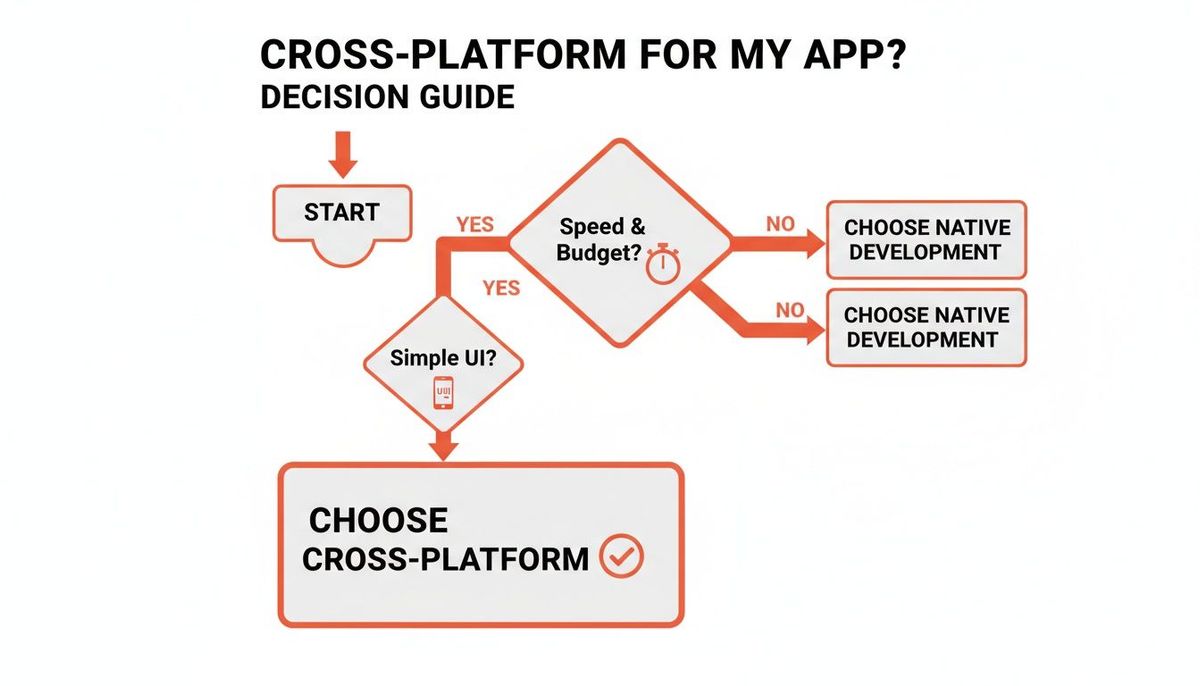
The takeaway is clear: if your primary business drivers are efficiency and reaching a broad audience with a standard interface, cross-platform is the recommended path.
When Native Development Is The Better Path
On the flip side, there are situations where the trade-offs of cross-platform just don't make sense. Native development is still the undisputed champion for apps that demand peak performance and deep integration with the operating system itself.
Key Consideration: If your app's core value proposition depends on squeezing every last drop of power from the device hardware, native is the only way to go.
Think about going native if your project involves:
- High-Performance Gaming: Graphically intense games with complex physics and real-time rendering need direct access to the device's GPU. Only native provides that.
- Apps Using the Latest OS Features: If you need to use a brand-new sensor or API from Apple or Google the day it’s released, native development gives you immediate access. Cross-platform frameworks often lag behind.
Understanding these lines in the sand is crucial. The choice between native and other approaches can seriously impact your startup's trajectory. You can dive deeper into this by checking out our guide on the differences between a native app vs. a web app for your startup.
Investor confidence continues to pour into this space, with the cross-platform framework market valued at $50 billion and projected to grow. This growth highlights the industry's bet on tools that enable efficient deployment across both major platforms. By aligning your choice with your specific business needs, you set your app up for success from day one.
Building a Revenue-Ready App with Vermillion
Getting a functional app into the App Store is one thing. Launching a profitable business is something else entirely.
Many startups get lost in the gap between a working piece of tech and a genuine, revenue-generating asset. This is exactly where we step in. Our work in cross-platform development—especially with React Native—is about much more than just writing clean code. We build revenue-ready apps from day one.
What does that mean? It means we think like business partners, not just developers. A revenue-ready approach involves architecting your app around its monetization strategy from the very first sprint. It's about making sure your app isn't just a great product, but a sustainable business engine.
From Code to Cash Flow
One of the most common mistakes we see is treating monetization features—like subscriptions or in-app purchases—as an afterthought. We build them into the app's core, creating a seamless experience that naturally guides users toward becoming customers. This takes a lot more than just plugging in a payment processor.
We embed analytics deep into the user journey to track the Key Performance Indicators (KPIs) that actually move the needle. Instead of getting distracted by vanity metrics, we focus on what matters: user lifetime value (LTV), monthly recurring revenue (MRR), and conversion rates.
This KPI-aligned process effectively turns your app into a powerful data-gathering tool. You get immediate, actionable insights into user behavior. You can see exactly where users are dropping off, which features are driving subscriptions, and how to optimize for profitability from the moment you launch.
Practical Example: A Monetization-Focused Launch
Let me walk you through how this works in the real world. We partnered with a healthtech client who needed to launch a subscription-based wellness app fast to validate their market. Instead of just jumping into building features, we started with their business goals: hitting a target LTV within six months.
Here’s how our process broke down:
- Integrate Monetization Early: We built the subscription logic and payment flows (using RevenueCat) directly into the initial React Native build, not as a feature to be tacked on later.
- KPI-Driven Analytics: We set up event tracking to monitor every single step of the subscription funnel, from the moment a user views the pricing page to when they complete a purchase.
- Backend Optimization: We implemented a scalable backend designed to handle subscription management and secure user data from the get-go. For startups looking for efficient ways to do this, guides on using Bubble.io as a mobile backend for React Native apps can be incredibly insightful.
The result? They didn't just launch an app; they launched a business intelligence machine. Within weeks, they had crystal-clear data showing which onboarding flow led to the highest conversion rate. Actionable Insight: This allowed them to iterate quickly, running an A/B test on their pricing page copy. The winning version increased their trial-to-paid conversion rate by 15%, directly boosting their MRR without writing a single new line of feature code.
This is the kind of strategic approach that makes React Native a financial powerhouse for so many startups. The revenue stats speak for themselves: 790 React Native apps are in the $10K–$100K revenue range, and a solid 173 are earning over $1M. As you can read in the full research from forasoft.com, this financial success shows how a well-executed cross-platform strategy can translate directly into a thriving business. By focusing on being revenue-ready, your app becomes more than functional—it becomes an asset built for financial success.
So, how do you make the final call?
This isn't just a technical decision—it's a business one. The right path for your app hinges entirely on your goals, your timeline, and your budget. Let's cut through the noise and get to the core of it.
Cross-platform is your go-to for speed, cost-efficiency, and hitting the entire market on day one. It's the powerhouse for the vast majority of business, e-commerce, or content-driven apps where launching quickly and affordably is everything. Think of it as the versatile multi-tool you'd want for most jobs. It just works.
When Native Still Owns the Game
But let's be clear: native development is still the undisputed champion for apps that need absolute peak performance or deep, instant access to the latest device hardware. If you're building a graphically intense game, a high-frequency trading app, or something that relies on brand-new iOS or Android features the moment they're announced, native code is non-negotiable. It's the specialized, high-performance instrument built for one specific, demanding task.
Once you get these fundamental trade-offs, you're in a position to make a smart call that sets your app up for success. The goal is to pick the development path that serves your business strategy, not the other way around.
Ask yourself these two final questions:
- Is my main goal to launch fast, test the market, and scale efficiently? Cross-platform is almost certainly your answer.
- Is my app's core value directly tied to bleeding-edge performance or the absolute newest hardware features? Native is the safer bet.
Making the right choice is about balancing ambition with pragmatism. If you’re ready to see how a KPI-aligned, revenue-ready approach to cross-platform development can bring your idea to life without forcing you to compromise on your business goals, let's talk. We build apps that don't just work—they win.
Got Questions? We've Got Answers.
As you get your head around cross-platform development, a few common questions always seem to pop up. Let's tackle them head-on so you can get a clearer picture of what you're walking into.
Is Cross-Platform a Good Fit for High-Performance Apps Like Games?
In a word, no. For graphically intense, high-performance games, cross-platform development is generally not the right tool for the job. Those kinds of apps need raw, direct access to the phone's hardware and graphics processing to deliver the buttery-smooth experience gamers expect.
Now, for most business, e-commerce, and content-driven apps, frameworks like React Native and Flutter are absolute powerhouses. The performance is so good that users often can't tell the difference between a cross-platform and a native app. But when you're talking about cutting-edge gaming or anything with heavy 3D rendering, native is still the undisputed king for hitting peak performance.
How Much of a Headache Is Maintaining a Cross-Platform App?
This is actually one of the biggest wins for the cross-platform approach. Because you’re managing a single codebase, things like fixing bugs, pushing updates, and adding new features become way simpler and more affordable than juggling two entirely separate native apps.
Think about it: an update gets applied once and rolls out to both iOS and Android simultaneously. That cuts your development hours for ongoing support in half, right there. The main challenge is just keeping up with framework updates and managing any platform-specific plugins, which can sometimes throw a curveball.
The Bottom Line: While you have to keep the framework updated, maintaining one codebase is almost always easier and cheaper than supporting two distinct native apps. It's a huge operational advantage.
Can I Switch from Cross-Platform to Native Later On?
Absolutely. But let's be clear: this isn't like flipping a switch. It's a complete rewrite of the application from the ground up. The code, the architecture—it's all fundamentally different between a cross-platform build and a native one.
That said, this is a very common—and smart—strategy for startups. Many build their MVP using a framework like React Native to get to market fast, prove their concept, and find their footing without breaking the bank. If the app takes off and eventually needs deep native features to scale, they can then make the strategic call to invest in building out separate native apps for the long haul.
Ready to build an app that’s not just functional, but designed to drive revenue from day one? At Vermillion, we live and breathe a KPI-aligned, revenue-ready approach to React Native development. Let's talk about bringing your vision to life.
*Article created using Outrank*