Boost Conversions with ux audit services for Your Product

A UX audit service is a deep, systematic teardown of your digital product. Its job is to find all the hidden usability issues that frustrate your users and, frankly, kill your business metrics. We're talking about a forensic analysis that uncovers every point of friction—from a confusing navigation bar to a clunky checkout flow—that quietly sabotages your conversions and retention.
For a founder, it’s the most critical diagnostic tool you can run. It’s what stops you from having to do a massively expensive rewrite six months down the line.
What Are UX Audit Services and Why They Matter
Think of your product as a high-performance engine. A UX audit is the full diagnostic you run before the big race. It's not just a quick design review; it’s a methodical investigation designed to answer your most pressing business questions: Where are users dropping off? Why did our conversion rate just hit a plateau? What invisible hurdles are costing us real money?
This reframes the audit from a reactive cost into a proactive investment. It’s all about finding the subtle usability headaches that silently chip away at your key performance indicators (KPIs). When you pinpoint these problems early, you build a scalable, user-focused product on a rock-solid foundation. You're making sure you can slam the accelerator without the engine seizing up.
A Diagnostic for Your Digital Health
A professional UX audit measures your product against proven usability principles and best practices. Auditors are looking for inconsistencies, confusing workflows, and anything that violates what users have come to expect from a modern digital experience. A deep understanding of modern design philosophies—especially those focused on human-centered UX like conversational design—is key to knowing just how well a product is actually meeting those expectations.
A UX audit is more than a report card; it's a strategic roadmap. It translates user frustrations into actionable, prioritized recommendations that directly link UX improvements to business growth.
For example, an audit might show that your mobile app’s sign-up form has way too many steps, causing a 50% drop-off rate. The recommendation isn't just a lazy "fix the form." It’s a detailed plan showing exactly how simplifying that flow will directly boost your user acquisition metrics. To see what a seamless mobile experience looks like, check out our guide on the best practices for mobile app design.
To provide a clearer picture, let's break down the core components typically examined in a professional UX audit.
Core Components of a Professional UX Audit
This table outlines the essential areas we investigate, what each component reveals about your user experience, and the direct impact these findings have on your business's bottom line.
| Audit Component | What It Uncovers | Business Impact |
|---|---|---|
| **Heuristic Evaluation** | Violations of established usability principles and best practices. | Identifies core design flaws that create friction, reduce trust, and hurt engagement. |
| **User Flow Analysis** | Points where users get stuck, confused, or abandon key tasks. | Directly pinpoints revenue leaks in critical paths like onboarding or checkout. |
| **Accessibility (WCAG)** | Barriers that prevent users with disabilities from using the product. | Expands your addressable market and mitigates legal risks. |
| **Performance Metrics** | Slow load times, unresponsive elements, and technical glitches. | Improves user satisfaction and SEO, reducing bounce rates. |
| **Information Architecture** | Confusing navigation, poor content organization, and unclear labeling. | Makes it easier for users to find what they need, increasing conversion rates. |
| **Visual Design & Branding** | Inconsistent branding, outdated aesthetics, and poor visual hierarchy. | Strengthens brand perception and user trust. |
By examining each of these areas, a UX audit provides a holistic view of your product's health, turning subjective opinions into objective, data-backed opportunities for growth.
The Business Case for Proactive Audits
Ignoring the small usability problems under the surface is a huge financial risk. The global market for User Experience (UX) services, which includes UX audit services, is on track to hit $30.2 billion by 2030. That explosive growth shows just how seriously businesses are taking user-centric design to avoid the expensive rebuilds that come from poor initial planning.
When you operate in a market where usability issues put trillions in potential revenue at risk, a UX audit isn't an expense. It's a foundational investment in your product's long-term survival and success. You can explore more data about this growing market on kbvresearch.com.
The UX Audit Process From Kickoff to Roadmap
A real UX audit isn’t a vague, unstructured review. It’s a systematic, data-driven process that turns your business goals into a clear, prioritized plan for improvement. We're pulling back the curtain to show you exactly how we go from that initial discovery call to a final, actionable roadmap.
The process always kicks off with deep alignment. We get your key team members in a room—from the CEO to product managers and engineers—for stakeholder interviews. The goal here is simple but critical: understand the core business objectives, the user pain points you already know about, and any technical constraints we need to respect. This first step ensures the audit is laser-focused on solving real business problems, not just chasing cosmetic fixes.
This diagram shows the high-level flow, moving from identifying friction to the audit itself, and finally, to driving growth.
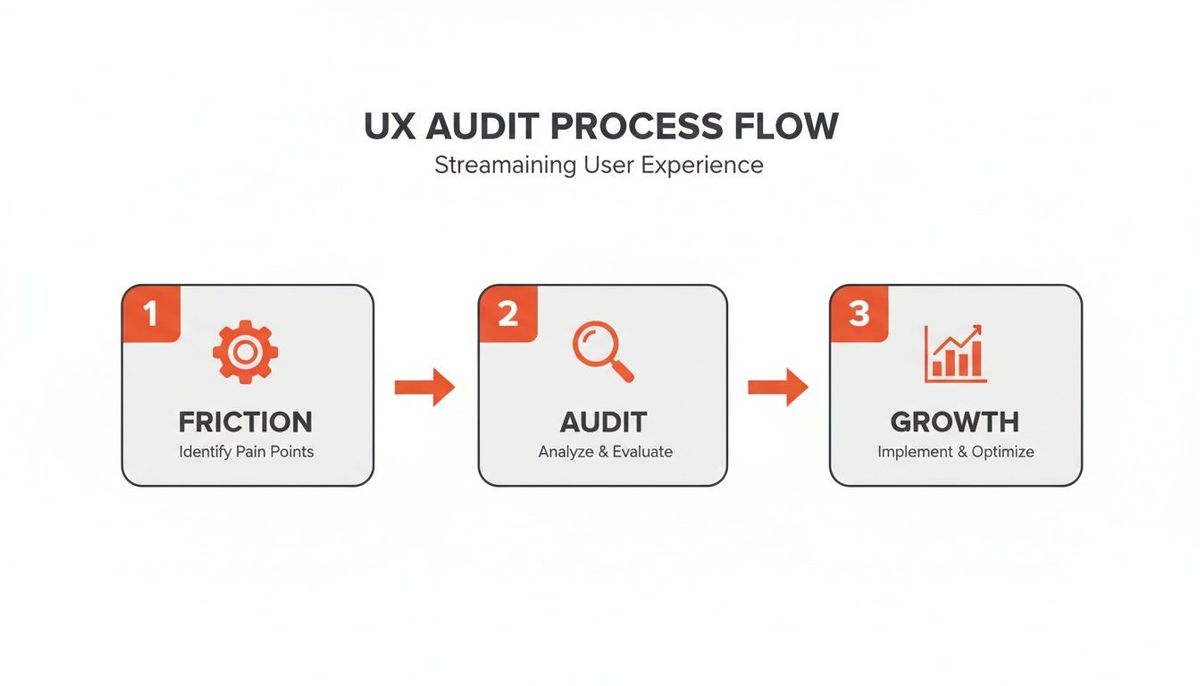
The key takeaway is that an audit is a structured investigation designed to produce tangible outcomes, not just a list of observations.
Uncovering Issues with Heuristics and User Journeys
Once we’re clear on the goals, the deep analysis begins. A cornerstone of this phase is a heuristic evaluation, where we meticulously assess your product against a set of established usability principles. These aren't just arbitrary rules; they're research-backed standards for what makes an interface feel intuitive and effective.
For example, one of the most important heuristics is "Recognition rather than recall." An audit might uncover that your B2B SaaS dashboard forces users to remember complex product codes instead of just showing human-readable names. This kind of violation creates unnecessary cognitive load and increases the odds of user error—a finding we’d flag immediately.
At the same time, we map out your most critical user journeys. This means tracing the exact steps a customer takes to complete a key task, like signing up for the first time, creating their first project, or upgrading their subscription.
- Onboarding Flow: We hunt for the exact spots where new users get confused or lose motivation. A classic problem is asking for too much information upfront, which can cause a 70% drop-off before a user ever experiences your product's value.
- Checkout Process: For any e-commerce or subscription product, this journey is make-or-break. An audit might reveal a clunky, multi-step form with vague error messages—a direct cause of cart abandonment. In fact, research shows 24% of users abandon checkout simply because the process is too long or complicated.
- Core Feature Engagement: We also dig into how users interact with the main features they're paying for. If a core workflow is buried three levels deep in confusing menus, it directly torpedoes the perceived value of your product and hurts long-term retention.
Gathering Qualitative and Quantitative Data
While a heuristic evaluation tells us where the problems might be, data tells us where they actually are. That’s why professional UX audit services always blend expert review with a mix of qualitative and quantitative tools to see how real users are behaving.
Heatmaps and session recordings are invaluable here. A heatmap might show us that users are furiously clicking on a non-interactive element, a clear sign that the design is misleading them. Session recordings are even better—they give us a play-by-play of an individual user's experience, letting us witness their frustration as they struggle to find a feature or complete a purchase.
A great audit combines expert evaluation with real user data. It doesn't just say, "This is confusing." It says, "This is confusing, and here are five session recordings showing users giving up at this exact step."
We often run quick, targeted usability tests to confirm our hypotheses. We’ll recruit a small group of users and ask them to complete a specific task that we’ve flagged as a potential issue. Watching them struggle firsthand provides undeniable proof of a problem and gives us direct insight into how to fix it.
From Findings to an Actionable Roadmap
This is the most crucial phase: turning all those findings into a strategic roadmap. This isn't just a laundry list of problems. It’s a prioritized set of recommendations built for execution.
Each finding is documented with:
- A Clear Problem Statement: "The checkout button is styled like inactive text, violating the principle of 'Signifiers'."
- Supporting Evidence: A screenshot with an arrow pointing to the button, paired with analytics showing a high drop-off rate on the checkout page.
- A Specific Recommendation: "Change the button color to the brand's primary action color (#007bff) and increase the font weight to bold."
- Prioritization Score: A rating based on the estimated business impact (e.g., revenue, retention) versus the effort required to implement the fix.
This structure allows your product and engineering teams to immediately grasp what needs to be done and why. We prioritize the high-impact, low-effort fixes to deliver quick wins, while the larger, more complex issues get slated for future sprints.
As we prep these findings for your roadmap, knowing how to format them is key. For example, learning the best practices for writing clear and actionable bug reports becomes essential for communicating effectively with development teams. This ensures every issue we identify is translated into a task that engineers can understand and execute flawlessly, closing the loop from audit to implementation.
Connecting Audit Findings to Business Growth
An audit that just hands you a list of problems isn't doing its job. The real value comes from translating those abstract usability issues into measurable improvements in the metrics that actually matter to founders and investors—revenue, retention, and growth.
This is where we move past fuzzy ideas like "a better experience" and get laser-focused on tangible ROI. We draw a straight line from a specific design recommendation to a specific KPI, making the business case for every change crystal clear.

Suddenly, UX isn't a cost center anymore. It's a growth engine. Every point of friction we find becomes an opportunity to directly move your bottom line.
From Unclear Calls-to-Action to Increased Conversions
One of the most common issues we find is a weak or poorly placed call-to-action (CTA) on a critical page. Think about a pricing page where the button to start a trial is buried at the bottom and says something passive like "Learn More." Users who are ready to buy get confused, lose momentum, and often just leave.
A proper audit doesn't just flag this as a problem; it provides a specific, data-backed solution.
- Practical Example: An audit for a project management tool revealed their "Start Free Trial" CTA was a muted grey button at the bottom of a long features list.
- Audit Finding: The CTA has low visibility and weak copy. Heatmaps showed less than 5% of users even scrolled far enough to see it.
- Actionable Recommendation: Move the CTA into a sticky header that remains visible as users scroll. Change the button color to a high-contrast orange and sharpen the copy to be action-oriented—"Start Your 14-Day Free Trial Now."
- Measurable Outcome: After implementing the change, the client saw a 22% increase in trial sign-ups within the first month.
This simple example shows how a minor UX fix, uncovered by an audit, can have a significant and immediate impact on your customer acquisition funnel.
Streamlining Onboarding to Boost LTV and MRR
User retention is another area where a UX audit delivers huge value. A clunky, confusing, or overly long onboarding process is one of the biggest reasons new users churn within their first week. If they can't quickly get to that "aha!" moment where your product's value clicks, they're gone for good.
Our audit process meticulously dissects this critical journey to pinpoint the exact moments of friction.
A streamlined onboarding flow isn't just about making users happy; it's a direct investment in their long-term value. Reducing first-week churn is one of the highest-leverage activities for improving Customer Lifetime Value (LTV).
Imagine a SaaS product with a multi-step setup that forces users to configure five different settings before they can do anything useful. An audit might reveal that 60% of new users drop off by step three. The clear recommendation would be to redesign the flow, perhaps by using smart defaults and introducing advanced settings much later.
That one change can dramatically slash first-week churn. A 15% reduction in early churn directly increases your customer LTV and boosts your monthly recurring revenue (MRR), making your entire business fundamentally more valuable. For more on this, check out our deep dive on how to increase user retention.
The Quantifiable Impact of Regular Audits
The link between UX fixes and financial performance isn't just a theory; it's backed by hard data. We've seen that companies that regularly perform UX audits and iterative testing see a direct, positive effect on their most important metrics.
Here’s a snapshot of how specific UX issues translate directly into business impact.
| From UX Fix to Business Metric | ||
|---|---|---|
| **Common UX Problem Identified** | **Actionable Recommendation** | **Potential KPI Improvement** |
| Confusing navigation menu causing user drop-off. | Simplify the information architecture and introduce clear labels. | Increased user engagement; lower bounce rates. |
| Slow page load times on critical conversion pages. | Optimize images, minify code, and leverage browser caching. | Higher conversion rates; improved SEO rankings. |
| Complicated and lengthy checkout process. | Reduce form fields, add guest checkout, and show a progress bar. | Lower cart abandonment; increased revenue. |
| Inconsistent design elements creating a jarring experience. | Implement a standardized design system across the product. | Higher user trust; stronger brand perception. |
These examples are just the beginning. The data shows companies can achieve up to 10.8% higher revenue retention over three years, driven by major lifts in both user engagement and conversion rates. In fact, some redesigns guided by audit findings have resulted in an average conversion growth of +31%. For teams getting ready to scale or facing due diligence, a UX audit is a direct path to higher revenue.
This data reinforces the core message: investing in a UX audit is investing in a more profitable and sustainable business. By systematically removing friction, you create a superior product experience that not only attracts new customers but also keeps them coming back for more.
How UX Audit Services Are Priced
Figuring out the investment for a UX audit is a critical step for any founder. The pricing for UX audit services isn't pulled out of thin air; it’s a direct reflection of the depth, complexity, and ultimately, the value of the insights you get back. The real goal is to find a model that actually fits your needs, budget, and where you're trying to take the business.
Think of it like a home inspection before you buy a house. A quick visual check is cheap but might miss the cracked foundation that’s going to cost you a fortune later. A deep structural analysis costs more upfront but gives you a clear roadmap to protect your investment. The logic is identical here—a proper audit saves you from building on a shaky foundation.
Fixed-Scope Project Pricing
The most straightforward model for a standalone audit is a fixed-scope project. We agree on a set price for a clearly defined scope of work. This is perfect when you have a specific goal in mind, like figuring out why your onboarding flow is bleeding users or getting ready for a major feature launch.
A fixed-scope project gives you cost predictability, which is a massive win for budgeting. The provider will tell you exactly what they’re going to analyze, the methods they’ll use (like a heuristic evaluation or user journey mapping), and what the final report will look like. You know the total investment before a single hour of work begins.
For example, a fixed-scope audit for a small mobile app with two core user journeys is going to be priced very differently from one for a complex B2B SaaS platform with multiple user roles and dozens of intricate workflows.
Hourly Consulting and Retainers
For situations that are a bit more fluid, other pricing models offer more flexibility. Hourly consulting is great for smaller, targeted tasks or for ongoing advice after an initial audit is done. This works well when the scope is tough to pin down upfront or if you just need an expert on call to review new designs as your team builds them.
An ongoing retainer is a powerful option for teams that want continuous UX support. It’s like having a fractional Head of UX embedded directly with your team.
A retainer moves beyond a one-time audit to a continuous improvement cycle. It ensures that as your product evolves, the user experience remains a top priority, preventing new friction points from emerging.
This model is ideal for companies that are shipping features fast and need consistent, expert oversight to keep quality high and users happy. It lets the audit partner build deep product knowledge over time, which means their recommendations become more impactful and context-aware.
To get a better sense of how different project scopes influence cost, you can explore our detailed guide and use our app development cost calculator.
Key Factors That Influence Cost
The final price tag on any UX audit service is shaped by a few critical factors. Understanding these variables helps you see why a one-size-fits-all price just doesn't work and what’s really driving the value behind the investment.
- Product Complexity: The number of screens, user flows, and features directly impacts the hours required for a thorough analysis. More complexity means more work.
- Audit Depth: A basic heuristic review is much less intensive than a comprehensive audit that pulls in competitor analysis, user interviews, and a deep dive into your analytics.
- Team Expertise: Partnering with a senior team that brings years of pattern recognition and an understanding of technical feasibility will command a higher investment than a junior-level review. This expertise is what ensures recommendations are not just insightful, but actually practical to implement.
How to Choose the Right UX Audit Partner
Picking a partner for your UX audit is a bigger deal than just hiring a vendor. You're not buying a report; you're investing in a strategic relationship that can literally define your product's future. The wrong choice gets you a generic checklist of surface-level problems. The right one becomes an extension of your team, handing you a clear, executable plan for growth.
This decision is especially critical in a market this hot. North America is the undisputed hub for UX audit services, pulling in over 40% of global UX revenue and is on track to hit $10.6 billion by 2030. That growth is driven by tech hubs where founders simply can't afford a misstep. You can dig into the UX market dynamics on cognitivemarketresearch.com, but the takeaway is clear: choosing a partner here means finding someone who can prevent the costly errors that put all that revenue at risk.

Look for Relevant Portfolio Experience
First thing's first: vet their track record. Don't get dazzled by a portfolio packed with slick consumer apps if you're building a complex B2B SaaS platform. You need to see specific, provable experience with business models and user challenges that mirror your own.
A partner who's already audited other B2B products gets the nuances—multi-user permissions, complex data tables, long sales cycles. They won't waste your time with generic advice that doesn't apply.
- For B2B SaaS Founders: Ask for examples of audits on products with similar user roles or data complexity. For instance: "Show me an audit you did for a product with an admin dashboard and team collaboration features."
- For E-commerce Brands: Find a partner with experience on your platform (like Shopify or Magento) who understands the psychology of online shoppers. Ask: "Can you share findings from an audit that improved cart conversion rates?"
- For Mobile-First Products: Make sure they have deep expertise in both iOS and Android human interface guidelines and have audited apps that scaled to thousands of users.
Demand Sample Deliverables and Judge Clarity
A portfolio shows you the shiny finished product. A sample deliverable shows you the thinking. Ask to see a redacted audit report from a past project. This is the single best tool you have for judging their work quality before you sign anything.
When you get it, you’re not just looking for the problems they found. You’re looking at how they communicate those findings. Is the report clear and written for a business leader, or is it bogged down in academic jargon?
A great audit deliverable is a strategic document, not just a technical one. It should be just as useful for your CEO as it is for your lead engineer, clearly connecting each UX issue to a business outcome.
Look for a report that prioritizes recommendations by impact and effort. A laundry list of 100 "critical" issues is completely useless. A focused list of 10 high-impact fixes that will actually move your KPIs? That's invaluable.
Prioritize Technical Feasibility and Senior Leadership
This is the non-negotiable that separates the best UX audit partners from the rest. Anyone can point out a confusing button. But can they explain why it's confusing, propose a solution that works with your tech stack, and create a plan your engineers can actually build?
The most important question you can ask a potential partner is this: "How do you translate your findings into a technically feasible roadmap?"
Their answer tells you everything. The best firms have senior technical leadership involved in the audit. They don't just find problems; they pressure-test the solutions. They know that a "simple" design change might require a massive backend overhaul, and they factor that reality into their recommendations.
This ensures the plan you get is:
- Actionable: Your dev team knows exactly what to build.
- Scalable: The fixes won't create a mountain of technical debt later.
- Aligned: The recommendations support your long-term business and product goals.
When you choose a partner with this blend of design sense and engineering pragmatism, you’re not just getting insights. You're getting a clear path to a better, more profitable product.
Common Questions About UX Audit Services
When founders and product leaders start looking into UX audits, a few practical questions always come up. You need straight answers about the process, the value, and how it all fits into your roadmap.
This section cuts through the noise and tackles the most common questions we hear. The goal is to give you the clarity you need to move forward with confidence, seeing an audit not as a cost, but as a strategic tool.
How Long Does a Typical UX Audit Take?
Most UX audits take between one to four weeks, but it really depends on the complexity of your product.
- Practical Example: Auditing a 5-screen mobile app's checkout flow might take one week. Auditing a complex enterprise SaaS platform with 50+ screens and multiple user roles could take a full month to ensure thoroughness.
A good partner will give you a clear timeline upfront, focusing on a thorough, actionable roadmap rather than just speed.
Is a UX Audit the Same as Usability Testing?
No, but they are closely related. Think of it like this: a UX audit is the complete health diagnostic for your product, while usability testing is one specific tool a doctor might use during that diagnostic.
An audit is a holistic review that pulls from heuristic analysis, user journey mapping, and competitive reviews. Usability testing, where you watch real users interact with your product, is often used to add undeniable, qualitative proof to the audit’s broader findings.
A great UX audit service uses usability testing to validate its expert analysis with real-world user behavior. It connects the "what" to the "why."
Can We Just Do a UX Audit Ourselves?
You can certainly start with an internal checklist, and that's often a good first step. But a professional service brings one thing to the table that you simply can't replicate: critical objectivity.
Your team is deep in the weeds every day. They're too close to the product to see its flaws clearly—a classic case of "creator bias." An external partner brings a fresh perspective, plus pattern recognition from working on hundreds of other products. That outside view is invaluable for catching costly mistakes before you try to scale.
What Should I Expect as a Final Deliverable?
You should expect way more than just a long list of problems. A high-quality UX audit delivers a comprehensive report built for action. It should always include:
- An Executive Summary: A one-page overview for stakeholders who need the bottom line, fast.
- Detailed Findings: A breakdown of the issues, complete with visual examples and supporting data.
- Prioritized Recommendations: Concrete solutions, ranked by their impact on your business goals versus the effort required to implement them.
The best deliverable is a strategic, technically feasible roadmap that bridges the gap between insight and execution. It should give your team a clear, step-by-step path forward.
At Vermillion, we deliver UX audits that provide more than just findings; we provide a clear, technically feasible roadmap for growth. Get in touch to see how our senior team can help you build a product that scales.