Vermillion Insights
December 25, 2025 · Ken Vermeille · 20 min read
A Modern Playbook for User Acquisition for Mobile Apps
Master user acquisition for mobile apps with our definitive playbook. Learn data-backed strategies to acquire high-value users and drive sustainable growth.

User acquisition for mobile apps isn't just about getting people to download your app. It's the whole game of finding the right people, convincing them to install, and making sure they stick around long enough to become valuable. It’s a mix of smart advertising, organic hustle, and product-led magic designed to attract users who will actually use - and pay for - your app.
Building a Modern Mobile App Acquisition Engine
In the early days of the app stores, you could win by just getting a ton of downloads. That strategy is completely broken now.
Success isn't measured by install counts anymore. It’s defined by acquiring users who stay, who engage, and who ultimately drive revenue. To do that, you need to build a modern user acquisition engine - a system that weaves together your marketing, product, and data to create predictable, sustainable growth.
Think of this engine less like a simple machine that just churns out installs, and more like a sophisticated refinery. The old model was about pouring money into ads to find the cheapest Cost-Per-Install (CPI). The modern engine, on the other hand, is obsessed with Lifetime Value (LTV) and Return on Ad Spend (ROAS). It’s about quality, not just quantity.
The Core Components of a Growth Engine
A powerful acquisition engine stands on three pillars. If one is weak, the whole structure wobbles. They all have to work together to create a self-sustaining growth loop.
- Diversified Channel Strategy: Putting all your eggs in one basket is a recipe for disaster. A modern approach blends paid, organic, and referral channels to build a resilient, multi-pronged attack.
- Solid Unit Economics: You have to know your numbers, period. This means mastering the core metrics that tell you if you're actually making money: Customer Acquisition Cost (CAC), LTV, and your payback period.
- Acquisition-to-Retention Handoff: Your job isn't over when someone hits "install." A killer onboarding experience is absolutely critical for turning that fresh download into an engaged, long-term user who sees the value.
So many startups make the classic mistake of dumping money into paid ads before they've figured out retention. If your app is a leaky bucket and users churn after three days, it doesn't matter how cheap your installs are. You're just lighting cash on fire.
Practical Example: A meditation app might use TikTok ads showing a 30-second breathing exercise to get its first wave of users. But its engine is incomplete without great App Store Optimization (ASO) to pull in people searching for "anxiety relief," plus an in-app referral program that gives users a free month for bringing in a friend. This way, if TikTok ad costs spike, the business doesn't grind to a halt.
This playbook will give you the frameworks to build each of these components, piece by piece. The goal is to turn your acquisition efforts from a simple cost center into a predictable machine that drives real revenue.
Decoding the New Economics of App Acquisition
The old playbook for mobile user acquisition is dead. Gone. For years, the game was simple: chase the lowest Cost-Per-Install (CPI) you could find. Success was just a numbers game - how many installs could you buy for the least amount of money? Today, that volume-at-all-costs strategy is the fastest way to burn through your marketing budget with almost nothing to show for it.
The entire financial model has flipped. With ad costs soaring and competition at an all-time high, even a "cheap" install is a waste of money if that user churns in the first 24 hours. The new economics of acquisition demand a fundamental shift in how we think, moving away from pure volume and focusing laser-like on user value.
From Cost Per Install to Value Per User
Forget obsessing over low CPIs. The smartest growth teams I know are now comfortable paying more for an install, but only when they can justify it. How? By targeting users who show early, powerful signals of high Lifetime Value (LTV). These are the folks who are most likely to stick around, get hooked on your app, and eventually pull out their credit cards.
So what does this actually look like in practice? It means you stop optimizing your campaigns for the install itself. Instead, you aim for valuable post-install events that happen after the download.
- Completing Onboarding: A user who finishes your entire setup flow is way more invested than someone who bails halfway through. This is a huge signal.
- Making a First In-App Purchase (IAP): This is the gold standard. It's the clearest sign that a user gets the value you're offering and is willing to pay for it.
- Starting a Free Trial or Subscription: This action signals clear intent to become a long-term, paying customer.
Practical Example: A fitness app could run two campaigns. Campaign A optimizes for "app installs" and gets a $2 CPI. Campaign B optimizes for "start free trial" and gets a $10 CPI. Campaign A users open the app once and churn. Campaign B users, while more expensive, have a 40% conversion rate to a paid subscription. Campaign B is the clear winner because it's acquiring revenue, not just downloads.
When you optimize for these deeper-funnel actions, your CPI will almost certainly go up. But you're no longer just buying installs; you're buying a user base that actually drives revenue.
This diagram shows how all the pieces of a modern acquisition engine have to work together - it’s a self-reinforcing cycle, not a linear funnel.
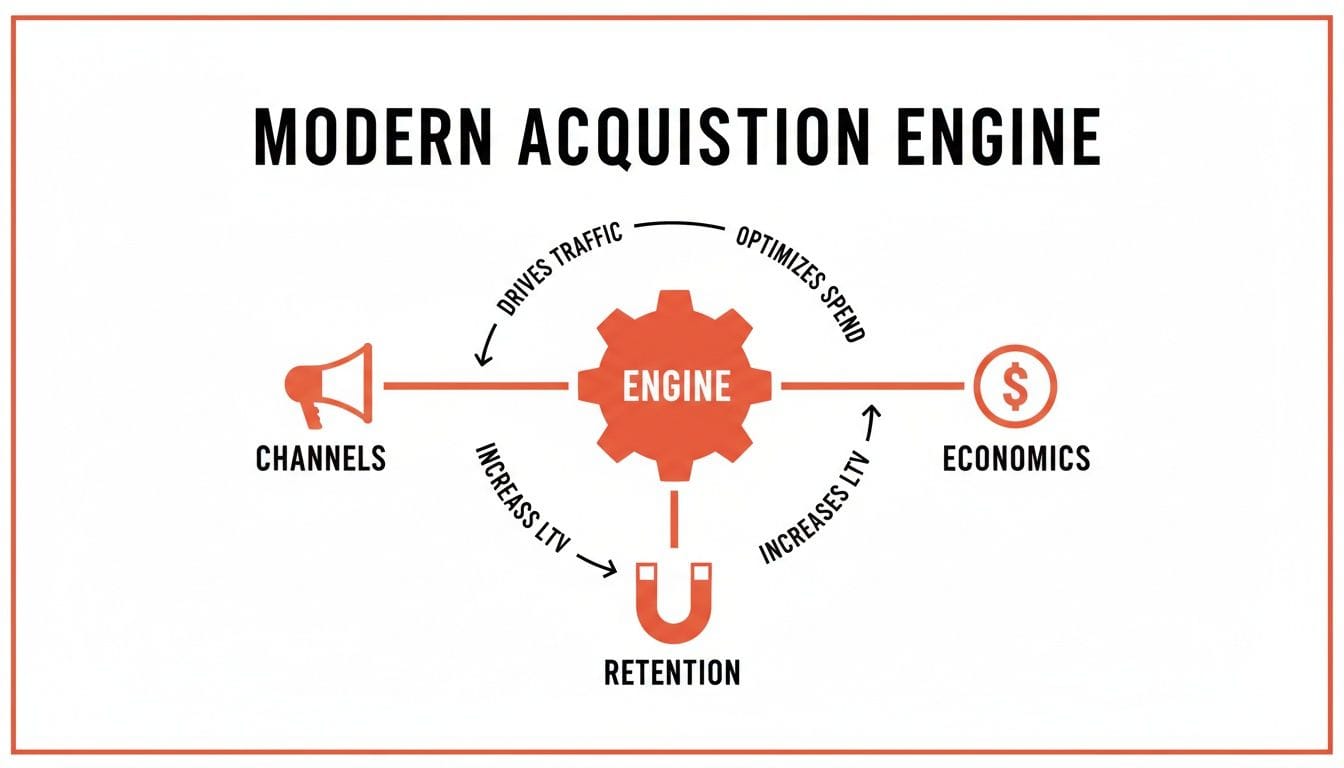
As you can see, sustainable growth isn't just about pouring users in at the top. It's about building a system where the unit economics justify the ad spend, and the product experience is good enough to keep the users you just paid for.
The Rise of Predictive Modeling
This entire strategic shift is powered by predictive AI models. These aren’t just fancy tools for enterprise companies anymore; they're a must-have for any app that wants to compete. Predictive models crunch thousands of data points to figure out which users are most likely to become profitable before you've spent a dime acquiring them. This lets you bid more intelligently and confidently on ad platforms, even when it means a higher upfront CPI.
The new acquisition mantra is simple: Pay more for the right user. A $10 CPI for a user who generates $50 in LTV is infinitely better than a $1 CPI for a user who deletes your app after five minutes.
The market data paints a stark picture of this new reality. Global user acquisition ad spend hit a staggering $65 billion in 2024, pushing the average CPI up to anywhere from $1.50 to over $12.00, depending on the app category. At the same time, most apps lose up to 80% of new users within just three days. This brutal churn rate makes install-only campaigns completely unsustainable.
To really get the new economics right, you have to get serious about mobile marketing attribution. The best teams are laser-focused on those early monetization signals to protect their return on investment.
By shifting your focus to acquiring high-value users from the start, you dramatically shorten your CAC payback period and build a far more resilient, profitable business.
Choosing Your Platform Battleground: iOS vs. Android
Deciding where to launch your app isn't just a technical choice - it's a fundamental business strategy. Throwing your app on both the iOS App Store and the Google Play Store with the same game plan is a rookie mistake. It’s like trying to sell the same product in two completely different countries without changing the marketing. You’ll burn through your ad spend and wonder why nothing is clicking.
The two platforms are completely different ecosystems. One is built for massive reach and scale; the other is a monetization machine for capturing high-value users.
Your entire user acquisition strategy hinges on understanding this split. Get it right, and you create a powerful growth loop. Get it wrong, and you're just lighting money on fire.
The Great Divide: Volume vs. Value
The strategic difference between Android and iOS boils down to a simple, powerful trade-off.
Android, with its colossal global market share, is your go-to for getting a huge volume of installs, often at a much lower Cost-Per-Install (CPI). If your goal is to quickly penetrate a market, test out viral loops with a massive audience, or build network effects, Android is the perfect playground. Think of it as casting a wide net to see what you can catch.
On the flip side, iOS users have consistently shown they are far more willing to open their wallets. For apps that rely on in-app purchases or subscriptions, the App Store is king. If your business model is monetization-first, focusing on an iOS audience is often the fastest path to healthy unit economics and a quick CAC payback period.
This isn't just a hunch; the numbers are impossible to ignore. While Android dominates global app downloads, iOS consistently punches above its weight in revenue, capturing somewhere between 65% and 90% of total app store spending. For a fintech app, the story is even more dramatic: one study found that while 83.6% of its installs came from Android, a staggering 63.5% of its revenue was generated by iOS users. You can explore more on platform-specific acquisition strategies to see how this plays out in campaign planning.
This imbalance has huge implications for your budget and your product roadmap. A relatively small group of high-value iOS users can easily drive the majority of your early revenue. This makes iOS the ideal environment for testing out your pricing, subscription tiers, and premium features before you scale.
Building Your Platform-Specific Strategy
The smart move isn't to pick one platform and ignore the other. It's to use each one for what it's good at. This means creating a blended strategy where your budget, your ad creative, and your campaign goals are tailored to each ecosystem.
Practical Example: Imagine you're launching a new social media app. You could use Android for a low-cost, high-scale campaign in a test market like the Philippines to test your referral engine and see if you can spark network effects. At the same time, you could run a laser-focused, value-optimized campaign on iOS in the US, targeting users known to make in-app purchases for virtual goods. You might pay a higher CPI on iOS, but the potential for a much higher LTV would easily justify it.
Here’s a simple framework to think about allocating your resources:
- For Subscription or IAP-First Apps: Put your budget and product optimization muscle behind iOS first. Your primary goal is to attract users who will convert to paying customers. Use the App Store to prove your monetization model works.
- For Ad-Supported or Virality-Driven Apps: Go big on Android. You need scale and audience density to generate ad impressions or get viral features off the ground, and Android offers that at a lower cost.
- For Hybrid Models: Strike a balance. Acquire users for scale on Android while running targeted, high-value campaigns on iOS to capture your most profitable customer segments.
By treating iOS and Android as two complementary tools in your user acquisition toolbox, you build a growth engine that's more resilient, efficient, and - most importantly - profitable.
To help you crystallize this, here's a strategic framework comparing the two platforms and what it means for your startup's decisions.
iOS vs Android Strategic Acquisition Framework
This table compares key strategic considerations for user acquisition on iOS and Android to help startups allocate resources effectively.
| Factor | iOS (Apple App Store) | Android (Google Play Store) | Strategic Implication for Startups |
|---|---|---|---|
| Primary Strength | High User Value & Monetization. Users are more willing to pay for apps and in-app purchases. | Massive Volume & Global Reach. Dominant market share, especially in emerging markets. | Prioritize iOS to validate monetization models. Use Android to test for scale, virality, and network effects. |
| User Demographics | Typically higher income, concentrated in North America, Western Europe, and developed Asia. | Broader demographic and geographic spread, including a massive presence in developing nations. | If your target user is a high-earning professional in a major city, start with iOS. If you're building a utility for a global audience, Android is key. |
| Cost-Per-Install (CPI) | Generally higher. Bidding on high-value users is more competitive. | Generally lower. The sheer scale of the user base allows for more cost-effective acquisition. | Expect to pay more for an iOS user, but justify it with higher LTV. Use Android for cost-efficient top-of-funnel growth. |
| Monetization Model Fit | Excellent for subscriptions, premium apps, and high-value in-app purchases (IAP). | Strong for ad-supported models, freemium with mass-market IAPs, and viral loops. | A subscription-first app (e.g., Calm, Headspace) should be iOS-first. An ad-driven game should scale on Android. |
| App Store Review | Strict and lengthy. Apple's review process is meticulous, which can delay launches and updates. | Faster and more lenient. Google's automated process allows for quicker iterations and launches. | Use Android's flexibility for rapid testing and iteration. Be prepared for longer feedback cycles and potential rejections on iOS. |
| Fragmentation | Minimal. A limited number of devices and OS versions makes development and testing simpler. | High. Thousands of different devices, screen sizes, and OS versions create significant testing challenges. | iOS offers a controlled environment to build a polished MVP. Android requires more QA resources to ensure a consistent experience. |
Ultimately, this framework shows there's no single "best" platform - only the platform that's best for your specific business goals at this specific time. A thoughtful, platform-aware strategy will always outperform a generic, one-size-fits-all approach.
Mastering Your Core Acquisition Channels
Think of your user acquisition strategy like a well-balanced investment portfolio. Going all-in on a single channel is just asking for trouble. If ad costs spike or an algorithm changes overnight, your entire growth engine could stall. The real trick is mastering a blend of paid, organic, and partnership channels that work together.
This isn’t about just having a presence everywhere. It’s about knowing what each channel is uniquely good at and using specific tactics to squeeze every drop of value out of your efforts. Let's break down the core channels that will form the bedrock of your acquisition strategy.
Paid Social: Meta and TikTok
Paid platforms like Meta (Facebook and Instagram) and TikTok are absolute powerhouses for finding massive, laser-focused audiences. But success here isn't about setting a budget and crossing your fingers. It’s all about smart creative and optimizing for real value, not just cheap installs.
The key is to aim your campaigns at valuable actions that happen after the install. Instead of telling the algorithm to find you "app installs," tell it to find people who will "start a free trial" or "make their first purchase." Yes, your initial Cost-Per-Install (CPI) will go up, but you're paying for users who are far more likely to actually make you money.
Actionable Insight: The Paid Campaign Checklist
Before you launch anything, run through this quick sanity check:
- Objective Set for Value? Is the campaign optimizing for a post-install event (like a subscription) instead of a simple install? Example: Set your Meta campaign objective to "App Events" and select "Subscribe."
- Audience Defined? Are you targeting a lookalike audience built from your best users, or a tightly defined interest group? Example: Create a lookalike audience from a list of your current paying subscribers.
- Creative Variants Ready? Do you have at least 3-5 different ad creatives (a mix of video and static images) ready to test? Example: For a gaming app, test a user-generated-style clip vs. a polished cinematic trailer vs. a static image of a rare in-game item.
- Tracking Confirmed? Have you double-checked that your mobile measurement partner (MMP) is correctly tracking the conversion event you care about?
App Store Optimization (ASO)
ASO is basically SEO for the app stores. It’s the entire process of making your app more visible so you can drive more organic, free downloads. Your app store page is your digital storefront - if people can't find it, or they aren't impressed by what they see, they’ll just keep scrolling.
Good ASO is so much more than just cramming keywords into your app's title. It’s a holistic game that involves your app's name, subtitle, description, keywords, icon, screenshots, and reviews. Every single piece has to work together to convince both the store's algorithm and the user that your app is the one they need. If you're serious about this, leveraging the best App Store Optimization (ASO) tools is a must for getting ahead.
A huge mistake I see is founders treating ASO as a "set it and forget it" task. The app stores are constantly changing. You should be auditing and tweaking your ASO elements at least once a quarter to keep up with competitors and new keyword trends.
Actionable Insight: A Mini ASO Audit
Take 15 minutes right now and ask yourself these questions:
- Title and Subtitle: Do they clearly explain what your app does and include your single most important keyword? Example: "Headspace: Mindful Meditation" clearly states the brand and core function.
- Screenshots: Does the very first screenshot instantly show off your app's core value? Are they clean, attractive, and use caption text to highlight benefits? Example: A budgeting app's first screenshot shows a beautifully simple dashboard with the text "See All Your Accounts in One Place."
- Reviews and Ratings: Is your average rating above 4.0 stars? Do you have a system in place to gently prompt your happiest users to leave a review? Example: Trigger an in-app review prompt only after a user successfully completes a key task for the third time.
Organic Content and Community
Organic channels are all about building an audience by creating genuinely useful content that naturally points people toward your app. This is a long game, for sure, but it builds an incredibly strong, defensible moat around your business that paid ads can't replicate. This could be a blog, a YouTube channel, or a killer social media account where you give value first and pitch your app second.
Practical Example: A meditation app could create a blog with SEO-optimized articles on "how to manage anxiety at work." A budgeting app might start a YouTube channel breaking down complex financial topics like "how to build a credit score" for beginners. The content attracts the right kind of people, builds trust, and makes your app feel like the next logical step. This is a core pillar of many strategies for effective mobile app marketing that are built to last.
Strategic Partnerships and Influencers
Why build an audience from scratch when you can tap into someone else's? Strategic partnerships let you get in front of an established, trusted audience. This could mean co-marketing with a brand that serves the same customers, or sponsoring an influencer who truly vibes with your mission. The goal is simple: get an endorsement from a source your target users already know and respect.
Practical Example: A recipe app could partner with a popular food blogger for a dedicated Instagram Reel showcasing a unique recipe made using the app. The key is to prioritize authenticity over a massive follower count. A micro-influencer with 10,000 super-engaged followers in your niche will almost always drive more high-quality installs than a celebrity with millions of passive fans. Give them a clear brief, but let them have the creative freedom to talk about your app in their own voice. That’s where the magic happens.
Connecting Acquisition to a Killer First Impression
Getting the install is a victory, but it's just the first battle. Winning the war for user acquisition for mobile apps happens in the critical hours after the download. You’ve spent time and money to get a user through the door; now the real work begins - convincing them to stay.
This is where your acquisition efforts hand off the baton to your product experience. A clunky, confusing, or uninspiring first impression will undo all your hard work, leading to quick churn and wasted ad spend. The user who clicked your ad had a specific expectation, and your app has one chance to deliver on that promise.
The Make-or-Break First 72 Hours
The first three days of a user's journey are where most apps bleed users. The data is sobering; industry reports consistently show that apps can lose a massive share of their user base within this initial window.
This is why modern growth teams are obsessed with retention-first acquisition. They know that install counts are a poor predictor of success. Instead, the focus has shifted to early engagement metrics as the primary lever for efficient user acquisition. Only about one-quarter of users even return the day after an install, making that first-run experience absolutely decisive for your app's long-term health. Learn more about the importance of retention in mobile app growth from recent studies.
Your goal during this period is simple but challenging: deliver an immediate "aha!" moment. This is the instant a user understands your app's core value and sees how it can solve their problem or improve their life.
Designing an Onboarding Flow That Delivers
A great onboarding experience is the bridge between the promise of your ad and the reality of your product. It’s not just a tutorial; it's a guided journey to value. A seamless flow validates the user's decision to install and sets them up for long-term success.
To get this right, you need a deep understanding of what drives users to your app in the first place. You can explore a variety of best practices for mobile app design that directly impact how users perceive and interact with your onboarding from the very first screen.
Actionable Onboarding Examples:
- For a Budgeting App: Instead of a long tour of every feature, the onboarding could immediately prompt the user to connect one bank account. Seeing their transactions categorized automatically delivers that "aha!" moment of effortless organization within minutes.
- For a Language-Learning App: The flow could skip a lengthy sign-up and jump straight into a fun, two-minute mini-lesson. This immediately demonstrates the app's teaching style and gives the user a quick win, making them more likely to create an account to save their progress.
- For a Photo-Editing App: The onboarding could guide the user to upload one photo and apply a signature filter. Seeing the instant transformation proves the app's value without requiring the user to learn a complex interface.
The cardinal rule of onboarding is this: Show, don't just tell. Get the user to perform a core, value-creating action as quickly as humanly possible. The faster they experience the magic, the higher the chance they'll stick around.
Using Push Notifications to Re-Engage, Not Annoy
Push notifications are a powerful tool for bringing users back during that critical 72-hour window, but they must be used with precision and care. Generic, poorly timed notifications are the fastest way to get your app uninstalled.
The key is to make them timely, personal, and actionable.
- Timely: A notification should be triggered by a user's action (or inaction). For example, if a user starts an onboarding step but doesn't finish, a gentle reminder an hour later can be very effective.
- Personal: Use the user's name or reference their in-app activity. Instead of "Come back and finish your setup," try "Hey [Name], you're one step away from creating your first budget!"
- Actionable: The notification should have a clear purpose and deep-link directly to the relevant screen in your app, removing any friction.
By carefully orchestrating this initial experience, you ensure your user acquisition efforts don't just lead to fleeting installs. You create a system that acquires users who are activated, engaged, and on the path to becoming valuable, long-term customers.
Building a Scalable and Profitable Growth Model
Getting a ton of downloads feels great, but it's pure vanity if you're not building a real business. Sustainable user acquisition isn’t about growth at all costs; it's about building a predictable financial engine.
To do this, you have to stop obsessing over install counts and start speaking the language of unit economics. This is the financial literacy that separates apps with a flash-in-the-pan moment from businesses that generate real, long-term revenue.
The whole model boils down to a few core metrics. Get these right, and you've got a roadmap for scale.
Demystifying Core Growth Metrics
Your app's financial health is a simple tug-of-war: what does it cost to get a user, and how much is that user worth over time?
- Customer Acquisition Cost (CAC): This is the total price tag for acquiring one new customer. Just divide your total marketing and sales spend over a period by the number of new customers you brought in. Actionable Insight: If you spent $5,000 on ads in June and acquired 500 new subscribers, your CAC for that month is $10.
- Lifetime Value (LTV): This is the magic number. It’s the total revenue you can reasonably expect from a single customer during their entire time using your app. A high LTV means you’ve found a valuable user base that sticks around.
- LTV-to-CAC Ratio: This is the ultimate health check for your acquisition engine. The gold standard is a ratio of 3:1 or higher. It means for every dollar you spend to get a user, you get three dollars back over their lifetime.
A bad LTV-to-CAC ratio is a screaming red flag. If it costs you $50 to acquire a user (CAC) who only ever pays you $30 (LTV), you don't have a growth problem - you have a business model problem. You're literally paying to shrink your company with every single install.
The Ultimate Health Check: CAC Payback Period
While the LTV-to-CAC ratio tells you if you'll make money, the CAC Payback Period tells you when. It's the time it takes for a customer to generate enough revenue to cover their own acquisition cost.
A shorter payback period is your best friend. Why? Because it means you get your capital back faster, ready to be reinvested into acquiring the next wave of users.
Practical Example: Imagine your subscription app has a $100 CAC and you charge $20 per month. Your payback period is five months. The name of the game is to shrink that window, either by finding cheaper ways to acquire users (lowering CAC) or by increasing what they're worth (raising LTV). This is directly tied to your mobile app monetization strategies, because how you charge has a massive impact on how quickly you get paid back.
Setting Your First User Acquisition Budget
You don't need a PhD in finance to get started. A basic spreadsheet is more than enough to map out some initial forecasts and see how your spending will impact growth.
When you're starting out, a smart way to split your budget is between learning and earning:
- Testing New Channels (Approx. 20% of Budget): Put a slice of your cash toward experimenting with unproven channels. The goal here isn't immediate profit; it’s gathering data and finding your next big win. Actionable Insight: If your starting budget is $10,000, allocate $2,000 to test three new channels (e.g., Apple Search Ads, a specific influencer, Reddit Ads) with small, controlled campaigns.
- Scaling Proven Channels (Approx. 80% of Budget): Once a channel consistently delivers users with a healthy LTV-to-CAC ratio and a payback period you can live with, it's time to pour fuel on the fire. This is where the bulk of your budget should go to drive predictable growth.
This balanced approach keeps you exploring new opportunities while you capitalize on what you know already works. That’s how you build a growth model that doesn't just scale - it actually lasts.
Common Questions We Hear About Mobile UA
Running user acquisition for a mobile app can feel like a maze, especially when you're starting out. Here are some of the most common questions founders and marketers ask when they're getting their growth engine fired up.
What Is a Good CAC for a Mobile App?
This is the wrong question. There's no magic number for a "good" Customer Acquisition Cost (CAC). The only thing that matters is how it stacks up against your Lifetime Value (LTV).
A healthy app business lives by one simple rule: your LTV has to crush your CAC. We look for an LTV-to-CAC ratio of 3:1 or better as a benchmark for sustainable growth. This means for every dollar you spend bringing someone in, you're getting at least three dollars back over their time with your app.
Practical Example: A gaming app with a $5 CAC might seem cheap, but if its LTV from in-app purchases is only $3, it's a losing business. In contrast, a fintech app with a $50 CAC is a brilliant investment if its average user generates $200 in LTV from subscription fees over two years.
The real question isn't "What's a good CAC?" It's "Is my CAC profitable?" Your focus should always be on the ratio between what you spend to get a user and what that user earns you. That's the only way to know if your acquisition strategy is actually working.
How Much Should I Budget for UA Initially?
When you’re just getting started, your budget has two jobs: learning and scaling. Don't blow it all at once.
A smart way to start is by dedicating 20-30% of your initial marketing cash to pure experimentation. Spread this across promising channels like Meta, TikTok, and Apple Search Ads. The goal here isn't to turn a profit on day one; it's to get clean data on what actually moves the needle.
Hold back the other 70-80% of your budget. You'll use this to pour gas on the fire once you find a winning channel. As soon as you see a channel delivering users with a solid LTV-to-CAC ratio, that’s your signal to double down and start driving real, predictable growth.
What Is the Most Common UA Mistake to Avoid?
Easy. The single biggest mistake we see is spending money on acquisition before fixing retention.
So many startups get excited and pour their budget into paid ads to juice their install numbers. The problem? They watch in horror as 80% of those brand-new users churn within the first week. If your app is a "leaky bucket," it doesn't matter how cheaply you fill it - you're just burning cash.
Actionable Insight: Before you spend a single dollar on ads, use an analytics tool to track your Day 1, Day 3, and Day 7 retention rates. If your Day 7 retention is below 10-15%, pause all paid spend and focus entirely on improving your onboarding and core product loop. A solid retention foundation is what turns your acquisition spend into long-term value instead of just a bunch of temporary downloads.
Ready to build a mobile app that not only gets users but actually keeps them? At Vermillion, we partner with startups to build revenue-ready apps designed for growth from day one. Learn more about our performance-based model and see how we can help you hit your KPIs.
Keep reading
See all →
March 22, 2026
Unlocking Revenue Your Guide to Price Tier Strategy
March 21, 2026
Your Guide to Flawless Stripe Subscription Management

May 14, 2026
Fractional Mobile Engineering vs. Full-Time Hiring in 2026
The mobile engineering talent market has shifted dramatically over the past two years. Budgets are tighter, AI tools have changed what a sin...
March 20, 2026
Recurring Billing With Stripe a Guide for Subscription Apps
Master recurring billing with Stripe. This guide covers everything from setup and server logic to webhooks and churn reduction for subscript...
March 19, 2026
Unlocking Growth with Mobile App Retention Metrics
Discover the mobile app retention metrics that directly fuel MRR growth. This founder's guide offers actionable strategies to track, analyze...