7 Top Mobile App Development Agencies for Startups in 2026
For a Seed or Series A startup, choosing a mobile development partner is a high-stakes decision that extends far beyond just shipping features. The right agency acts as a technical co-founder, protecting your runway from costly rewrites and guiding your architecture to support future scale. The wrong one can burn six figures and months of momentum on a fragile product that collapses under its first wave of real users. When beginning your search, it's vital to fully grasp everything involved in outsourcing software projects to avoid common pitfalls.
This guide is a curated roundup of the top mobile app development agencies and platforms, specifically evaluated for the needs of early-stage founders. We cut through the noise of generic directories to give you actionable intelligence. We analyze each option through the lens of a startup leader, focusing on critical factors like:
- React Native Expertise: Assessing proficiency in building high-performance, cross-platform applications.
- Time-to-Market: Evaluating processes that accelerate development without sacrificing quality.
- Monetization Strategy: Highlighting partners who understand and can implement effective revenue models.
- Transparent Pricing: Focusing on agencies with clear, predictable engagement costs.
This article provides a comparative framework, actionable case studies, and a practical checklist to help you make a strategic investment, not just a line-item expense. Each profile includes screenshots and direct links, enabling you to quickly vet the best-fit partner to build and scale your product.
1. Vermillion
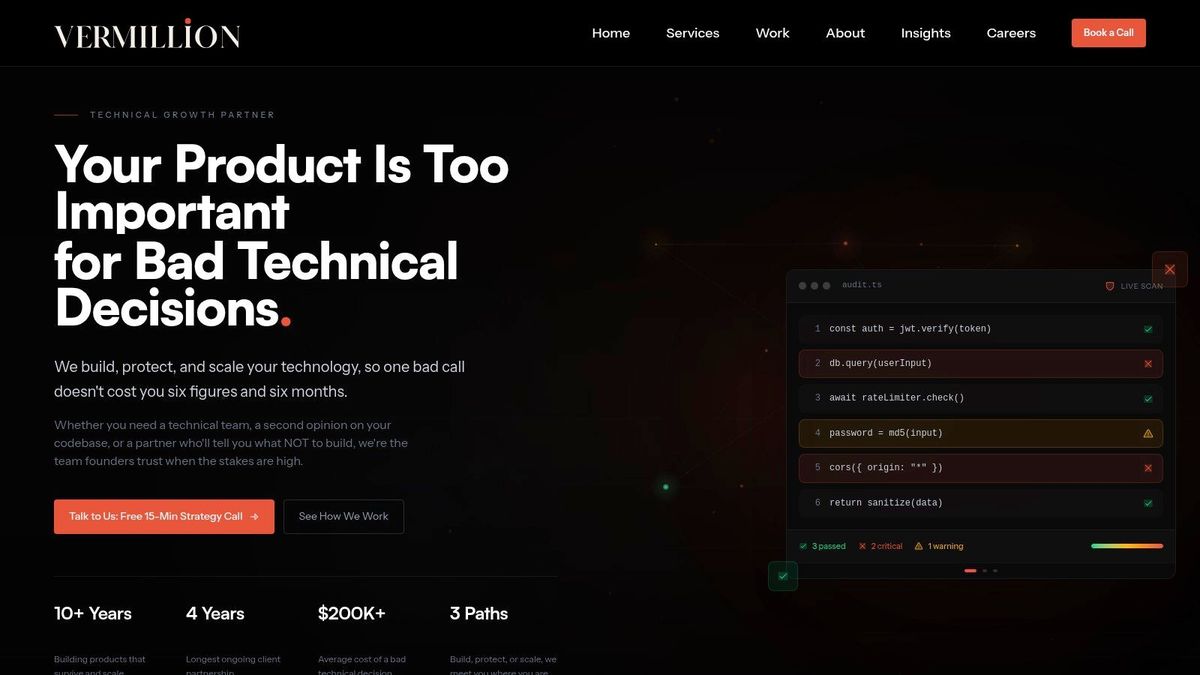
Vermillion stands out among the top mobile app development agencies by positioning itself as a "technical growth partner" rather than a traditional order-taking development shop. They offer a unique blend of senior engineering leadership and hands-on execution, designed specifically for funded startups and scaling companies who recognize that poor technical decisions can silently erode runway and opportunity. Their core philosophy is "judgment-first engineering," a proactive approach that prioritizes challenging assumptions and mitigating risks before they evolve into costly, six-figure rewrites.
This model is ideal for founders and product leaders who need more than just code; they need a strategic partner to guide architectural decisions, harden security, and ensure the product is built on a scalable foundation. For teams inheriting a messy codebase or preparing for due diligence, Vermillion’s process provides the clarity and remediation needed to move forward confidently.
Key Offerings and Engagement Model
Vermillion’s engagement model is transparent and structured to de-risk the partnership from day one. It begins with a free 15-minute strategy call to assess fit. From there, the typical entry point is their Technical Health Check, a one-week, $7,500 deep-dive audit of your entire codebase.
This audit is not a superficial scan. The team delivers a comprehensive Red/Yellow/Green risk map that pinpoints immediate threats, future scaling bottlenecks, and security vulnerabilities.
- Practical Example: The audit might identify an unoptimized database query as a "Yellow" risk (a future scaling bottleneck) and a missing authentication check on a critical API endpoint as a "Red" risk (an immediate threat). This actionable report provides a clear, prioritized roadmap for improvement. If you decide to continue into a monthly partnership, the cost of the audit is credited toward your first month, making it a low-risk diagnostic investment.
Ongoing collaboration is managed through tiered monthly retainers:
- Advisory ($5,000/month): Access to senior technical guidance and limited development.
- Core ($10,000/month): A dedicated team for core development, architecture, and ongoing leadership.
- Full Partnership ($15,000/month): An embedded team that functions as your fractional CTO and execution arm.
Strategic Advantages for Startups
The primary advantage Vermillion offers is its focus on preventing expensive mistakes. Instead of just building features as requested, they actively participate in product strategy, questioning if a short-term shortcut today will become a technical liability tomorrow. This proactive stance is particularly valuable for startups navigating the complex trade-offs between speed and stability. For a deeper look into their methodology, you can explore their guide to successful app development for startups.
Furthermore, they leverage modern AI-assisted tooling to accelerate development cycles and are adept at building AI-enabled product features and internal automations. This dual capability allows them to both ship faster and create more intelligent, efficient products. Case studies like their work with PicklePlay (which led to a successful acquisition) and Washlava (a marketplace scale-up) provide tangible proof of their impact on real business outcomes.
| **Feature** | **Description** |
|---|---|
| **Judgment-First Engineering** | Proactively identifies risks and challenges assumptions, acting as a strategic partner. |
| **Technical Health Check** | A one-week, fixed-price codebase audit that maps all technical risks and opportunities. |
| **Tiered Retainer Model** | Flexible monthly partnerships ($5K–$15K) to match different levels of need and budget. |
| **AI Integration** | Utilizes AI-assisted tooling for faster delivery and builds AI-native features for products. |
Who It's Best For
Vermillion is an excellent fit for:
- Funded startups ($500K–$5M+ raised) needing to build or scale a reliable product.
- Bootstrapped companies with traction that are ready to invest in a stable technical foundation.
- Teams that have inherited a complex or fragile codebase and need a clear path forward.
- Companies preparing for fundraising or acquisition due diligence.
However, their premium, retainer-based model is not suited for pre-revenue projects with limited runway or teams looking for the lowest-cost freelance developers to simply execute a predefined task list.
- Website: https://vermillion.agency
2. Clutch
Clutch is the heavyweight B2B directory for sourcing and vetting professional service firms, and its dedicated section for mobile app development is one of the most comprehensive resources available. Rather than a simple list, Clutch provides a deeply filterable database of agencies, fortified by a robust, analyst-led client review process. This makes it an indispensable tool for founders who prioritize due diligence and qualitative feedback when searching for top mobile app development agencies.
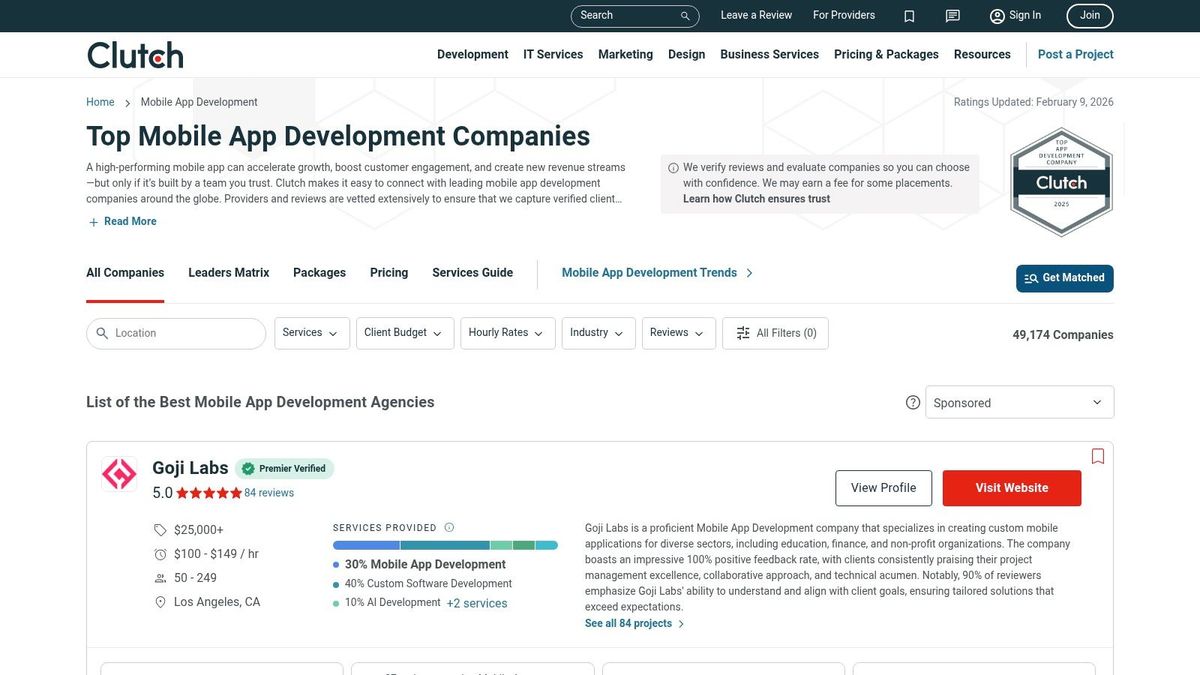
The platform’s core strength lies in its verified reviews. Clutch analysts conduct phone interviews with an agency's former clients to capture detailed, unbiased feedback on project management, technical quality, and business outcomes. These reviews go far beyond a simple star rating, offering narrative-style case studies that provide a clear picture of an agency's strengths and weaknesses. This qualitative data is gold for founders trying to assess risk and find a partner with a proven track record in their specific industry.
How to Use Clutch Effectively
To get the most value from Clutch, founders should move beyond the default rankings, which can be influenced by sponsored placements. Instead, leverage the powerful filtering tools to create a targeted shortlist.
- Filter by Location and Tech Stack: Start by filtering for agencies in your target region (e.g., U.S.-based) and those specializing in your desired technology, such as React Native or Swift.
- Set Budget Parameters: Use the filters for minimum project size and hourly rate to immediately disqualify agencies that are not a financial fit. This saves significant time on discovery calls.
- Focus on Verified Reviews: Prioritize reading the in-depth, verified reviews. Look for patterns in feedback related to communication, adherence to timelines, and the ability to contribute strategic product insights.
A practical approach involves shortlisting 5-7 agencies based on filters, then diving deep into the reviews of their 2-3 most relevant projects.
- Actionable Insight: Look for a review from a client who was in a similar stage to you (e.g., a Series A company). Did the agency adapt to their changing priorities, or did they rigidly stick to the initial scope? This insight reveals their flexibility, a critical trait when working with startups.
The platform is free to use for buyers; the agencies pay for premium placements and other marketing services.
Pros and Cons
| Pros | Cons |
|---|---|
| ✅ **Deep, Qualitative Reviews:** Verified, interview-based reviews provide unmatched insight into an agency's process and client relationships. | ❌ **Sponsored Placements:** First-page results can be biased by agencies paying for visibility, requiring users to filter actively. |
| ✅ **Granular Filtering:** Excellent filters for budget, location, industry, and technology make it easy to create a targeted shortlist. | ❌ **Not Transactional:** Clutch is a discovery tool, not a marketplace. You still need to conduct outreach, scoping, and negotiation. |
| ✅ **Upfront Triage Data:** Profiles clearly list minimum project size and hourly rates, saving time on initial qualification. | ❌ **Review Volume Varies:** Newer or smaller high-quality agencies may not have the volume of reviews to rank highly. |
3. G2 — Mobile App Development Companies (Development Services)
For founders and product leaders accustomed to vetting SaaS products, G2 offers a familiar and streamlined environment for sourcing service providers. Its dedicated category for Mobile App Development Companies leverages the platform's well-known review aggregation model, presenting a high-level, comparative view of potential partners. This makes it an efficient starting point for those looking to quickly gauge market sentiment and identify reputable top mobile app development agencies.
The primary strength of G2 is its user-friendly interface, which summarizes thousands of reviews into digestible star ratings and sentiment analysis. G2 categorizes feedback into common themes like "ease of doing business" and "quality of support," which helps buyers rapidly compare agencies on a like-for-like basis. This focus on aggregated sentiment is ideal for an initial screening phase where the goal is to create a broad list of candidates before diving into deeper due diligence.
How to Use G2 Effectively
To maximize G2's value, it's best used as a tool for initial discovery and sentiment analysis, rather than for deep technical vetting. Its interface excels at helping you quickly build a longlist of potential agencies.
- Focus on Market Segments: Use the provider scope information to filter for agencies that specialize in your company size (e.g., Small-Business, Mid-Market). An agency serving mostly enterprise clients may not be the right fit for a seed-stage startup.
- Scan Review Themes: Instead of reading individual reviews at first, look at the aggregated "What G2 Users Liked/Disliked" sections. This provides a quick summary of an agency's perceived strengths and recurring issues, helping you spot potential red flags early.
- Leverage Pricing Information: Some agency profiles list starting project prices or offer a "Get a Quote" call-to-action. Prioritize these to accelerate your outreach process and quickly eliminate agencies that are out of your budget.
A practical workflow is to identify 10-15 agencies that meet your market segment criteria and have strong overall ratings. From there, quickly scan their pros and cons themes to narrow the list down to a more manageable 5-7.
- Actionable Insight: If multiple reviews in the "Disliked" section mention "scope creep" or "unexpected charges," it’s a strong signal that the agency's project management or initial scoping process might be weak. This is a critical red flag for a startup on a tight budget.
These become your primary targets for further investigation on platforms like Clutch or through direct discovery calls. G2 is free for buyers to use; agencies pay for enhanced profiles and lead generation features.
Pros and Cons
| Pros | Cons |
|---|---|
| ✅ **Familiar UI for Quick Comparison:** Its software-review format allows for rapid, at-a-glance sentiment comparison. | ❌ **Lacks Technical Depth:** Reviews often focus on general project management rather than deep technical case studies. |
| ✅ **Efficient Initial Screening:** Helps quickly build a longlist of agencies based on aggregated reviews and market fit. | ❌ **Review Quality Varies:** The depth and detail of user-submitted reviews can be less consistent than analyst-vetted platforms. |
| ✅ **Clear Contact and Pricing Actions:** Many profiles include starting prices or quote requests, speeding up the outreach process. | ❌ **Less Granular Filtering:** Filtering options are less specific for technical stacks or niche industries compared to specialized directories. |
4. Upwork — App Development Companies (Agencies)
Upwork is a massive freelance marketplace that extends beyond individual contractors to include a dedicated directory for agencies. Its "App Development Companies" section serves as a high-velocity platform for founders who need to find, vet, and engage a development team quickly. Unlike traditional directories, Upwork integrates discovery with execution, allowing you to move from shortlisting to a formal contract with built-in payment protection, all within a single ecosystem. This makes it a compelling option for founders looking for top mobile app development agencies when speed is a critical factor.
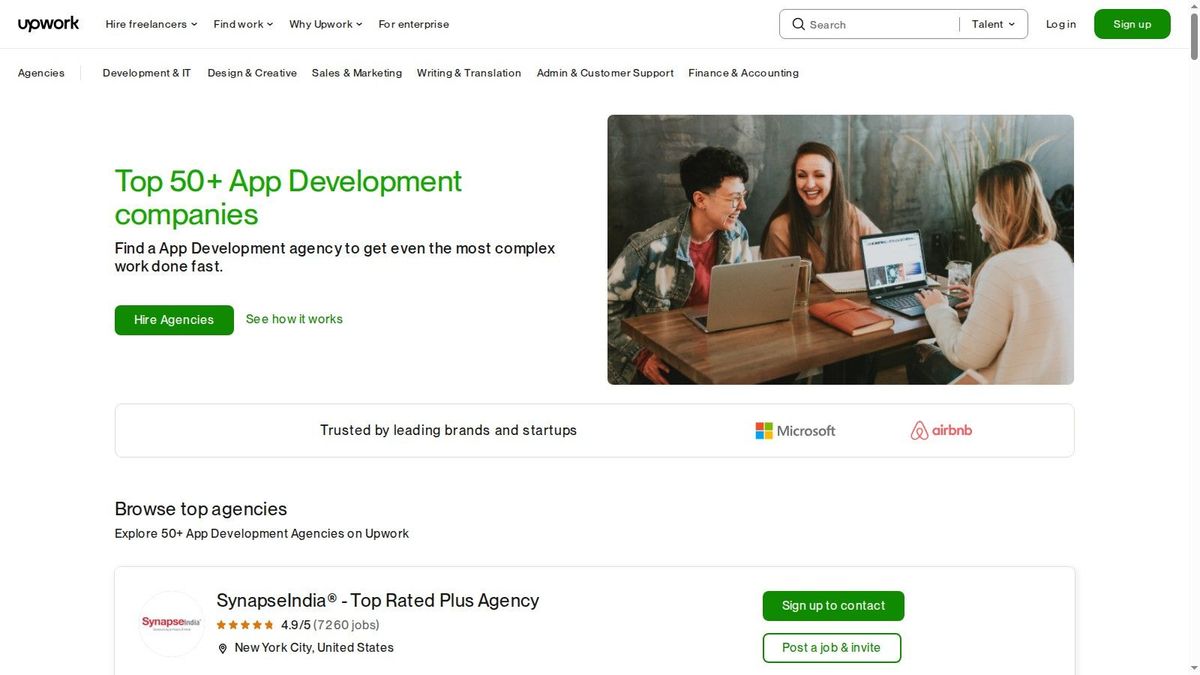
The platform’s key advantage is its streamlined contracting and payment infrastructure. Once you identify a suitable agency, you can initiate a fixed-price or hourly contract directly through the site. Upwork handles invoicing, provides escrow services for milestone-based projects, and offers dispute resolution, significantly reducing the administrative overhead and risk associated with global hiring. Agency profiles display crucial upfront data like hourly rate bands, team size, total hours billed on the platform, and client reviews, enabling rapid initial screening.
How to Use Upwork Effectively
Success on Upwork requires a structured approach to cut through the noise and identify high-quality partners. The sheer volume of options can be overwhelming, so effective filtering and vetting are non-negotiable.
- Focus on Agency-Specific Metrics: Look beyond individual freelancer ratings. Prioritize agency profiles with a high number of hours billed, a strong "Job Success Score" (90%+), and multiple positive reviews on projects similar to yours.
- Post a Detailed Job Brief: Create a clear, concise job post outlining your project scope, tech stack (e.g., React Native, Swift), and desired outcomes. This attracts relevant agencies and allows you to evaluate them based on the quality and relevance of their proposals.
- Conduct Paid Vetting Projects: For your top 2-3 candidates, consider creating a small, paid discovery project (e.g., a one-week technical audit or a feature-scoping exercise). This is a low-risk way to assess their communication, technical expertise, and project management style before committing to a larger engagement.
A practical workflow involves inviting 5-10 pre-vetted agencies to your job post, conducting video interviews with the 3-5 most promising respondents, and then running a paid discovery project with your top choice.
- Practical Example: A good paid trial project could be, "Create a proof-of-concept for integrating the Stripe payments SDK into a sample screen." This tests their ability to handle third-party APIs and deliver functional code within a tight deadline, validating their capabilities in a real-world setting.
Buyers pay a client marketplace fee (typically 5%) on all payments, with options like the Business plan offering additional features and reduced fees for large-volume U.S. clients using ACH.
Pros and Cons
| Pros | Cons |
|---|---|
| ✅ **Speed from Shortlist to Contract:** Integrated tools for hiring, contracting, and payment enable rapid team onboarding. | ❌ **Marketplace Noise:** Quality varies significantly, requiring diligent vetting to separate top-tier agencies from lower-quality providers. |
| ✅ **Abundant Supply Across Budgets:** A vast pool of agencies is available at nearly every price point, from boutique to large-scale. | ❌ **Client Service Fees:** A marketplace fee is added to every payment, increasing the total project cost compared to direct contracting. |
| ✅ **Transparent Procurement Workflow:** Clear fees, optional Business features, and built-in payment protection simplify the hiring process. | ❌ **Less In-Depth Vetting:** Agency reviews are client-written and lack the third-party analyst verification found on platforms like Clutch. |
5. Toptal
Toptal operates as a premium, curated talent network rather than a traditional agency directory. Its core value proposition is an intensive screening process that accepts only the top 3% of applicants, providing companies with direct access to elite freelance developers, designers, and product managers. This model is ideal for founders who need to augment their team with senior-level capacity quickly, without the high overhead of a traditional agency or the time-consuming vetting required by open marketplaces. For those seeking top mobile app development agencies, Toptal offers a unique hybrid: agency-level talent with freelancer flexibility.
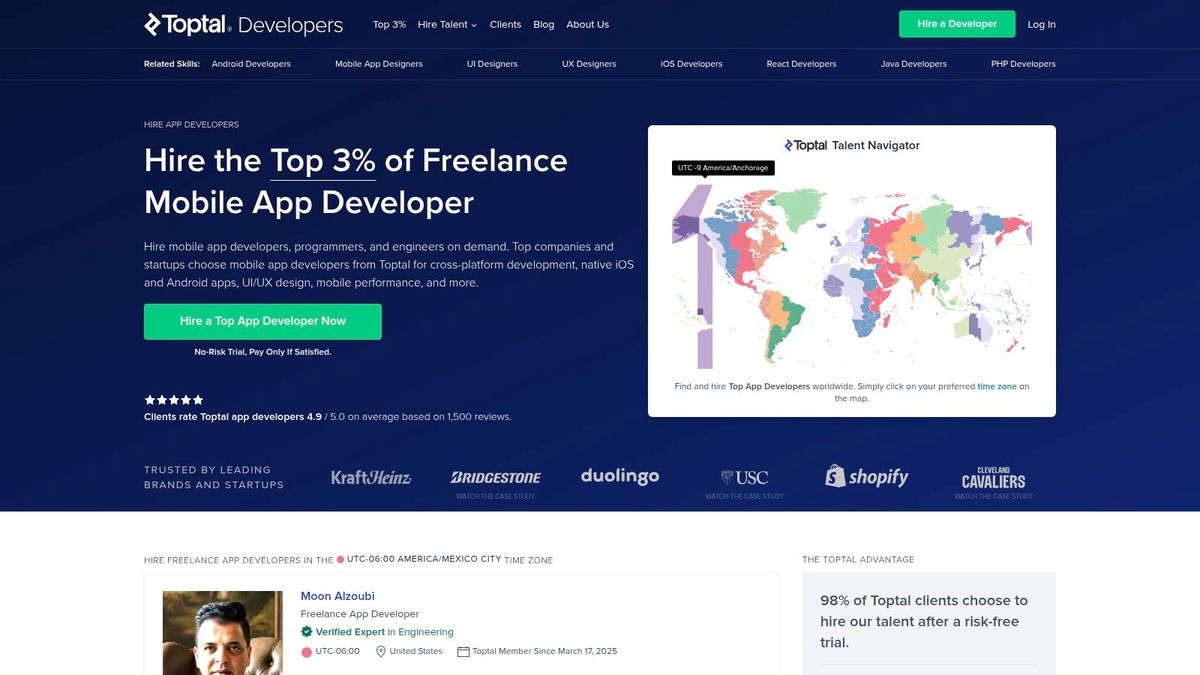
The platform's strength is its matching process. After an initial consultation, Toptal's team handpicks a small number of candidates whose skills and experience align precisely with the project's needs, often within 48 hours. This drastically reduces the founder's burden of sifting through dozens of unqualified applicants. Furthermore, Toptal stands behind its talent with a two-week, no-risk trial period. If the engagement isn't a perfect fit, the client isn't billed, which significantly de-risks the hiring decision for critical mobile development roles.
How to Use Toptal Effectively
To maximize value from Toptal, founders should treat it as a strategic staffing partner, not just a freelance board. Clarity and precision in your requirements are key to getting the best possible match.
- Define Your Need Precisely: Be explicit about your required tech stack (e.g., "senior iOS developer with Swift and SwiftUI expertise"), project duration, and weekly commitment (part-time or full-time). The more detailed your brief, the better the match.
- Leverage the Trial Period: Use the two-week trial for a real, scoped-out task. Assigning a small, well-defined feature or bug-fix sprint is an excellent way to evaluate a developer's technical skills, communication style, and integration with your team.
- Discuss Engagement Models: Toptal supports hourly, part-time, and full-time engagements. Be prepared to discuss which model fits your budget and roadmap. While rates are premium, understanding the different structures can help manage costs.
A practical approach for a startup is to hire a senior Toptal developer for a specific project, like building out a monetization feature or refactoring a problematic part of the codebase.
- Actionable Insight: Instead of a long-term contract, frame the initial engagement as a 3-month project to "Increase app performance by reducing load time by 30%." This outcome-oriented goal gives the developer a clear target and provides you with a measurable way to assess their impact.
This allows you to access top-tier talent for a critical need without the long-term commitment of a full-time hire.
Pros and Cons
| Pros | Cons |
|---|---|
| ✅ **Heavily Vetted Talent:** The rigorous screening process provides a strong signal of quality and seniority, saving significant vetting time. | ❌ **Premium Pricing:** Rates are higher than open marketplaces like Upwork, reflecting the caliber of talent. |
| ✅ **Fast Matching Process:** Typically provides a shortlist of qualified candidates within 24-48 hours. | ❌ **Smaller Talent Pool:** The highly selective process means the absolute supply of developers is smaller than larger platforms. |
| ✅ **No-Risk Trial Period:** A two-week trial allows you to assess the fit before committing financially, reducing hiring risk. | ❌ **Not a Full-Service Agency:** While Toptal can assemble teams, the model is primarily focused on providing individual experts. |
6. DesignRush — Top Mobile App Development Companies
DesignRush operates as a B2B marketplace and agency directory that curates lists of professional firms across various sectors, including a substantial category for mobile app development. It combines editorial-style roundups with a filterable directory, offering a useful starting point for founders conducting an initial landscape scan. Its frequent ranking updates and clear profile data make it a practical tool for building a preliminary list of potential partners among the top mobile app development agencies.
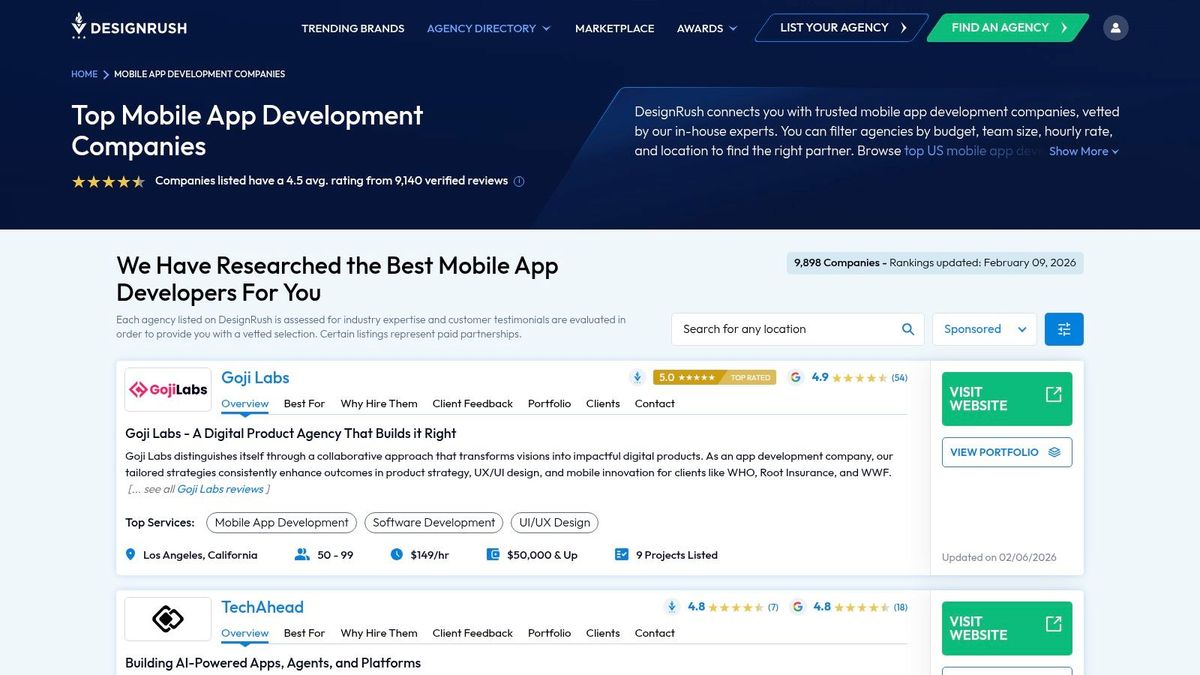
The platform's main value proposition is its blend of curated content and agency profiles. DesignRush frequently publishes "Top" lists and press roundups that are timestamped, giving a sense of recency. Agency profiles are often well-populated with key triage data like minimum project sizes, hourly rates, team size, and sample projects. This transparency allows founders to quickly disqualify agencies that are misaligned with their budget or scale before ever initiating contact, streamlining the initial discovery phase.
How to Use DesignRush Effectively
To maximize value from DesignRush, it's crucial to look past the top-level rankings and use the platform's tools to create a focused, relevant shortlist. The platform is free for businesses seeking agencies; agencies pay for premium listings and promotion.
- Focus on Niche Filters: Begin by using the filters for industry focus (e.g., FinTech, Healthcare), budget, and location. This is the fastest way to narrow the vast list to agencies with directly relevant domain experience.
- Analyze Profile Data First: Before reading reviews, scan the key data points on an agency's profile: hourly rate, minimum project size, and services offered. If your seed-stage startup has a $50k budget, you can immediately eliminate agencies with a $100k project minimum.
- Cross-Reference Claims: Use DesignRush as a discovery tool, not a final verdict. If an agency looks promising, cross-reference its portfolio and client testimonials on its own website and other review platforms like Clutch to get a more holistic view.
A practical approach involves identifying 10-15 potential agencies on DesignRush based on filters and profile data. From there, visit each agency's website to review detailed case studies.
- Actionable Insight: When reviewing a case study, don't just look at the final app screenshots. Look for process details. Do they mention user testing, A/B testing different designs, or post-launch performance monitoring? This shows a mature, results-driven process, not just a design-and-deliver shop.
This two-step process leverages DesignRush for its broad discovery capabilities while ensuring you conduct deeper, independent due diligence.
Pros and Cons
| Pros | Cons |
|---|---|
| ✅ **Good for Initial Scans:** Quickly generates a broad list of agencies, which is useful for understanding the market landscape. | ❌ **Pay-to-Promote Influence:** Rankings can be heavily influenced by sponsored placements, requiring users to look beyond the first page. |
| ✅ **Upfront Triage Data:** Profiles often include hourly rates, project minimums, and team size, which helps in rapid qualification. | ❌ **Promotional Tone:** The editorial "press" pages can feel more like advertisements than objective rankings, so skepticism is warranted. |
| ✅ **Niche Filtering:** Strong filters for industry and service focus help uncover specialized agencies that might be missed elsewhere. | ❌ **Review Verification Varies:** While a review system exists, its depth and verification process are less rigorous than more specialized platforms. |
7. GoodFirms — Top USA Mobile App Development Companies
GoodFirms serves as a long-standing B2B research and review platform, with its dedicated list of U.S.-based mobile app development companies acting as a valuable sourcing tool. Like other directories, it aggregates agencies but places a strong emphasis on regional search, making it particularly useful for founders looking to partner with firms in a specific city or state. Its transparent display of hourly rates, team sizes, and minimum project costs allows for rapid initial qualification, helping leaders quickly identify potential partners among the top mobile app development agencies.
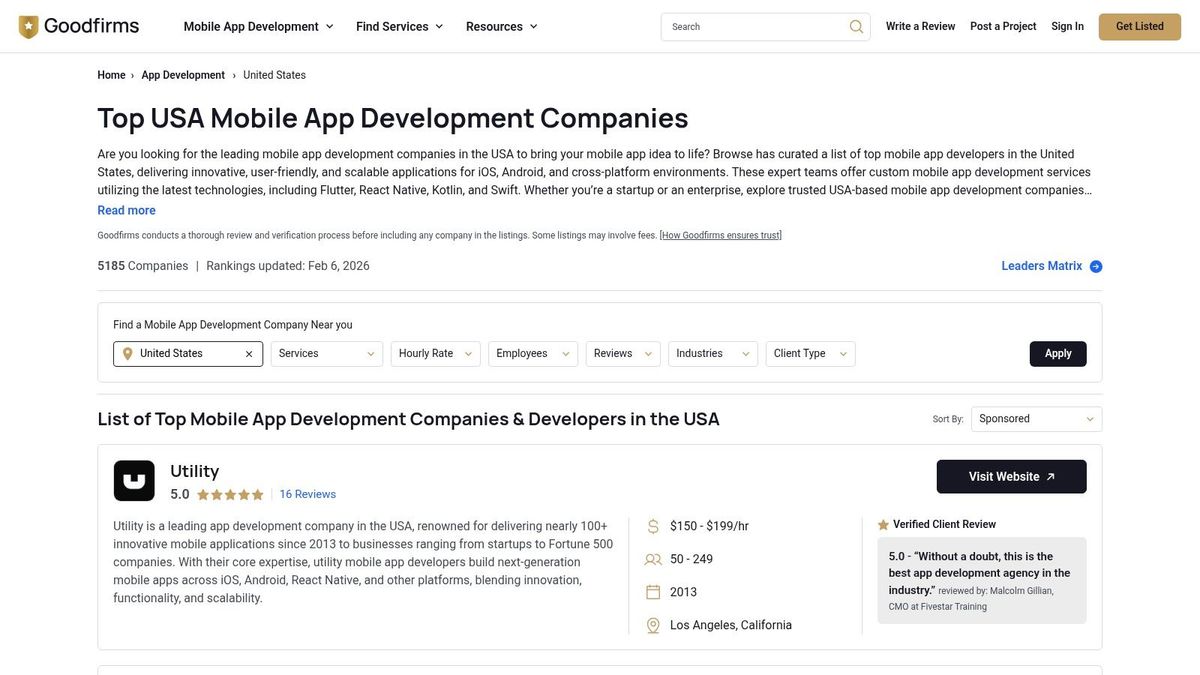
The platform’s primary utility for a founder is its role as a high-level triage directory. The "Verified" reviews offer a baseline of credibility, and the rich profile fields provide the essential data points needed for a first-pass assessment. While its review system is less narrative-driven than Clutch's, the structured data on industry focus, client segments (e.g., small business, enterprise), and technology stacks is clearly presented. This format is ideal for founders who prefer a data-centric approach to building an initial long list before diving into deeper qualitative research.
How to Use GoodFirms Effectively
The sheer volume of listings on GoodFirms can be a challenge, so a methodical filtering strategy is essential. The goal is to narrow the field from thousands to a manageable shortlist of highly relevant candidates.
- Leverage Geographic Filters: If co-location or time-zone alignment is a priority, start by filtering by state or major metropolitan area. This is a key strength of the platform for founders seeking a local or nearshore partner.
- Apply Budget Constraints First: Immediately use the "Hourly Rate" and "Min. Project Size" filters. This is the fastest way to eliminate agencies that are out of your budget range, preventing wasted time on outreach and discovery calls.
- Scrutinize Portfolio and Tech Stack: Once you have a filtered list, click into individual profiles. Pay close attention to the portfolio section and the listed technology services (e.g., iOS, Android, React Native). Look for evidence of past work that aligns with your product vision and technical requirements.
A practical workflow involves creating a list of 10-15 agencies based on location and budget, then cutting it down to 5-7 based on a deeper review of their portfolios and client focus.
- Actionable Insight: When checking a portfolio, don't just look at the brand names. Download the apps they've built from the App Store or Google Play. Is the app still live? Is it performant? Check the recent reviews. This real-world check provides more truth than a polished case study.
From there, you can proceed with outreach to the most promising candidates. Access to the directory is free for those searching for agencies; providers pay for enhanced visibility and sponsored listings.
Pros and Cons
| Pros | Cons |
|---|---|
| ✅ **Broad U.S. Coverage:** Extensive directory with strong geographic filters, perfect for sourcing agencies in specific states or cities. | ❌ **Overwhelming List Size:** The sheer number of agencies can make it difficult to find top-tier talent without aggressive filtering. |
| ✅ **Quick Budget Triage:** Upfront display of hourly rates and minimum project sizes allows for efficient financial qualification. | ❌ **Paid Placements:** Sponsored listings can influence rankings, requiring users to look beyond the first few results. |
| ✅ **Clear Data Presentation:** Agency profiles are well-structured with key data points like team size, industry focus, and tech stack. | ❌ **Varying Quality:** The quality and experience level of listed agencies can vary significantly, demanding careful vetting. |
Top 7 Mobile App Agencies Comparison
| Item | Implementation complexity | Resource requirements | Expected outcomes | Ideal use cases | Key advantages |
|---|---|---|---|---|---|
| Vermillion | Moderate–high — retainer onboarding, code audits, architecture work | Premium budget ($5K–$15K+/mo), access to codebase, executive time | Reduced technical risk, scalable architecture, audit reports, faster delivery | Funded startups, messy codebases, fundraising/acquisition prep | Judgment-first senior leadership, hands-on delivery, AI-assisted engineering |
| Clutch | Low — directory-based discovery and shortlisting | Time for research and outreach; no browsing cost | Shortlist of agencies with qualitative case studies and review context | Sourcing regional/mobile agencies, vetting vendors by review | Verified client reviews, detailed profiles, budget/location filters |
| G2 — Mobile App Dev | Low — browse ratings and summary comparisons | Time to compare reviews; follow-up for quotes | Quick sentiment comparison and provider fit signals | Fast market comparison, buyers who prioritize review metrics | Star ratings, review-derived pros/cons, integrated contact/quote flows |
| Upwork — Agencies | Low–medium — job posting to contract setup | Flexible budgets; time for interviewing; platform fees | Rapid hires or contracts and immediate execution capability | Founders needing quick execution across budgets | Fast contracting & escrow, abundant supply, clear fee structure |
| Toptal | Medium — screening/matching and trial onboarding | High budget (premium rates), defined scope for trials | Vetted senior talent, reduced vetting time, scalable teams | Need for senior engineers or building managed delivery teams | Rigorous screening, two-week no-risk trial, strong quality signal |
| DesignRush | Low — curated listings and editorial shortlists | Time to review profiles; be aware of sponsored placements | Curated shortlists by niche/budget and timestamped rankings | Initial landscape scans, niche or industry-specific searches | Editorial roundups, filters and profile details, sample projects |
| GoodFirms | Low — filterable U.S.-focused directory | Time to triage many entries; outreach required | Regional shortlists and budget triage via rate/min-size fields | U.S. regional sourcing and vendor comparison by state | Broad U.S. coverage, hourly/min-project fields, verified reviews |
From Shortlist to Partnership: Making Your Final Decision
Navigating the landscape of top mobile app development agencies can feel overwhelming, but this guide has equipped you with a curated list of platforms and partners to build your initial shortlist. We've explored everything from broad marketplaces like Upwork and specialized networks like Toptal to high-touch, strategic partners like Vermillion. Your task now is to transition from research to rigorous evaluation.
The right partner does more than just write code; they become an extension of your team, providing the strategic guidance necessary to navigate the complexities of scaling a mobile application. Remember, the choice isn't just about finding developers. It's about securing a partnership that aligns with your business goals, technical reality, and long-term vision.
Your Actionable Vetting Checklist
Choosing an agency is a significant investment of both capital and trust. To move from your shortlist to a signed contract with confidence, implement a structured due diligence process. Use the following checklist to systematically evaluate your top two or three candidates.
- Assess Communication and Cultural Fit: Schedule introductory calls with the agency’s leadership and the potential project lead. Pay close attention to their communication style. Do they listen more than they talk? Do they ask insightful questions about your business challenges, not just your feature list?
- Practical Example: During a call, present a vague feature idea, like "we want to add social sharing." A tactical agency might just ask for the spec. A strategic partner will ask, "What user behavior are you trying to drive with social sharing? How does this tie into your Q3 growth goals?" This reveals their depth of thinking.
- Demand a Technical Deep Dive: Insist on a technical discussion with the actual senior engineers who would be assigned to your project, not just a sales engineer. This is non-negotiable. You need to verify their expertise directly.
- Practical Example: Ask them to walk you through how they would approach refactoring a specific, problematic part of your existing codebase or how they would design the architecture for a critical new feature. Their ability to articulate trade-offs between performance, cost, and speed is a key indicator of their seniority.
- Request Hyper-Relevant Case Studies: Don't settle for generic success stories. Ask for case studies that mirror your specific situation.
- Practical Example: If you are a Series A fintech app struggling with technical debt from your MVP, ask for a case study from a B2C fintech client they helped scale post-Series A. Specifically, ask for metrics: "How did your work impact user retention, crash-free rates, or the cost of serving a new user?"
- Clarify the Offboarding Process: It might seem counterintuitive, but understanding how a partnership ends is as important as knowing how it begins. A professional agency will have a clear, documented process for knowledge transfer, ensuring you are never locked in.
- Practical Example: Ask them directly: "If we decide to bring development in-house in 12 months, what does your knowledge transfer and code handoff process look like? What documentation can we expect?"
Defining Your True Need: Executor vs. Strategic Partner
Ultimately, your final decision hinges on one critical question: What kind of partner do you really need right now?
If you have a perfectly defined product roadmap, a detailed technical specification, and strong internal technical leadership, a more tactical agency found through a platform like Clutch or Upwork might be sufficient. They can provide the raw development power to execute your vision.
However, if you're facing challenges like navigating significant technical debt, preparing your product for a due diligence audit, or needing a team that can challenge assumptions and prevent costly mistakes, you need more than just an executor. You need a strategic technical growth partner. This is where a firm like Vermillion distinguishes itself from other top mobile app development agencies. Their model is built for founders and leaders who need senior judgment to protect their business and ensure their technology is an asset, not a liability.
The journey from a great idea to a scalable, successful mobile app is a marathon. Choosing the right development partner is like choosing your lead pacer. They not only help you keep up the pace but also guide you around obstacles, conserve your energy, and ensure you have what it takes to cross the finish line strong.
Ready to de-risk your next technical investment and build a foundation that can truly scale? Vermillion specializes in helping funded startups and product leaders move beyond tactical execution to achieve strategic technical excellence. Start with our no-obligation strategy call or a fixed-price Technical Health Check to gain immediate clarity on your codebase and a roadmap for the future.