The Real Telemedicine App Development Cost A Founder’s Budget Guide
Building a telemedicine app isn't just about writing code; it's a serious investment into a market that's absolutely exploding—projected to rocket past $335 billion by 2032.
The first question every founder asks is, "So, what's this actually going to cost me?"
The short answer? A focused, lean Minimum Viable Product (MVP) can start around $50,000, while a complex, enterprise-grade platform can easily exceed $400,000. It's a huge range, I know. But the final number isn't arbitrary; it's tied directly to the complexity and ambition of your vision.
So, How Much Does a Telemedicine App Cost?
Think of it like building a house. A simple, one-bedroom cottage has a completely different budget and timeline than a sprawling mansion with a custom foundation and smart home integrations. The cost is a spectrum, not a single price tag.
Your initial investment directly shapes your app's market potential. An MVP gets your foot in the door quickly. It lets you validate your core idea with real patients and gives you something tangible to show investors. For example, a startup focused on dermatology could launch an MVP that only does one thing: allows patients to upload a photo of a skin condition for a quick, asynchronous review by a dermatologist. This targeted approach proves the model without the massive cost of live video or e-prescribing.
On the other hand, a full-featured platform is built for scale from day one, often designed to plug into existing hospital EMRs and handle complex compliance from the get-go.
Breaking Down the Budget Tiers
To give you a clearer picture, let's break this down into three common budget tiers. This should help you map your vision to a realistic financial plan. Each tier builds on the one before it, adding more layers of functionality, security, and complexity.
To give you a high-level view of what to expect, here’s a quick breakdown of the typical cost tiers.
Telemedicine App Cost Tiers At A Glance
| App Tier | Estimated Cost Range | Typical Timeline | Core Functionality |
|---|---|---|---|
| **Lean MVP** | $50,000 - $90,000 | 10-20 Weeks | Secure user profiles, basic appointment scheduling, and integrated video consultations. |
| **Mid-Level App** | $90,000 - $200,000 | 6-9 Months | All MVP features plus e-prescribing, payment gateway integration, and basic EHR/EMR connection. |
| **Enterprise Platform** | $200,000 - $400,000+ | 9-18+ Months | Advanced features like AI symptom checkers, remote patient monitoring, and full compliance automation. |
As you can see, the scope of work expands significantly as you move up the tiers, which is directly reflected in the cost and timeline.
Actionable Insight: The goal here isn't just to build an app; it's to build a scalable, revenue-generating asset. The right partner helps you align your budget with clear business outcomes. For a more personalized figure, playing around with an interactive app development cost calculator can show you exactly how different features move the needle on price.
Building regulated health software is a different beast altogether. For a deeper dive into the technical and compliance hurdles that influence these costs, the guide on mastering medical device software development is an excellent resource. It provides critical context, helping you frame the conversation not just around cost, but around long-term value and bulletproof compliance.
Deconstructing Your Budget One Feature At A Time
Trying to figure out your telemedicine app's final price tag without breaking it down feature-by-feature is like trying to price a house without knowing how many rooms it has. It’s an impossible guess. The final number isn’t some monolithic figure; it’s the sum of all the individual parts you choose to build.
This is where the abstract vision for your app starts to take real financial shape. Looking at costs on a feature level lets you make smart trade-offs. You can see exactly what to prioritize for your Minimum Viable Product (MVP) and what can wait, ensuring every dollar you spend directly contributes to what your first users actually need.
This breakdown shows how quickly costs can escalate as you move from a barebones MVP to a feature-rich enterprise platform.
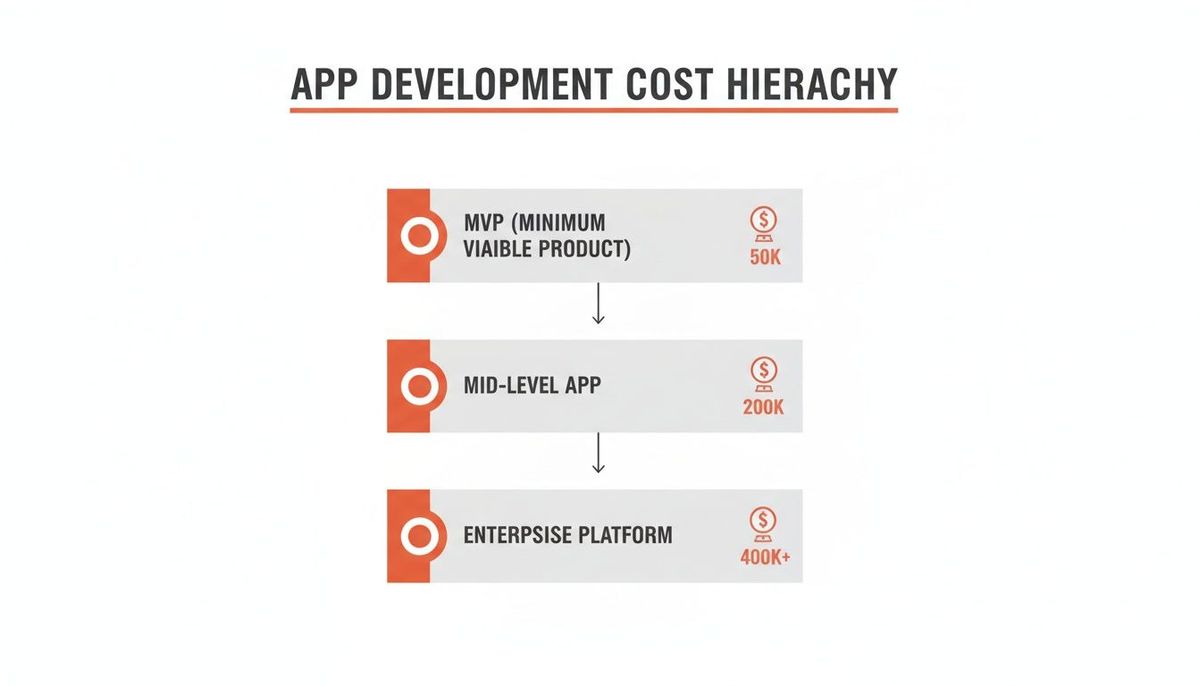
As you can see, the jump from a simple MVP to a full-fledged enterprise system isn't just a small step—it's a massive leap in investment, driven almost entirely by feature complexity and the heavy weight of compliance.
Patient and Provider Profiles
Every telemedicine app starts here: secure profiles for both patients and clinicians. But this is far more than a simple login screen. It’s the gatekeeper for the entire system, and it has to be bulletproof from day one.
Patient profiles need to handle personal info, insurance details, and medical history. Provider profiles are even more complex, managing credentials, specialties, and license verifications. Because you're dealing with Protected Health Information (PHI), the security stakes are incredibly high right out of the gate.
- Estimated Cost: $3,000 - $7,000
- Cost Drivers: The price climbs with features like multi-factor authentication (MFA), role-based access controls (differentiating a doctor from a nurse or an admin), and the secure, HIPAA-compliant database needed to store it all. A practical example: Implementing role-based access for a small clinic (doctor, nurse, admin) is simpler. For a hospital system with dozens of roles (specialists, residents, billing), the logic becomes exponentially more complex and costly.
Appointment Scheduling and Calendar Sync
Once users are in, they need a dead-simple way to book appointments. A solid scheduling system is the logistical heart of your app, completely replacing the old-school friction of phone tag and manual calendar invites.
This feature has to juggle different time zones, show real-time provider availability, and send out automated reminders to slash no-show rates. Users also expect it to sync flawlessly with their personal calendars like Google Calendar or Outlook, which adds another layer of technical work.
- Estimated Cost: $4,000 - $9,000
- Cost Drivers: The main cost drivers are the real-time calendar sync, building out the automated notification system, and the complexity of the booking logic itself. Think about handling recurring appointments or multi-provider consultations—that's where the work adds up. For instance, scheduling a single 15-minute consult is simple. A system that can book a complex therapy session requiring two different specialists at the same time can nearly double the development cost for this one feature.
Secure Video Conferencing
The video call is the virtual visit. It's the core of the experience, and it has to be absolutely reliable and secure. One dropped call or security scare can instantly vaporize user trust and make the whole platform feel useless.
You have two real paths here. Integrating a third-party API like Twilio is the faster, more budget-friendly route for an MVP. Building your own custom video solution with WebRTC gives you more control but comes with a much steeper price tag and a significantly longer timeline.
Actionable Insight: For most startups, using a third-party video API is a no-brainer. You get enterprise-grade security and reliability without the massive upfront engineering cost, freeing up your budget to build the unique features that actually set your app apart—like a custom patient intake form or a post-visit follow-up survey.
- Estimated Cost (API Integration): $8,000 - $15,000
- Cost Drivers: Your final cost will depend on which API provider you choose, how much you want to customize the video interface, and whether you need to add features like session recording, screen sharing, or an in-call secure chat.
E-Prescribing and Pharmacy Integration
For most telehealth platforms, the appointment isn't truly over until the prescription is sent. E-prescribing closes the loop, allowing doctors to send prescriptions directly to a patient's preferred pharmacy.
This is a feature with a heavy compliance burden. It requires strict provider identity verification and a secure, auditable data trail, all governed by regulations. Because of the hurdles, this is almost never built from scratch; you’ll be integrating with a certified e-prescribing network like Surescripts.
- Estimated Cost: $5,000 - $12,000
- Cost Drivers: Costs here are mostly from the licensing and integration fees charged by the e-prescribing network. The rest is the development work needed to build a smooth interface for providers to write prescriptions and for patients to select their pharmacy. A practical example: a simple integration might just allow sending new prescriptions. A more complex one could cost more by adding features for medication refill requests and prior authorization workflows.
Uncovering The Hidden Cost Drivers In Your Tech Stack
The features your users see—the slick interface, the easy scheduling—are only half the story. Under the hood, a series of critical backend and platform decisions quietly control a massive chunk of your total telemedicine app development cost. These are the hidden drivers, the architectural choices that make or break your app's security, scalability, and long-term success.
Think of it like building a hospital. You don't see the foundation, the plumbing, or the electrical grid, but they are absolutely non-negotiable for the building to function safely. In digital health, your backend architecture and compliance framework serve this exact purpose.
The True Cost of HIPAA and GDPR Compliance
One of the most common—and dangerous—budgeting mistakes is treating HIPAA or GDPR compliance like a checkbox. It's not a feature you can just "add on" at the end. It’s a foundational commitment that has to be woven into every single line of code and server decision from day one.
Actionable Insight: A truly compliant architecture demands end-to-end encryption, strict access controls, secure data storage, and audit trails for every interaction with Protected Health Information (PHI). This isn't a small task; it can easily account for 10-20% of your entire development budget.
Trying to bolt this on later is a recipe for disaster. You'll either end up with expensive, insecure patchwork or, even worse, crippling fines. For example, a simple chat feature becomes far more expensive when it must be HIPAA-compliant, requiring every message to be encrypted in transit and at rest, and logging every time a user accesses a conversation containing PHI.
Navigating EHR and EMR Integrations
For most telemedicine apps, connecting with existing Electronic Health Record (EHR) or Electronic Medical Record (EMR) systems is a killer feature. It allows doctors to get a complete patient history without tedious manual entry, creating a seamless clinical workflow.
But integrating with healthcare giants like Epic or Cerner is notoriously difficult. These legacy systems often use a mix of older data standards like HL7v2 alongside modern ones like FHIR. Each integration becomes its own custom project, demanding specialized knowledge and a ton of development hours just to map data fields correctly and ensure the connection is secure.
Here’s a real-world example: A basic, read-only data feed from an EHR to pull patient demographics might run you $15,000 - $25,000. But if you need a more complex, bi-directional integration that lets your app write appointment notes back into the EHR? That figure can easily jump past $50,000 per system because of the intense testing and validation required.
Choosing Your Platform: Native vs. Cross-Platform
This is arguably the single biggest decision that will impact your budget. When it comes to building your mobile apps, you have two main paths, and the financial implications are massive.
- Native Development: This means building two completely separate applications from the ground up—one for iOS (with Swift) and another for Android (with Kotlin). While this approach delivers the absolute best performance, it also essentially doubles your development team, your timeline, and your cost. It’s two of everything.
- Cross-Platform Development: This is the game-changer. Frameworks like React Native let your team write a single codebase that runs beautifully on both iOS and Android.
For a startup, the efficiency of going cross-platform is just undeniable. You can slash your development costs by a solid 30-40% because you're building, testing, and maintaining one app instead of two. That's capital you can pour back into marketing, user acquisition, or other critical growth activities. We break down these savings in much greater detail in our guide to React Native app development cost.
The telemedicine market is exploding, with some projections showing it could hit $710 billion by 2034. This incredible growth highlights just how important it is to make smart, scalable tech choices right from the start. Building a platform that is compliant, integrated, and cost-effective is your ticket to capturing a piece of this opportunity.
How Your Team's Location And Model Impact Your Bottom Line
Once you’ve locked down what you’re building, the next big question is who is going to build it. This decision can swing your total telemedicine app development cost more dramatically than almost any feature you choose. Your development team isn't just a group of coders; they're a strategic partner, and their location and how you work with them will directly shape your budget.
Think about it: the global talent pool offers a massive range of rates. A great developer in North America might bill at $100-$200 per hour, while an equally talented engineer in Eastern Europe could be in the $40-$80 per hour range. Over a project spanning several months, that difference doesn't just add up—it compounds. Geography is one of the biggest cost levers you can pull.
Comparing Developer Rates Across The Globe
In 2025, building a telemedicine app is a global game. A solid MVP can run anywhere from $40,000 to over $150,000, and hourly rates are a huge piece of that puzzle. The telehealth market is on fire, hitting $112 billion this year and projected to race towards $335 billion. This explosion in growth means more demand for skilled developers everywhere, but where you hire them can make or break a startup's budget. To get a better sense of the market, you can dive deeper into these telemedicine app cost findings.
So, let's break down what those rates look like and what you're really getting for your money in different parts of the world.
A quick look at the global landscape shows just how much location matters. For startups, finding the sweet spot between cost, quality, and communication is everything.
Hourly Developer Rates By Region Comparison
| Region | Average Hourly Rate (USD) | Pros | Cons |
|---|---|---|---|
| **North America (US/Canada)** | $100 - $200 | Deep expertise in HIPAA compliance and seamless time-zone collaboration for US-based startups. | The highest development costs, which can quickly drain a seed-stage budget. |
| **Western Europe (UK/Germany)** | $80 - $150 | Strong technical talent with a deep understanding of GDPR and other EU regulations. | High costs and significant competition for top-tier developers. |
| **Eastern Europe (Poland/Ukraine)** | $40 - $80 | A perfect balance of high-quality code, strong technical education, and moderate costs. | Minor time zone differences may require some scheduling adjustments. |
| **Latin America (Brazil/Mexico)** | $30 - $70 | Growing talent pool with good cost efficiency and overlapping business hours with the US. | Experience with complex healthcare regulations can be less consistent. |
| **Asia (India/Philippines)** | $25 - $50 | The most budget-friendly option, ideal for well-defined tasks and MVPs. | Potential for significant time zone and communication challenges. |
As you can see, the cost savings can be huge, but it's a balancing act. The key is to find a partner who understands the nuances of healthcare, regardless of their location.
Choosing Your Engagement Model
Beyond where your team is, how you work with them is just as important. The engagement model you choose sets the rules of the game—it defines incentives, who holds the risk, and the entire dynamic of your partnership.
Actionable Insight: Your choice of engagement model is really a statement about your appetite for risk. Are you paying for hours, a fixed scope, or tangible business results? For example, if your goal is to reduce patient no-show rates, a performance model might tie a portion of the development fee to achieving a specific reduction target (e.g., a 15% decrease in no-shows within 6 months of launch).
Let's walk through the three main ways this plays out.
- Fixed-Price Model: This model feels safe at first glance. You agree on one price for a very specific scope of work. It’s a good fit for small, highly predictable projects where you know nothing will change. The catch? It’s completely rigid. Any new idea or change means stopping everything to renegotiate, which can kill your ability to adapt and innovate.
- Hourly Model (Time & Materials): This is all about flexibility. You pay for the actual hours your team spends building your product, which is perfect for an agile approach where you're constantly learning from user feedback and making adjustments. The risk, of course, is that your budget can get away from you if the project scope isn't managed carefully.
- Performance-Based Model: This is where the industry is heading. A modern partner like Vermillion ties their success directly to yours. Instead of just billing hours, their compensation is linked to hitting key performance indicators (KPIs) that actually matter—like patient retention, monthly recurring revenue (MRR), or user engagement. This model shifts the focus from just shipping code to building a product that drives real business outcomes, which is the ultimate way to de-risk your investment.
Budgeting For Life After Launch: Maintenance And Scaling
Getting your telemedicine app to launch is a huge milestone, but it's not the finish line. It’s the starting line. The initial telemedicine app development cost gets you in the race, but your post-launch budget is what keeps you competitive. I've seen too many promising apps falter after a strong start simply because they failed to plan for what comes next.
Think of it like buying a brand-new car. The sticker price is the big upfront hit, but you still have to budget for gas, insurance, and oil changes to keep it on the road. Your app is exactly the same. These recurring costs aren't surprises; they're predictable and absolutely essential for maintaining performance, security, and the trust of your users.
A solid rule of thumb is to budget 15-20% of your initial development cost for annual maintenance. So, if your MVP cost $100,000 to build, you need to have another $15,000 to $20,000 set aside for that first year just to keep the lights on and the platform secure.
Deconstructing Your Ongoing Expenses
That maintenance budget isn't just one lump sum for bug fixes. It's a pool of funds that covers several critical operational needs. These aren't optional line items—they are the lifeblood of your platform.
Here’s what that budget actually pays for:
- Server and Hosting Fees: Your app needs a place to live online. Services like Amazon Web Services (AWS) or Google Cloud provide the infrastructure, but they come with monthly bills that grow as your user base does. More patients means more data, and that means higher hosting costs. A practical example: a startup with 1,000 monthly active users might pay $500/month for hosting. At 50,000 users, that cost could easily climb to $5,000/month or more.
- Third-Party API Subscriptions: Those powerful features you rely on? They're not free. Video calls (powered by services like Twilio), payment processing (Stripe), and e-prescribing (Surescripts) all run on subscription models. As your usage climbs, so do these fees. For instance, a video API might charge per minute; a small practice's bill could be a few hundred dollars, while a large network's could be tens of thousands.
- Essential Security and OS Updates: Apple and Google roll out major operating system updates every single year. Your app must be updated to stay compatible. If you don't, it will start to crash, feel clunky, and you'll lose users fast. This also includes applying security patches to protect against new vulnerabilities.
Actionable Insight: Post-launch costs are not just about fixing bugs. They are strategic investments in scalability and security. A proactive approach to maintenance prevents costly downtime and protects the sensitive patient data that is the foundation of your users' trust.
Planning for Scalable Growth
As your user base grows, your costs will naturally follow. More users mean more server load, higher API bills, and a greater need for customer support. This is a great problem to have, but it can sink a startup that hasn't planned for it financially.
This is where a true development partner proves their worth. A good firm doesn't just hand over the code and vanish. They prepare you for this next phase with a structured handoff, providing clear documentation and training so your team actually understands the architecture. This empowers you to manage these scaling costs effectively, making smart decisions about when to upgrade infrastructure or roll out new features.
For a deeper dive, our guide on maintaining a mobile app provides key strategies for success and can help you build a much more robust post-launch plan.
Smart Ways to Lower Your App Costs Without Lowering Your Standards
Building a telemedicine app doesn't have to break the bank. The secret isn't cutting corners—it's about making sharp, strategic moves that get the most out of every dollar, especially when you're just starting out. It's all about efficiency and proving your concept.
By focusing on what delivers immediate value to your first users, you can build something powerful without draining your funds. The game plan is simple: get to market, prove people want what you've built, and get the traction you need to fund the next big push.

Start with an MVP (Minimum Viable Product)
The single best way to control costs is to launch a Minimum Viable Product, or MVP. This isn’t a cheap, feature-light version of your app. Think of it as a concentrated version that solves one core problem for one specific audience, and does it exceptionally well.
It’s like building an urgent care clinic instead of a full-scale hospital. You solve an immediate problem, confirm that people need your service, and create a solid base to build on later.
Here's what an MVP gets you:
- Real-World Validation: You can test your core idea with actual users before you pour money into features they might not even use. For example, a mental health app MVP could focus solely on connecting users with licensed therapists via secure chat, proving the demand before investing in complex video or group therapy features.
- Faster Investor Interest: A live product with real people using it is infinitely more convincing to investors than a PowerPoint deck.
- Priceless Feedback: Early user data is gold. It tells you exactly what to build next and ensures you're creating something people genuinely want.
Use Cross-Platform Development to Your Advantage
Building separate, native apps for both iOS and Android from day one is a massive cash burn. There's a much smarter way.
Using a cross-platform framework like React Native lets your team write one codebase that works on both operating systems. This move alone can slash your mobile development costs by a staggering 30-40%.
The telemedicine market isn't just growing; it's exploding. It hit $83.5 billion in 2022 and is on track to reach $455.3 billion by 2030. Smart startups are riding this wave by being clever with their budgets. For instance, one company launched a lean iOS-only MVP for just $57,000. Another built a $155,000 cross-platform app that cut patient no-shows by 27%, adding $420,000 to their annual revenue.
These examples prove that a single codebase gets you to market faster and delivers a much higher ROI.
Don't Forget About R&D Tax Credits
This is one financial tool too many founders overlook. Many countries offer Research & Development (R&D) tax credits to incentivize companies pushing technical boundaries. Guess what? Building an innovative telemedicine platform often qualifies.
Actionable Insight: This isn't just some small rebate. R&D tax credits can cut your effective development costs by up to 40%. For example, in the UK, the RDEC scheme allows companies to claim back a percentage of their qualifying R&D expenditure. A development agency experienced in this area can help you meticulously track qualifying expenses (like developer salaries and software licenses) to maximize your claim.
When you pair smart development strategies with financial incentives, you create a powerful, budget-friendly path to launch. For a deeper dive into financial planning, check out these proven strategies for sustainable savings in the healthcare space.
Common Questions About Telemedicine App Costs
When you're figuring out the budget for a new telemedicine app, a few questions always pop up. Here are the straight answers I give founders every day.
How Long Does It Take To Build A Telemedicine App?
The honest answer? It depends entirely on how much you're trying to build right out of the gate.
A focused Minimum Viable Product (MVP)—something that proves your core concept and gets you in front of early users—can be market-ready in as little as 10-20 weeks.
If you're aiming for a more robust platform with features like e-prescribing or integrated payments, you're looking at a 6-9 month timeline. For a full-blown, enterprise-grade system with complex integrations and automated compliance, you should plan for a year or more.
Is HIPAA Compliance A One-Time Cost?
No, and thinking it is can be a fatal budgeting mistake. HIPAA compliance isn't a feature you just "build" once; it's an operational commitment you live and breathe every single day.
The initial build lays a secure foundation, sure. But the real costs are ongoing. You have to budget for things like secure hosting, regular third-party security audits, continuous team training, and maintaining compliant data handling procedures. These are running expenses, not a one-and-done item on your development invoice.
Actionable Example: Think of HIPAA compliance like hospital-grade sterilization. You don't just clean the operating room once; it's a constant, vigilant process. In practice, this means budgeting for annual penetration tests (which can cost $5,000-$20,000) and ongoing employee training on data privacy, ensuring your team doesn't become the source of a breach.
Can I Use A Template To Save Money?
Using a template or a white-label solution feels like a smart shortcut upfront, but it almost always leads to bigger problems down the road. You’ll hit a wall with customization, you won’t actually own the source code, and trying to scale becomes a nightmare.
For any startup serious about growth, creating a unique user experience, and attracting investors, a custom build is the only real path forward. It doesn't have to break the bank, either. Using a smart, cross-platform framework like React Native gives you the control and flexibility you need to build a valuable asset that can actually scale with your business. For example, a template might lock you into a specific payment provider, but a custom app lets you integrate with the one that offers the best rates for healthcare transactions, saving you money in the long run.
Ready to build a telemedicine app that proves traction and delivers real ROI? The team at Vermillion specializes in creating revenue-ready React Native apps with a performance-based model that aligns our success with your business goals. Learn how we can get your app to market in as little as 10 weeks.