Startup MVP Development Services Your Guide to Building a Winning Product
Startup MVP development services are a founder's secret weapon for one simple reason: they stop you from building something nobody wants.
The whole point is to launch the absolute core version of your idea to prove people will actually use it before you sink a ton of time and cash into it. It’s the fastest way to get from a concept on a napkin to feedback from a real, live user.
Why Smart Founders Start With An MVP
Picture a sea captain hunting for a legendary treasure. The foolish captain spends two years and every last piece of gold building a massive, fancy galleon before ever even glancing at a map.
The smart captain? They build a small, fast boat first. It's just big enough to check the currents, test the waters, and make damn sure the treasure is actually out there.
That small boat is your Minimum Viable Product (MVP). It’s not the final galleon; it’s the discovery tool. The #1 reason startups fail isn’t because they lack features or have an ugly design—it’s because they lack customers. An MVP tackles that risk head-on.
The Ultimate Risk Mitigation Tool
Using startup MVP development services is all about killing risk. Instead of guessing, you start operating on real data. The entire game is about learning as much as you can, as fast as you can, for as little money as possible.
- Protect Your Cash: You avoid burning your entire budget on features that, it turns out, your users couldn't care less about.
- Learn Faster: An MVP gets your product in front of real people in a few months, not a few years. That feedback is gold and tells you exactly what to build next.
- Get Investors Interested: A running product with actual users and validated data is infinitely more convincing than a slide deck full of promises.
Think of an MVP less as a "minimum product" and more as the "maximum validated learning" you can squeeze out of the smallest possible effort. It’s a process, not just a thing you build.
A Practical Example in Action
Let's say you have an idea for a feature-packed social media app for local chefs. The old-school approach would be to spend a year building everything: profiles, direct messaging, event creation, and a recommendation algorithm. This could easily blow through your seed funding before a single chef signs up.
Actionable Insight: The MVP approach focuses on validating the core hypothesis: "Will chefs in the same city actively engage with each other online?" The first version might just be a simple web app with a single feature: a "Chef's Table" forum where they can post questions and share tips. You could build this in weeks for a fraction of the cost. Success isn't measured by features, but by the number of active weekly discussions. If you get crickets, you've saved a year and your funding. If it takes off, you've just proven your core idea and know exactly what to build next based on what they're talking about.
Smart founders know that the Agile Minimum Viable Product isn't really a product at all—it's a tool for rapid learning and iteration. This mindset shift is what separates the startups that make it from the ones that burn through their funding building in the dark.
Understanding the Scope of MVP Development Services
Hiring a team for startup MVP development services isn't like ordering code off a menu. Think of it as bringing on a fractional CTO—a strategic partner who will challenge your assumptions and co-pilot the journey from a raw idea to a market-ready product.
The best engagements don't kick off with coding. They start with a deep-dive discovery workshop. This is where your vision gets stress-tested. A top-tier team won’t just take your feature list at face value; they'll rigorously question your core hypotheses about your users and their problems to make sure you're building the right thing from day one.
This initial phase is all about de-risking the entire venture before a single line of code is written. It forces you to get laser-focused on the single, most critical user journey the MVP has to solve perfectly.
From Core User Journey to Technical Foundation
Once that core problem is nailed down, the focus shifts to crafting a streamlined user experience (UX). The goal isn't to build every shiny feature you can dream up. It's about designing a frictionless path for your first users to solve their primary pain point, keeping the product lean and intuitive.
At the same time, crucial architectural decisions are being made in the background. This is where a partner's experience is worth its weight in gold. They’ll help you choose a technology stack that balances immediate needs with future growth.
- Speed vs. Scale: Do you use a framework like Firebase for lightning-fast development, or build a more robust backend with Node.js to handle future scale?
- Platform Choice: Is a responsive web app enough to start, or does your user base demand a native-like React Native application for a slicker mobile experience?
These aren't just technical choices; they're business decisions. A true development partner aligns the technology with your business goals, building a foundation that won't accumulate the kind of technical debt that cripples startups after launch.
A common mistake is treating the MVP tech stack as a temporary throwaway. The right services build a production-ready foundation, ensuring the architecture is engineered to scale alongside your success, not hold it back.
A professional MVP build is a comprehensive process that turns an idea into a functional, market-ready product. It covers everything from initial strategy and design to development, analytics integration, and launch support. Below is a breakdown of what you should expect from a quality engagement.
Core Components of a Professional MVP Build
A breakdown of the essential deliverables and strategic considerations included in a high-quality startup MVP development service engagement.
| Component | What It Is | Why It's Critical for an MVP |
|---|---|---|
| **Discovery & Strategy Workshop** | An intensive session to validate the core problem, define the user journey, and map out the MVP's scope. | De-risks the entire project by ensuring you're building a solution for a real, validated user need. |
| **UX/UI Design** | Creating wireframes and a clean, intuitive interface focused on the primary user flow. | A great user experience is non-negotiable for early adopters. A confusing app gets deleted instantly. |
| **Mobile App or Web App** | The actual coded product, typically built using agile methodologies for rapid iteration. | This is the tangible asset that users interact with and that delivers the core value proposition. |
| **Backend & Database** | The server-side logic and data storage that powers the application's functionality. | A scalable and secure backend is the foundation for future growth and user trust. |
| **Payment Integration** | Securely connecting a payment processor like Stripe to handle transactions. | For any business model involving revenue, this needs to be architected correctly from the start. |
| **Analytics & Growth Tooling** | Integrating tools like Mixpanel or Amplitude to track user behavior and measure key metrics. | Turns the MVP into a learning machine, providing the hard data needed to iterate and prove traction. |
| **Deployment & Launch Support** | Managing the process of getting the app live on web servers or submitted to app stores. | Ensures a smooth, stable launch so your first users have a positive experience from day one. |
Ultimately, these components work together to create more than just a piece of software; they create a business asset designed for learning and growth.
Integrating the Essential Growth Engine
A modern MVP is more than a functional app; it's a learning machine from the moment it goes live. This means integrating essential systems for payments and analytics isn't an afterthought—it's part of the core build.
Practical Example: For a new fintech lending app, the MVP needs more than just a "Request Loan" button. A professional service integrates a trusted payment processor like **Stripe correctly from day one. This involves setting up secure transaction handling and basic compliance checks. Actionable Insight:** This isn't just about taking payments; it's about validating your business model. Can you successfully process a loan application and disburse funds? Proving this core mechanic works builds investor confidence and saves you from a complete, costly rebuild after you secure funding.
Similarly, analytics are baked in from the beginning. Tools like **Mixpanel or Amplitude** are woven into the user journey to track behavior, measure activation rates, and gather the data needed to make informed decisions. This turns your MVP into an engine for validated learning, giving you the traction data investors demand.
This visual shows how the MVP acts as a compass, guiding your initial idea toward the ultimate goal of a successful product through a cycle of learning and building.
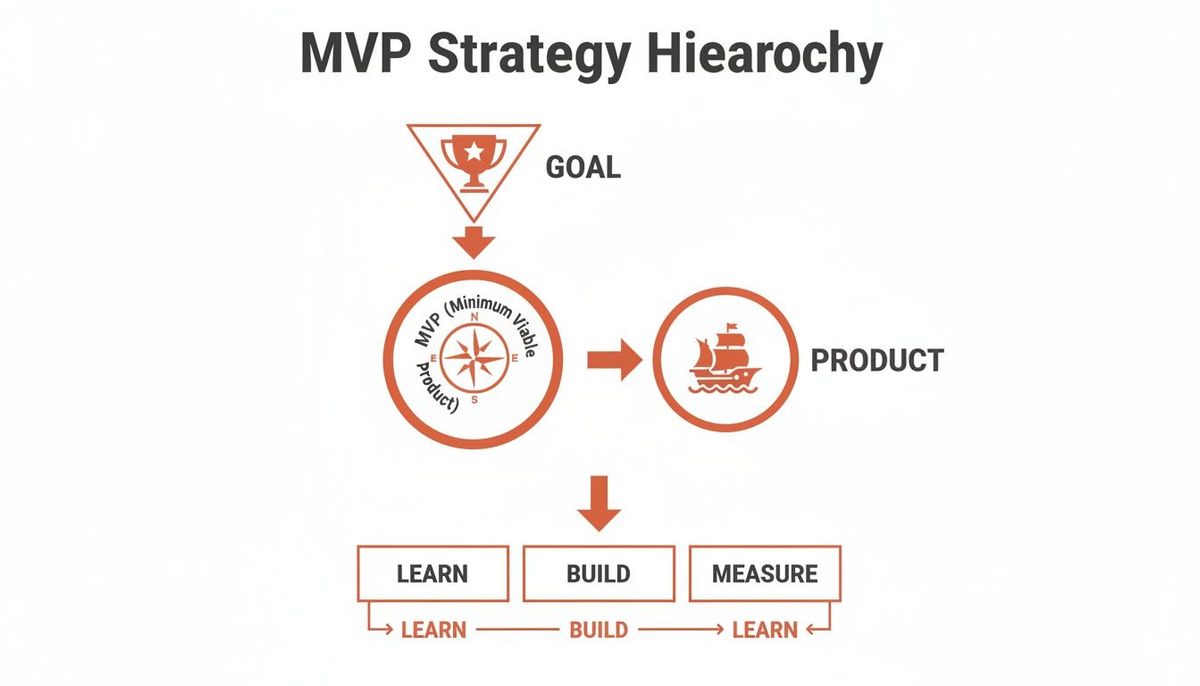
The key insight here is that an MVP is not the final destination. It's a critical navigational tool in the startup journey.
The Final Mile: Launch and Handoff
The partnership doesn't end when the code is deployed. A comprehensive service includes a smooth launch, managing everything from deployment to app stores to ensuring the server infrastructure is stable and ready for your first users.
After the launch, a critical knowledge transfer takes place. This isn't just a code dump; it involves detailed documentation and walkthroughs, empowering your internal team to understand the codebase, manage the application, and continue building on the solid foundation that's been laid.
This handover ensures you aren't dependent on the agency forever. It's the final step in transforming the engagement from a project into a lasting asset for your startup.
So, How Long Will This Take and What Will It Cost?
Every founder I talk to has two burning questions: "How long until we launch?" and "What's the damage?"
This isn't just about getting a price tag. It's about mapping out a financial strategy where your MVP isn't an expense, but an investment. You're not just buying code; you're buying validated learning and de-risking your entire venture.
The timeline and budget are completely tied to the scope. There's a universe of difference between a simple SaaS tool that automates a single spreadsheet task and a complex AI analytics platform that has to chew through messy data. Every feature, every slick animation, and every technical requirement adds another layer to the build.

What Really Drives the Cost and Timeline
A few key things will dictate the final budget and schedule. Getting your head around these will help you have a much better conversation with a potential development partner and set realistic expectations for your investors.
- Technical Complexity: A simple content app is straightforward. An MVP needing a custom AI model to analyze user data and provide real-time recommendations requires PhD-level talent and significant development time.
- Platform Needs: A responsive web app is the fastest to market. If your MVP is a photo-editing tool that requires access to native phone hardware (camera, GPU), a native app is non-negotiable, increasing complexity.
- Design and UX Polish: A clean, functional interface using standard components is efficient. A highly polished, custom-animated user experience requires significantly more design and front-end development cycles.
- Strategic Input: Is your partner just writing code, or are they a fractional CTO guiding your strategy? That deeper level of partnership is an investment that pays for itself with a stronger, more focused product.
Ballpark Budgets and Timelines
Every project is different, but you can get a general sense of where you'll land. A simple no-code prototype to test an idea might only take 3-4 weeks. A more robust, custom-coded MVP often lands in the 3-6 month range. The real goal is hitting that sweet spot between moving fast and building something solid enough to actually test your core hypothesis.
Your MVP budget isn't just for code. It's an investment in speed, learning, and momentum. The faster you get to market with a stable product, the sooner you can generate the feedback and traction needed to survive and thrive.
Across the board, MVP development costs have started to standardize. Simple no-code MVPs usually fall in the $5k-$15k range over 4-6 weeks. A custom mobile app of medium complexity will typically be between $30k-$60k over 2-4 months. For heavy-duty platforms involving AI or complex fintech, you could be looking at $60k-$150k+ over 4-8 months.
Getting to Market Faster
The best partners don't just build; they accelerate. Any modern team providing startup mvp development services should be using agile methods, breaking the project into small, manageable sprints. This approach means you're giving feedback constantly, making adjustments on the fly and ensuring the product doesn't drift away from what users actually need.
Top-tier teams also act as a force multiplier by using AI-assisted development. This isn't about letting an AI build your app. It means senior engineers use smart tools to handle the repetitive, boilerplate stuff. This frees them up to focus on the hard problems—architecture, complex logic, and performance—that make or break a product.
This blend of agile process and AI-assisted engineering gets you to market faster. You start collecting crucial user feedback sooner, all without cutting corners on the technical foundation.
For a deeper dive into the numbers, this software development cost budgeting guide is a great resource. You can also play around with different scenarios using our app development cost calculator.
Measuring Real MVP Success with the Right Metrics
Launching your MVP feels like crossing the finish line, but it’s actually the starting gun. The whole point of using startup mvp development services isn’t just to ship a product; it’s to build a learning machine. To do that, you have to ignore the siren song of vanity metrics and zero in on the data that truly signals a healthy, growing business.
Total downloads, website visits, or registered users might feel good, but they don't tell you if your product is actually solving a problem. These are vanity metrics—they look impressive on a slide deck but provide zero actionable insight. Are those thousand downloaded apps just sitting on a homescreen, unused?
The real game is measuring user behavior. Actionable metrics tell you what users are doing, not just that they showed up. This is what lets you make the tough calls: do we pivot, or do we double down on the current roadmap?

Key Metrics That Actually Matter
Instead of chasing big, empty numbers, smart founders track a handful of key performance indicators (KPIs) that prove the business model is working. These are the metrics that answer the most important questions about your startup's viability.
Here are the essentials to build your MVP dashboard around:
- User Retention Rate: This is the undisputed king of MVP metrics. It tells you what percentage of users come back after their first visit. High retention is the clearest signal you’re providing real, repeatable value.
- Activation Rate: This tracks the percentage of new users who complete a key "aha!" moment. For a project management tool, this might be creating their first task. It proves users aren't just signing up; they're actually engaging with the core feature.
- Customer Lifetime Value (LTV): This metric forecasts the total revenue a single customer will generate over their entire relationship with your product. Even an early, estimated LTV helps prove your business model can actually make money.
- Monthly Recurring Revenue (MRR): For any subscription startup, MRR is the lifeblood. Tracking its growth shows that users find enough value in your product to pay for it month after month.
The core purpose of an MVP is to answer one question: "Do people care enough about this to come back?" A high User Retention Rate is a definitive "yes" and the first true sign of product-market fit.
Benchmarks and Actionable Insights
Knowing what to track is only half the battle. You also need context. What does "good" actually look like? While benchmarks vary by industry, some general targets can point you in the right direction.
For a B2B SaaS tool, a Week 1 retention rate of 30% or higher is a strong signal. If your numbers are way below that, it’s a red flag that your initial user experience or core value prop isn't hitting the mark. This data tells you where to dig deeper. Are users dropping off during onboarding? Is the "aha!" moment too hard to find?
A low Activation Rate points to a similar friction point in the user journey.
Practical Example: A B2B SaaS MVP
Imagine you launched a SaaS tool for small businesses. You see 1,000 sign-ups in the first month (a vanity metric).
- Bad Data: "We got 1,000 users!"
- Good Data: "Our Activation Rate is only 15% (just 150 users created a project), and our Week 1 retention is a dismal 8%."
Actionable Insight: This data tells you the initial experience is failing. Your next development sprint shouldn't focus on new features. Instead, it must be laser-focused on fixing the onboarding. You could implement a guided product tour or simplify the project creation flow. The goal is to move that activation rate up, because you can't retain users who never get started. Understanding these product-market fit metrics is what separates the startups that guess from the ones that grow.
How to Choose the Right MVP Development Partner
Picking a partner to build your MVP is one of the most important calls you'll make as a founder. This isn't just about hiring someone to write code; it's about finding a strategic ally who can step in and act like a fractional CTO. The right team will challenge your assumptions, make your strategy stronger, and build a technical foundation that’s meant to last well beyond your launch.
A simple vendor takes your feature list and spits back a quote. A real partner starts by asking why those features are on the list in the first place. They’re obsessed with your business goals, not just checking off tasks. Their job is to be your guardrail, protecting you from your own blind spots and making sure every dollar you spend is a smart bet on learning what your customers actually want.
Getting this right is everything, especially when you look at the market. Startups are driving the demand for MVP development, making up the biggest and fastest-growing slice of the pie. They’re all racing to test ideas and lock down funding.
The market itself is projected to explode from $9 million in 2025 to over $1,200 million by 2033, a surge almost entirely fueled by this startup demand. But here’s the harsh truth behind those numbers: a lot of these startups will fail because they build a full product before ever finding out if anyone wants it. You can discover more insights about these market trends on datainsightsmarket.com.
Beyond the Portfolio: A Checklist for Vetting Partners
To tell the difference between an order-taker and a true strategic partner, you have to ask questions that get to the heart of their process and philosophy. A slick portfolio can hide a lot of problems. You need to go deeper.
Your mission is to find a team that thinks like a founder but communicates with the clarity of a CTO. They should be the ones flagging business risks and focusing on building something that won't fall over the second you start to grow.
Here are the questions I’d be asking any potential partner:
- Assumption Validation: "How do you challenge a founder's core assumptions? Give me a specific example of when you did this."
- Feature Pushback: "Tell me about a time you told a client not to build a feature they were dead set on. What was it, and why did you push back?"
- Technical Debt Strategy: "How do you balance moving fast with building quality code? What's your approach to managing technical debt so it doesn't kill us six months from now?"
- Scaling and Architecture: "Walk me through how you’d plan an architecture for us. How do you make sure it works for our first 1,000 users but doesn't need a total rewrite to handle 100,000?"
- Communication Cadence: "What does your day-to-day communication look like? How do you report progress, and more importantly, how do you handle it when things go wrong or the scope needs to change?"
Their answers will tell you more than any case study ever could. A great partner will have sharp, confident responses backed by real stories. They’ll welcome these tough questions because it shows they operate on a higher level.
Red Flags to Watch Out For
Knowing what to look for is only half the battle. You also need to know what to run from. A few common red flags can signal a vendor who’s more interested in their bottom line than yours.
Be very skeptical of any firm that:
- Instantly Agrees With Everything: If they never push back or question your ideas, they're not a partner—they're a yes-man. You’re paying for expertise, and that includes constructive friction that sharpens your vision.
- Focuses Only on Technology: The conversation should always come back to your business goals. If all they want to talk about is frameworks and programming languages without tying it to user retention or revenue, they're missing the entire point of an MVP.
- Provides Vague or Generic Answers: If you ask about managing technical debt and get a fuzzy, non-committal answer, it’s a massive warning sign. It usually means they don’t have a real strategy and just plan to build it cheap and fast.
- Offers an Unbelievably Low Price: A rock-bottom quote almost always means they're cutting corners on something critical—senior talent, quality assurance, or strategic oversight. You’ll end up paying for it later in the form of rewrites, delays, and a product that can’t scale. For more specific guidance on this topic, check out our guide on how to hire mobile app developers.
Your MVP partner's most valuable contribution isn't their code; it's their judgment. Choose the team you trust to tell you you're wrong. That's the team that will help you win.
Structuring Your Engagement with Pricing and Contracts
Getting the commercial side of an MVP build right is just as important as the tech. Nail the contract, and you create a partnership. Get it wrong, and you're set up for friction, misaligned goals, and a budget that evaporates before you even launch.
You'll almost always run into two core models: Fixed Price and Time & Materials. They sound simple, but the implications for a startup are massive.
Fixed Price vs Time and Materials
A Fixed Price contract feels safe. You get a single number for a defined scope of work, which is great for managing a tight runway. You know exactly what you’re spending.
But that predictability is also its biggest weakness: it’s rigid. An MVP is a learning machine. When your first users tell you to pivot, a fixed scope becomes an anchor. Every change requires a painful, slow, and expensive contract renegotiation.
The Time & Materials (T&M) model is the exact opposite. You pay for the team's actual time, which gives you the flexibility to adapt on the fly. When you get market feedback, you can immediately shift priorities without bureaucratic headaches. The trade-off? Less budget certainty. This model lives and dies on trust and transparent communication with your dev partner.
For almost every startup MVP, a T&M model with a capped budget per sprint is the way to go. It gives you the agility to iterate based on real user feedback while still controlling your monthly cash burn. It’s the best of both worlds, built for the reality of finding product-market fit.
Advanced Partnership Models
Once you move past the basics, you can structure deals that turn a vendor into a true partner with skin in the game. These aren't just contracts; they're incentive systems designed to focus everyone on your success.
Think about pushing for more advanced structures like these:
- Retainer with Performance Incentives: You pay a set monthly fee for the team, but a chunk of that fee is tied to hitting real business goals. Actionable Example: The team gets a bonus only after the MVP hits a 25% Week 1 user retention rate. Suddenly, they're not just shipping code; they're shipping outcomes.
- Equity or Revenue Share: For the right partner, you can negotiate a lower cash rate in exchange for a small slice of equity or a percentage of future revenue. This is the ultimate alignment. It makes your development firm an investor, deeply committed to your long-term growth.
The right model really depends on your stage, funding, and the relationship you have with your partner. The goal is to build a commercial foundation that forces everyone to obsess over the only thing that matters: building a product users can't live without.
Questions Founders Always Ask About MVP Development
Even with the best plan, you probably still have a few questions rolling around in your head. It’s completely normal. Let's tackle some of the most common ones we hear from founders just like you.
What’s the Real Difference Between a Prototype and an MVP?
It’s a classic question, and the distinction is critical.
Think of it like building a car. A prototype is a full-scale clay model. It looks exactly like the final car. You can sit in it, touch the dashboard, and see how it feels. But it has no engine. It can’t actually do anything. It’s all about validating the look and feel.
An MVP, on the other hand, is more like a go-kart built from the essential parts of that car. It has an engine, a steering wheel, and brakes. It’s not pretty, and it's missing the doors, windows, and stereo, but it can actually drive you from point A to point B. It’s a real, functioning product that solves the core problem, allowing you to learn from real-world use.
How Much User Feedback Do I Need Before Starting?
You don’t need hundreds of interviews, but you absolutely cannot start with zero. The sweet spot we've found is having deep, honest conversations with 5-10 people who perfectly fit your ideal customer profile.
The goal here isn't to get a feature wishlist. It's to validate one single thing: is the problem you're solving a real, painful, and urgent one for them? Their answers—their stories, their frustrations—are the fuel for a focused MVP.
Actionable Insight: Before building a task-management app for freelance designers, talk to 7 of them. Don't ask "Would you use this?" Ask "What's the most frustrating part of managing your client projects right now?" If they all say "tracking my hours for invoices," then your MVP's single feature should be a dead-simple time tracker and invoice generator, not a complex Kanban board. This is how you build what they actually need, not what you think they want.
This early validation is why the market for MVP development services is exploding, set to hit $21.5 billion by 2033. Founders are catching on that this is the best defense against the #1 startup killer: building something nobody actually wants. You can discover more insights about MVP market trends on esparkinfo.com.
At Vermillion, we don't just build software. We help you validate your vision and build a technical foundation that’s ready to scale when you hit product-market fit. If you're ready to turn your idea into real traction, let's talk about building an MVP that gets you learning from day one. Learn more about our approach.