Building Your Service On Demand App from the Ground Up
A service on demand app is basically a remote control for the real world. You need food, a ride, or your house cleaned? There's an app that connects you to someone who can do it, right now, with just a few taps on your phone.
The On-Demand Economy Explained

At its core, an on-demand app isn't just software; it's a bridge. It closes the gap between what someone needs right now and the person who can provide it. This whole model has completely changed our expectations. We're now wired to expect the same instant fix from real-world services that we get from firing up Netflix.
For founders, this creates a huge opportunity, but it also dials up the pressure immensely. People expect a flawless, fast, and reliable experience every single time. A solid technical foundation isn't just a "nice-to-have"—it's the only way to earn trust and survive in a market this competitive.
The Driving Force Behind On-Demand Services
This explosion in on-demand services didn't happen by accident. It’s the perfect storm of new tech meeting a massive shift in how we value our time. A few key things made it all possible:
- Ubiquitous Smartphones: The phone in your pocket is the command center. Actionable insight: This means your app's user interface must be designed for one-handed use, with critical buttons easily accessible by thumb, as users are often booking services while on the move.
- Convenience Culture: We're all short on time and willing to pay a premium to get some of it back. Convenience is the new killer feature. Actionable insight: Reduce friction at every step. For example, implement one-click payments and pre-filled forms to make booking a service take seconds, not minutes.
- Trust Infrastructure: Things like built-in payment systems, GPS tracking, and two-way reviews solved the age-old problem of trusting a stranger to do a job. Actionable insight: Make provider profiles robust. Include a clear photo, verified credentials, and unfiltered customer ratings to build instant trust before a transaction even begins.
This guide is a practical roadmap for founders. We're going past the buzzwords to dig into the critical tech decisions, business models, and growth strategies you need to build a successful on-demand platform from scratch.
The Scale of the Opportunity
The on-demand market isn't just a passing trend; it's a massive slice of the economy. Projections show the global market growing from an estimated $216 billion in 2026 to a staggering $346 billion by 2035. That's a clear signal of serious, long-term demand.
This growth isn't just in one area, either. It’s happening in everything from food delivery and home services to healthcare and logistics, proving just how deeply the service on demand model is becoming part of our daily lives. You can find more market data and learn about these on-demand industry trends.
Choosing Your On-Demand Business Model
Your business model is the blueprint for your technology. Picking the right one isn't just a business decision—it dictates your entire technical strategy before you ever write a single line of code. It defines how you operate, how you make money, and exactly what kind of software you need to build.
There are three dominant models in the on-demand economy. Each comes with its own set of operational headaches and technical trade-offs. Let's break them down so you can see which path fits your vision.
The Aggregator Model
Think of the Aggregator model as a digital storefront. You don’t own the inventory or employ the service providers; you simply connect users with existing, independent businesses. Companies like DoorDash and Grubhub are the classic examples—they don't run the restaurants, they just make it incredibly easy to order from them.
This model is popular for a reason: it allows for lightning-fast expansion. You can grow your user base without the crushing overhead of managing physical assets or a massive workforce.
The real challenge here is integration. Your entire platform's success hinges on your ability to seamlessly plug into the messy, disparate systems of your partners. This means building and maintaining bulletproof APIs to handle everything from menu updates and order placements to real-time status tracking.
- Practical Example: A local food delivery aggregator signs a popular pizzeria. The problem? The pizzeria uses an ancient point-of-sale (POS) system with no modern API. Actionable insight: Instead of a complex custom integration, offer the restaurant a simple tablet-based app that receives orders directly from your system. This standardizes the process, reduces errors, and is easier to scale than building one-off solutions for every partner.
The Provider-Centric Marketplace
In a Provider-Centric model, your platform exists to empower individual professionals to find clients. The focus shifts to creating tools for the providers themselves—the freelancers, tutors, or handymen who use your app to run their own small businesses. Upwork and TaskRabbit perfected this playbook.
Your platform becomes the central nervous system for discovery, booking, communication, and payments. This creates serious "stickiness" for providers because you're solving the administrative headaches they'd otherwise face alone.
Technically, your job is to build a powerful, multi-sided marketplace. This means sophisticated tools for provider profiles, scheduling systems that actually work, secure messaging, and a review system that builds trust. The matching algorithm is also mission-critical; it has to intelligently connect the right client with the right provider based on skill, availability, and reputation. To get a better handle on the revenue side, you might find it helpful to explore different subscription business model examples.
Practical Example: On a platform like TaskRabbit, a handyman can sync their personal calendar with the app's booking system. Actionable insight: Build this feature to automatically block off times they're unavailable, preventing double-bookings and saving them administrative time. This simple tool empowers the provider and directly increases their loyalty to your platform.
The Managed Marketplace Model
Finally, there’s the Managed Marketplace. This model gives you end-to-end control over the entire service experience. You hire the providers, you set the quality standards, and you often own the equipment. Companies like Sonder (hospitality) or Honor (senior care) use this approach to deliver a highly consistent service.
This model offers the highest potential for quality control and brand consistency, which can be an enormous competitive advantage. By managing every step, you can guarantee a level of service that aggregators simply can't touch.
The trade-off? Massive operational complexity. Your technology has to manage logistics, inventory, workforce scheduling, and quality assurance at scale. This requires building complex internal software for everything from employee onboarding and dispatching to route optimization and real-time performance monitoring. It’s easily the most capital-intensive model, but the reward is a superior, defensible user experience.
On-Demand Business Model Comparison
To make this crystal clear, here’s a simple breakdown of how these three models stack up against each other. Each has a fundamentally different technical DNA.
| Model Type | How It Works | Key Technical Challenge | Example Company |
|---|---|---|---|
| **Aggregator** | Connects users with existing third-party businesses. You're the middleman. | **System Integration:** Building and maintaining robust APIs to connect with diverse partner systems. | DoorDash |
| **Provider-Centric** | Empowers individual professionals to find clients and manage their business. | **Marketplace Dynamics:** Creating trust, sophisticated matching algorithms, and provider tools. | Upwork |
| **Managed Marketplace** | Employs providers and controls the entire service experience from start to finish. | **Operational Complexity:** Building internal software for logistics, scheduling, and workforce management. | Sonder |
Choosing the right model from the start is critical. It’s the foundation upon which your entire product, team, and company will be built. Pick the one that aligns not just with your market opportunity, but with the kind of company you're prepared to run.
Architecting a Scalable On-Demand Platform
Once you've landed on a business model, the next step is turning that vision into a real, working product. The architecture of your platform is its central nervous system; it dictates how fast you can move, how reliably you can operate, and whether you can actually handle success when it comes. A well-designed system is the difference between scaling smoothly and hitting a wall of expensive technical problems down the road.
At a high level, every service on demand platform has three distinct faces, or "front-ends," that users interact with.
- The Customer App: Think of this as your digital storefront. It has to be dead simple, fast, and completely focused on making it effortless for a user to find, book, and pay for whatever you're offering.
- The Provider App: This is the mission control center for your service providers. It needs to give them everything they need to accept jobs, manage their schedule, talk to customers, and, most importantly, get paid.
- The Admin Panel: This is your team's command center. It’s the behind-the-scenes dashboard for managing users, stepping in to resolve disputes, monitoring transactions, and getting a pulse on the health of your entire marketplace.
While these front-ends are what everyone sees, the real magic happens in the backend systems that make the whole operation tick.
The Core Backend Engines
You can think of the backend as a collection of specialized engines, each doing one critical job. When they all work together in perfect harmony, they create that seamless experience users just expect. A modern on-demand platform is really a symphony of several key systems.
This diagram shows the conceptual flow between different on-demand models, which directly impacts the kind of architecture you'll need to build.
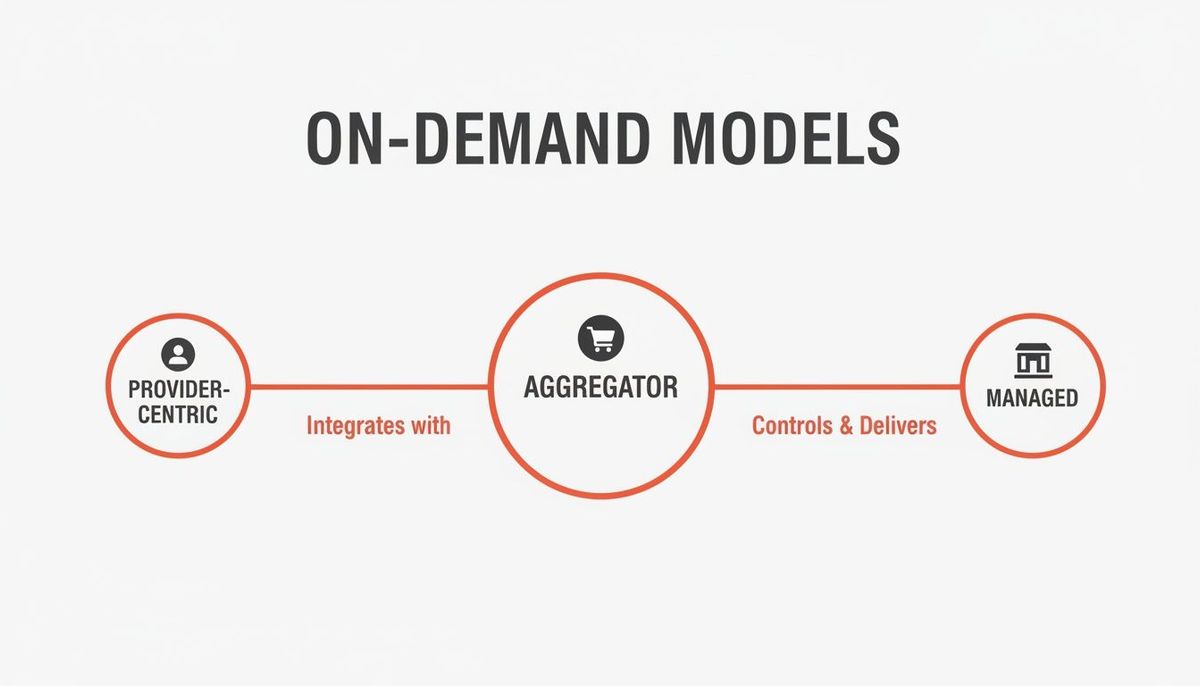
As you can see, different models often feed into each other, highlighting just how interconnected the on-demand economy is. Your architecture needs to be flexible enough to handle this.
A successful platform almost always needs these components:
- Geolocation and Tracking: This engine is all about location, using GPS to pinpoint where customers and providers are in real-time. It’s the key to calculating ETAs, showing that little car moving on the map, and matching users based on who's closest.
- Dynamic Pricing: This is the algorithm that adjusts your prices based on real-time supply and demand. Think of ride-sharing "surge" pricing during a rainstorm—that’s this engine at work, automatically balancing the marketplace when demand spikes and fewer drivers are on the road.
- Payment Gateway Integration: Securely handling money isn't optional; it's everything. This means plugging into trusted payment processors like Stripe or Braintree to manage credit cards, process transactions, and handle payouts to your providers.
- Matching and Dispatching: This is the brain of your entire operation. It's the logic that takes a customer's request and connects it to the best available provider based on things like proximity, skills, ratings, and current availability. A smart algorithm here can become a massive competitive advantage.
- Ratings and Reviews: This system is what builds trust. It lets customers and providers rate each other after a service is complete, creating a self-policing community that rewards quality and accountability. For platforms delivering physical goods, Mastering Last Mile Delivery is a critical part of this trust equation, as it's often the final, most memorable touchpoint with the customer.
Avoiding the Monolith Trap with Microservices
One of the biggest architectural decisions you'll face is choosing between a monolith and a microservices approach. A monolith is like building your entire application as one giant, interconnected chunk of code. It might feel faster to get started, but it almost always becomes a trap.
Imagine your whole app is a single, massive building. If one small thing breaks—say, the plumbing in the review system—the entire building might have to shut down for repairs. Adding a new feature is like trying to bolt a new wing onto the building; it's slow, risky, and impacts everything else.
Practical Example: A ride-sharing app built as a monolith needs to update its payment processing logic. To deploy this one change, the entire application—including maps, user profiles, and messaging—must be re-tested and re-deployed. This can turn a simple update into a week-long, high-risk event.
A microservices architecture, on the other hand, is like building a campus of smaller, independent buildings. Each building handles a single service—payments, notifications, user profiles, and so on. For a growing service on demand platform, this approach has huge advantages.
- Independent Scalability: If your mapping service gets slammed with traffic, you can scale up just that one "building" without touching anything else. This is way more efficient and cost-effective than scaling the entire monolithic application.
- Faster Development: Different teams can work on different services at the same time without tripping over each other. This lets you ship new features and fixes much more quickly.
- Improved Fault Isolation: If the review service goes down, it doesn't take the payment or booking services with it. The rest of your platform stays online, minimizing the blast radius and keeping users happy.
- Technology Flexibility: You can write each microservice in whatever programming language is best for that specific job. Your matching algorithm might be best in Python, while your real-time messaging service might perform better in Go. That's a freedom you just don't have in a monolith.
By breaking down a complex backend into these manageable, independent pieces, a microservices architecture gives you the flexibility and resilience you need to thrive. It allows your platform to evolve and handle growth without collapsing under its own weight. For a deeper technical dive, our guide on using an API for microservices breaks down how these pieces talk to each other. Ultimately, this approach makes your tech a growth enabler, not a bottleneck.
Profitable Monetization and Metrics That Matter

A brilliant app that doesn't make money is just an expensive hobby. Having a solid technical foundation is table stakes, but building a real business demands a smart monetization plan and a ruthless focus on the metrics that actually signal a healthy company.
This is the point where your service on demand platform stops being just a cool product and starts becoming a business.
Most founders default to the simplest model: taking a percentage of every transaction. It's straightforward, sure, but it's far from the only way to build a profitable company. The most resilient on-demand businesses layer multiple revenue streams to create a much stronger financial base.
Designing Your Revenue Engine
Don't just think about taking a cut. Think about where you can add real value for specific user groups, because that's where you'll find your most powerful revenue streams. This approach doesn't just diversify your income; it can lock in user loyalty by offering clear benefits for recurring payments.
Here are a few proven monetization strategies to consider:
- Subscription Tiers: Give customers a reason to pay you every month. Practical example: A dog-walking app offers a "$29/month premium" plan that includes unlimited walks, free cancellation, and a dedicated walker. This creates predictable revenue and increases customer lifetime value.
- Provider-Side Subscriptions: Charge your service providers for premium tools. Practical example: A freelance platform charges designers $50/month for a "Pro" badge on their profile, access to higher-paying project leads, and lower commission fees. This aligns your revenue with your providers' success.
- Tiered Service Levels: Create different service levels at different prices. Practical example: A delivery app might offer standard 60-minute delivery for $5, a 30-minute "Express" option for $10, and a cheaper $2 "Eco" delivery scheduled for off-peak hours. This captures value from different customer segments.
This is a critical junction where you have to align what your business needs with what your users actually want. To get this right, you need to go deep. We break it all down in our guide on the best app monetization strategies.
The right monetization mix depends entirely on your market. For a high-frequency service like food delivery, a customer subscription makes a ton of sense. For a low-frequency service like plumbing, focusing on provider-side tools or tiered service fees will likely be more effective.
The on-demand home services market is a perfect example of getting this right. The sector exploded from $1.32 billion in 2019 to a projected $7.28 billion by 2026. That kind of growth only happens when platforms deliver real value that people are happy to pay for.
Key Metrics That Define Success
Once the money starts coming in, you have to measure what matters. Vanity metrics like total downloads are fool's gold. In the on-demand world, success boils down to a handful of core numbers that measure the actual health and efficiency of your marketplace.
1. Customer Acquisition Cost (CAC)
This is what it costs you, in real dollars, to get one new paying customer. Actionable insight: If your marketing spend was $10,000 last month and you acquired 500 new paying customers, your CAC is $20. Track this per channel (e.g., Facebook Ads vs. Google Ads) to see which is most effective and double down.
2. Lifetime Value (LTV)
LTV is the total amount of revenue you can reasonably expect from a single customer over their entire relationship with you. Actionable insight: If an average customer makes 5 purchases at $40 each with a 25% profit margin, your LTV is ($40 5 0.25) = $50. This tells you how much you can afford to spend on CAC.
3. Provider Utilization Rate
This metric tells you how busy—and how happy—your service providers are. It’s the total time a provider spends working on jobs divided by the total time they are marked as "available" on your platform. Actionable insight: If a cleaner is available for 8 hours and spends 6 hours on paid jobs, their utilization rate is 75%. If this number is below 50%, they're likely to leave your platform for a competitor.
The All-Important LTV to CAC Ratio
The real magic happens when you look at these metrics together. The LTV-to-CAC ratio is the ultimate health indicator for an on-demand business. It answers the single most important question: are you spending more to get customers than they are worth to you?
A healthy ratio is generally considered 3:1 or higher. This means for every dollar you spend acquiring a customer, you make at least three dollars back over their lifetime. This is the green light investors are looking for. It proves your business model isn't just working—it's scalable and profitable.
Avoiding Common Pitfalls That Sink Startups
Learning from someone else's mistakes is the cheapest education a founder can get. The road to a successful service on demand platform is paved with the wreckage of startups that fell into the same predictable traps. These aren't exotic, unforeseeable disasters; they're the classic, recurring blunders of building a two-sided marketplace.
Knowing what they are ahead of time is your best defense.
Solving the Chicken-and-Egg Problem
It's the timeless marketplace dilemma: you can't get customers (demand) without providers (supply), and you can't get providers to stick around if there are no customers. This chicken-and-egg problem is where most on-demand businesses quietly die.
The secret is to stop trying to solve for both at once. Pick a side and go all-in. For on-demand services, you almost always have to build your supply first.
Think about it. A customer might open your app, see no providers, and close it. Disappointing, but they might give you a second chance. A service provider who signs up, gets zero job requests for a week, and makes no money? They’re gone forever.
Actionable insight: To get started, create artificial density. Launch in an absurdly small area—one neighborhood, not one city. Then, give your first batch of providers a compelling reason to be available, like guaranteed hourly minimums or sign-on bonuses. For a new tutoring app, this could mean paying five math tutors $25/hour to simply be online and available for the first two weeks, even if no students book them.
Underestimating Operational Complexity
Too many founders with a software background get lost in the beauty of their app and forget they're actually running a messy, real-world logistics company. A gorgeous UI is worthless if the service itself is a train wreck.
Your business doesn’t live on a server; it lives on city streets, inside people's homes, and in the unpredictable reality of your providers' days. People get sick, traffic is awful, addresses are wrong, and customers change their minds. Things go wrong. All the time.
Your only shield against this chaos is a powerful internal toolset. Your ops team needs a dashboard—a god-mode view—to see everything happening in real time. They need to be able to reassign jobs, communicate with both sides, and solve problems instantly. Actionable insight: Build a feature in your admin panel that automatically flags jobs at risk of being late (based on traffic data and provider location) so your support team can proactively contact the customer before they get angry.
Choosing a Non-Scalable Tech Stack
In the frantic rush to get an MVP out the door, it’s easy to grab tech that’s fast to build with but impossible to grow. A stack that gets you to your first 100 users will often become the very thing that prevents you from reaching 10,000.
This usually takes the form of a rigid, monolithic architecture where everything is tangled together. It feels fast at first, but it quickly becomes a prison. Trying to add a new feature is like playing Jenga—pull one block, and the whole thing might collapse. Development slows to a crawl right when you need to be speeding up.
The downstream consequences are brutal:
- Slow Feature Development: Simple changes require massive testing, killing your ability to react to what customers want.
- Frequent Outages: As you get more users, a single point of failure can crash the entire platform, burning through user trust.
- The Big Rewrite: Eventually, you hit a wall and are forced into a massively expensive and time-sucking platform rewrite, wiping out any early speed advantage you had.
Ignoring the Provider Experience
This is the big one. Many founders treat their service providers like a commodity—just another row in a database. This is the single fastest way to poison your service quality and kill your company.
Your providers are your product. They are the face of your brand. They deliver the experience customers pay for.
If their app is a buggy mess, if getting paid is a hassle, or if they feel like you don't listen or care, the best ones will leave. You'll be stuck in a constant churn of low-quality, unreliable providers, and your customer reviews will reflect that. Your ratings will tank, and you'll never recover.
Actionable insight: Implement an "Instant Pay" feature for your providers. Instead of waiting a week for a bank transfer, allow them to cash out their earnings daily for a small fee. This simple tool can be a massive differentiator and a huge reason for providers to choose your platform over a competitor's.
Your Go-to-Market and Growth Playbook
Launching your app is just the starting line. Smart, strategic growth is what builds an empire.
A powerful service on demand platform doesn’t just pop up fully formed in every major city. It starts small, proves its value in one place, and then expands methodically. This isn't about a big bang launch; it's about building a repeatable playbook for growth.
The journey starts with a Minimum Viable Product (MVP), but what’s even more critical is finding your Minimum Viable Market. Resist the urge to go big and launch everywhere at once. Instead, pick a single, dense neighborhood or a small, well-defined city.
This hyper-local focus is your best friend in the early days. It lets you manage the delicate dance between supply (your service providers) and demand (your customers). You can personally onboard your first providers, make sure they get enough work to stick around, and create a positive feedback loop that proves your model works. This is where you get invaluable real-world data before you spend a single dollar on wider expansion.
From Local MVP to Scalable Growth
Once you’ve nailed it in your launch market, it's time to get ready for growth. This is about more than just marketing—it's about making sure your tech and your operations can handle the pressure of scaling.
A rock-solid expansion plan really comes down to three things:
- Technical Readiness: Your platform has to be built for this moment. This is where a microservices architecture really shines, letting you scale individual parts of your system—like geolocation or payments—without having to tear down and rebuild everything.
- Data-Driven Market Selection: Don't guess where to go next. Use data to find the most promising new markets. Look at demographics, competitor weaknesses, and even local search trends that show people are already looking for what you offer.
- Built-in Growth Loops: The best growth is organic. Engineer viral mechanics right into your app from day one. Practical Example: A "Give $10, Get $10" referral program where a user can share a unique code. Their friend gets $10 off their first order, and the original user gets a $10 credit after the friend's order is complete. This makes every user a potential marketer.
The secret to scaling is to replicate your initial success, not reinvent it. Turn the process that worked in your first market into a repeatable playbook you can roll out in every new city.
A Case Study in Mobile-First Expansion
The on-demand home services space is a perfect example of this in action. The U.S. market is on a wild ride, projected to jump from $1,252.2 million in 2022 to over $3,636.9 million by 2030. A massive driver of this is the mobile-first approach. In fact, mobile platforms pulled in nearly 75% of all revenue in 2022. This tells you a seamless mobile app isn't just nice to have—it's everything. You can read more about the findings on home services market growth.
Let’s say you're launching a home cleaning service. Here’s what your playbook might look like:
- Launch (MVP): Start in a single, high-density, affluent suburb. Onboard 20 trusted cleaners and guarantee them minimum pay for the first month to make sure they’re always available.
- Validate: Focus your marketing on local social media groups and direct mail to get your first 100 customer bookings. Relentlessly gather feedback to make the service and the app better.
- Scale: Once your provider utilization hits 70%, use your data to pinpoint three similar suburbs. Run targeted digital ads and a referral bonus to seed both sides of the market before you officially launch there.
This methodical expansion, powered by a killer mobile app and a clear playbook, is how you turn a local solution into a national service on demand powerhouse.
Common Questions (and Straight Answers)
When you're building an on-demand service app, you’re not just building software—you’re building a two-sided marketplace from scratch. The questions you face are tough, and the answers have serious consequences for your budget and timeline.
Here are the most common questions we hear from founders, along with the straight answers you need.
How Much Should I Really Budget for an MVP?
Let’s get right to it: a well-built Minimum Viable Product (MVP) is going to land somewhere between $75,000 and $150,000. That number gets you on the field, but what drives it up or down?
It really comes down to three things: the number of platforms you launch on (iOS, Android, Web), the brains of your operation (your matching algorithm), and the essential plumbing (payment gateways, mapping APIs).
Actionable Insight: To stay on the lower end of that budget, launch on a single platform first (e.g., just iOS if your target demographic skews that way). Use a simple proximity-based matching algorithm instead of a complex AI-driven one. This gets you to market faster and lets you validate your core idea before investing in more complexity.
Native vs. Cross-Platform: Which Hill Should I Die On?
For almost every on-demand service, going native (that means Swift for iOS and Kotlin for Android) is the right long-term play. I can't stress this enough.
Why? Because your app lives and dies on performance, reliability, and deep access to the phone's hardware—especially the GPS. Real-time location tracking has to be flawless. A laggy map or a glitchy booking process will kill user trust instantly.
I’ve seen founders get tempted by cross-platform tools like React Native because they promise a faster, cheaper MVP. While that can be true initially, they almost always create performance issues and limitations down the road. Those "shortcuts" become massive technical headaches right when you're trying to scale.
The single biggest technical mistake you can make? Building a rigid, monolithic app. It feels fast at first, but it quickly becomes impossible to add features or fix bugs without breaking something else. A microservices architecture gives you the flexibility to adapt and grow without having to rebuild everything from the ground up.
How Do I Solve the Chicken-and-Egg Problem Without Going Broke?
This is the classic marketplace dilemma. You can't get customers without service providers, and you can't get providers without customers. So, where do you start?
You have to focus on one side first, and it’s almost always supply (your service providers). Customers will leave in seconds if they open your app and see zero available providers.
The playbook is simple but effective:
- Go small. Launch in a tiny, dense geographic area—a single neighborhood, not a whole city.
- Create overwhelming value for providers. Offer big incentives to your first group. Practical Example: A new pet-sitting app could partner with a local vet clinic, offering their trusted vet techs a $200 sign-on bonus and first access to jobs. This seeds the platform with high-quality, trusted supply from day one.
That initial positive buzz is what gets the flywheel spinning.
At Vermillion, we've guided countless founders through these exact decisions. Our job is to build a technical foundation that’s ready to scale from day one, so you can focus on growing your marketplace. If you’re looking for a technical partner to build and scale your vision, see how we can help at https://vermillion.agency.