How to Hire the Right React Native Development Company
When you partner with a React Native development company, you’re hiring a team to build your mobile app for both iOS and Android from a single JavaScript codebase. For a founder, this isn't just a technical decision—it's a strategic move. The entire point is to slash your time-to-market and development costs, which is exactly what you need to hit growth targets and impress investors.
Why React Native Is a Smart Bet for Mobile Growth
Choosing your tech stack is a business decision, plain and simple. When you're running a startup between Seed and Series A, every dollar and every week counts. This is where React Native stops being a buzzword and becomes a serious competitive advantage. It’s about more than "write once, run anywhere"—it’s about delivering real business results, fast.
The core value is efficiency. Forget managing separate iOS and Android development teams. With React Native, you build, test, and ship with one unified team. This simple change can get your app into users' hands weeks, or even months, sooner than going the traditional native route.
Accelerate Your Path to Market Validation
In the early stages, speed is your most valuable asset. You're in a race to validate your core idea, test your pricing, and show investors real traction. React Native is practically built for this kind of rapid iteration.
- Launch Your MVP Faster: A single codebase means you can get a minimum viable product (MVP) out the door in as little as 10-20 weeks.
- Test Features on the Fly: Need to see if users will pay for a new feature? Hot-reloading lets developers push updates almost instantly, so you can pivot based on real-time feedback.
- Hit Investor Milestones: Shorter development cycles mean you hit your product goals sooner. This is critical when you’re fundraising and need to demonstrate progress.
We go deeper into how React Native speeds up mobile app development in our full guide on the topic.
This isn't some niche framework, either. It’s a proven workhorse. React Native currently holds a massive 35% market share among developers building cross-platform apps. Its popularity comes from being battle-tested by companies like Meta, Discord, and Shopify. Learn more about these mobile app development trends on techaheadcorp.com.
Build an Enterprise-Grade Product That Delivers ROI
Beyond just getting an MVP out the door, React Native has the maturity to build a polished, revenue-generating app that can actually scale. It’s not just for simple prototypes; it’s the engine behind complex apps serving millions of users.
For a founder, this means you're not just building an MVP; you're laying the foundation for a scalable, enterprise-grade application. The framework handles everything from complex UIs to native performance-heavy features, ensuring your app can grow with your user base without requiring a complete rebuild.
Another huge business advantage is the talent pool. Since it’s built on JavaScript, finding skilled engineers to join your team later on is far easier and more cost-effective.
Ultimately, choosing a React Native development company is an investment in a technology that aligns with the financial and strategic realities of a startup that needs to grow. It’s a practical choice for founders who need to move fast without sacrificing quality.
Choosing Your Ideal Development Partner Model
Not all partners who build React Native apps are created equal. When you're a founder with a limited runway, picking the right type of React Native development company is just as critical as choosing the tech stack itself. Your choice typically boils down to three models, and each has its own rhythm, cost structure, and ideal use case.
Making the wrong call here can lock you into a partnership where your goals—like hitting revenue milestones or closing your next round—take a backseat to the vendor's goal of billing more hours. Let’s break down the landscape so you can find a partner that actually fits your startup's stage and ambitions.
The flowchart below gives you a quick decision-making framework if you're weighing React Native for your app.
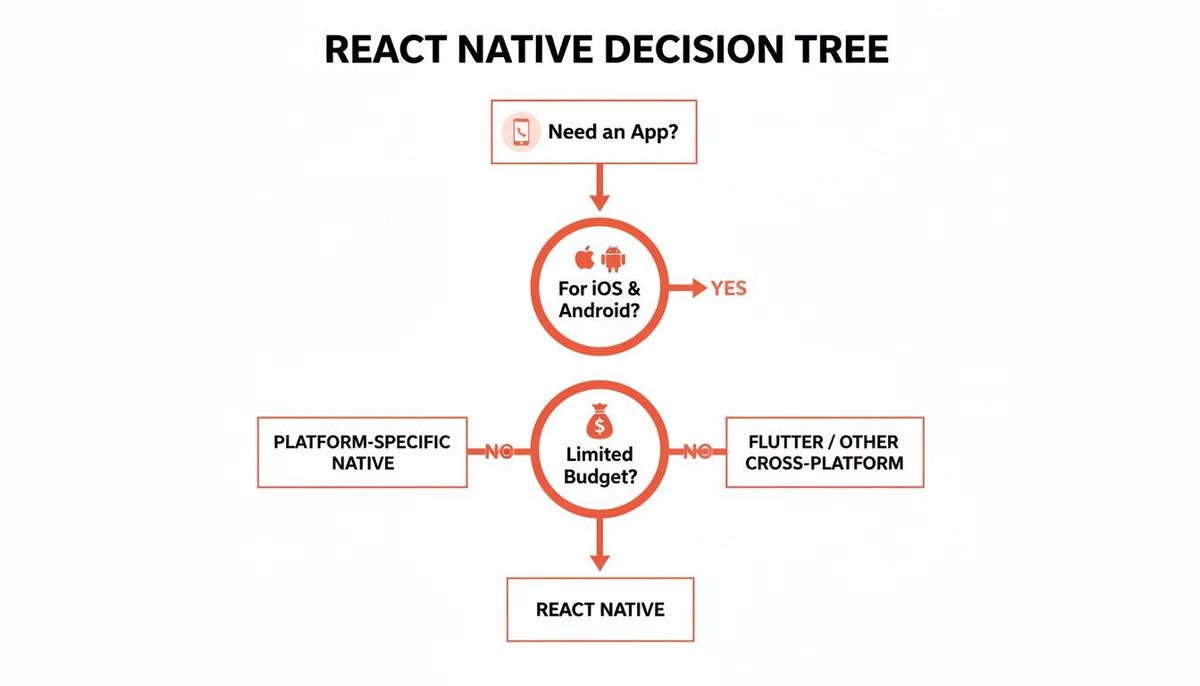
As you can see, factors like your platform needs and budget often point directly toward cross-platform solutions like React Native.
Freelance Aggregators
Platforms like Upwork or Toptal are essentially massive talent marketplaces, giving you direct access to individual developers or small, loosely-knit teams. On paper, this is often the cheapest route and feels like a smart move for specific, well-defined tasks.
Practical Example: You need to build a single, standalone feature, like adding a new social login option to your existing app. A freelance marketplace is perfect for this. You can hire a developer for a short contract, get it done, and move on with no long-term overhead. But trying to build a complex, monetizing MVP from scratch this way is a huge gamble—it puts the entire burden of project management, QA, and product strategy squarely on your shoulders.
Traditional Hourly Agencies
This is the classic model you'll run into most often. These agencies work on a time-and-materials basis, billing you for every hour their developers, designers, and project managers spend on your project. They bring established processes to the table and offer a more structured engagement than a collection of freelancers.
But their primary incentive is to keep their team billable. While they can deliver high-quality code, their focus is on executing the tasks you give them, not necessarily questioning the business logic behind those tasks.
Practical Example: A founder hires an hourly agency to build a marketplace app and hands them a list of ten "must-have" features for the MVP. The agency diligently builds all ten, billing $150,000 over six months. The app launches, but only two of the features get any real user engagement. The other eight were a complete waste of capital because the agency's job was to build, not to validate.
Performance-Based Product Partners
A newer, far more aligned model is the performance-based partner. These firms operate less like vendors and more like an extension of your own product team. They don't just write code; they take ownership of the business outcomes.
A performance partner ties a portion of their compensation to your app's actual success. Their incentives are completely aligned with yours—if your app hits KPIs like user retention, conversion rates, or MRR, they win too.
This model is a game-changer for Seed to Series A startups that need more than just code. They need a strategic partner who can guide them on product-market fit, monetization, and scalability. A performance-based partner will challenge your assumptions, help you prioritize features based on real ROI potential, and build an app engineered for growth from day one.
Actionable Insight: When you're vetting a potential partner, ask them this: "Describe a time you advised a client against building a requested feature." A traditional agency will likely stumble over that question. A true product partner will have stories about saving clients time and money by focusing only on what moves the needle.
Choosing the right partner model directly impacts your ability to scale efficiently. The table below breaks down the key differences to help you make an informed decision based on what your startup truly needs right now.
Comparing React Native Development Partner Models
| Evaluation Criteria | Freelance Aggregators | Hourly Agencies | Performance-Based Partners |
|---|---|---|---|
| **Primary Incentive** | Complete short-term tasks | Maximize billable hours | Achieve business KPIs (e.g., revenue, retention) |
| **Best For** | Small, defined tasks; bug fixes | Well-defined projects with a clear scope | Building a monetizing MVP; finding product-market fit |
| **Typical Cost Structure** | Fixed-price or hourly | Time & materials (hourly billing) | Hybrid: Retainer + performance-based bonus |
| **Strategic Input** | None; pure execution | Limited; follows client direction | High; acts as a a strategic product advisor |
| **Founder Involvement** | High (project management, QA) | Medium (scope definition, feedback) | Low to Medium (strategic alignment) |
| **Risk Profile** | High risk for complex projects | Medium risk; budget overruns are common | Low risk; incentives are aligned with founder's success |
Ultimately, the right choice depends on your stage. For a quick fix, freelancers are fine. For a predictable build, an agency can work. But if you're building a business, not just an app, a performance partner is the only model that truly aligns with your long-term success.
How to Vet a Company’s Real-World Expertise
Once you’ve shortlisted a few potential partners, the real work begins. A slick portfolio and a confident sales pitch are just table stakes. To find a truly great React Native development company, you have to dig deeper and find hard evidence of their technical and product chops.
It’s the difference between hiring a team that just builds what you ask for, and one that builds what your business actually needs.
This isn't about asking trick questions. It’s about starting conversations that reveal how a team thinks, how they solve problems, and how they handle the inevitable chaos of building a product from the ground up. You’re looking for a partner who has genuine product sense, not just coding skills.

Uncovering Technical Depth Beyond the Surface
Anyone can claim to be a React Native expert. Your job is to poke holes in that claim with questions that force them to go beyond generic answers. Forget asking, "How many years have you used React Native?"—it’s a dead-end question. Instead, probe their specific philosophies.
A team's technical choices tell you a lot about their experience with scale and performance. A great place to start is state management.
- Actionable Question 1: "Walk me through your decision-making process for choosing a state management library. When have you picked Redux over something like Zustand, or vice versa? What were the specific trade-offs on that project?"
- What to Listen For: A strong answer won't just declare one library "better." They'll talk about project complexity, team familiarity, reducing boilerplate, and performance. For example, they might say, "For a large-scale e-commerce app with a complex shopping cart and user profiles, we chose Redux for its strict data flow and middleware capabilities. But for a simpler content app, we went with Zustand to move faster and write less code."
Another critical test is how they handle the really tough stuff. Many apps need features that push JavaScript to its limits, which means dropping down into the native layer.
- Actionable Question 2: "Tell me about a time you had to build a custom native module to bridge Swift or Kotlin code. What was the performance bottleneck you were solving?"
- What to Listen For: You want to hear specific war stories. Maybe they built a module for heavy-duty image processing, managed background tasks, or integrated a finicky hardware SDK. A good answer sounds like: "We had a client whose app needed to process video in the background. React Native's JS thread couldn't handle it, so we wrote a native module in Kotlin to offload the processing, which cut battery drain by 30% and prevented crashes." This proves they can solve real problems, not just assemble apps from pre-built parts.
A team that can’t clearly articulate their technical philosophies is a team that likely follows trends without understanding the principles. This is a huge red flag for any founder building a product meant to last.
Assessing Product Sense and Business Acumen
Technical skill without product sense is how you end up with a beautiful app that nobody uses. A great partner acts more like a strategic advisor, always tying development decisions back to your business goals. You have to test for this.
The best way to do this is with behavioral questions that force them to talk about past experiences. Real stories are far more revealing than hypotheticals.
- Actionable Question: "Tell me about a time you advised a founder against building a feature they were excited about. What was your reasoning, how did you handle that conversation, and what was the outcome?"
- What a Good Answer Looks Like: "A client wanted to add a complex social feed to their MVP. We ran the numbers and showed them it would add six weeks to the timeline and push them past their runway. We recommended launching with a simpler community feature first to validate user interest. They agreed, launched on time, and secured their next funding round." This shows they protect your budget and focus on business goals.
Equally important is their attitude toward data. An app without analytics is an app flying blind.
- Actionable Question: "How do you approach analytics and event tracking from day one? What tools do you like, and how do you help clients define the key events for tracking things like user retention and engagement?"
- What a Good Answer Looks Like: "We integrate Segment or Mixpanel from the first sprint. For a subscription app, we'd immediately set up tracking for
user_signup,trial_started,subscription_purchased, andfeature_X_used. This way, we're not guessing about user behavior post-launch; we're making data-driven decisions from day one." This shows they’re focused on results, not just shipping code.
Auditing Their Portfolio for Real Complexity
A portfolio is more than just a beauty pageant of polished screenshots. You need to hunt for evidence of complex, real-world problem-solving. When they show you past work, ignore the pretty UI for a minute and focus on what's happening under the hood. For a more detailed guide, check out our tips for finding a good software development company.
Here’s an actionable checklist for portfolio reviews:
- Complex Integrations: Do their apps have sophisticated third-party hooks? Look for payment gateways like Stripe, subscription management tools like RevenueCat, or complicated API orchestrations. Ask: "In this app, how did you handle failed payments with Stripe's API to prevent subscription churn?"
- Monetization Evidence: Can you see clear examples of in-app purchases, subscription models, or marketplace transaction fees? Ask: "Walk me through the architecture for the in-app purchase flow. How did you handle receipt validation and restoring purchases?" This proves they know how to build apps that actually make money.
- Performance Under Load: If you can, download their apps from the store. Do they feel quick and responsive? Or do lists stutter and animations lag? This is a direct reflection of their code quality and commitment to following essential code review best practices.
By combining these technical, product-focused, and portfolio-based questions, you’ll get a genuine feel for a company's real capabilities. This is how you find a partner who will help you build a successful business, not just a functional app.
Don’t Just Look at the Sticker Price: Understanding Your App’s True Cost
When you’re pricing out a new mobile app, it’s easy to get tunnel vision on the initial build cost. But that number? It’s just the down payment. The real figure you need to worry about is the Total Cost of Ownership (TCO), which covers everything from day-one development to the ongoing maintenance, bug fixes, and feature updates that keep your product alive and kicking.
Getting this right is absolutely critical when you're evaluating a React Native development company. A low hourly rate can feel like a win, but more often than not, it’s a trap that ends up costing you far more down the road.
Why That "Cheap" Hourly Rate Is a Red Flag
Let's walk through a practical example I’ve seen play out too many times. A founder, trying to stretch their seed funding, goes with an agency offering a bargain-bin hourly rate of $40/hour. They get an MVP for $50,000, and on the surface, it works. But under the hood, it’s a mess of technical debt—spaghetti code, a nonsensical architecture, and zero documentation.
Sure, the app functions, but it's built on a foundation of sand. The moment you try to add a new feature, things start breaking. As more users sign on, performance grinds to a halt. Before the year is out, that same founder is forced to hire a second, much more expensive team at $150/hour just to rebuild the entire thing from scratch for $180,000. The initial "savings" ended up costing them an extra $130,000 and six months of lost momentum.
A partner who just takes orders and builds for the lowest price is building you a disposable product. A true partner understands your business goals and builds a scalable asset designed to last.
The smart move is to tie your development investment to business outcomes. Even if the upfront cost seems higher, a team focused on hitting your KPIs—like boosting user retention or driving revenue—is going to build a product that actually delivers a return.
Calculating the Total Cost of Ownership
To get a real sense of your budget, you have to look past that first invoice. Your TCO needs to account for all the costs that pop up after launch.
Here’s a practical breakdown for your calculation:
- The Initial Build: This is the obvious one—the cost to design, code, and launch your MVP. (Example: $120,000)
- Ongoing Support & Maintenance: Bugs happen. OS updates are mandatory. Security patches are non-negotiable. Plan to budget 15-20% of your initial build cost every year just to keep the lights on. (Example: $18,000 - $24,000 per year)
- Feature Enhancements: Your first version won't be your last. As user feedback rolls in, you’ll be constantly adding features and tweaking the experience to find product-market fit. This is an ongoing investment.
- Hosting & Third-Party Services: Don't forget about server costs (AWS, Google Cloud) and subscriptions for essential tools like analytics platforms (Mixpanel), crash reporting (Sentry), and push notification services (OneSignal). (Example: $3,000 - $5,000+ per year)
For a deeper dive into the numbers, check out our complete guide on understanding React Native app development costs. It'll help you create a budget that reflects the reality of the entire product lifecycle.
The Financial Upside: React Native and R&D Credits
Choosing React Native isn't just a technical decision; it's a massive financial one. The framework lets you share one codebase across both iOS and Android, which can slash your development costs by up to 40% compared to building two separate native apps. That efficiency means a much faster path to ROI. It’s no wonder giants like Netflix, Shopify, and Coinbase trust it to serve millions of users. The market is projected to hit $28.6 billion by 2027, and for good reason—React Native gives startups a serious strategic edge.
There's another financial lever most founders overlook: R&D tax credits. In many countries, the money you sink into building innovative software can qualify for tax relief that cuts your net development cost by 20-40%.
A forward-thinking development partner will help you document your work to maximize these claims. They'll track every eligible activity, from designing a novel algorithm to solving a tough technical hurdle. That paper trail makes claiming your credits a breeze, turning a necessary expense into a smart financial move. When you're interviewing agencies, ask them about R&D credits. Their answer will tell you whether they're just thinking about their invoice or your bottom line.
Critical Red Flags to Spot Before You Sign
Hiring the wrong partner can absolutely torch your runway and put your startup's future in jeopardy. This part of the process isn't just about finding a team that can code; it's about spotting the warning signs of a bad partnership before you're legally and financially tied to them. Think of this as your field guide for protecting your business.
Catching these red flags early saves you more than just money. It saves you time, momentum, and the brutal stress of a failing project. A bad partnership doesn't just deliver a buggy app—it can stall your growth and kill investor confidence right when you need it most.

Unquestioning Agreement and Over-Promises
One of the sneakiest and most dangerous red flags is the agency that agrees with everything you say. They just nod along to every idea, every feature request, never once pushing back or asking, "But why do we need this?" This isn’t a sign of great service; it’s the mark of an order-taker focused on racking up billable hours, not shipping a successful product.
A great React Native development company will challenge your assumptions. They'll ask the hard questions to figure out if a feature actually drives your core business goals or if it's just a shiny distraction. If they promise you the moon—a complex build on a shoestring budget with an impossible timeline—you need to run, not walk, away.
Actionable Insight: During a sales call, describe a feature you know is a bad idea (e.g., "We want to build a custom video chat from scratch for our MVP"). If they say "No problem!" without suggesting a simpler, faster alternative like a Twilio integration, that's a massive red flag. They should be protecting your timeline and budget, not blindly agreeing to build anything.
A partner who never says "no" isn't a partner at all; they're a vendor waiting for you to make expensive mistakes. Real partners protect your budget and timeline by forcing you to focus on what creates the most impact, even when those conversations are tough.
Lack of Direct Access to the Team
Another massive warning sign is when communication feels like it’s being routed through a switchboard operator. If the agency insists all communication must go through a project manager or account exec, that's a problem. This structure is often used to hide a disjointed team, significant language barriers, or junior developers they don't trust to speak with clients.
You absolutely need direct, unfiltered access to the developers and designers actually building your product. This is non-negotiable. It leads to clearer communication, faster problem-solving, and a team that is genuinely bought into your vision.
- Ask this directly: "Will we have a shared Slack channel with the developers who are writing the code?"
- Insist on it: Make direct access a deal-breaker in your agreement.
This kind of transparency is the lifeblood of a startup's agile environment. Without it, you're essentially flying blind, and tiny misunderstandings can quickly blow up into major development disasters.
Vague Plans for Handoff and Support
A project isn't over when the app launches. In fact, that's when the real learning begins. You need a partner who has a crystal-clear plan for what happens next: support, bug fixes, and knowledge transfer. If their plan for this phase is fuzzy or non-existent, it tells you they're only focused on the initial payday, not your long-term success.
Your ultimate goal should be to own your own technology. A good partner gets this and plans for their own exit from day one, preparing to hand the keys over to your future in-house team. This process should be spelled out in detail.
Here’s what a solid handoff plan actually looks like in a contract clause:
- Comprehensive Documentation: "All features will be accompanied by documentation in Confluence, including API endpoints, data models, and architectural diagrams."
- Structured Knowledge Transfer: "A 40-hour knowledge transfer period will be conducted post-launch, including paired programming sessions between their senior developer and our first engineering hire."
- Ongoing Support Retainer: "A post-launch support retainer is available for $X/month, guaranteeing a 4-hour response time for critical bugs and 20 hours of developer availability."
If a potential partner gets cagey when you bring this up, they might be trying to create vendor lock-in, making it painful for you to ever take full control. Choosing the right React Native development company means finding a team that empowers you for the long haul, not one that holds your codebase hostage.
Common Questions from Founders
When you're looking to hire a development partner, a lot of practical questions come up. Here are the straight answers to the things founders and product leaders ask us most.
How Long Does It Realistically Take to Build a Monetizing MVP?
For a tightly-scoped MVP designed to hit the market and start generating revenue, a skilled partner can typically get you launched in 10 to 20 weeks. This assumes they have a full-stack team handling everything—frontend, backend, and all the integrations.
The real key here is ruthless prioritization. A good partner doesn't just build what you ask for. They push back and help you strip the product down to its absolute core, focusing only on what’s needed to validate your main business hypothesis and get that first dollar in the door.
Practical Example: A founder wants to build a fitness app with live classes, on-demand videos, a social feed, and custom meal plans. A good partner will advise them to launch an MVP with just the on-demand videos and a simple subscription feature. This core functionality can be built in 12 weeks, allowing them to test the market's appetite before investing in more complex, expensive features.
What KPIs Should I Include in a Performance-Based Contract?
Your KPIs need to be laser-focused on your business goals. Generic metrics are useless. They should be specific, measurable, and directly tied to what makes or breaks your startup.
- For a consumer subscription app: You’d want to track things like Day 7 user retention, the trial-to-paid conversion rate, or Average Revenue Per User (ARPU). These tell you if people are sticking around and paying.
- For a marketplace app: The big one might be the number of successful transactions per week or the growth rate of active listings. This shows if your marketplace is actually working.
- For a B2B SaaS mobile app: You might focus on the daily active user (DAU) to monthly active user (MAU) ratio or the percentage of users completing a key workflow. This proves engagement and value.
A strong React Native development company that offers a performance model will work with you to nail these down before you sign anything. Look for a partner who is willing to tie their own compensation to hitting these numbers. That’s how you know your incentives are perfectly aligned.
Should I Hire a US-Based Firm or an Offshore Company?
This really comes down to a classic trade-off: budget versus the need for deep, strategic collaboration. There's no single right answer, but for an early-stage startup, the choice has massive implications.
Offshore teams can look incredibly attractive on paper with lower hourly rates. It’s tempting when every dollar counts. But you often pay for that savings in other ways—time zone headaches, communication friction, and cultural gaps that can slow things down and lead to costly misunderstandings.
Actionable Insight: Before signing with an offshore team for a complex MVP, run a small, two-week paid trial project with them. Ask them to build a single, well-defined feature. This low-risk experiment will immediately reveal any communication gaps, process issues, or quality concerns before you commit to a six-month, six-figure project.
For a startup where speed, crystal-clear communication, and product strategy are everything, the higher investment in a domestic partner almost always delivers a better long-term ROI.
A US-based firm, especially one working on a performance model, is built to be more than just a code factory. They're in your time zone, they get the market, and they act like an extension of your own team, contributing to strategy, not just executing tickets.
What Is the Handoff Process to an In-House Team?
A great partner starts planning for your independence from day one. The handoff shouldn't be an afterthought where they dump a folder of code on you. It needs to be a structured, deliberate transfer of knowledge.
A proper handoff is your ticket to owning your tech for the long haul and avoiding vendor lock-in. It should always include a few key things:
- Rock-Solid Documentation: This isn't just commented code. It's a fully documented codebase, clear architecture diagrams, and straightforward instructions for setting up the development environment.
- Paired Programming & Training: Their senior developers should spend real time working alongside your first in-house hires, walking them through the system and explaining the "why" behind key architectural decisions.
- Help with Hiring: The best partners will even help you vet and interview your first engineers. They know the codebase better than anyone, so they’re in a perfect position to help you build a team that can actually run with it.
This approach ensures your new team can hit the ground running without missing a beat, building on the solid foundation the agency created.
Ready to build a mobile app that drives real business results? At Vermillion, we partner with funded startups to deliver revenue-ready React Native products that are engineered for growth. Our performance-based model ensures we’re as invested in your KPIs as you are. Learn more about how we can help you hit your next milestone.