Vermillion Insights
December 23, 2025 · Ken Vermeille · 21 min read
Mobile App Monetization Strategies: Proven Ways to Boost Revenue
Explore mobile app monetization strategies with practical examples for ads, in-app purchases, and subscriptions to boost your revenue.
Mobile app monetization is just a fancy way of saying, "how your app makes money." It's the plan you put in place to generate revenue from the people who use your app. The most common playbooks involve in-app advertising, in-app purchases, subscriptions, and sometimes a clever mix of all three.
Finding Your App Monetization Game Plan
Figuring out how your app will make money is one of the most important decisions you'll make. This goes way beyond just slapping a "buy now" button somewhere. Your monetization model needs to be woven directly into the user experience.
Get it right, and making a payment feels like a natural part of the value your app provides. Get it wrong, and it feels like a clunky, annoying roadblock that just pushes people away.
Think about it like setting up a real-world retail store. You have a few different ways you can run the business, and each one attracts a different type of customer and creates a totally different vibe.
A Quick Look at App Monetization Models
Before we dive deep, here's a high-level look at the core strategies. Each one is built for a different kind of app and user, and each one will push different metrics for your business.
| Monetization Model | Best For | Primary Metric Impact | Actionable Example |
|---|---|---|---|
| In-App Advertising | Casual games, utility apps, content apps with high traffic | Daily Active Users (DAU), Ad Impressions | A local news app shows a native ad that looks like another article in the feed. The user gets free content; you get paid for the click. |
| In-App Purchases | Gaming apps, photo/video editors, productivity tools | Average Revenue Per User (ARPU), Conversion Rate | A drawing app offers a basic set of brushes for free but sells a "Pro Brush Pack" with advanced textures for a one-time $4.99 fee. |
| Subscriptions | Content, media, SaaS, fitness, and wellness apps | Monthly Recurring Revenue (MRR), Lifetime Value (LTV) | A language-learning app like Duolingo offers a free ad-supported version but a "Super" subscription removes ads and usage limits. |
| Hybrid Models | Apps with large, diverse user bases (e.g., media, music) | A blend of all key metrics | The fitness app Strava offers a free version with ads, but its subscription unlocks advanced analytics and training plans. |
This table is just the starting point. The real magic happens when you understand the DNA of each model and how it aligns with the problem your app solves for its users.
The Four Core Monetization Approaches
Your app's revenue strategy will almost always be built on one or more of these foundational models.
- In-App Advertising: This is like a store getting sponsors to cover its operating costs. The doors are open to everyone for free, but customers will see branded ads inside. Actionable Example: A weather app places a small, unobtrusive banner ad at the bottom. It doesn't disrupt the user's primary goal (checking the weather) but generates consistent revenue from daily active users.
- In-App Purchases (IAP) & Freemium: This is the classic "free entry" retail model. Anyone can walk in and browse, but the best stuff has a price tag. Actionable Example: A mobile game lets you play for free, but you can buy a "Starter Pack" of in-game currency for $1.99 to speed up your progress. The value is clear and the price is low enough to encourage impulse buys.
- Subscriptions: Think of this as a membership club. Your users pay a recurring fee for consistent, ongoing access to premium value. Actionable Example: A financial planning app offers a free version for basic budgeting but requires a $9.99/month subscription to unlock investment tracking and automated savings plans.
- Hybrid Models: This is where you combine tactics. It’s like a store that’s free to enter and sells products but also offers an exclusive paid membership for special perks. Actionable Example: Spotify's free tier monetizes millions of casual listeners with ads, while its Premium subscription captures high-value users who will pay to remove those ads and get offline access.
A sustainable monetization strategy is about more than just getting the initial sale. It's just as critical to have effective strategies to reduce churn rate in place. After all, what's the point of converting users if they don't stick around?
The best strategy is never one-size-fits-all. It has to be custom-fit to your app’s purpose, your audience, and the value you deliver. Even massive enterprise apps carefully pick and choose from these models - something we cover in our guide on app monetization strategies for Fortune 500 companies. This guide sets the stage for a deeper dive into each model.
Generating Revenue with In-App Advertising
While subscriptions and one-time purchases get a lot of attention, don't sleep on in-app advertising. It's still one of the most powerful and accessible ways to monetize a mobile app. Think of it like running a TV network - you provide the show (your app's content or features) for free, and advertisers pay to get in front of your audience. When you get the balance right, this model can bring in serious revenue without sending your users running for the hills.
Advertising is the absolute juggernaut of mobile monetization. The numbers are staggering: it's projected to pull in over $340 billion in 2024 and rocket to around $447 billion by the end of 2025. That's about 65% of all mobile app revenue. The growth is fueled by smarter ad formats, like rewarded videos, with total in-app ad spending expected to hit a $390 billion market-wide in 2025. Publishers are getting smarter, too, leaning into formats like rewarded ads that boast incredible 91% completion rates because they offer a fair trade to the user. You can get a fuller picture from the latest mobile app market forecast.

Finding the Right Ad Format
Success with ads isn't about carpet-bombing your app with banners. It’s a game of context - choosing the right ad format for the right moment in the user's journey. Each type has a different job and a different potential for annoying people.
- Rewarded Video Ads: This is the gold standard of user-friendly advertising. The user chooses to watch a short video in exchange for something valuable. Actionable Insight: In a photo editing app, instead of hitting users with a paywall for a premium filter, offer them the chance to "Watch a quick ad to unlock this filter for your next photo." It feels like a fair trade, not a roadblock.
- Interstitial Ads: These are the full-screen ads that pop up at natural breaks. Timing is everything. Actionable Insight: In a utility app like a document scanner, show an interstitial ad only after the user successfully saves and shares their PDF. The task is complete, so the interruption is far less frustrating.
- Native Ads: These are the chameleons designed to blend in with your app's content. Actionable Insight: If you run a recipe app, a native ad could appear in the search results for "chicken recipes" as a "Sponsored Ingredient" from a grocery delivery service. It's relevant and helpful, not disruptive.
- Banner Ads: The classic small ads at the top or bottom of the screen. They're best for apps where users spend a lot of time on one screen. Actionable Insight: For a sudoku or crossword app, a static banner at the bottom is perfect. It generates revenue without ever interrupting the core puzzle-solving experience.
Essential Metrics to Track for Ad Monetization
To get good at ad monetization, you need to know the score. Two key metrics will tell you almost everything you need to know about how your strategy is performing.
eCPM (Effective Cost Per Mille)
This tells you how much money you're making for every 1,000 ad impressions. (Total Ad Revenue / Total Impressions) * 1000. Actionable Insight: If your rewarded video ads have a much higher eCPM than your banner ads, it's a clear signal to double down on rewarded placements and potentially reduce your reliance on low-performing banners.
ARPDAU (Average Revenue Per Daily Active User)
This metric asks: how much ad revenue is each active user generating per day? Total Daily Ad Revenue / Unique Daily Users. Actionable Insight: If you run a promotion that brings in thousands of new users but your ARPDAU drops, it means the new users aren't engaging with ads. This tells you that you either attracted the wrong audience or your ad placements aren't effective for newcomers.
Think of it this way: tracking eCPM helps you pinpoint which ad formats and placements are your star players. Meanwhile, ARPDAU gives you the 30,000-foot view of your ad revenue engine's daily health.
Practical Example: A Casual Gaming App
Let's say you built a casual puzzle game called "Gem Quest." Your mission is to make money without making players so mad they quit. A smart, hybrid ad strategy is the way to go.
- Primary Revenue Driver - Rewarded Videos: A player gets stuck on a tough level. A prompt appears: "Watch a short video for 3 extra moves?" This is a perfect moment. The player is highly motivated, the reward is valuable right now, and the ad is totally optional. This becomes your bread and butter.
- Secondary Revenue - Interstitials: After a player beats a level, a full-screen interstitial ad shows up. But you’re smart about it - you cap the frequency to one ad every three levels so players don't get burned out. This works because it’s a natural pause in the game.
- Passive Revenue - Banner Ads: On the main menu screen, you place a small, unobtrusive banner at the very bottom. It doesn't get in the way of playing the game but generates a small, consistent stream of income while users are deciding what to do next.
By combining these formats, "Gem Quest" builds a balanced monetization system. It finds a way to earn revenue from almost every session while putting the user's experience first, which is the key to keeping players coming back for more.
Mastering In-App Purchases and Freemium Models
The freemium model is hands-down one of the most powerful ways to monetize an app. It nails the delicate balance between attracting a huge user base and actually making money.
Think of it like a high-end chocolate shop handing out free samples. You let everyone taste the quality for free, creating a genuine desire to buy the whole box. This completely removes the barrier to entry, letting you build a massive audience first, then converting your biggest fans into paying customers.
At the heart of this strategy are In-App Purchases (IAPs) - the mechanism that lets users buy digital goods, features, or content right inside your app. This isn't a small corner of the market; the mobile app industry is on track to pull in a staggering $190 billion in global revenue, with IAPs driving a huge chunk of that. Mobile gaming is the undisputed champion here, projected to earn $98 billion this year alone. That’s 52% of all global app revenue, fueled by people buying everything from cosmetic skins to power-ups.
The Two Flavors of In-App Purchases
IAPs aren't a one-size-fits-all solution. They come in two distinct flavors, each designed for a different purpose and user motivation. Getting this distinction right is the first step toward building a revenue model that actually works.
- Consumable IAPs: These are one-time-use items that users can buy over and over. They’re designed to be used up, creating a natural cycle of repeat purchases. Actionable Example: In the dating app Bumble, users can buy "SuperSwipes" to show strong interest in another profile. Each use consumes one SuperSwipe, encouraging users to repurchase when they run out.
- Non-Consumable IAPs: These are permanent unlocks. Once a user buys one, they own it forever. This is all about providing lasting value. Actionable Example: The podcast app Overcast offers a free, ad-supported experience. For a one-time payment of $9.99, users can permanently remove all visual ads from the app, providing a cleaner, lifetime upgrade.
Whether you use one, the other, or a mix of both comes down to what your app actually does. For a deeper look at the technical setup and strategic side of things, check out our complete guide on in-app purchase models and strategies.
Designing a Freemium Experience That Sells Itself
A great freemium app doesn't feel like a stripped-down demo. The free version needs to be so good that users fall in love with it, while subtly showing them what they’re missing. The goal isn’t to cripple the free experience; it’s to make the paid one feel like an irresistible, natural next step.
Practical Example: The Gaming Powerhouse (Candy Crush)
Candy Crush is a masterclass in driving consumable IAP revenue through urgency. The game is free and genuinely fun. But when you get stuck on a tough level, you’re given a choice: wait for more lives or buy a bundle of Gold Bars (a consumable) to keep playing right now. The purchase isn't just for an item; it’s a way to skip frustration and get back to the fun - a powerful psychological trigger.
Practical Example: The Creative Tool (VSCO)
The photo editing app VSCO takes a different tack with its non-consumable (and subscription) offerings. It provides a solid set of free editing tools and filters, more than enough to create beautiful images. But the app is also a gallery, constantly showcasing incredible photos edited with its premium filters. This makes the upgrade feel essential for anyone serious about their mobile photography. It’s not about overcoming a roadblock; it’s about unlocking your full creative potential.
Your free version is the best marketing tool you have for your premium features. Let users see what’s possible, get them hooked on the core value, and then position the upgrade as the key to mastering your app.
Pricing, Bundling, and Testing Your IAPs
Figuring out what to charge for your IAPs is more art than science, and it absolutely requires experimentation. Don’t just pull a number out of thin air.
- Price Anchoring: Offer a high-value bundle to make smaller packages feel more reasonable. A game might offer 1000 gems for $9.99, which makes the 100-gem pack for $1.99 feel like a casual, no-brainer purchase. Actionable Insight: This works because the large price point "anchors" the user's perception of value, making the smaller one seem like a great deal.
- Smart Bundling: Group related items to create a high-value package. A productivity app could bundle "Advanced Export Options," "Cloud Sync," and "Priority Support" into a single "Pro Pack" non-consumable IAP. Actionable Insight: Frame the bundle as the "Best Value" option and show the user how much they're saving compared to buying each feature individually. This creates a powerful incentive to choose the bundle.
- A/B Test Everything: You need to be running tests constantly. Does a $0.99 price point convert better than $1.99? Do more users buy a "Starter Pack" bundle or individual items? Actionable Insight: Use a tool to split your new users into two groups. Show Group A a price of $4.99 and Group B a price of $7.99 for the same feature. After a week, measure which group had a higher total revenue to find your optimal price point.
Building Predictable Revenue with Subscriptions
Forget one-off sales. The subscription model turns your app into a stable, recurring revenue engine. Instead of chasing single transactions, you're building a long-term relationship with users who pay regularly for ongoing value. This completely shifts your focus from just getting the conversion to nurturing loyalty and creating a predictable stream of income.
Subscriptions aren't just a trend; they're fast becoming the backbone of mobile monetization. The model is exploding, projected to hit $140 billion in 2025 - that's 15% of all app revenue and a massive 45% jump from 2023. Apps like Spotify, Duolingo, and Netflix have mastered this, using tiered plans to lock in revenue from loyal users.
In the US alone, subscriptions pull in 62% of the $187 billion app revenue pie and boast the highest Average Revenue Per User (ARPU) at $4.32 monthly. The winning strategy is a clear value ladder that guides users from a free taste to premium perks, dramatically boosting their lifetime value.
Structuring Your Subscription Tiers for Growth
A killer subscription model is all about how you structure your offers. You need a clear "value ladder" that makes upgrading from a great free experience to a paid plan feel like a no-brainer.
- Tiered Access Model: This is the classic approach. You offer different levels of access at different price points. Actionable Insight: A meditation app could offer a "Basic" plan ($4.99/mo) for guided meditations, a "Plus" plan ($9.99/mo) that adds sleep stories, and a "Premium" plan ($12.99/mo) with personalized coaching. This lets users self-select the value they need.
- Usage-Based Model: Here, the subscription cost is tied directly to how much a user consumes. It feels fair because users only pay for what they use. Actionable Insight: A video hosting service for creators might offer a free plan with 10GB of storage, then a paid plan that charges $5 per 100GB of storage used. This scales with the user's success.
- Content-Based Model: If you're in media, education, or wellness, this is your go-to. The value proposition is simple: pay a recurring fee for unlimited access to an ever-growing library. Actionable Insight: The New York Times app allows a few free articles per month. Once the limit is hit, a paywall appears, offering full digital access for a monthly fee. The value is unlimited access to new content.
From Free Trial to Loyal Subscriber
Your free trial is your best salesperson. It’s your chance to shut up and let the product do the talking. A well-designed trial doesn't just unlock a few features; it helps the user build a habit and feel the core value firsthand.
Practical Example: Calm, the Meditation App
Calm doesn't just give you random meditations. It hooks new users with a structured "7 Days of Calm" program. By the end of the week, users have felt a tangible benefit, making them far more likely to subscribe for full access to sleep stories and the complete meditation library. This is a brilliant example of proving value before asking for payment.
Practical Example: Duolingo, the Language-Learning App
Duolingo's freemium model is a masterclass. The free version is completely functional but has ads and a "hearts" system that limits how many mistakes you can make. The "Super Duolingo" subscription removes these pain points. The upgrade feels less like buying new features and more like removing friction from a beloved daily habit.
Shifting Your Focus to Subscription Metrics
Switching to subscriptions means you have to change how you measure success. Downloads and daily active users still matter, but your new north stars are Monthly Recurring Revenue (MRR) and Lifetime Value (LTV).
MRR is the real-time pulse of your business's health and growth. LTV tells you exactly how much you can expect to earn from a single customer, which helps you make much smarter decisions on how much you can afford to spend to acquire them. Actionable Insight: If your LTV is $150 and it costs you $30 to acquire a new user (Customer Acquisition Cost or CAC), you have a healthy 5:1 LTV:CAC ratio. If your LTV is only $40, your business is unsustainable.
When you're focused on predictable revenue, you also have to get serious about churn. Gaining insight into understanding common subscription cancellation reasons is key to building effective retention strategies. This means actively managing failed payments, communicating new features, and constantly delivering enough value to justify that recurring charge.
Using Hybrid Models to Maximize Earnings
Why marry one monetization strategy when you can build a more resilient revenue engine by combining them? The truth is, the most profitable mobile apps rarely put all their eggs in one basket. They use hybrid models - a smart blend of advertising, in-app purchases, and subscriptions - to create multiple income streams that work for different kinds of users.
Think of your user base like shoppers in a department store. Some are just window shopping (your non-paying users). Some are ready to buy one specific thing they need right now (your IAP users). And some are loyalists who want the full VIP treatment (your subscribers). A hybrid model makes sure you have something to offer every single one of them.
This approach lets you make money from people who will never subscribe but don't mind a few ads, while also giving your power users a way to pay for a premium, ad-free experience.
Crafting a Cohesive Hybrid Strategy
The secret to a great hybrid model isn't just bolting on a bunch of different payment options. It's about designing a system where each revenue stream complements the others, serving a distinct user segment.
Here’s a simple framework that just works:
- Ads for the Masses: Use ads - especially rewarded videos - to monetize the largest chunk of your audience: the free users. This creates a solid, predictable baseline of revenue.
- IAPs for Specific Needs: Offer one-time purchases for users who need to unlock a specific feature, buy a virtual item, or get a single power-up. This is perfect for people who aren't ready to commit to a subscription but are willing to pay for immediate value.
- Subscriptions for Power Users: This is your VIP room. Reserve subscriptions for your most engaged fans who want the absolute best, uninterrupted experience. That usually means removing all ads, unlocking every feature, and maybe even giving them some exclusive content.
This creates a natural value ladder. Users can start for free, make a few small purchases as they get more invested, and eventually graduate to a subscription once they can't live without your app.
Real-World Examples of Hybrid Monetization
You don’t have to reinvent the wheel. Many of the world’s top apps have already perfected the hybrid approach, giving us a clear blueprint to follow.
Practical Example: YouTube
YouTube is the undisputed king of the hybrid model, executing it at a massive scale.
- Ad-Supported Experience (The Foundation): The overwhelming majority of people use YouTube for free, funded by pre-roll, mid-roll, and banner ads. This is how they monetize billions of casual viewers.
- Premium Subscription (The Upgrade): For its die-hard users, YouTube offers YouTube Premium. What does it do? It solves the biggest pain points of the free version by removing all ads, enabling background play, and allowing offline downloads. It's a classic "pay to remove friction" strategy.
- A La Carte Purchases (The Extras): On top of that, users can rent or buy movies. They can also support creators directly through things like Super Chat and Channel Memberships, which are essentially different flavors of in-app purchases.
YouTube’s model is so effective because each revenue stream hits a different user motivation. The free version gets the masses, the subscription captures the loyal fans, and the IAPs satisfy those specific, in-the-moment wants.
Practical Example: A Productivity App
Let's bring it down to a startup level. Imagine a task manager app. A smart hybrid strategy could look something like this:
- Free Version: Users get core features for managing their to-do lists, but there’s a small banner ad at the bottom and they are limited to three projects.
- In-App Purchase: For a one-time payment of $4.99, a user can buy the "Power Pack" which unlocks unlimited projects and custom tagging. This is for the serious individual user.
- Subscription: For $29.99/year, users can upgrade to the "Pro" plan. This removes all ads, includes the Power Pack, and adds killer features like cloud sync and team collaboration tools. This targets professional teams.
This structure gives everyone a way to pay on their own terms, letting the app capture value from a casual user, a more serious individual, and a professional team all at the same time.
Your Roadmap to Choosing and Launching a Strategy
Okay, we’ve covered the core monetization models. Now comes the fun part: building your action plan. A winning strategy isn't just picked out of a hat; it's designed with purpose. This roadmap breaks that process down into clear, manageable phases so you can select, build, and fine-tune a revenue stream that actually fits your app and your business goals.
Think of this less like a one-and-done decision and more like a continuous cycle of learning and tweaking. You start with a strong hypothesis, measure how it holds up in the real world, and stay nimble enough to adapt.
Phase 1: Pre-Launch Research and Model Selection
Before you write a single line of monetization code, you have to do your homework. Actionable Insight: Download your top 5 competitors. Use each one for 15 minutes. Document exactly when and how they ask for money. Are their ads intrusive? Is their paywall confusing? Read their one-star App Store reviews - users will tell you exactly what they hate about the monetization strategy.
Next, get crystal clear on your ideal user. Are they casual gamers who won't mind a few ads, or are they busy professionals who would happily pay for a tool that saves them time? Your audience's willingness to pay is probably the single most important piece of this puzzle.
Use this research to form your initial hypothesis. Something like: "Based on our competitors and our user profile, we believe a freemium model with a one-time IAP to unlock 'Pro' features will bring in the most revenue without killing our retention."
Phase 2: Launch Day Implementation and Analytics
With a model chosen, the focus shifts to execution. This phase is all about the technical plumbing and making sure you can measure everything from the moment you go live.
- Technical Integration: This means getting the right SDKs in place. For subscriptions or IAPs, you'll be working with tools like RevenueCat to manage purchases through Apple's StoreKit and the Google Play Billing Library. For ads, you'll integrate an ad mediation platform.
- Analytics Setup: Get your analytics configured to track the metrics that matter for monetization. Actionable Insight: Create a specific analytics event called
Paywall_Viewedand another calledSubscription_Started. The ratio between these two events gives you your paywall conversion rate, one of the most critical metrics to optimize.
Don't wait until after launch to think about data. A solid analytics framework is non-negotiable for understanding how your monetization strategy performs in the wild. For a deeper dive, check out our guide on how to approach mobile app analytics for making data-driven decisions.
Phase 3: Post-Launch Optimization and Iteration
Your launch is just the starting line. The real work begins now, using data and user feedback to fine-tune your strategy. Your best friend here is A/B testing.
You should be relentlessly testing everything: the price points of your IAPs, the copy on your paywall, how often you show interstitial ads, and which features are included in your subscription tiers. Actionable Insight: Test your subscription paywall. Create two versions: Version A lists features with bullet points. Version B uses customer testimonials. Show each version to 50% of new users and see which one converts better.
This flowchart shows a simple way to think about a hybrid model, where you combine ads, IAPs, and subscriptions to appeal to different types of users.
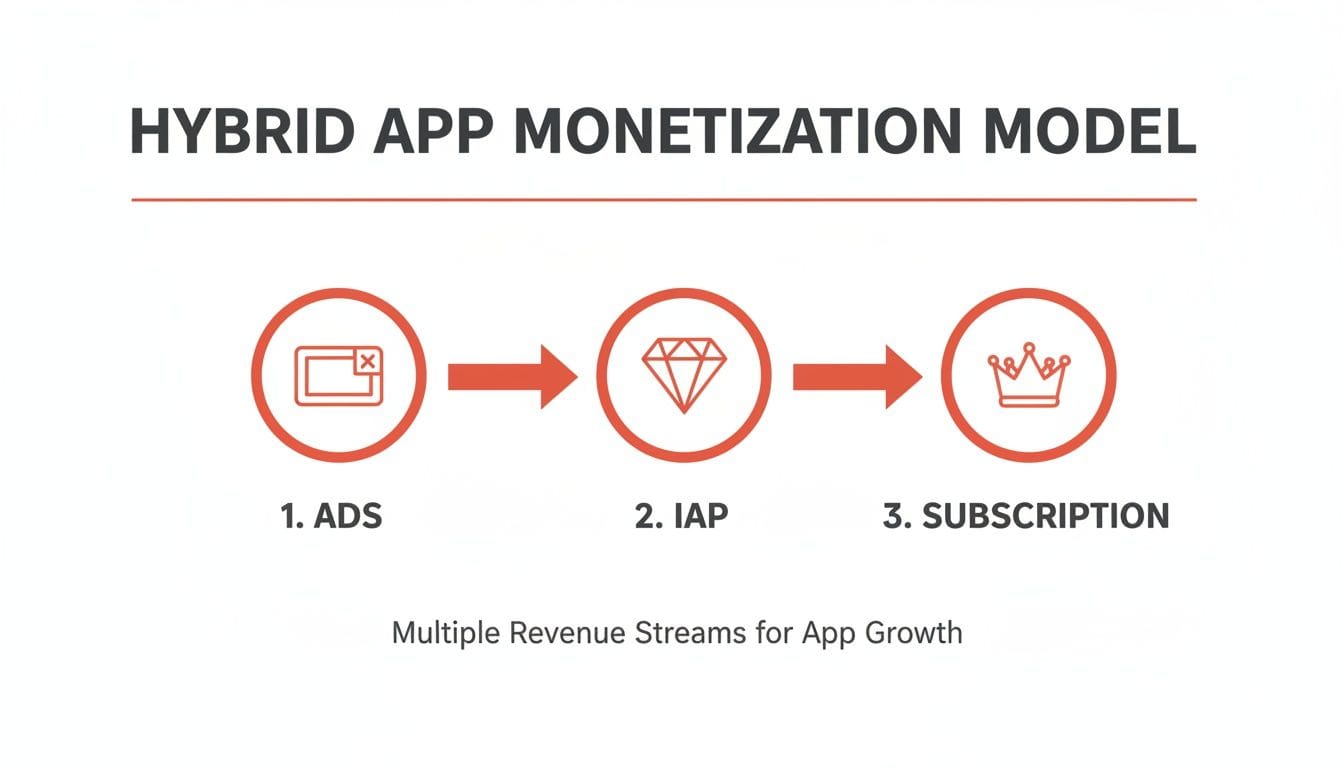
This visual is a great reminder of how different revenue streams can work together, guiding users from a free, ad-supported experience toward higher-value purchases or recurring subscriptions.
Pay close attention to what your users are telling you through support tickets and reviews. If people are consistently confused about what your subscription offers, your messaging is broken. If they complain that the ads are too disruptive, it's time to experiment with different placements or frequencies.
Monetization Model Decision Matrix
To help tie all this together, here’s a quick-reference table. Use it to see which models generally align best with different types of apps. Think of it as a starting point for your own hypothesis.
| App Category | Primary Model | Secondary Model (Hybrid) | Key Metric to Watch |
|---|---|---|---|
| Gaming (Casual) | In-App Advertising | In-App Purchases | Ad eCPM, Daily Active Users |
| Gaming (Hardcore) | In-App Purchases | Subscriptions (Passes) | Average Revenue Per User (ARPU) |
| Productivity/Utility | Freemium / Subscription | One-Time Purchase | Trial Conversion Rate, Churn |
| Content/Media | Subscription | In-App Advertising | Monthly Recurring Revenue (MRR) |
| Social/Community | In-App Advertising | Tipping / IAPs | User Engagement, Session Length |
| Health & Fitness | Subscription | Freemium (basic access) | LTV, Retention Rate |
| E-commerce/Marketplace | Transaction Fees | Affiliate / Advertising | Gross Merchandise Volume (GMV) |
Remember, this matrix isn't gospel. The most successful apps often find a unique blend that perfectly matches what their users value. Your job is to find yours.
Common Questions About App Monetization
Let's cut through the noise. Founders always circle back to the same few questions when it's time to talk money. Here’s what you actually need to know.
What's the Best Strategy for a Brand New App?
There’s no magic bullet here. The "best" strategy is the one that lines up with what you're trying to achieve right now.
Actionable Insight for Growth Focus: If your #1 goal is rapid user acquisition, go with an ad-supported model. Your only barrier to entry is a free download. Once you have a large, engaged audience, you can introduce IAPs or a subscription to remove ads. The game Wordle is a perfect example of this: build a massive user base first, monetize later.
Actionable Insight for Value Focus: If your app delivers deep, ongoing value (like a fitness coach or a business tool), start with a subscription model and a compelling 7- or 14-day free trial. The trial lets users experience the core "aha!" moment. For example, a budget app's trial should be long enough for the user to connect their bank accounts and see their first spending report. Once they see that value, the subscription becomes an easy decision.
How Can I Use Ads Without Ruining the User Experience?
This is the big one. The goal isn't to cram ads in wherever they fit; it's to make them feel like a fair exchange for a free product.
Here’s an actionable checklist:
- Prioritize Rewarded Ads: Let users choose to watch an ad in exchange for a tangible benefit. In a game, this could be "Watch ad for 100 coins." In a utility app, "Watch ad to unlock a premium feature for 1 hour." It's opt-in, not forced.
- Time Interstitials Wisely: Only show full-screen ads at natural stopping points. After completing a level, after saving a file, or before returning to the main menu. Never interrupt a user mid-task.
- Offer an Ad-Free Upgrade: Always provide a clear, easy way for your most engaged users to pay to remove all ads. This can be a one-time IAP or part of a subscription. This respects user choice and creates a new revenue stream. The popular podcast app Pocket Casts does this perfectly with its "Patron" tier.
Monetization isn't something you bolt on at the end. It needs to be in your app's DNA from the very beginning. While your first priority is always building a stable product people love, you should be testing monetization ideas on a small group of users early. This is how you get the real-world data you need to nail your pricing and strategy before you roll it out to everyone.
Ready to build an app that’s designed for revenue from day one? At Vermillion, we partner with startups to create mobile products that prove traction and ROI fast. We specialize in implementing robust monetization systems that drive MRR and LTV. Learn more about our performance-based model.
*Article created using Outrank*
Keep reading
See all →
March 22, 2026
Unlocking Revenue Your Guide to Price Tier Strategy
March 21, 2026
Your Guide to Flawless Stripe Subscription Management

May 14, 2026
Fractional Mobile Engineering vs. Full-Time Hiring in 2026
The mobile engineering talent market has shifted dramatically over the past two years. Budgets are tighter, AI tools have changed what a sin...
March 20, 2026
Recurring Billing With Stripe a Guide for Subscription Apps
Master recurring billing with Stripe. This guide covers everything from setup and server logic to webhooks and churn reduction for subscript...
March 19, 2026
Unlocking Growth with Mobile App Retention Metrics
Discover the mobile app retention metrics that directly fuel MRR growth. This founder's guide offers actionable strategies to track, analyze...