Vermillion Insights
January 31, 2026 · Ken Vermeille · 19 min read
Mobile App Development Timeline: Your Clear Roadmap to Launch
Discover the mobile app development timeline and learn how each phase guides your launch, resource planning, and faster time to market.
So, how long does it really take to build an app?
Founders often ask us this, and the honest answer is that a market-ready app typically takes 10 to 20 weeks from the initial idea to a polished product ready for its first users.
How Long Does It Really Take to Build an App
Here’s where many founders get it wrong: they think the timeline is just about the coding. In reality, building an app is a lot like building a house. You need a solid blueprint and a stable foundation long before you can even think about putting up walls.
Jumping straight into engineering without that crucial planning is a recipe for disaster. It leads to endless delays, blown budgets, and costly rework down the line.
This guide is designed to demystify the entire process for startup leaders. We'll frame the timeline not just as a schedule, but as a strategic roadmap for allocating your resources, keeping stakeholders aligned, and hitting the business milestones that actually matter.
The Essential Phases at a Glance
Every stage of development builds on the last one. It’s a logical progression from a rough concept to a live product in the app store. If you rush or skip a phase, you're injecting massive risk into your project.
For example, a fuzzy strategy in the Discovery phase almost always leads to chaotic feature changes during Engineering, derailing the entire timeline.
Here’s a quick look at the journey your idea will take:
- Discovery & Strategy: This is where we pressure-test your assumptions, define the absolute must-have features, and lock in a clear project scope.
- UI/UX Design: The focus here isn't just making it look pretty. It's about creating a user journey that feels intuitive and keeps people engaged.
- Engineering (Development): Now the coders get involved, turning all those designs and plans into a real, functional application.
- QA & Testing: We rigorously hunt down and squash bugs to make sure the app is stable, secure, and performs exactly as it should.
- Launch & Optimization: The app goes live! From there, it's all about monitoring performance, gathering user feedback, and planning what comes next.
An app's timeline is directly tied to its complexity, which of course, influences how much you'll invest. To learn more about that side of the equation, check out our complete guide on the cost to produce an app.
A High-Level Look at the App Development Timeline
To give you a bird's-eye view before we dive deep into each phase, this table breaks down how time is typically allocated.
| Phase | Typical Duration (Weeks) | Key Objective |
|---|---|---|
| Discovery & Strategy | 1-2 | Validate the core idea and define the Minimum Viable Product (MVP). |
| UI/UX Design | 2-4 | Create intuitive wireframes, mockups, and a clickable prototype. |
| Engineering | 5-10 | Build the front-end, back-end, and integrate necessary APIs. |
| QA & Testing | 2-3 | Ensure the app is bug-free, secure, and performs flawlessly. |
| Launch & Optimization | 1+ | Deploy to app stores and begin gathering user feedback for improvements. |
Think of these numbers as a solid starting point. As we'll explore, factors like features, integrations, and your team structure can shift these timelines significantly.
The Six Critical Phases of App Development
Turning an abstract idea into a tangible app requires a concrete game plan. You need to break the massive task of "building an app" into smaller, manageable stages. Each phase has its own purpose, a clear set of tasks, and a specific deliverable that sets up the next step for success.
This structure isn't just project management jargon; it's the vocabulary you need to confidently steer your app from a sketch on a napkin to a live product in the App Store.
Think of it like a six-stage rocket launch. Each stage has to fire perfectly, in the right sequence, for the mission to succeed. Skipping a pre-flight check (Discovery) or rushing the engine build (Engineering) puts the entire project at risk.
Phase 1: Discovery and Strategy
This is, without a doubt, the most important phase - and it's the one most startups try to rush. The goal here isn't just to brainstorm a list of cool features. It's about validating your entire business case before you spend a dime on code.
This is where you pressure-test your assumptions about the market, define who your core users really are, and map out the competitive landscape. Key activities include stakeholder interviews, deep competitor analysis, and defining the Key Performance Indicators (KPIs) that will actually measure success.
The main deliverable from this phase is a crystal-clear Product Requirements Document (PRD). This document outlines the app's core purpose, features, and technical needs, becoming the north star for the entire project.
Practical Example: Let's say you're building a subscription-based fitness app. During Discovery, you’d lock down your monetization model and pick a provider like RevenueCat to handle in-app purchases. Making this decision now prevents massive engineering headaches later, because the entire backend will be built from day one to support it.
Phase 2: UI and UX Design
A lot of people think this phase is just about "making it look pretty." That's a dangerous misconception. UI/UX design is less about aesthetics and more about crafting an intuitive user journey that keeps people coming back.
User Experience (UX) design is the logical flow of the app - how a user gets from screen A to screen B to accomplish their goal. User Interface (UI) design is about the visual elements - the buttons, icons, colors, and typography they interact with along the way.
First, UX designers create low-fidelity blueprints called wireframes, followed by interactive prototypes. This lets you test the user flow and get feedback before a single line of code is written. Once the flow is solid, UI designers step in to apply the branding, colors, and visual polish, creating high-fidelity mockups.
Actionable Insight: Use a tool like Figma to create your interactive prototype. Before approving the design, send a link to 5-10 potential users and ask them to perform a core task, like "sign up for a free trial." Watch where they get stuck. Fixing a confusing flow at this stage takes hours; fixing it after it's been coded can take weeks.
Phase 3: Engineering or Development
With the design blueprint approved, the engineering team starts the actual construction. This is almost always the longest and most resource-intensive phase in the mobile app development timeline. It’s typically broken down into three parallel streams of work:
- Backend Development: This is the engine under the hood. Developers build the server, database, and Application Programming Interfaces (APIs) that handle things like data storage, user accounts, and all the core business logic.
- Frontend Development: This is everything the user sees and touches. Developers take the UI mockups and bring them to life, building the actual screens, navigation, and interactive elements.
- API Integration: This is the crucial step of connecting the frontend to the backend, allowing data to flow seamlessly between the user's device and the server.
While this article focuses on the phases for mobile apps, having a clear development roadmap is universal. The same principles apply whether you're building an iOS app or following a guide on how to build an AI chatbot from concept to launch.
Phase 4: Quality Assurance and Testing
Before your app is ready for prime time, it needs to be put through the wringer. The Quality Assurance (QA) phase is all about finding and squashing bugs. The goal is to ensure the app is stable, secure, and performs flawlessly across a wide range of devices and network conditions.
QA testers run a whole battery of tests, including:
- Functional testing: Do the features actually work as intended?
- Usability testing: Is the app easy and intuitive to use?
- Performance testing: Is it fast and responsive, or does it lag and drain the battery?
A thorough QA process is non-negotiable. A buggy, crash-prone app can destroy user trust in seconds. To see how this fits into the bigger picture, you can explore the full stages of the product development lifecycle.
Phase 5: Launch
After all the rigorous testing and bug fixing, it’s finally time to deploy your app to the world. This phase involves more than just flipping a switch. You'll need to prepare all the assets for the app stores, including your app icon, screenshots, a compelling description, and a privacy policy.
Once you submit your app, it goes through a review process by both Apple and Google, which can take anywhere from a few hours to several days. A successful launch isn't an accident; it's the result of all the previous phases working in perfect harmony.
Actionable Insight: Don't wait until the last minute to prepare your App Store listings. Two weeks before your planned launch date, create your listings in App Store Connect and Google Play Console. Upload all your screenshots, write your descriptions, and fill out the privacy questionnaires. This avoids a frantic rush on launch day and gives you time to fix any unexpected issues.
Phase 6: Post-Launch Optimization
Getting your app launched isn't the finish line - it's the starting line. The post-launch phase is a continuous cycle of monitoring, learning, and improving. You'll be using analytics tools to track your KPIs, gathering user feedback from reviews and surveys, and planning future updates.
This ongoing optimization is what separates successful apps from forgotten ones. The history of mobile apps is a testament to this truth. When the iPhone launched in 2007, the App Store exploded from just 552 apps to a billion downloads in its first year. This rapid growth proved that relentless improvement based on real user data is what drives traction and retention - a principle that's more true today than ever.
Three Real-World App Development Timelines
Abstract phases and week counts are a good starting point, but the best way to really get a feel for a mobile app development timeline is to see it in action. So, let's move from theory to practice and walk through three completely different scenarios. Each one shows how different goals, complexities, and trade-offs shape the final schedule.
Think of these timelines less as rigid schedules and more as strategic roadmaps. Each one is built around a specific business goal, whether that’s getting to market as fast as humanly possible or building something with deep, compliant functionality from day one.
This diagram gives a simplified look at how the core phases - Discovery, Design, and Engineering - flow one after the other.
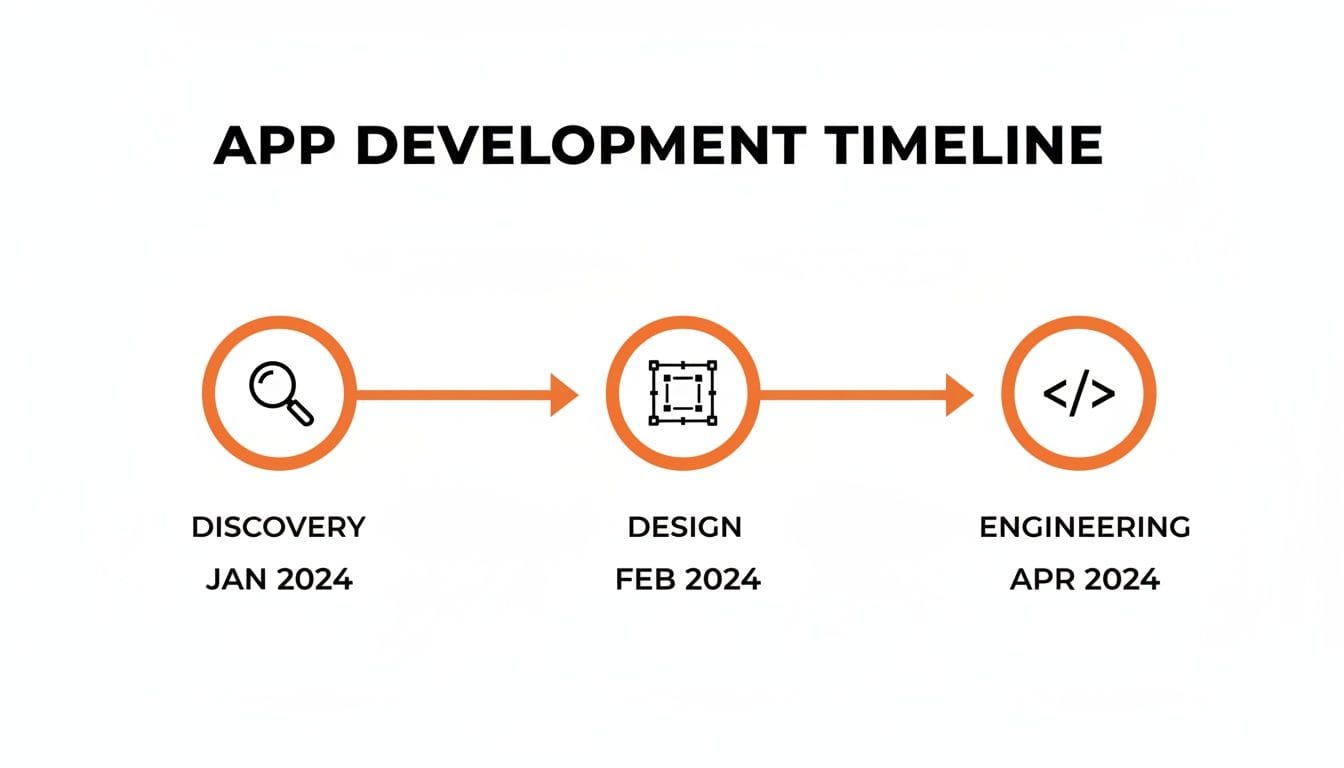
It’s a good reminder that these stages are sequential for a reason. Each one builds on the last, forming the project's critical path.
The 10-Week Social MVP
Picture a startup with a unique idea for a content-sharing app. Their number one goal is speed. They need to validate the concept with actual users before a competitor beats them to it. This timeline is aggressive and all about the core loop - everything else is noise.
- Weeks 1-2 (Discovery & Design): This phase is brutally focused. The team defines and locks down the single most important feature: the content feed and sharing mechanic. Wireframes are created and approved almost immediately to keep the momentum going. No time for "what ifs."
- Weeks 3-7 (Engineering): Developers are laser-focused on the essentials. They build user profiles, a basic content feed, and the core sharing function. That's it. Fancy analytics and complex notification settings can wait.
- Weeks 8-9 (QA & Testing): Testing is concentrated on the primary user journey. Is the core loop of creating, sharing, and viewing content stable and bug-free? That’s the only question that matters.
- Week 10 (Launch): The app hits the stores. The goal isn't a polished, feature-packed product; it's getting the MVP into users' hands to start collecting real-world feedback.
The 12-Week Marketplace App
Now, let's switch gears to a marketplace app that connects local service providers with customers. This is inherently more complex. You have two distinct user types (buyers and sellers), a booking system, and secure payment processing. You can't just throw this together.
The timeline is more balanced. It carves out enough time for the critical integrations while still pushing for a reasonably quick launch.
This 12-week schedule is a very common and realistic timeline for many startups. It strikes a great balance between the need for speed and the reality of building a secure, transactional platform that can actually make money from day one.
The 20-Week Healthtech App
Finally, let’s look at a healthtech app designed to track patient data and sync with medical devices over Bluetooth. This is a whole different ballgame. The complexity skyrockets due to iron-clad security requirements (HIPAA compliance), real-time data synchronization, and third-party hardware integration. Cutting corners here isn't an option; it's a liability.
- Weeks 1-3 (Discovery & Strategy): This phase is longer because it has to be. It involves deep dives into regulatory compliance, data security protocols, and mapping out the logic for handling incredibly sensitive health information.
- Weeks 4-7 (UI/UX Design): The design process is all about trust and accessibility. The user experience has to be crystal clear, reassuring, and simple enough for non-technical users to navigate with confidence.
- Weeks 8-16 (Engineering): This becomes the longest phase by far. The team is building a complex backend for secure data storage, writing the logic for device integration, and developing a rock-solid API.
- Weeks 17-19 (QA & Testing): Testing is exhaustive. We're talking security penetration testing, hardware compatibility checks across a range of devices, and painstaking data accuracy validation.
- Week 20 (Launch): The launch is careful and phased. It often starts with a small pilot group of users to ensure every system is stable and secure in a real-world setting before opening the floodgates.
Example Project Timelines Compared
To see these differences side-by-side, here’s how the phases might break down across our three examples. Notice how the engineering and testing phases expand dramatically as the scope and risk increase.
| Phase/Milestone | 10-Week (Simple MVP) | 12-Week (Marketplace) | 20-Week (Complex Healthtech) |
|---|---|---|---|
| Discovery & Design | Weeks 1-2 | Weeks 1-3 | Weeks 1-7 |
| Engineering | Weeks 3-7 | Weeks 4-8 | Weeks 8-16 |
| QA & Testing | Weeks 8-9 | Weeks 9-11 | Weeks 17-19 |
| Launch Prep & Deploy | Week 10 | Week 12 | Week 20 |
As you can see, understanding these different timeline models is key to setting expectations that are actually achievable. The complexity of your idea and your strategic goals will ultimately point you toward the right path.
If you want to get more granular on how these tasks are sequenced, our guide on defining the critical path for your project is a great next step.
Key Factors That Can Stretch (or Shrink) Your App Timeline
While a sample schedule gives you a good starting point, no two app development timelines are ever the same. Think of certain variables as levers: some will compress your launch date, while others can stretch it well into the next quarter. Understanding these factors upfront is the best way to spot potential delays and make smarter, faster decisions.
Imagine your app is a car. A basic sedan is much quicker to assemble than a high-performance race car loaded with custom parts. The same idea applies to your app's features and integrations.
Feature Complexity and Scope
This is the big one. The single largest influence on your timeline is the sheer complexity of what you're trying to build. It's the difference between snapping a pre-built component into place and engineering a novel system from the ground up.
- Simple Features: These are the standard, well-understood functions we all expect. Think user login, static "About Us" screens, or a basic feed. These can often be built in a matter of days.
- Complex Features: This is where the real time gets spent. These features demand custom logic, advanced algorithms, or heavy backend work. Building a simple social feed is one thing; engineering an AI-powered recommendation engine that learns from user behavior is a whole other beast that can easily add 4-6 weeks to your timeline.
Actionable Insight: For every proposed feature, ask this question: "If we don't build this for V1, can we still solve the user's core problem and charge money for it?" If the answer is "yes," move it to the backlog. This ruthless prioritization is your best defense against scope creep.
Third-Party Integrations
Modern apps rarely live in a bubble. They plug into other services via APIs to handle everything from payments and analytics to push notifications. But - and this is a big but - not all integrations are created equal. Their complexity can have a massive impact on your schedule.
Here’s a real-world example we see all the time:
Integrating a modern, well-documented payment gateway like **Stripe** might take a development team a week. In contrast, trying to connect to a company's outdated, poorly documented legacy Enterprise Resource Planning (ERP) system could take over a month of painstaking work, full of trial-and-error and custom scripting.
Before you commit to an integration, have your technical lead spend a few hours assessing the quality of its documentation and developer support. That small bit of due diligence can save you weeks of unforeseen headaches.
Platform Choice: Native vs. Cross-Platform
This is a foundational decision with major timeline implications. You essentially have two paths you can go down:
- Native Development: This means building two entirely separate apps - one for iOS (using Swift) and another for Android (using Kotlin). While this approach delivers the absolute best performance and user experience, it's also the most time-consuming and expensive. You're effectively running two parallel projects.
- Cross-Platform Development: This is the accelerator. Using a framework like **React Native** lets you write a single codebase that runs on both iOS and Android. It allows you to build, test, and deploy for both platforms at once, often cutting engineering time by 30-50%.
The rise of these tools has been a game-changer for startups. Cross-platform frameworks really took off after the initial app store boom of 2008, a time when building for both iOS and Android meant hiring two separate, expensive, and specialized teams. Today, frameworks like React Native allow startups to get a native-like feel and performance with one efficient team, dramatically shortening the path to revenue. You can learn more about the history and impact of these platforms by exploring the evolution of mobile app development.
Team Structure and Communication
Finally, don't underestimate the human element. The structure of your team and the clarity of your communication channels can either create a well-oiled machine or a source of constant friction.
A small, dedicated team with a single point of contact for feedback can move incredibly fast. On the flip side, a project with multiple stakeholders who provide conflicting feedback can get bogged down in endless revision cycles. To keep things moving, you have to establish a clear decision-making process from day one.
Similarly, if your app has specific regulatory needs - like HIPAA compliance for a healthtech app - that adds significant overhead to every single phase, from design to testing. That kind of requirement absolutely has to be factored into your schedule from the very beginning.
How to Accelerate Your Timeline and Boost ROI

Shrinking your development timeline isn't about cutting corners - it’s about making smarter, more strategic decisions to get you to revenue faster. Every week you shave off your schedule is another week you can be in the market, learning from real users and actually making money. Speed is the result of killer planning, not rushed work.
The real goal is to stamp out ambiguity and squeeze every drop of efficiency out of each stage. This takes a disciplined approach that prioritizes proving your idea in the market over building a bloated, feature-heavy product nobody asked for.
Embrace a Lean MVP with a Clear Monetization Goal
The single most powerful way to slash your timeline is to shrink your scope. Define the absolute bare-minimum set of features your app needs to solve one core problem for one specific type of user. This is your Minimum Viable Product (MVP).
An MVP isn't a cheap version of your final product; it's a strategic tool for learning. Every single feature must be put on trial: does this directly help us prove our main idea and test our monetization model? If the answer is no, it gets kicked to a future release.
Practical Example: A meditation app's MVP shouldn't launch with a social network, a mood journal, and a library of 500 soundscapes. The real MVP is a handful of core guided meditations behind a simple subscription paywall. That intense focus lets you launch in 10 weeks, not 20, and immediately find out if people will actually pay for what you're offering.
Build Once for Both Platforms with Cross-Platform Frameworks
Your tech choice is a massive lever for speed. Building two separate native apps for iOS and Android essentially doubles your engineering work. For most startups, that’s a completely unnecessary drain on time and cash.
Cross-platform frameworks like React Native are total game-changers here. They let your team build from a single codebase that runs beautifully on both platforms. This decision alone can cut your engineering phase by 30-50%, letting you launch on the Apple App Store and Google Play Store at the same time.
Prepare Detailed Requirements Before Kickoff
Ambiguity is the enemy of a tight timeline. Starting development with vague ideas is like asking a construction crew to build a house without a blueprint. It’s a guarantee for endless back-and-forth, expensive rework, and massive delays.
Before anyone writes a single line of code, invest the time to create a detailed Product Requirements Document (PRD) and interactive prototypes. This forces everyone - stakeholders, designers, and developers - to get on the exact same page about what's being built.
Here are a few ways to speed things up without compromising on quality:
- Leverage No-Code Tools: For fast prototyping and building internal tools, no-code and low-code platforms are incredibly powerful. Using platforms with no-code API capabilities, like those in Flutterflow API no-code solutions, can dramatically accelerate development and help you build complex apps quickly.
- Plan Phased Rollouts: Don't try to launch with a "big bang" that includes every feature you've ever dreamed of. Get your core MVP out the door first, then follow up with updates every 2-4 weeks. This gets you to market faster and lets real user feedback drive your roadmap.
- Establish Clear Communication Protocols: Set up a single person as the point of contact for feedback and decisions. Daily stand-ups and a shared project management tool (like Jira or Asana) keep the whole team synced up and prevent communication from becoming a bottleneck.
Ultimately, a faster timeline comes from focusing your resources on what actually drives business results. By combining a lean MVP, smart technology choices, and disciplined planning, you can drastically shorten your path to market and start building a profitable app that much sooner.
Planning Your Transition for Long-Term Success
Launching your app is a huge milestone, but let's be clear: it’s the starting line, not the finish line. What comes next is the crucial handoff from your development partner to your own in-house team. For any startup with serious growth ambitions, taking ownership of your technology is non-negotiable.
This is the exact point where many promising projects fall apart. A rushed, poorly managed transition creates massive knowledge gaps, balloons your technical debt, and leaves you dangerously dependent on your agency.
Get it right, though, and you empower your company to innovate on its own terms and truly control its destiny.
Building Your Handoff Blueprint
A smooth transition doesn’t happen by accident. It's a structured process built on disciplined communication and obsessive documentation. The goal isn't just to get the code; it's to transfer all the deep, nuanced product knowledge your partner has spent months accumulating.
Think of it like buying a custom-built race car. You wouldn't just take the keys and drive off. You'd demand the full schematics, the service manual, and a track day with the engineers who built it. The exact same principle applies to your software.
A well-executed handoff plan is the bridge between a successful launch and a sustainable, high-growth tech company. It ensures the momentum you’ve built isn’t lost the moment your development partner steps away.
Key Components of a Successful Transition
To make sure nothing slips through the cracks, your handoff plan needs to be more than just a vague checklist. This isn't just about getting access to a GitHub repository; it's about a complete transfer of operational intelligence.
Your plan absolutely must include:
- Comprehensive Documentation: This is the bare minimum. We're talking about the full tech stack, architecture diagrams with the "why" behind key decisions, API endpoint definitions, and crystal-clear instructions for setting up a new development environment from scratch.
- Knowledge Transfer Sessions: Don't let this be a single, rushed meeting. Schedule dedicated workshops where the agency's engineers walk your new team through the codebase. They need to explain the core logic, point out the tricky parts, and highlight potential pitfalls.
- A Clear Future Roadmap: The handoff should conclude with a prioritized list of features and technical improvements for the next 3-6 months. This gives your new team a clear direction and immediate purpose from day one.
By demanding a structured transition plan from the very beginning of your engagement, you ensure your mobile app development timeline sets you up not just for a great launch, but for the years of growth that need to follow.
Common Timeline Questions Answered
Even with the clearest roadmap, founders always have a few lingering questions. Let’s tackle some of the most common ones we hear when talking through a build schedule. Think of this as the expert FAQ section.
Can a Mobile App Really Be Built in Less Than 10 Weeks?
Yes, but it’s a sprint, not a marathon. Pulling off a sub-10-week build means you're laser-focused on a prototype or a single-feature MVP. We're talking minimal backend complexity, zero fluff.
To even attempt this, you need your requirements locked down cold, UI/UX designs already validated, and a tech stack built for pure speed - like React Native with a library of pre-made components.
Practical Example: Imagine a team aiming for an 8-week launch of a simple journaling app. The only feature is creating and saving text entries locally on the device. That's it. No user accounts, no cloud sync, no social sharing. The entire goal is to validate one single thing: Do people want the core experience?
It’s a high-risk, high-reward play. You use it for rapid market validation before you write the big checks.
How Does Using React Native Affect the Development Timeline?
React Native is one of the biggest timeline accelerators in our toolkit. Instead of building two separate apps for iOS and Android - which means two codebases, often two teams, and two sets of problems - you write a single codebase that runs on both.
Compared to traditional native development, this single-codebase approach can slash engineering time by a solid 30-50%.
But the efficiency doesn't stop at launch. Every future update, every bug fix, every new feature is simpler because you only have to make the changes once. For a startup, this is huge. You get to market on both platforms faster and run a much leaner operation once you're there.
What Is the Biggest Cause of Timeline Delays in App Development?
Hands down, it's "scope creep." It’s the slow, constant drip of new features and "just one more thing" requests after the project has already started.
Nine times out of ten, this is a direct symptom of a weak discovery and planning phase. When you don't have a ruthlessly defined MVP scope and a prioritized feature list, the floodgates open for every stakeholder to add their pet feature.
Each small addition creates a domino effect. It hits design, then development, then testing, pushing everything back. Sticking to the plan you locked in during the strategy phase is the single most important thing you can do to keep your project on schedule.
Ready to build an app that hits its timeline and drives real business results? At Vermillion, we specialize in delivering revenue-ready React Native apps in 10-20 weeks. We tie our success to your KPIs, ensuring our incentives are perfectly aligned with your growth. Learn how we can accelerate your path to market.
Keep reading
See all →
March 22, 2026
Unlocking Revenue Your Guide to Price Tier Strategy

March 21, 2026
Your Guide to Flawless Stripe Subscription Management
May 14, 2026
Fractional Mobile Engineering vs. Full-Time Hiring in 2026
The mobile engineering talent market has shifted dramatically over the past two years. Budgets are tighter, AI tools have changed what a sin...
March 20, 2026
Recurring Billing With Stripe a Guide for Subscription Apps
Master recurring billing with Stripe. This guide covers everything from setup and server logic to webhooks and churn reduction for subscript...
March 19, 2026
Unlocking Growth with Mobile App Retention Metrics
Discover the mobile app retention metrics that directly fuel MRR growth. This founder's guide offers actionable strategies to track, analyze...