How Startups Hire Mobile App Developers For Growth
Finding the right mobile app developers isn't about running technical interviews. It's about translating your vision into a concrete, buildable plan before anyone writes a single line of code.
Success hinges on defining your core business outcomes, monetization strategy, and user journey with absolute clarity. Honestly, this initial blueprint is the single most important document you'll create in your startup's early days.
Translating Your Vision Before You Hire Developers
Before you even start looking for a development partner, you need to turn that big idea swirling in your head into an actionable roadmap. This foundational work ensures any team you bring on understands not just what to build, but why they're building it. A well-defined vision aligns everyone around the metrics that actually matter for growth, like Lifetime Value (LTV) and Monthly Recurring Revenue (MRR).
Getting this clarity is more important than ever. The global mobile app development workforce is projected to hit over 35 million professional developers by 2025—a massive leap from just 2.5 million back in 2010. With roughly 40% of all software developers now specializing in mobile, the talent pool is huge, but so is the variation in quality. To attract the best, you need a plan that gets them excited.
Define Your Core Business Outcomes
Forget about features for a minute. What does success look like in 12 months? You need to start with the business goals those features are supposed to achieve. This simple shift changes the entire conversation from "we need a chat function" to "we need to increase user session time by 20% to drive more ad revenue." See the difference?
A practical way to nail this down is to set three primary KPIs.
- Practical Example: For a new meditation app, your core outcomes aren't just "get downloads." They are specific and measurable.
- User Retention: Achieve a 15% Day 30 retention rate within six months of launch. This forces you to think about features like daily reminders and progress tracking that bring people back.
- Monetization: Hit $10,000 in MRR by the end of year one. This tells developers that the subscription flow and paywall logic are top priorities, not afterthoughts.
- User Acquisition: Onboard the first 1,000 paying subscribers through organic search and targeted social ads. This goal informs technical choices like deep linking and referral code functionality.
These kinds of goals give potential development partners a clear finish line to run toward. It’s a target, not just a to-do list.
Articulate Your Monetization Strategy
How you plan to make money directly impacts the app's architecture. It’s not just a slide in your pitch deck; it's a technical spec. Before you hire anyone, you need a firm grasp on this. Exploring some proven mobile app monetization strategies can give you a solid starting point.
- Practical Example: Let's say you're building a language-learning app.
- Scenario A (Freemium): You offer the first three lessons for free and then hit users with a paywall. This requires developers to build logic to track user progress and restrict access to specific content based on their subscription status.
- Scenario B (In-App Purchases): You sell "packs" of advanced lessons or a "grammar power-up." This requires a completely different architecture for managing one-time purchases, restoring purchases if a user changes devices, and setting up a virtual currency system.
Defining this early saves you from incredibly expensive rebuilds down the road. Our guide on app development for startups goes deeper into how to align your business model with your product from day one.
Key Takeaway: A monetization strategy isn’t just a business plan slide; it’s a technical specification. A fitness app planning to sell one-time workout plans has vastly different backend needs than one offering a tiered monthly subscription with a free trial.
Map the Entire User Journey
How does a complete stranger go from discovering your app to becoming a loyal, paying customer? Mapping this journey is the best way to figure out the critical screens and features your Minimum Viable Product (MVP) absolutely must include.
- Practical Example: Let's map the user journey for a hypothetical photo-editing app that sells premium filters.
- Onboarding: A user downloads the app. The first screen shouldn't be a login wall; it should be a button that says "Edit Your First Photo." This provides immediate value and gets them hooked before asking for a commitment like an email address.
- Core Action: The user uploads a photo and applies a few free filters. The interface is clean, fast, and the results look great. This is the core loop of the app.
- Value Realization: The user sees a "premium" filter with a small lock icon. They tap it, and a preview of the filter is applied to their photo—the "aha!" moment. A non-intrusive popup says, "Unlock all 50 premium filters for $2.99/month."
- Re-engagement: Two days later, a push notification says, "New 'Vintage Film' filter pack just dropped! Check it out." This drives them back into the app and reinforces its value.
This mapping exercise forces you to create a tight, focused MVP scope. It helps you zero in on only the features that validate your core assumptions and prove you can get traction, all within a realistic 10-20 week timeline.
Choosing the Right Development Partner Model
The way you structure your development team is one of the most critical decisions you'll make. It’s not just a budget line item; it’s a strategic choice that dictates your speed, your burn rate, and ultimately, your product's trajectory. For a startup, this decision usually boils down to three paths: building an in-house team, hiring a traditional agency, or finding a performance-based partner.
Each route comes with its own set of very real trade-offs. The right answer depends entirely on your startup's stage, how much cash you have in the bank, and what you’re trying to achieve in the next 6-12 months.
Before you can even think about who to hire, you need to be brutally honest about your own business plan—your monetization strategy, your ideal user journey, and the absolute minimum you need to build for an MVP. This kind of planning has to happen first.
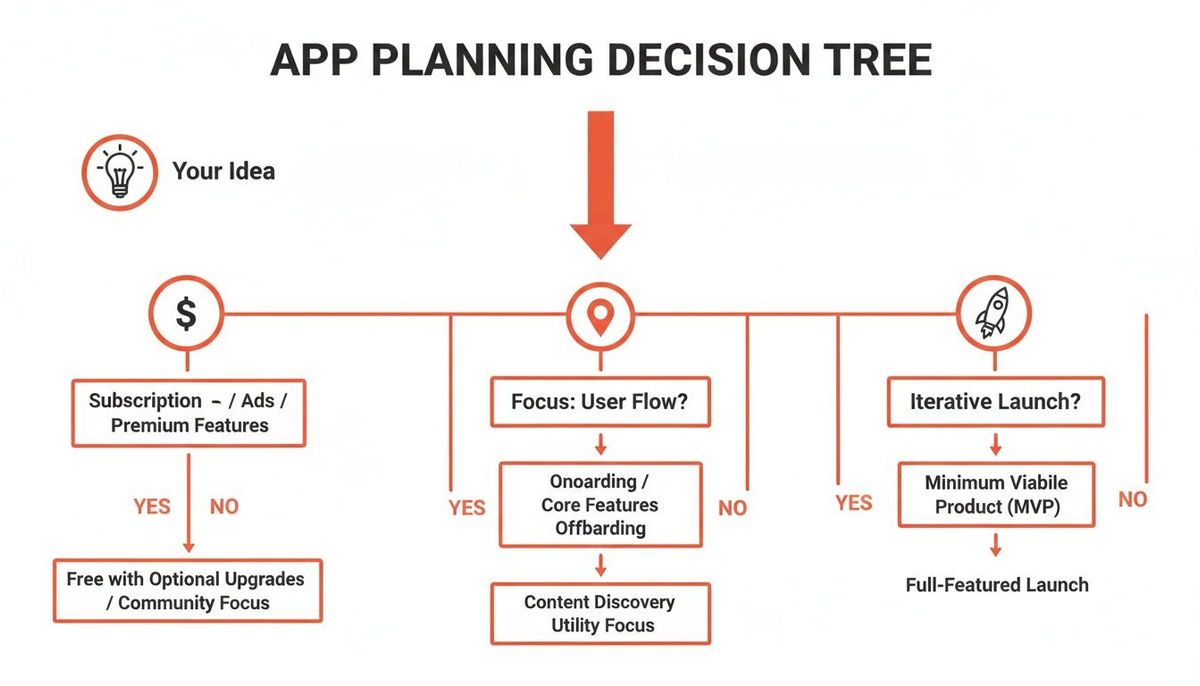
This initial strategy work is the foundation. Only after you've defined these core business drivers can you seriously evaluate which development model makes sense for you.
To help clarify the trade-offs, here’s a quick comparison of the three main models across the factors that matter most to a startup.
Development Partner Model Comparison for Startups
| Factor | In-House Team | Traditional Agency | Performance-Based Partner |
|---|---|---|---|
| **Speed to MVP** | Very Slow (6-9 months) | Fast (3-5 months) | Very Fast (2-4 months) |
| **Upfront Cost** | Highest | High | Moderate |
| **Risk** | Highest (on founder) | High (on founder) | Shared |
| **Alignment** | High (long-term) | Low (project-based) | Very High (business outcomes) |
| **Flexibility** | Low | Moderate | High |
This table gives you a high-level view, but the real devil is in the details of how these models play out in the real world. Let's dig into what each one actually feels like for a founder.
The In-House Team Conundrum
Building your own team of mobile app developers feels like the "right" thing to do. It’s the gold standard, offering total control, deep product knowledge, and a long-term company asset. But for an early-stage startup, this path is almost always a trap, loaded with hidden costs and brutal delays.
- Practical Example: You decide to hire one senior mobile developer and one backend developer.
- Month 1-2: You spend this time writing job descriptions, working with recruiters (and paying their fees), and conducting dozens of interviews.
- Month 3: Your first hire starts. For the next month, they are mostly unproductive, learning your vision, setting up their development environment, and waiting for the second hire to arrive.
- Month 4-6: The second hire starts. Now the real ramp-up begins as they learn to work together and try to build the initial architecture. You are already half a year in, have spent over $100,000 in salaries and fees, and still don't have a single line of code written for your actual product features.
If you need to get an MVP out the door in 10-20 weeks, the in-house route is a non-starter. It’s far too slow and eats up too much capital. It might be a great goal for year two, but it's a massive roadblock in year one.
Traditional Agencies: Speed at a Price
A traditional mobile app development agency gives you what you desperately need: immediate access to a full team of designers, developers, and project managers. They come with established processes and can start building almost right away. Speed is what they sell.
The problem? A fundamental misalignment of incentives. Most agencies work on either an hourly or a fixed-bid model, and both are flawed.
- Practical Example (Hourly Billing): You hire an agency at $150/hour. During development, they discover a more complex technical issue with a third-party API. Instead of finding a quick workaround, their incentive is to spend more hours "investigating the problem," billing you for an extra 40 hours of work that doesn't add direct value to the user. Your budget is blown, and the timeline is delayed.
Bottom line: they get paid whether your app succeeds or fails. The model is designed to de-risk the project for them, not for you.
When an agency's success metric is billable hours, and your success metric is user retention, you're running toward two different finish lines.
Performance-Based Partners: A Smarter Model
A third model has emerged, built specifically to solve the startup dilemma: the performance-based partner. This approach tackles the incentive problem head-on by tying a chunk of the development fees to your business's actual performance.
Instead of just checking off a list of features, a performance partner gets compensated when you hit critical KPIs that actually matter, like:
- Monthly Recurring Revenue (MRR)
- User Lifetime Value (LTV)
- Day 30 Retention Rates
- Conversion rates from free to paid
- Practical Example: You agree to a performance model where 20% of the partner's fee is tied to achieving a 10% free-to-paid conversion rate within 3 months of launch. Now, your developers are proactively suggesting changes to the paywall design, A/B testing the call-to-action text, and analyzing user behavior to see where people drop off in the subscription funnel. They are acting like co-owners, not just coders.
This structure completely changes the dynamic. Your mobile app developers are now financially motivated to build a product that doesn't just work, but grows. If this sounds like a better fit, our guide on how to hire a mobile app agency for your startup dives deeper into evaluating these kinds of partnership structures.
How to Vet and Interview Mobile App Development Teams
Okay, you've landed on a development model. Now for the hard part: finding the elite talent that can turn your vision into a product people actually use and pay for.
Let's be clear. Vetting a development partner isn't about asking technical trivia questions. You're not just hiring coders; you're looking for strategic partners who will challenge your assumptions and own the business outcomes right alongside you. This is your first and best defense against hiring a team that just builds features versus one that builds value.
The goal is to move past the generic questions any half-decent team can answer and get to the stuff that reveals their real-world problem-solving skills, their experience in the startup trenches, and their ability to think like a founder.
Beyond The Standard Technical Questions
Generic questions get you generic answers. Asking "Do you know React Native?" is a yes/no question that tells you precisely nothing. You need to dig into their actual, hands-on experience and see how they handle the chaos that inevitably comes with building something new.
- Practical Example: Instead of asking "Do you have experience with APIs?", ask: "Describe a time you had to integrate with a poorly documented third-party API. What was the API for? What specific steps did you take to figure it out, and how did you build a resilient integration that could handle unexpected errors or API changes?" A good answer will involve tools like Postman, reading source code, and implementing error handling with retries—demonstrating real-world problem-solving.
Here are a few questions designed to separate the talkers from the doers:
- Problem-Solving: "Walk me through a time you had to hunt down a nasty performance bug in a React Native app—something like a memory leak or a painfully slow startup. What tools did you use, what was your process, and what was the final fix?"
- Architecture: "Let's say we're building a complex app with both local user data and real-time server updates. How would you structure the state management? What libraries would you reach for—Redux, MobX, Zustand—and why?"
- Cross-Platform Nuances: "Tell me about a time a feature worked perfectly on iOS but was a complete mess on Android (or the other way around). How did you figure out it was a platform-specific issue, and what did you do to fix it?"
There's no single "right" answer here. What you're listening for is a clear, logical thought process, a comfort level with professional tools, and an honest story about their problem-solving journey.
Probing Their Expertise in Monetization and Growth
A team that only knows how to write code is a liability for a startup. Your development partner must understand the business of apps. That means they need hands-on experience with the tools that actually drive revenue and keep users coming back.
Frankly, their familiarity with the growth stack is just as important as their coding ability. You need to know if they can implement and optimize the very systems that will make you money.
Key Insight: Don't ask if they've used Stripe. Ask them to describe the most complex payment integration they've ever built with it. The details will tell you everything you need to know about their real level of expertise.
Here’s how you can gauge their commercial mindset:
- Subscription Logic: "We're planning a freemium model with monthly and annual subscriptions. Can you explain the technical steps for implementing this using a tool like RevenueCat, including how you'd handle things like grace periods and subscription upgrades/downgrades?"
- Analytics and Growth Tooling: "Describe how you've used a tool like Amplitude or Mixpanel to help a past client understand their user funnels. For our MVP, what are the absolute essential events you'd recommend we track to measure user activation and retention?"
- Push Notifications: "Walk me through the architecture of a solid push notification system. How would you handle user segmentation so we can send targeted messages without spamming our entire user base?"
- Actionable Insight: A great answer to the analytics question would be: "For an MVP, we must track 'User Signed Up', 'Core Action Completed' (e.g., 'First Meditation Played'), and 'Subscription Initiated'. This minimal setup lets us calculate your activation rate and initial conversion funnel from day one." This shows they think about business metrics, not just code.
A great team will have strong opinions on these topics. They'll suggest specific tools, talk about the trade-offs, and maybe even share a success story from a past project. Their answers should give you confidence that they can build an app that is not just functional, but ready to grow.
Identifying Red Flags and Positive Signals
The interview is a two-way street. You're not just evaluating them; you're also looking for a cultural fit and a compatible working style. The best partnerships are built on proactive communication and a shared obsession with the product's success.
Keep an eye out for these warning signs and green flags during your conversations.
Common Red Flags to Watch For:
- Passive Agreement: You say, "We should build a social feed," and they just reply, "Okay, we can do that." A true partner will push back with, "That's a huge feature. For the MVP, could we achieve a similar goal of user engagement with a simpler community leaderboard to test the hypothesis first?"
- Vague Answers: They can't give you specific examples or metrics from past projects. This is a huge sign that their experience is shallow.
- Focus on Hours, Not Outcomes: The conversation always circles back to hourly rates and timelines instead of your business goals and KPIs.
- No Questions for You: This is a big one. A top-tier team will grill you just as much as you grill them. They want to know about your market, your funding, and your vision to make sure it's a good fit for them, too.
Positive Signals of a Great Partner:
- They Challenge You: They ask tough questions about your business model or feature priorities, showing they're already thinking strategically.
- They Talk in "We": When they talk about past projects, they use "we," indicating a collaborative, partnership-style relationship with their clients.
- They Are Data-Informed: They can reference specific metrics, like "we helped App X increase their Day 7 retention by 15% by implementing a new onboarding flow."
- They Are Transparent About Failures: They can openly discuss a project that didn't go to plan and, more importantly, what they learned from it.
Ultimately, you’re looking for mobile app developers who demonstrate a deep sense of product ownership. Their job isn't just to ship code on time; it's to help you build a successful business. This vetting process is your chance to make sure you find a team that shares that critical mindset.
Decoding Pricing Models and Realistic Project Timelines
Let's talk about the single most important conversation you'll have with a development partner: how they get paid. This isn't just about a number on an invoice; the pricing model itself reveals their true incentives. Get it right, and your partner is locked in on your success. Get it wrong, and you could burn through your entire seed round before you even find product-market fit.
Choosing the wrong model is a classic startup-killer. A misaligned structure can bleed your funding dry, while overly optimistic timelines lead to rushed, buggy launches that flop with both users and investors.
The Three Common Pricing Structures
When you start getting quotes, you'll run into three main ways agencies structure their deals. Each one has huge implications for a startup, and what works for a Fortune 500 company can be a death sentence for a founder.
- Hourly (Time and Materials): This one feels straightforward—you pay for the hours they work. It’s flexible, sure, but it puts 100% of the financial risk on you. Scope creep becomes your worst nightmare, and since the partner is paid for time, there’s zero incentive for them to be efficient.
- Fixed-Price: This seems safe because you get a predictable budget for a set scope of work. The problem? It's dangerously rigid. The moment you have a new insight from user feedback—which is the whole point of being a startup—you're stuck in contract renegotiations. It punishes you for learning.
- Performance-Based Retainer: This is where things get interesting. It’s a hybrid where a chunk of the compensation is tied directly to hitting real business KPIs—think user retention, monthly recurring revenue (MRR), or conversion rates. It’s the only model that truly aligns everyone, turning your developers into partners who are financially invested in your growth.
- Practical Example: A fixed-price contract for $100k might seem secure. But when user testing reveals your onboarding flow is confusing, the agency will say, "That change is out of scope. We'll need a change order for another $15k and two weeks to fix it." A startup can't afford that kind of friction.
A rigid fixed-price contract might give you a false sense of security, but it forces you to either stick with an obsolete plan or pay a premium for every new idea. For a startup, that lack of agility is fatal.
The Power of Performance-Based Pricing
For a startup, the performance-based model changes everything. It flips the dynamic from a transactional client-vendor relationship to a genuine partnership. Your mobile app developers aren't just shipping code anymore; they're obsessed with shipping code that actually moves the needle for your business.
- Practical Example: Imagine your partner’s success fee is tied to hitting a 10% Day 7 user retention rate. When they are building the push notification system, they won't just build a generic one. They will proactively suggest creating a "Welcome Series" of notifications for new users, an "Inactive User" reminder, and personalized alerts based on in-app behavior—because they know these features directly impact retention, which in turn impacts their payout.
Their success becomes your success. This model forces a much deeper strategic conversation and ensures every feature is judged by its potential business impact, not just its technical elegance.
A Reality Check on Project Timelines
Timelines are where founder optimism often collides with development reality. You have to be brutally honest about what's achievable so you can set the right expectations for your team and your investors. For a more granular look at what your budget can buy you, a good app development cost calculator can give you a solid baseline.
Here’s what you can realistically expect.
The 10-20 Week MVP Sprint
This is the sweet spot for validating your core hypothesis. In this window, a sharp, focused team can deliver a revenue-ready MVP that feels polished, not cobbled together.
- What you get: A clean app on both iOS and Android (built with React Native), the core user journey, a smooth onboarding experience, a primary monetization mechanic (like a simple subscription via RevenueCat), and foundational analytics.
- What you don't get: A dozen complex features, deep social networking components, extensive third-party integrations, or a massive admin dashboard. The goal here is depth and quality, not breadth.
The Roadmap to a Full-Scale App (6-12+ Months)
Once your MVP is live and you've got those first precious bits of user data, the real work starts. This phase is all about iterating, learning, and building a scalable business.
- Practical Example: Your MVP data shows that users who complete their profile are 3x more likely to subscribe. In this phase, you use that insight to build new features that encourage profile completion, like progress bars, "profile strength" meters, and personalized suggestions based on their profile data. This is data-driven development, not just building a long list of features.
This is where you'll build out secondary features, relentlessly optimize your monetization funnels, integrate advanced analytics for cohort analysis, and beef up the backend to handle a real user load. It’s a marathon guided by the KPIs you set from day one, not a sprint to an arbitrary finish line.
Planning for a Seamless Technical Handoff
The real goal isn’t just to launch an app. It's to own your technology and eventually build a world-class team around it. The best development partners get this. They aren’t trying to create a lifelong dependency; they're building your product with the clear intention of handing you the keys.
This structured handoff process is one of the most overlooked—and most critical—phases of working with an external team. It’s the bridge that takes your startup from borrowing outside expertise for speed to building a sustainable, in-house powerhouse for the long haul.

A great handoff doesn't happen when the contract is ending. It’s planned from day one. Think of it as a gradual transfer of knowledge and ownership over 12-18 months, making sure nothing falls through the cracks.
Laying the Groundwork for Independence
The foundation for a smooth transition is all about documentation and knowledge sharing. This isn't about creating a massive, unreadable encyclopedia of your codebase. It’s about practical, living documents that make it easy for your first in-house hires to get up to speed and contribute within their first week.
Your partner should be on the hook for creating and maintaining these assets as part of the deal.
- Comprehensive Code Documentation: This is more than just a few code comments. It means clear documentation for all major APIs, an explanation of the architectural decisions, and a guide on how to set up the local development environment from scratch. A new engineer should be able to clone the repo and get the app running in under an hour.
- A "Bus Factor" Playbook: What happens if a key developer gets hit by a bus? Your partner needs to document all critical infrastructure, third-party service credentials (stored securely, obviously), and deployment processes. Actionable Insight: This playbook should include a step-by-step guide titled "How to Deploy a Hotfix to Production" with screenshots and command line snippets.
- Video Walkthroughs: I've found that a 15-minute screen recording explaining a complex feature's architecture is often worth more than 50 pages of dense docs. These are absolute gold for onboarding new team members.
From Partner to Recruiter
One of the biggest value-adds a top-tier partner can offer is actively helping you build your own team. They know your product, codebase, and technical challenges better than anyone, which makes them the perfect ally in recruiting your first in-house mobile app developers.
This is where the relationship truly shifts from a simple service provider to a strategic partner.
Your development partner should be an active participant in your hiring process. They should help write the job descriptions, conduct the initial technical screenings, and even sit in on final-round interviews to ensure you're hiring A-players who can own the codebase.
- Practical Example: Your partner can create a short, practical coding challenge for candidates that is based on a real problem they solved while building your app. For instance, "Given this sample API response, build a React Native component that displays the data and handles loading/error states." This tests for relevant skills, not just abstract algorithms.
This collaborative approach de-risks your first critical hires. You’re not just relying on your own limited technical knowledge to vet candidates; you're using the expertise of the very people who built the product.
The Structured Handoff Timeline
A seamless transition isn't a single event; it's a phased process. Rushing it leads to chaos, bugs, and a demoralized new team. A well-paced handoff, on the other hand, ensures your internal team feels supported and confident as they take the reins.
Here's a proven timeline for a successful 12-18 month handoff:
- Months 1-6 (Partner-Led Development): Your external team is in the driver's seat, focused on building and launching the MVP. Their primary focus is speed and execution, but they're also building out the foundational documentation as they go.
- Months 7-12 (Collaborative Development and First Hire): Time to hire your first in-house engineer. The partner's role shifts to mentorship. They'll pair-program with your new hire, answer questions, and slowly transfer ownership of smaller features.
- Months 13-18 (In-House Led with Partner Support): Your internal team, now maybe two or three strong, takes the lead on the product roadmap. Your external partner transitions to a support and advisory role, available to help with major architectural decisions or troubleshoot tough bugs.
This gradual process ensures a smooth transfer of institutional knowledge and sets your in-house team up for long-term success. It’s the final, crucial step in turning an initial investment into a self-sustaining, company-owned asset.
Common Questions About Hiring an App Development Partner
When you're a founder trying to balance a tight budget with huge ambitions, navigating the world of app development can feel like a minefield. To cut through the noise, we've put together answers to the most common, real-world questions we get from startups every day.
Getting straight answers on costs, timelines, and the right team structure is non-negotiable before you sink a dollar of your hard-won capital into a project.
What Should an MVP Actually Cost to Build?
For a serious, revenue-ready MVP built by a top-tier partner, funded startups should expect to budget between $150K and $750K. I know that's a wide range, but it reflects the reality of building a real business, not just a toy app.
This isn't just for a few lines of code. A budget in this range covers the entire strategic lift:
- Deep Strategy & Design: This is where we map out the core business logic, nail the user journey, and create a UI/UX that people will actually want to use.
- Full-Stack Engineering: We're talking the whole nine yards—building the complete iOS and Android app (usually with React Native for speed) and all the backend services needed to power it.
- Growth & Monetization Hooks: This means building in payment systems, subscription logic, push notifications, and analytics from day one, so you're ready to grow from the moment you launch.
- Practical Example: A $250K budget might get you a focused social networking app with core features like user profiles, a basic content feed, and direct messaging. A $600K budget might be required for a fintech app with complex security compliance, bank API integrations, and real-time transaction processing. The complexity of the backend and third-party integrations is the primary cost driver.
How Long Until My App Is in the App Store?
For a focused MVP, you should plan for a timeline of 10 to 20 weeks from the kickoff meeting to seeing your app live in the App Store. This isn't a pipe dream; it's what's possible when you work with an efficient partner who prioritizes the essential features needed to test your business model.
That timeline should cover everything: discovery, design, development, QA testing, and deployment. Be very skeptical of anyone promising a complex app in just a few weeks—that’s a recipe for cut corners and strategic blunders. Naturally, apps with heavy-duty backend needs will require a bit more runway.
Should I Hire a Freelancer, an Agency, or an In-House Team?
Honestly, the right answer depends entirely on where your startup is right now and what you need to achieve in the next six months. Each model has its pros and cons, especially for an early-stage company. If you want a deep dive, check out this ultimate guide to hiring an app developer.
Freelancers are great for small, contained tasks, but they rarely have the strategic vision to build an entire product from the ground up. Building an in-house team gives you long-term control, but it's incredibly slow and expensive to get started. A traditional agency gets you a full team fast, but their hourly billing model often means their goals aren't aligned with yours.
For most startups we talk to, a performance-based partner is the sweet spot. It gives you the speed and expertise of an agency but with the aligned incentives of a co-founder. It’s a model built for startups that are laser-focused on hitting critical growth KPIs. When your mobile app developers only win when you win, the entire dynamic changes.
At Vermillion, we build revenue-ready mobile apps for funded startups who need to prove traction and deliver ROI. Our performance-based model means our success is tied directly to your business metrics. We're not just another vendor; we're your growth partner. If you're ready to build an app that actually drives results, learn more about our approach.