How to Validate Startup Idea: A Practical Guide (how to validate startup idea)
Validating a startup idea isn't about asking friends if they "like" your idea. It's about finding cold, hard evidence that people will actually pay for your product before you pour your life savings into building it. Think of it as a strategic process of testing your core assumptions to dodge the number one startup killer: building something nobody wants.
Why Validation Separates the Wins from the Write-Offs
We all love the romantic story of a founder with a genius idea, building it in secret, and launching to instant fame and fortune. It's a great movie plot, but it's mostly a myth.
The reality is far more brutal. About 90% of startups eventually go under, and a shocking 10% don't even make it past their first year. But here’s the statistic that should keep every founder up at night: 42% of those failures happen for one single reason—a lack of market need.
That one number is the most compelling reason to get obsessed with validation. Most startups don't die from a lack of funding, weak marketing, or tough competition. They die because they built a beautiful solution to a problem that wasn't that painful—or, in some cases, didn't exist at all.
The Validation Mindset Shift
True validation requires a fundamental shift in your thinking. You have to move away from the emotional "if I build it, they will come" fantasy and adopt a rational, data-driven approach: "prove they will come before I build it." This isn't about being pessimistic; it's about being smart.
To get there, you need to adopt a different way of thinking. Many founders fall into common traps, but successful ones operate from a place of inquiry and evidence.
The Validation Mindset Shift
| Common Founder Assumption | Validation-Driven Reality |
|---|---|
| "My idea is so good, it's a guaranteed success." | "My idea is a set of hypotheses that need to be tested and proven." |
| "I need to build the full product to show people." | "I need to run the cheapest, fastest experiment to learn what people actually want." |
| "I don't want to share my idea in case someone steals it." | "Getting feedback to build the right thing is far more valuable than secrecy." |
| "Failure is not an option." | "Finding out my assumption is wrong early is a massive win." |
| "I'll figure out pricing later." | "Willingness to pay is the ultimate validation and should be tested early." |
Embracing this new mindset isn't just a philosophical exercise; it has tangible benefits that directly impact your odds of success.
By treating every part of your idea as an assumption that needs proof, you start de-risking your venture with every conversation and experiment. This approach prevents you from wasting months of your life and thousands of dollars on a product nobody will use. Early feedback from real potential customers doesn't just validate—it sharpens your understanding of the problem, leading to a much stronger, more focused product.
And when it comes time to talk to investors? Walking in with real data that shows validated demand is infinitely more powerful than just pitching a dream on a slide deck.
The goal of validation isn't to confirm you're right; it's to discover the truth. The truth about your customer's problems, their real-world behaviors, and their actual willingness to pay for a solution. It’s the closest thing to a crystal ball a founder can get.
Ultimately, this entire process is about finding that crucial, almost magical connection between your product and its audience. If you want to dive deeper into that concept, check out our guide on product-market fit, what it is, and why it's crucial for your startup.
The foundational principles behind this—continuous validation, rapid iteration, and customer-centric learning—are all core tenets of the Lean Startup methodology, a must-read framework for any serious founder.
Turning Your Big Idea into Testable Hypotheses
An idea is just a starting point. A flash of inspiration. To find out if it has legs, you need to break that big, exciting vision down into smaller, testable beliefs.
These are your hypotheses—clear, specific statements about what you believe to be true. Each one is a question you're asking the market.
This isn't an academic exercise. Instead of a fuzzy goal like, "I think people will like my fitness app," a strong hypothesis gets brutally specific: "I believe busy professionals aged 25-40 will pay $10/month for a fitness app that provides personalized 15-minute workouts they can do at home."
See the difference? This structure forces clarity. It defines who you're building for, what you're offering, and how you plan to make money. Suddenly, you have something concrete you can actually go out and prove or disprove.
Identifying Your Riskiest Assumptions
Every new venture is built on a pile of assumptions. Your job is to find the riskiest ones—the beliefs that, if wrong, will sink the entire business. These are the hypotheses you absolutely must test first.
To unearth them, ask yourself a few tough questions:
- Problem Hypothesis: Does my target customer really have this problem? Is it painful enough that they're actively trying to solve it?
- Practical Example: For a new project management tool, the riskiest assumption isn't "will they like our features?" but "are teams currently using and paying for tools like Asana but are still frustrated enough with specific workflow gaps to switch?"
- Solution Hypothesis: Does my solution actually solve this problem in a way that’s meaningfully better than what they’re doing now?
- Practical Example: If you're building an expense-tracking app, is your "AI-powered receipt scanning" truly 10x faster and more accurate than a user just manually entering data into a spreadsheet, which is their current, free alternative?
- Customer Hypothesis: Can I actually reach my target customers? And more importantly, are they willing and able to pay for this?
- Practical Example: Your idea is for a high-end, subscription box for dog owners. The assumption is that you can reach these "premium" customers via Instagram ads. The riskiest part is not if they love their dogs, but whether your customer acquisition cost (CAC) through those ads will be low enough to make a profit on a $50/month box.
Thinking this way helps you zero in on the foundational pillars of your idea. For example, a B2B SaaS tool might be built on the assumption that small businesses are losing 20 hours per month on manual invoicing. If it turns out that number is closer to two hours, the entire value proposition falls apart. That's a deal-breaker assumption.
A hypothesis isn't a commitment; it's a question you're asking the market. Your goal isn't to be right—it's to learn the truth as quickly and cheaply as possible. This mindset shift is central to how you validate a startup idea effectively.
Crafting Hypotheses with Clear Success Criteria
A great hypothesis is useless without a clear definition of success. Before you run a single experiment, you have to decide what a "win" looks like. This means attaching specific, measurable metrics to each belief.
Let’s look at a couple of real-world examples:
Example 1: B2B SaaS Tool
- Belief: "Marketing managers at mid-sized tech companies struggle to track ROI from multiple ad platforms."
- Hypothesis: We believe that marketing managers at tech companies (50-250 employees) will sign up for a waitlist for a unified analytics dashboard that promises to save them 10 hours per month.
- Success Criteria: We’ll consider this validated if we can achieve a 15% conversion rate on a landing page targeting this audience, with a cost per acquisition under $50.
- Actionable Insight: If the conversion rate is only 2%, the problem isn't the landing page design; it's likely the value proposition ("save 10 hours") isn't compelling enough, or the target audience isn't the right one. The next step is to interview the people who didn't sign up to understand why.
Example 2: Consumer Marketplace
- Belief: "Pet owners find it difficult to book trusted, last-minute pet sitters in their neighborhood."
- Hypothesis: We believe that dog owners in Austin, Texas, are willing to pre-pay a $25 booking fee to secure a vetted pet sitter with less than 24 hours' notice.
- Success Criteria: This is validated if at least 20 people make a pre-payment within a two-week testing period.
- Actionable Insight: If you get 100 waitlist sign-ups but zero pre-payments, you've validated interest but invalidated willingness-to-pay. The problem is trust or price, not demand. The next experiment could be offering a money-back guarantee to see if that overcomes the trust barrier.
Of course, you can't frame these detailed hypotheses without knowing who you're building for. A critical first step is learning how to identify target customers who will actually open their wallets. Once you have a clear picture of your audience, building out detailed personas becomes much easier. For more guidance, explore our deep dive into using user personas as the key to validating your ideas. This process transforms assumptions into a strategic roadmap, guiding every experiment you run.
Running Smart Experiments to Get Real Answers
Okay, you’ve framed your hypotheses. Now it’s time to get out of the building and see if they hold up in the real world. Validation isn't a single, dramatic event; it's a series of smart, targeted experiments designed to pull real answers from real people.
The trick is choosing the right experiment for what you need to learn right now, balancing your time, money, and the quality of feedback you'll get back.
The path from a vague idea to a proven concept is pretty logical. You start with the core problem you think people have, you mock up a potential solution, and then you put that solution in front of your target customer to see what happens.
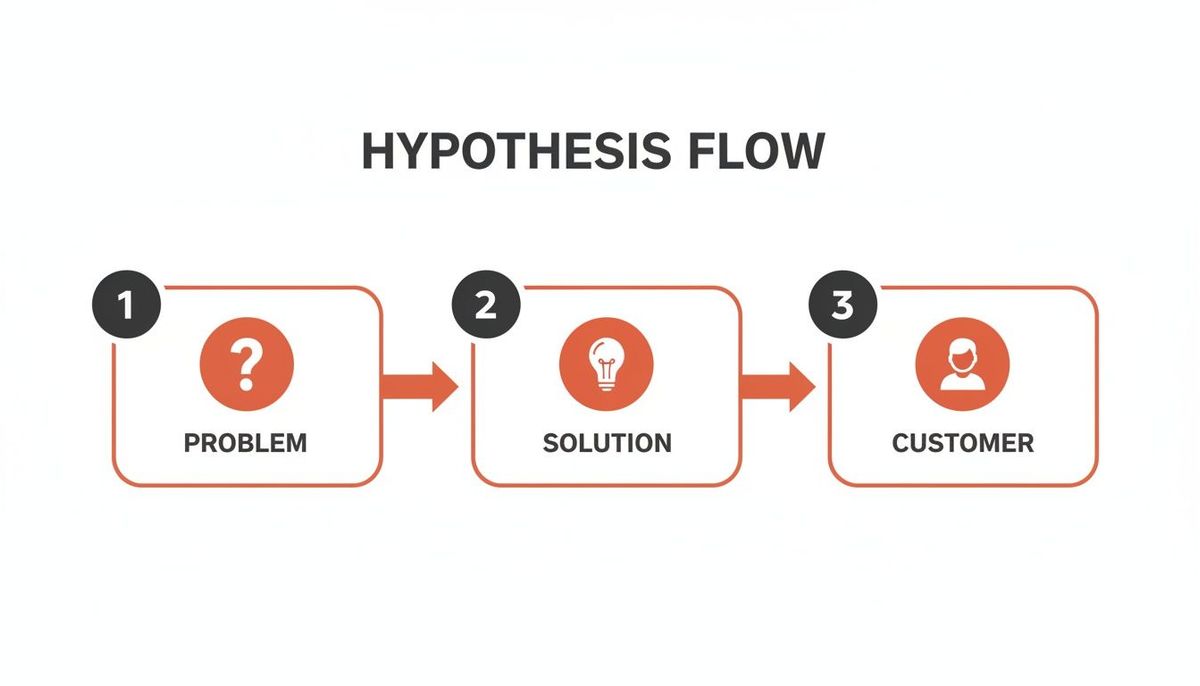
This simple flow is your north star. It’s all about testing your core assumptions about the problem, solution, and customer before you sink a dollar into development.
Start with Low-Fidelity Smoke Tests
The first goal is simple: gauge interest with the least possible effort and cash. This is where "smoke tests" are your best friend. You're essentially creating the illusion of a product to see if anyone even bothers to show up.
The classic smoke test is the simple landing page. Using tools like **Carrd** or **Webflow**, you can spin up a one-page site that nails your value proposition in a weekend. The magic is in the call-to-action—usually an email signup for a waitlist or early access.
A Real-World Example: Smoke Test for a B2B Tool
Let's say you've got an idea for a SaaS tool that uses AI to automate social media content for small businesses.
- The Test: Build a landing page with a headline like, "Stop Wasting 10 Hours a Week on Social Media. Get AI-Powered Content in Minutes."
- The 'Product': Use clean mockups showing what the dashboard could look like.
- The Ask: "Join the waitlist for exclusive early access and a 50% lifetime discount."
- Actionable Insight: You're not just collecting emails. You're testing your messaging. Run a few small, targeted ads on LinkedIn or Facebook and measure your cost-per-signup. If it costs you $100 to get one person on the list, your business model might be dead before it starts. But if you're getting signups for $5, you have a strong signal that your value proposition resonates and your acquisition channel is viable.
The Art of the Concierge MVP
A Concierge MVP is one of the most powerful—and underrated—ways to validate a service-based idea without writing a line of code. Instead of building an automated system, you manually deliver the service to your first handful of customers.
This gives you an almost unfair advantage. You get a front-row seat to their workflow, their real pain points, and what they actually want the outcome to be. You become a human-powered version of your future app.
A Real-World Example: Concierge MVP for Meal-Planning
Imagine your idea is for an app that delivers personalized weekly meal plans based on dietary needs and local grocery sales.
- The Test: Forget the app. Find five paying customers through a local Facebook group for healthy eating.
- The 'Product': Every week, you personally interview them about their goals, then build and email them a PDF with their meal plan, recipes, and a shopping list you created by hand. Charge them $20 for this service.
- Actionable Insight: You'll immediately find out which recipes are too complicated, what ingredients are a pain to find, and how they really use your plans. If they complain about the PDF format and ask for a way to track macros, you've just discovered a critical feature for your future app. If they stop responding after one week, you've learned the service isn't "sticky" enough, saving you from building a product nobody would use repeatedly.
The cost is almost zero—just your time. The timeline? A few weeks. The goal isn't to scale; it's to learn.
The point of these early tests isn't to build a product; it's to build a deep understanding of the customer and their problem. The learnings from a Concierge MVP can save you tens of thousands of dollars in misguided development.
When to Level Up to Higher-Fidelity Tests
Once you have strong signals from these low-fidelity tests—a high-converting landing page, happy concierge customers who are asking to pay more—it’s time to dial up the realism. This is where you start simulating the actual product experience more closely.
A clickable prototype is usually the next move. With a tool like **Figma**, you can create an interactive mockup of your app that looks and feels real. Put this in front of users and watch them try to complete tasks. It’s an invaluable way to validate your user flow and design choices before any code is written. For a deeper dive, our **mobile app prototype guide for idea validation** walks through the whole process.
A functional MVP is the final gauntlet of pre-launch validation. This is the most bare-bones, workable version of your product that delivers on the core value promise. The keywords are "minimum" and "viable." It has to solve the main problem, but forget the bells and whistles for now. Building this usually requires a development partner, but it gives you the ultimate answer: will people actually use and pay for a real product?
Validation Experiment Cheat Sheet
Choosing the right experiment can feel daunting, so I've put together a quick cheat sheet to help you decide what to run based on what you need to learn.
| Experiment Type | Primary Goal | Typical Cost | Actionable Insight Example |
|---|---|---|---|
| **Landing Page** | Gauge initial interest & test messaging | **$100 - $500** | Run A/B tests on your headline. Does "Save Time on Invoicing" convert better than "Get Paid 2x Faster"? The winner tells you which pain point is more acute. |
| **Smoke Test Ads** | Measure cost of acquisition & value prop | **$500 - $2,000** | Target two different audiences (e.g., freelancers vs. small agencies) with the same ad. If one group's click-through rate is 5x higher, you've just found your primary customer segment. |
| **Concierge MVP** | Deeply understand user workflow & needs | **$0 (Time)** | If your concierge customers keep asking for the same thing you hadn't planned to build, that's not an edge case—it's your most valuable feature. |
| **Clickable Prototype** | Test usability, UI/UX, and core user flow | **$1,000 - $5,000** | Give five users the task of "add a new client." If four of them get stuck on the same screen, you've found a critical usability flaw that would have killed your activation rate. |
Each of these experiments builds on the last, systematically de-risking your idea one step at a time. This isn't about finding one big "yes" or "no"—it's about gathering enough evidence to make the next decision with confidence.
Translating Data into Decisive Action
Running experiments is the fun part. But staring at a spreadsheet full of numbers? That’s where the real work begins. The challenge isn't collecting data; it's translating that data into a clear "go" or "no-go" decision. This is where you learn to find the signal in the noise.
Your goal isn't just to gather data; it's to gather the right data. Too many founders get hooked on vanity metrics—things like website visits or social media followers. They feel good, but they don't prove anyone will actually pay for what you're building.
Instead, you need to obsess over actionable metrics. These are the numbers that signal real, genuine customer intent.

Focusing on Metrics That Matter
To get a true read on your idea's potential, you need to zero in on the key performance indicators (KPIs) that show real user engagement. While they can vary a bit depending on your business model, they almost always come down to three core concepts.
- Activation: This is the "aha!" moment. It’s when a user truly experiences the core value you promised. For a B2B SaaS tool, maybe it's when they import data and generate their first report. A strong activation rate tells you the solution is actually clicking with people.
- Retention: This is the metric that answers the single most important question: are people coming back? If users sign up and disappear, you don't have a business; you have a leaky bucket. Early retention signals are everything, even if it's just tracking how many people on your waitlist open your second or third email.
- Conversion: This is the ultimate form of validation. It tracks the percentage of people who take the most important action you've defined. That could be signing up for a waitlist, booking a demo, or—the holy grail—pre-paying for your product.
Setting Clear Benchmarks for Success
Knowing what to measure is only half the battle. You also need to know what "good" actually looks like. This is where industry benchmarks provide a much-needed reality check for your experiments.
For example, a landing page test for a niche B2B software tool could be a roaring success with a 5-7% conversion rate from highly targeted ad traffic. A consumer mobile app, on the other hand, often needs to see a 20%+ conversion rate to a waitlist to signal real, pre-launch demand.
Let’s make this real. Imagine you're validating a mobile app for amateur photographers. You spin up a smoke test with a landing page and drive traffic from Instagram ads.
- Weak Signal: You get 50,000 impressions and 1,000 clicks, but only 50 people sign up for the waitlist. That's a 5% click-to-signup rate. The messaging or the offer isn't strong enough.
- Actionable Insight: The problem is post-click. Your ad is getting attention, but the landing page isn't convincing. It's time to A/B test your headline and call-to-action, not spend more money on ads.
- Strong Signal: You get 10,000 impressions and 500 clicks, which results in 150 signups. That’s a 30% click-to-signup rate. Bingo.
- Actionable Insight: This is a powerful signal. Your audience and message are aligned. The next step is to email these 150 people and invite 10 of them to a 15-minute interview to dig deeper into their needs, solidifying your path to product development.
The second scenario, despite the smaller raw numbers, is a much stronger indicator that you've found a passionate audience. It shows your core idea is resonating deeply with the right people.
The most honest feedback you will ever get is a credit card number. A single pre-payment is worth more than a thousand email signups because it validates not just the problem, but your entire monetization strategy.
Testing Your Pricing and Monetization Early
One of the single riskiest assumptions any founder makes is that people will pay for their solution. Waiting until after you've built the product to figure out your pricing is a classic, and often fatal, mistake. You have to test willingness to pay from day one.
A simple way to do this is to add pricing tiers to your validation landing page, even when the product is nothing more than a mockup. Put a "Get Started" button under each plan. When someone clicks, you don't need a checkout page. Just show a message like, "Thanks for your interest! We're launching soon. Join the waitlist for a 50% early-bird discount."
- Practical Example: For your AI social media tool, you could test three tiers:
- Solo ($19/mo): 1 Social Profile, 20 AI Posts
- Pro ($49/mo): 5 Social Profiles, 100 AI Posts, Analytics
- Agency ($99/mo): Unlimited Profiles, Unlimited Posts, White-label Reports
- Actionable Insight: This simple test gives you invaluable data. It tells you which features people value most and what price points they consider reasonable. If 80% of clicks go to your "Pro" plan, you've just learned that analytics is a must-have feature, not a nice-to-have. That data is gold when you're shaping your business model and trying to prove to investors that you have a viable path to revenue.
This kind of rigorous, early testing is what separates the winners from the rest. Research from Exploding Topics shows that idea-stage founders often overestimate their IP value by 255% and skimp on market tests, causing them to need 3x the anticipated time to find traction. For ambitious teams building monetized mobile apps, hitting 20%+ conversion on pre-launch tests is a critical green light before committing $150K-$750K to development.
Deciding When to Build a Revenue-Ready MVP
You’ve run the experiments. Your landing pages, concierge tests, and scrappy prototypes have been in the wild. The data coming back is no longer just "interesting"—it's starting to look compelling.
This is the fork in the road. It's the moment you shift gears from cheap, fast, manual validation to the much heavier lift of building a high-quality, revenue-ready Minimum Viable Product (MVP).
Go too early, and you'll burn through cash building something nobody actually wants. Wait too long, and a faster competitor might just eat your lunch. The whole game is about knowing which signals give you the green light.
Reading the Signals to Build
Moving from validation to a full build isn’t a gut feeling. It’s a decision you make when a few key indicators all point in the same direction. You're ready when the evidence is too overwhelming to ignore.
Look for these specific green lights:
- Consistent Metrics: You’re not just hitting your success criteria; you’re consistently blowing past them. That landing page isn't just converting at 20% once; it’s holding steady or even climbing as you bring in more test users.
- Pre-Payment Velocity: You have a growing waitlist of customers who have put down real money. They didn't just sign up for updates; they pre-paid for your solution based on a promise. This is the ultimate form of validation—they’ve voted with their wallets.
- Inbound Pull: The dynamic has flipped. You're no longer just pushing your idea on people. They are actively reaching out, asking, "When can I use this?" or "How can I start paying for this right now?" This shift from "push" to "pull" is a massive sign you've hit a real nerve.
Practical Example: Imagine you ran a concierge MVP for a new reporting tool. If your first five clients are not only paying but are also referring new customers and begging for more advanced features, you've got it. The market is literally pulling the product out of you. That's your signal.
The decision to build an MVP is made when the risk of not building and missing the market opportunity becomes greater than the financial risk of development itself.
The Strategic Value of a Performance-Aligned Partner
Once you've made the call, the next question is how to build. For many funded startups, bringing in a development expert is the fastest way to get a scalable, monetizing product into the market. But be warned: not all development partners are created equal.
A traditional agency often works on time and materials. Their incentive, frankly, is to bill more hours. A true performance-aligned partner, like **Vermillion**, operates on a completely different model by tying their success directly to your business goals.
They measure their own performance against the same KPIs you report to your board:
- User Retention: Is the product sticky? Do people keep coming back?
- Conversion Rates: Are users upgrading to paid plans?
- Monthly Recurring Revenue (MRR): Is the product making predictable money?
This model completely changes the dynamic. Your development team is no longer just a vendor; they become a strategic partner who is laser-focused on building a product that drives business outcomes, not just one that checks off a feature list. They handle the full stack—from the backend and Stripe payment integrations to analytics and growth tooling—so you get a product ready to generate revenue from day one.
Building for a Seamless Handoff
The goal of a development partnership isn't to create a lifelong dependency. It's to accelerate your path to a revenue-generating asset that you can eventually own and scale with your own team. A good partner builds with the end in mind.
This means a structured process where the external team doesn’t just build the thing; they also help you recruit, train, and transition your own in-house hires. This ensures a seamless handoff where your new team inherits a clean, well-documented codebase and a product that already has real traction.
It’s an approach that lets you focus on growth while the experts build the engine, preparing you to take the wheel when the time is right.
Burning Questions About Validation? Let's Settle Them.
When you're deep in the trenches of validation, questions pop up left and right. It's totally normal. I've pulled together the most common ones founders ask me, with straight answers based on years of seeing what actually works.
How Much Should I Be Spending on Validation?
There isn’t a magic number, but the guiding principle is simple: spend as little as possible to learn as much as possible. Think of it as tiered spending—you only unlock the next level of budget after you've earned it with evidence.
Early on, you should be ruthlessly frugal. We're talking about experiments that cost more in your time than your money. Customer interviews are free. Setting up a survey on Typeform or spinning up a landing page on Carrd can easily be done for under $1,000.
Even a "Concierge MVP" is more about your sweat equity than your cash. Costs only really start to creep up when you need higher-fidelity tests. A clickable prototype in Figma, for instance, might run you $1,000 to $5,000. Building a full, revenue-ready MVP with a team like ours usually comes after you’ve proven everything out, often with pre-seed funds, and typically starts around $150K.
Your mantra should be staged investment. You spend a little to prove a little. Each successful test justifies a slightly bigger spend. Don't write a big check until you have big evidence.
What's the Real Difference Between a Prototype and an MVP?
People throw these terms around interchangeably, but confusing them is a classic, and costly, mistake. They serve completely different masters.
A prototype is a facade. It's a non-functional or semi-functional mockup of your product. Imagine a set of polished screens in Figma linked together to mimic the user journey. You can click around, but there's no live code or database humming in the background. Its entire job is to answer one question: "Can people figure out how to use this?" It's for testing usability and flow, nothing more.
An MVP (Minimum Viable Product) is the real deal, just stripped down to its absolute core. It’s the first working version of your product that solves one critical problem for your first users. It’s built with actual code and is designed to answer the million-dollar question: "Will people actually use this to solve their problem, and more importantly, will they pay for it?"
How Do I Know When I Have Enough Validation to Actually Build This Thing?
There's no green light that suddenly flashes on. Instead, you're looking for a powerful convergence of signals—a consistent pattern of "hell yes" from multiple experiments.
You're ready when the evidence has shifted your belief from "I think people want this" to "I have hard data that proves a specific group of people wants this, and they want it from me."
You're probably ready to build when you can tick these boxes:
- You’re consistently blowing past the success metrics you set for your experiments (e.g., hitting a 20%+ conversion rate on your landing page).
- People you're interviewing are getting impatient, asking, "This is great, when can I sign up and pay for it?"
- You've successfully pre-sold the concept to a handful of early adopters who have put real money on the table.
Can I Do This Without Any Technical Skills?
Absolutely. In fact, you should. The earliest and most important validation stages require zero coding ability. The myth that you need a technical co-founder from day one has killed more great ideas than I can count.
You have an arsenal of no-code tools at your disposal to run incredibly powerful experiments.
- Landing Pages: Use Carrd or Webflow to build a digital storefront for your idea and test your messaging.
- Surveys: Use a tool like Typeform to collect structured feedback at scale.
- Demand Testing: Run a small social media ad campaign pointing to your landing page and see if anyone actually signs up.
The Concierge MVP is the ultimate non-technical validation method—you are the software. By proving the demand exists before writing a single line of code, you create your single greatest asset for recruiting that technical co-founder or convincing an investor to back you.
Ready to turn your validated idea into a revenue-generating mobile app? At Vermillion, we partner with funded startups to build high-quality MVPs that prove traction, retention, and ROI. Our performance-based model aligns our success with your business goals. Learn how we can accelerate your path to product-market fit.