How to Monetize a Mobile App: A Guide for Startup Founders
Turning your app into a business means picking a monetization strategy that actually fits what your app does and how people use it. Think subscriptions, one-off in-app purchases (IAP), or even ads. The goal isn't just to make money; it's to align your revenue model with the core value you provide. This guide is your playbook for making those crucial decisions.
Your Blueprint for a Profitable Mobile App
Monetizing an app isn't something you bolt on at the end. It's a strategic foundation you have to build from the very beginning. It's about moving from just having a great product to designing a sustainable business around it. Whether you're building a content platform, a utility tool, or the next viral game, your monetization choice will shape your product roadmap, user experience, and ultimately, your company's future.
The opportunity is massive. By 2025, the global mobile app market is expected to hit $935 billion in revenue. Digging into the numbers, in-app purchases are projected to grab the biggest slice at $514 billion, with advertising pulling in $281 billion. Subscriptions, though smaller at $140 billion, are growing incredibly fast. For founders, this signals that a smart, sometimes blended, strategy is the key to creating resilient revenue.
Aligning Value with Revenue
First things first: map your monetization model directly to the value your app delivers. Don't just copy what a competitor is doing. You have to ask the hard questions:
- Is our value ongoing? If your app provides continuous, evolving value—think a fitness tracker with new workouts or a meditation library with fresh content—a subscription model is a natural fit. Actionable Insight: If you're a content app, commit to a content calendar. A language app like Babbel succeeds because users know new lessons and cultural content are always coming, justifying the recurring fee.
- Is our value transactional? For apps where value comes in specific, discrete moments, IAP is the way to go. A game selling extra lives or a photo editor offering premium filter packs are perfect examples. Actionable Insight: Identify the "stuck" moments in your user journey. For a puzzle game, this is when a level is too hard. Offering a "hint" for $0.99 at that exact moment is far more effective than a generic item shop.
- Is our value based on attention? If you have a huge, engaged user base that isn't likely to pay directly (like a casual game or a news aggregator), an ad-supported model can work wonders. Actionable Insight: Integrate ads where they feel like a natural break. A recipe app could place a banner ad on the ingredient list screen, where users pause anyway, rather than an intrusive pop-up mid-scroll.
A classic mistake I see founders make is trying to slap a monetization model onto a finished product. Real success comes from designing the user journey with revenue in mind from day one. The path to payment should feel like a natural, valuable extension of the app experience, not a clumsy afterthought.
To make this work, you have to understand your potential earnings over the long haul. Knowing how to calculate customer lifetime value is non-negotiable. It tells you how much you can afford to spend to acquire a new user and still be profitable. This single metric can be the difference between a passion project and a scalable, viable business.
Choosing and Implementing Your Monetization Model
Picking your monetization model is the single most important decision you'll make for your app. Get this wrong, and nothing else matters. This isn't just about bolting on a revenue stream; it’s about defining the entire relationship between your product and your users. Your model has to feel like a natural extension of the value you provide, otherwise it will come across as a cheap cash grab and tank your app.
This decision is entirely contextual. A meditation app like Calm thrives on subscriptions because it delivers ongoing, ever-changing value through its content library. For them, predictable recurring revenue makes perfect sense. On the other hand, a game like Candy Crush leans into consumable in-app purchases (IAPs)—like extra lives or boosters—because its revenue moments happen when players are deeply engaged and need a small boost to overcome a challenge.
To help frame your thinking, I’ve put together a decision tree that maps common app categories to the models that work best for them.
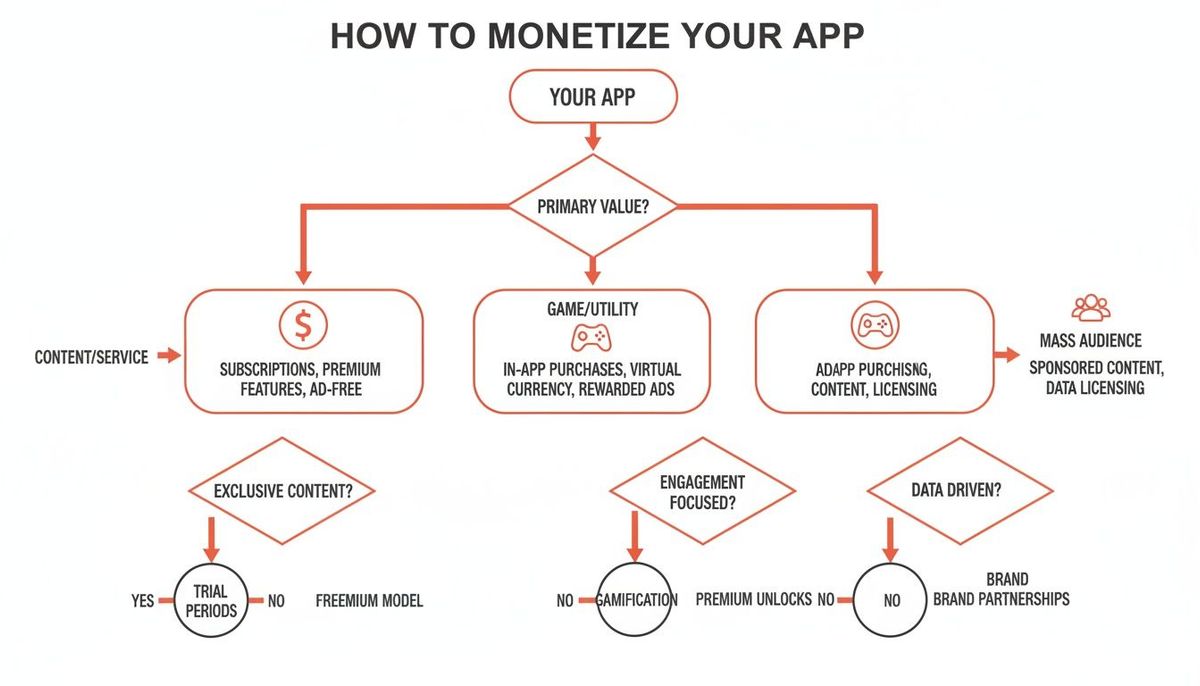
As you can see, an app's core purpose—whether it’s a utility, a content library, or a mass-market game—points you toward specific, battle-tested monetization strategies.
Subscriptions for Continuous Value
If your app delivers persistent, evolving value, subscriptions are your best bet. Users pay a recurring fee (usually monthly or annually) to maintain access to features, content, or services. We see this work incredibly well for fitness, education, productivity, and any app where the user's journey isn't a one-and-done event.
But how you structure those subscriptions is where the real strategy comes in. It requires you to know your users inside and out.
- For a SaaS Tool: Tiers are often based on features or usage caps. A project management app might have a "Basic" plan for solo users, a "Pro" plan with team features, and an "Enterprise" plan with advanced security and analytics. Practical Example: Notion offers a free plan with block limits, a "Plus" plan for small teams with unlimited blocks, and a "Business" plan with a SAML SSO for security-conscious companies. Each tier solves a bigger problem for a more sophisticated user.
- For a Fitness App: Tiers can be built around content depth. A free tier could offer a handful of basic workouts to prove value, while a premium subscription unlocks the entire workout library, personalized coaching, and meal plans. Practical Example: Strava’s free tier lets you track and share activities, but the paid subscription unlocks advanced route planning and performance analytics, targeting serious athletes who crave data.
The whole game with subscriptions is retention. You have to keep delivering fresh value to justify that recurring charge. If your app feels stale after a month, get ready for churn.
In-App Purchases for Transactional Value
In-app purchases (IAPs) are perfect when your app’s value is delivered in specific, transactional moments. Instead of an ongoing fee, users buy digital goods or features as they need them. This model dominates mobile gaming but also works wonders for creative tools and utilities.
IAPs typically fall into two buckets, and they tap into different user motivations:
- Consumable IAPs: These are one-time-use items users can buy over and over. Think in-game currency, hints, or extra lives. They’re impulse buys that capitalize on a user's desire to make immediate progress. Practical Example: In Pokémon GO, players buy Poké Balls to catch more Pokémon. They are used up and need to be repurchased, creating a recurring revenue stream from engaged players.
- Non-Consumable IAPs: These are permanent unlocks. Things like removing ads forever, unlocking a "Pro" feature set, or buying a new pack of photo filters. These appeal to users who love your core product and want to invest in making it better for the long haul. Practical Example: The video editing app LumaFusion is a one-time purchase, but it sells "Storyblocks" content packs as a non-consumable IAP for users who want access to a library of stock footage.
The key to making IAPs work is ensuring your free app is genuinely good on its own. The purchases need to feel like valuable enhancements, not like you're holding the core experience hostage. For a deeper look at building a business around these models, check out our guide on the five app business models that get funded.
Advertising for Mass-Audience Apps
If your app is built for a massive audience that's unlikely to ever pay directly, advertising is your path to revenue. This is the go-to model for casual games, social utilities, and news aggregators. You get paid based on how many people see or click on the ads.
But be careful. Implementation is everything. Shoving ugly, intrusive ads all over your app is the fastest way to kill your user experience and rack up uninstalls.
I’m a huge fan of rewarded video ads. They completely change the dynamic by offering a fair trade. Instead of forcing an ad on someone, you give them a choice: "Watch this quick video to get an extra life." The user gets something they want, and you make money without pissing them off. It’s a win-win.
Hybrid Models: The Best of Both Worlds
The truth is, most of the top-grossing apps don't just pick one model and stick with it. They use a hybrid model, blending different strategies to monetize every type of user.
Spotify is the classic example. Their ad-supported free tier is a massive user acquisition funnel. It gets millions of people onto the platform, and a portion of them will eventually get tired of the ads and upgrade to a premium subscription. This lets Spotify make money from nearly every single user without cannibalizing its main revenue source.
Another popular hybrid is pairing a subscription with optional IAPs for one-off feature bundles or special content. This gives you predictable monthly revenue plus opportunities to upsell your most engaged power users. Practical Example: The dating app Bumble has a premium subscription but also sells "Spotlights" and "SuperSwipes" as consumable IAPs for users who want a temporary visibility boost without committing to a monthly fee. A smart hybrid model maximizes your market and builds multiple, resilient streams of income.
Building Your Revenue Technology Stack
An idea doesn't generate revenue; a solid tech stack does. Once you've settled on a monetization model, it's time to build the engine that actually collects the money. This isn't just a task for your engineers—it's the plumbing for your entire business.
Getting this right from the start will save you hundreds, if not thousands, of engineering hours down the road. A huge piece of this puzzle is implementing robust payment gateways like Stripe, especially for any web-based signups you plan to offer. This gives you a direct line to your customers and a crucial escape hatch from the app stores' walled gardens.
Native IAP vs. Web Payments
Your first big fork in the road is deciding where you'll take payments. There are two main paths, and the trade-offs are massive.
- Native In-App Purchases (Apple/Google): This is the path of least resistance for users. It’s seamless—they pay with their card on file in the App Store or Google Play. But that convenience comes at a steep price: a 15-30% cut of every single transaction goes straight to Apple or Google.
- Web-Based Payments (Stripe): Taking payments on your own website through a gateway like Stripe drops your fees to around 2.9% + 30¢. More importantly, it gives you a direct relationship with your customers. The catch? Apple's rules are notoriously strict. For most digital goods, you can't just link out to your website to dodge their fee; you must offer IAP as an option.
So, what do the pros do? They use both. Actionable Example: Netflix and Spotify famously stopped allowing new users to subscribe through their iOS apps. Instead, they onboard new users through their website, capturing them at a much lower transaction fee. They still support existing IAP subscribers but funnel all new growth through the web to maximize revenue.
The Case for Subscription Management Platforms
I see early-stage founders make this mistake all the time: they try to build their own subscription logic to save a few bucks. It’s almost always a disaster. Managing subscriptions across iOS, Android, and the web is a nightmare of receipt validation, grace periods, and platform-specific edge cases.
This is exactly why a tool like **RevenueCat** should be in your stack from day one. It sits between your app and the app stores, handling all the messy parts of subscriptions.
RevenueCat isn't a 'nice-to-have'—it's your single source of truth for revenue. It abstracts away the endless complexities of receipt validation and cross-platform entitlements, freeing up your engineers to build features users actually pay for.
With RevenueCat, if a user subscribes on their iPhone, their premium access just works on their Android tablet or the web. Building that yourself is a massive distraction that provides zero unique value to your customers.
Tracking the Right Events to Optimize Your Funnel
You can't fix a funnel you can't see. Without the right analytics events, you’re just guessing why users abandon your trial or never see your paywall. Your analytics tool is a core part of your revenue stack.
Using a platform like Mixpanel or Amplitude, you need to track a few non-negotiable events from the very first session.
Essential Monetization Events to Track:
- `paywall_viewed`: How many people are even seeing your offer? Actionable Insight: If this number is low, it means your paywall is buried. Try adding a "Go Pro" button to your main navigation bar to improve visibility.
- `trial_started`: This measures how well your paywall is converting lookers into triers. It’s your top-of-funnel conversion rate.
- `subscription_purchased`: The finish line. This is what lets you calculate your trial-to-paid conversion rate, one of the most important metrics for a subscription app.
- `feature_used_by_subscriber`: This is a critical retention metric. Are paying customers actually using the premium features? Actionable Insight: If subscribers aren't using a key paid feature, create an in-app tooltip or a targeted email campaign to educate them on its benefits, reducing the risk they'll churn.
These events create a clear funnel. You can watch where users drop off and focus all your energy on fixing that specific step. Choosing the right platform is key, and we've broken down our top picks in our guide to the best analytics tools for mobile apps.
Designing Pricing and Paywalls That Convert
Your pricing strategy and the design of your paywall are where your entire monetization plan comes to life. Get them right, and you create a smooth, compelling path from a free user to a paying customer. Get them wrong, and even the best app will struggle to turn engagement into revenue.
This isn't just about picking a number; it's about communicating value at the most critical moment.
The most effective pricing strategies I've seen are always anchored in value-based pricing. Forget what it costs you to build. Forget what your competitors charge. Your price should be a reflection of the outcome you provide to the user. If your app saves a business professional 10 hours a month, the price should be a fraction of that value, not just a multiple of your server costs.
This is especially true in the subscription world. Subscription models are an absolute powerhouse, projected to surge by 45% to reach $140 billion by 2025. That growth is coming from users who are actively choosing premium, ad-free experiences. To win them over, founders have to nail tiered pricing that clearly shows why it's worth subscribing for the long haul. You can find more data on this trend in these app monetization statistics.
Crafting Your Pricing Tiers
Simply offering one "Pro" plan is a huge missed opportunity. Tiered pricing lets you connect with different user segments who have different needs and, crucially, a different willingness to pay. A well-designed set of tiers doesn't just present options—it guides users toward your most valuable plan.
A classic, and brutally effective, strategy here is decoy pricing. It’s a psychological tactic where you create three tiers, but one is intentionally designed to be a bit of a raw deal. Why? To make one of the other options look like a no-brainer.
Here’s how it works for a hypothetical meditation app:
- Monthly Plan: $12.99/month
- Annual Plan: $69.99/year (which is just $5.83/month)
- Six-Month Plan: $59.99 (which is $9.99/month)
See what's happening? The Six-Month plan is the decoy. It’s priced so close to the Annual plan that the annual option, with its drastically lower monthly cost, seems like an incredible value. This simple setup actively nudges users toward the annual plan, which is a massive win for your cash flow and long-term retention.
A/B Testing Your Paywall for Maximum Conversion
Your paywall is the final hurdle. The last click. Small changes here can have an outsized impact on your conversion rates. Never, ever assume you know what works. Test everything.
Start with the easiest thing: your call-to-action (CTA). The words you choose can completely reframe the user's perception.
- CTA Test Idea:
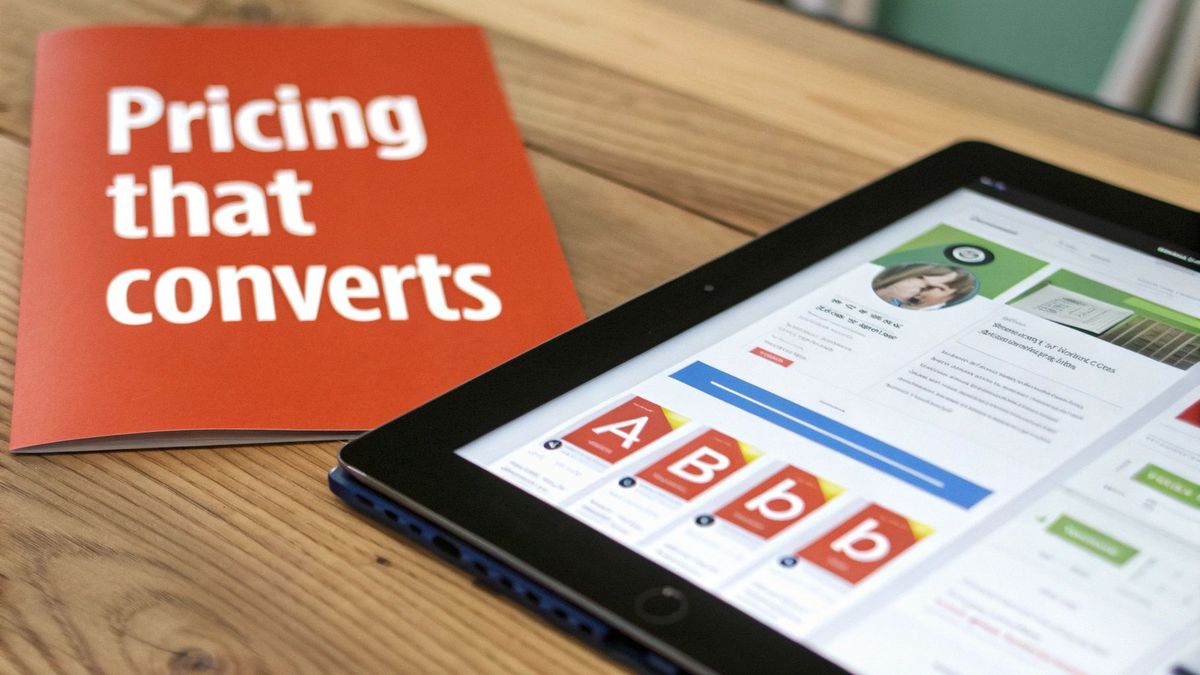
Start Your Free Trialvs.Unlock All Features. The first focuses on the action the user has to take, while the second highlights what the user will get. Actionable Insight: Run this as an A/B test for one week using a tool like RevenueCat Experiments. The winning variant could increase your trial starts by 5-10% with just a simple text change.
Visually highlighting your preferred plan is another powerful lever. Make your annual plan box a little bigger. Give it a colorful border. Slap a "Most Popular" or "Best Value" banner on it. These are simple visual cues that subconsciously guide a user's eyes—and their decision.
Your paywall should be a billboard for the outcome your app provides, not just a list of features. Instead of "Unlimited Exports," try "Create and Share Without Limits." Frame every benefit in terms of what the user can finally achieve.
Building Retention Hooks Into Your Product
Getting a subscriber is only half the battle. Keeping them is what builds a real, sustainable business. Retention hooks are features or mechanics you build directly into your product to create habits and make your app feel indispensable. They give users a reason to come back again and again.
Duolingo is the undisputed master of this. Their streak feature is a work of genius. Once a user builds a streak of a few days, the fear of losing it becomes an incredibly powerful motivator to open the app every single day. Notice that this isn't a premium feature—it's a core mechanic that drives the very engagement that leads to monetization down the line.
Think about how you can build similar hooks:
- For a Fitness App: Challenges are perfect. Actionable Insight: Create a "January Jumpstart" challenge that awards users a special badge on their profile for completing 15 workouts in the month. This drives engagement during a key resolution period.
- For a Journaling App: Send gentle reminders with thought-provoking prompts at the same time each day.
- For a Language App: Use gamified leaderboards to spark some friendly competition.
These hooks don't directly ask for money, but they build the loyalty and deep engagement that make users far more likely to see the value in paying when the time is right. They are the foundation for monetizing your app for the long run.
Launching and Scaling Your Monetized App
Rolling out monetization, especially to an existing user base, is a delicate operation. You’ve built trust and engagement, and now you’re asking for money. If you get it wrong, you risk a user revolt. The key is to have a thoughtful playbook that respects your early adopters while paving a clear path to sustainable revenue.
A successful rollout isn’t a single event; it's a phased process. Instead of just flipping a switch and throwing up a paywall for everyone, you need to be more strategic. Your goal is to turn your most loyal users into your biggest advocates, not your loudest critics.
Rolling Out Monetization Without a User Revolt
Introducing a paywall to users who’ve only ever known your app as free requires a mix of transparency and generosity. You need to make your early supporters feel rewarded, not punished. This is where grandfathering comes in.
One of the best tactics is to offer a significant, lifetime discount to your existing user base.
- Real-World Scenario: Imagine you have a productivity app that’s been free for its first year. Before launching a $9.99/month subscription, you email all existing users with a one-time offer: "As a thank you for being one of our first users, lock in premium access forever for just $2.99/month."
This approach does two things brilliantly. First, it converts a chunk of your most loyal users into paying customers right away. Second, it makes them feel valued. When new users start paying full price, your early adopters feel like they got an exclusive, insider deal.
You’re not just asking for money; you’re offering them a stake in your success. Frame the launch as a necessary step to keep improving the app they already love. Be transparent about why you're monetizing—to build new features, maintain servers, and grow the team. That honesty can go a long way.
Navigating App Store and Google Play Rules
Once your rollout strategy is set, you have to get past the final gatekeepers: Apple and Google. Getting your monetized app approved means strictly following their guidelines. A rejection at this stage is a costly delay you can't afford.
Both platforms have extensive documentation, but a few rules are notorious for tripping up founders:
- Clarity is Non-Negotiable: Your subscription terms, pricing, and what the user gets must be crystal clear on your paywall screen. Vague language like "Get Premium" without listing the specific features is a common reason for rejection.
- Restore Purchases Button: You must provide an easy way for users to restore their previous non-consumable purchases or active subscriptions—for instance, when they get a new phone. This button is mandatory.
- Don't Circumvent Their System: For digital goods and services, you have to use Apple's and Google's native in-app purchase systems. Trying to direct users to your website to pay with a credit card to avoid the platform fee is a direct violation that will get your app rejected or even removed.
Using Analytics to Scale Your Revenue
The launch is just the beginning. The real work of scaling revenue starts now. Your analytics platform is your command center for understanding where your monetization funnel is leaking. It's time to stop guessing and start measuring.
The first step is to build a simple dashboard tracking your core monetization KPIs. Don't get lost in vanity metrics. Focus on the numbers that directly impact your bottom line:
- Paywall Conversion Rate: What percentage of users who see your paywall actually start a trial?
- Trial-to-Paid Conversion Rate: Of those who start a trial, how many become paying subscribers?
- Churn Rate: How many subscribers are you losing each month?
- Lifetime Value (LTV): What is the total revenue you can expect from a single customer?
With this data, you can pinpoint your biggest drop-off points. Actionable Example: If your Trial-to-Paid conversion rate is low, maybe your onboarding during the trial isn't doing a good enough job of showing off your premium features. That insight lets you run targeted experiments—like adding guided tutorials for premium features—to systematically fix the leak and grow revenue. Improving your LTV is also crucial for funding your growth efforts, as it directly informs your strategy for effective user acquisition for mobile apps.
Answering Your Toughest Monetization Questions
Even the best-laid monetization plan hits a few speed bumps. Founders and product leaders always get stuck on the same handful of questions when the rubber meets the road. Let's clear those hurdles right now with some straight answers pulled from years of doing this.
"How Much Should I Actually Charge for This?"
This is the question, isn't it? And the answer is never, ever "whatever my competitor is charging." Your starting point has to be value-based pricing. Forget your costs, forget the market for a second, and anchor your price to the tangible value you deliver.
If your B2B app saves a sales team 10 hours a month, what's that time worth to the business? If your wellness app helps someone finally hit a health goal they've struggled with for years, what is that outcome worth to them? Actionable Insight: Use the Van Westendorp Price Sensitivity Meter. Ask a small group of ideal customers four simple questions: At what price would this be too expensive? Too cheap? A bargain? Starting to get expensive? The intersection of their answers will give you an optimal price range to test.
The most common mistake I see is pricing too low out of fear. It is far easier to launch with a confident price and offer discounts than it is to raise prices on an undervalued product later on. Start with a price that feels slightly ambitious but is completely defensible based on the value you provide.
"Can I Use Ads If I Already Have a Subscription?"
Absolutely. In fact, a hybrid model can be a massive revenue driver, but only if you do it right. The trick is to use ads to monetize your free users while positioning an ad-free experience as a core pillar of your paid subscription. This creates a powerful, natural incentive to upgrade.
Here’s how to think about it:
- Free Tier: Users get your core features but see non-intrusive ads—think rewarded videos for in-game currency or native ads that blend into a content feed. This tier pulls in revenue from the huge chunk of your audience who might never pay you a dime directly.
- Premium Tier: A key selling point here is the complete removal of all ads. You’re not just selling features; you're selling a cleaner, faster, and more focused experience.
Practical Example: The weather app AccuWeather offers a robust free version supported by display ads. For users who check the weather multiple times a day and find the ads distracting, they offer a one-time "Ad-Free" in-app purchase. This monetizes both casual users (via ads) and power users (via IAP).
"How Do I Change Prices Without Losing My Early Subscribers?"
Raising prices is a sign of a healthy, growing business. But you have to handle it with care or you risk alienating the loyal customers who got you here. The gold standard is to grandfather your existing subscribers.
Grandfathering simply means your current paid users get to keep their original price for as long as they stay subscribed. Anyone new pays the higher price.
It’s a simple, powerful gesture. Let's say you're bumping your monthly plan from $9.99 to $12.99. You'd send a quick email to your current subscribers that says something like:
"As a thank you for being one of our earliest supporters, your price will remain $9.99 forever. The new $12.99 price only applies to new customers joining from today."
Suddenly, a potentially negative event becomes a moment that rewards loyalty. Your early adopters feel valued and are far less likely to churn, and your business starts earning more from every new user that signs up. It’s a win-win.
"What’s Better: A Free Trial or a Freemium Model?"
The "free trial vs. freemium" debate really comes down to one thing: how quickly can a new user experience the core value—the "aha!" moment—of your app?
- Go with a Free Trial if: The magic of your app only reveals itself after a user has access to all the premium features. A 7-day or 14-day trial is perfect for complex productivity tools, project management apps, or creative software. Practical Example: Photo editing software Photoshop Express needs to let users try all the advanced retouching and layering tools to understand their power, making a trial essential.
- Go with a Freemium Model if: Your app delivers immediate and ongoing value with just its basic features, but has obvious upgrade paths. This is the world of apps like Duolingo or Spotify. The free version is so functional that it acts as your best marketing channel, slowly converting users over months or even years.
Don't forget you can also combine them. You can have a freemium app that also offers a limited-time free trial of the premium tier. This is often the most effective way to nudge long-time free users over the conversion line.
Ready to build an app that doesn't just get downloads but drives real revenue? At Vermillion, we partner with founders to develop monetization-ready mobile apps with a performance-based model tied directly to your business KPIs. Let's build your revenue engine together.