How to Hire Mobile App Developers A Founder's Playbook

Hiring a mobile app developer is one of those make-or-break decisions that boils down to a few key stages: strategic planning, smart sourcing, tough evaluation, and seamless onboarding. It's about turning your vision into a technical blueprint, knowing the real costs, vetting candidates with tests that mirror actual work, and structuring contracts so everyone is pulling in the same direction from day one.
This isn't just filling a technical role; it's a strategic investment in your product's future.
The High-Stakes Game of Hiring Mobile Developers

For a founder, bringing on a mobile developer isn't just another line item on the budget. It's one of the most critical investments you'll make. This decision directly shapes your odds of hitting product-market fit, closing your next funding round, and, frankly, just surviving.
Get it right, and you've built a direct pipeline to revenue and user growth.
But a bad hire? That’s a silent killer for a startup. It’s far more than just a wasted salary. We're talking about months of lost time, blown market windows, and a mountain of technical debt that will hamstring every single feature release down the road. For a deeper dive, check out this proven playbook for hiring remote developers.
The Strategic Imperative of Your First Hire
Stop thinking about this as recruitment. Frame it as a strategic initiative laser-focused on core business outcomes like boosting Monthly Recurring Revenue (MRR) and Lifetime Value (LTV). The right developer doesn't just ship code; they understand the why behind the features they build.
This guide cuts through the generic fluff to give you a concrete playbook. We'll walk through exactly how to:
- Craft a technical brief that attracts true specialists.
- Evaluate candidates based on business impact, not just their coding chops.
- Structure contracts and partnerships that align everyone’s incentives with your success.
Navigating a Competitive Talent Market
The challenge is amplified by a brutally competitive market. While the global developer pool has swelled to over 35 million professionals, demand for specialized talent consistently outstrips supply.
With 40% of all software developers now working on mobile apps and a projected job growth of 21% in the US alone, finding the right person is tougher than ever. This is precisely why a strategic approach is non-negotiable—it’s your best defense against a costly mismatch.
For a startup, the opportunity cost of a six-month delay caused by a bad technical hire can be the difference between a Series A and shutting down. Your first mobile developer hire sets the foundation for your product's architecture, culture, and velocity.
Ultimately, mastering how to hire mobile app developers is a core competency for any tech founder. Our guide on the key attributes of top-tier mobile app developers offers another lens on what to look for. Think of this playbook as your way to de-risk one of the highest-stakes games you'll play.
Translate Your Business Vision into a Technical Blueprint

Before you even think about writing a job post, you need to get what's in your head down on paper. A vague idea is a surefire way to burn through cash and time. The best developers I know are drawn to clarity; they want to sink their teeth into a well-defined problem, not spend weeks trying to guess your vision.
This means you need to translate your business goals into a technical blueprint. This isn't some exhaustive, final product spec. Think of it as a detailed brief that acts as a north star for the entire hiring process. It forces you to get real about the critical parts of your app, which in turn shines a light on the exact skills you need to find.
This document becomes your most powerful filter. It attracts the specialists who get it and helps you sidestep the generalists who don't.
From Big Idea to Core Features and User Stories
Your first job is to move past the high-level pitch. Instead of saying you want a "social media app," you need to define the specific things a user will actually do. This is where user stories come in. They're just simple, informal descriptions of a feature from the perspective of the person using it.
Actionable Insight: Create a simple Google Doc and write out 5-10 user stories using the format: "As a [type of user], I want to [perform an action] so that I can [achieve a goal]." For example, for a meditation app, a user story could be: "As a busy professional, I want to access 5-minute guided meditations so that I can de-stress during my lunch break."
That one sentence tells a developer a ton:
- There's an onboarding flow.
- It needs a quiz or form.
- Some kind of recommendation algorithm is required.
- The app must generate personalized content.
Documenting just 5-10 core user stories like this gives you a solid foundation. You start to see the real complexity and scope, which is absolutely essential before you can start looking for developers.
Get Specific on Technical and Business Requirements
Once your user stories are down, you can start layering in the technical and business logic. This is where you nail down how things should work, and it's what separates a project brief that attracts amateurs from one that attracts pros.
Look at the difference here:
| Vague Requirement | Specific Blueprint |
|---|---|
| **"Build a login screen."** | **"Implement social login via OAuth 2.0 (Google, Apple) and email/password with two-factor authentication for enhanced security."** |
| **"Add in-app purchases."** | **"Integrate a subscription model with monthly and annual tiers using RevenueCat to manage entitlements across iOS and Android."** |
| **"Users can chat with each other."** | **"Build a real-time chat feature using WebSockets, with support for message history, read receipts, and push notifications for new messages."** |
This level of detail signals to a developer that you've done your homework. It tells them this is a serious project, allowing them to give you much more accurate estimates and ask smarter questions right from the start.
A well-crafted technical brief is your single greatest asset in the hiring process. It not only aligns your team but also acts as a litmus test for a candidate's ability to grasp your business vision and translate it into a functional product.
Choose Your Platform and Tech Stack
Finally, your blueprint needs to show you've thought about the technology. For most startups I work with, speed to market is everything. This is why a framework like React Native is so often the right call—it lets you build for both iOS and Android from a single codebase, which can cut your initial development time and cost in half.
Your brief should touch on these key questions:
- Platform: Are you building for iOS only, Android only, or going cross-platform with something like React Native or Flutter?
- Backend: Can you get by with a service like Firebase, or do you need a custom backend built with Node.js or Python?
- Key Integrations: What third-party tools are non-negotiable? Think Stripe for payments, Twilio for messaging, or RevenueCat for subscriptions.
Actionable Insight: If you’re unsure about the tech stack, list your business priorities instead. For example: "Priority 1: Launch on iOS and Android simultaneously. Priority 2: Keep initial development costs under $100k. Priority 3: Must integrate with our existing Shopify store." A good developer can then recommend the best tech stack (e.g., React Native with the Shopify API) to meet those goals.
Decoding the True Cost of Mobile App Talent
When you start budgeting to hire mobile app developers, the number you see first—that hourly rate or annual salary—is just the tip of the iceberg. I’ve seen too many founders get caught off guard by the real cost, putting a serious and sometimes fatal strain on their runway.
The reality is that the Total Cost of Ownership (TCO) for new talent runs much deeper. You have to look past the base pay and account for every single associated expense. We're talking recruitment fees, benefits, payroll taxes, and the software licenses your developer needs just to do their job. Getting a clear-eyed view of these numbers is the only way to build a realistic financial model and avoid nasty surprises down the road.
Beyond the Paycheck: The Hidden Costs in Hiring
Let's get practical. Bringing on a full-time, in-house developer involves way more than just cutting a check for their salary each month. A whole host of expenses get stacked right on top.
Here’s a quick breakdown of what you should actually be planning for:
- Benefits and Payroll Taxes: In the US, this is a big one. Expect to add 20-30% on top of a salary to cover things like health insurance, 401(k) contributions, and other standard benefits.
- Recruitment Fees: Using a recruiter? Their fee is typically 15-25% of the developer's first-year salary. For a developer making $120,000, that’s an immediate hit of $18,000 to $30,000.
- Tools and Equipment: Your new hire needs the right gear to be effective. A powerful laptop (think MacBook Pro), software licenses for tools like Figma, and subscriptions to platforms like Jira can easily add another $2,000-$5,000 per year.
To get a real handle on the investment, you need to think beyond base pay and explore smart strategies to reduce your recruitment cost per hire. If you want a quick, personalized estimate to play with different scenarios, our app development cost calculator can help you model things out.
Global Talent Pools and Salary Benchmarks
Where you hire from will have a massive impact on your budget. The difference between bringing on a developer in San Francisco versus one in Eastern Europe or South Asia isn't just noticeable; it's a game-changer. This financial reality is exactly why so many startups look to nearshore or offshore talent pools.
Practical Example: Let's say your budget for a 6-month project is $100,000.
- Hiring in the US ($120/hr): This gets you about 833 hours of development time.
- Hiring in Eastern Europe ($70/hr): This gets you over 1,428 hours—nearly 70% more development for the same budget.
This illustrates why geographical strategy is crucial for early-stage startups managing a tight runway.
Globally, the picture is different. Rates can be as low as $20–$35/hour in South Asia or as high as $70–$120 in North America, which really underscores how critical your geographical hiring strategy is to your bottom line.
The key isn't just to find the cheapest option, but the best value. A highly skilled developer in a lower-cost region who delivers clean, scalable code can offer a far better ROI than a less experienced local developer for the same price.
Comparing Hiring Models: Freelancers vs. Agencies vs. In-House
The way you hire talent directly shapes both your costs and your ability to pivot. Each model—freelancer, in-house, agency—comes with a completely different financial and risk profile that you have to weigh against your startup’s current stage and long-term goals.
Before making a decision, it's worth comparing the trade-offs. This table breaks down the financial and operational realities of each model for a typical funded startup.
Hiring Model Cost and Risk Comparison
| Hiring Model | Typical Cost Structure | Risk Profile | Best For |
|---|---|---|---|
| **Freelancer** | Hourly or fixed-price per project. Minimal overhead. | **High.** Risk of disappearing, variable quality, and requires intense project management. | Short-term projects, specific tasks, or supplementing an existing team's skills. |
| **In-House Staff** | Full-time salary plus benefits, taxes, and overhead. | **Moderate.** High upfront cost and long-term commitment. Slow to scale up or down. | Building a core, long-term team when you have product-market fit and a stable runway. |
| **Agency** | Blended hourly rate or monthly retainer. Higher sticker price but includes management. | **Low-Moderate.** Professional management and processes reduce risk, but costs can be high. | Projects with a clear scope and a need for a complete team (design, dev, QA) from day one. |
| **Performance Partner** | Retainer plus performance-based incentives tied to KPIs (like MRR or user retention). | **Low.** Incentives are aligned with business outcomes, reducing the risk of paying for non-performance. | Startups needing a strategic partner to drive growth, not just code, from MVP to scale. |
Ultimately, decoding the true cost is about building a budget that reflects reality, not just wishful thinking. By factoring in all the variables—from the hidden expenses and global salary differences to the pros and cons of each hiring model—you can make a financially sound decision that gives your app the best possible chance of success.
A Battle-Tested Process for Vetting Developers
Finding a long list of potential candidates is easy. The real work—the part that separates a successful app from a stalled one—is figuring out who can actually build your vision. This takes a vetting process that goes way beyond scanning a résumé for keywords.
You're not just hiring someone to write code. You're looking for a partner who thinks like a product owner. That means finding a rare mix of deep technical skill, sharp problem-solving instincts, and genuine business sense. Here’s a process we’ve battle-tested to cut through the noise.
Sourcing Talent Beyond the Usual Suspects
Sure, you can post on LinkedIn or general job boards, but the best mobile developers aren't always hanging out there. To find the real talent, you have to go where technical skill is the main currency.
We've had the most success by looking in a few specific places:
- Niche Developer Communities: Sites like GitHub and Stack Overflow are more than just forums. They're living, breathing portfolios where you can see exactly how a developer thinks, communicates, and contributes to real-world projects.
- Curated Freelance Platforms: Marketplaces like Toptal have their own intense vetting processes. Tapping into these platforms gives you access to a pre-screened pool of talent with a proven history of delivering quality work.
- Industry Events and Meetups: Whether virtual or in-person, events focused on React Native or mobile monetization are goldmines. Getting involved shows you’re serious and connects you directly with developers who are passionate about the space.
The model you choose—freelancer, in-house, or agency—will change your approach, but the need for rigorous vetting stays the same.
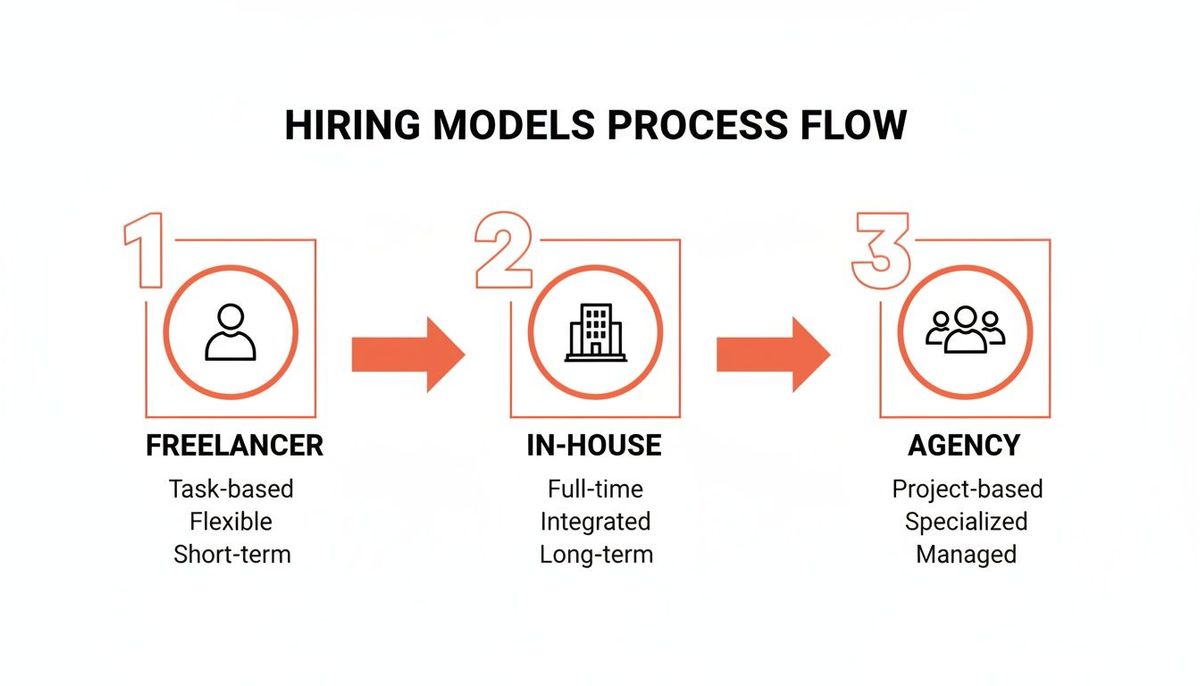
Each path has its own risks and rewards. Your vetting process needs to adapt accordingly.
Moving Beyond Generic Coding Tests
Whiteboard algorithm problems are mostly useless for hiring a mobile app developer. They test for abstract computer science knowledge but tell you nothing about a candidate's ability to ship a feature that users will actually pay for.
A much better approach is to create a technical assessment that looks exactly like a task they'd do on the job.
Here’s a real-world technical test we use: We give candidates a small, self-contained project: "Build a simple subscription screen in React Native using RevenueCat. The screen should show two subscription tiers (monthly and annual) and handle the purchase flow for a test user."
This kind of practical test reveals so much more than a generic puzzle. You immediately see:
- Can they work with third-party SDKs? Integrating tools like RevenueCat is a non-negotiable skill for any app focused on monetization.
- Do they understand state management? How do they handle loading indicators, error messages, and the successful purchase confirmation?
- Is their code clean? Even on a small project, you can spot the difference between organized, maintainable code and something that was just thrown together.
This tells you if they can deliver tangible business value, which is the only thing that matters. We dive deeper into this in our guide on the 4 factors to consider when choosing an app developer.
The Interview Script That Uncovers True Potential
If a candidate aces the practical test, the interview is where you find out how they think. You need to dig past the canned answers to see their communication style and problem-solving process in action.
A structured interview script is key. It ensures you evaluate everyone on the same criteria and helps you probe the soft skills that signal a great hire. I always focus on behavioral questions rooted in real-world situations.
Uncovering Problem-Solving and Product Mindset
- "Walk me through the most complex technical challenge you've faced on a mobile app. How did you break it down, and what was the outcome?" This question forces them to articulate a complex problem and reveals their thought process.
- "Imagine we need to add a new social login feature. What questions would you ask before writing a single line of code?" A great developer won't just talk about OAuth libraries. They'll ask about business goals, user impact, and security implications first.
- "You've just found a major bug right before a release. What do you do?" This tests their judgment, ownership, and ability to communicate under pressure.
The answers you get here are far more insightful than asking them to define a technical term. You're searching for evidence of a product mindset—someone who cares about the "why" as much as the "how."
To keep our evaluations objective, we use a simple scorecard. It helps us compare candidates fairly and ensures we're weighing the most critical skills appropriately.
Developer Vetting Scorecard
This scorecard provides a structured way to evaluate each candidate, moving beyond gut feelings to a more data-driven decision. By assigning weights to what matters most to your project, you can create a clear comparison across your talent pool.
| Evaluation Area | Criteria (Example) | Weight (1-5) | Score (1-10) |
|---|---|---|---|
| **Technical Skills** | React Native proficiency, state management, API integration | **5** | |
| **Monetization Exp.** | In-app purchases, RevenueCat/StoreKit/Google Play Billing | **5** | |
| **Problem-Solving** | Ability to break down complex issues, logical thinking | **4** | |
| **Product Mindset** | Asks "why," considers user impact, business goals | **4** | |
| **Communication** | Clearly explains technical concepts, asks good questions | **3** | |
| **Code Quality** | Clean, maintainable, and testable code in assessment | **3** |
After the interviews, tallying up these scores often makes the right choice incredibly clear. It's a simple tool, but it's incredibly effective at preventing bias and focusing the hiring decision on what truly predicts success.
Onboarding Your New Developer for Immediate Impact
Getting your new hire up and running quickly does more than just kickstart development—it sets the tone for the entire project. The first few days are critical. And it all starts with a rock-solid contract that removes ambiguity and locks in expectations before a single line of code is written.
Hiring a great developer is only half the battle. How you bring them into the fold determines how quickly they can start delivering value. The contract you choose shapes roles, timelines, and how everyone is incentivized.
Picking the Right Contract Model
There are generally three contract models I see founders use, each suited for different risk profiles and project stages. Getting this right from the start aligns everyone and builds in accountability.
| Contract Type | Best For | Pros | Cons |
|---|---|---|---|
| **Fixed-Price** | A well-defined MVP with a clear scope | **Predictable cost**; makes budgeting simple | Scope creep is a huge risk; very rigid if you need to pivot |
| **Time & Materials** | Iterative builds, projects that will evolve | **Flexible scope**; you only pay for hours worked | The budget can easily spiral without tight controls |
| **Retainer** | Long-term support, ongoing optimization | Aligns incentives for the long haul; ensures priority | Deliverables can be less defined without clear goals |
- Fixed-price is your go-to when you have detailed specs and know exactly what you need built.
- Time and materials is perfect for those early days when you're still experimenting and requirements are likely to change.
- Retainers work best when you need ongoing access to a developer for continuous improvements, bug fixes, or new feature sprints.
Key Legal Clauses You Can't Skip
Protecting your intellectual property is non-negotiable. You need a clause that explicitly assigns all source code, designs, and other work product directly to your company. This is your core asset.
Confidentiality is just as critical. Have every contractor sign a solid NDA before you share any sensitive product roadmaps, user data, or prototypes.
Finally, nail down the payment terms. Outline the deposit, milestone payments, and any final holdbacks. For example, it's common to hold back 10% of the total project fee until all final deliverables are tested and formally accepted.
A bit of legal clarity upfront saves you from massive headaches and protects your runway down the road.
But a contract is just paper. The real work begins with creating an experience that makes a new developer feel like part of the team from day one.
Practical Onboarding That Actually Works
A generic "welcome" email isn't enough. You need to immerse your new hire in the project and the team culture immediately.
- Assign a "buddy." Pair them with a current team member for a few pair programming sessions on the first day. It’s the fastest way to break the ice and get them familiar with the codebase.
- Schedule a "Lunch and Learn." Have your product lead walk the new hire through the product vision, the "why" behind it, and the roadmap for the next few quarters.
- Create a living onboarding doc. This should be a one-stop shop with architectural diagrams, coding standards, API documentation, and even short video walkthroughs of complex parts of the system.
- Start a feedback journal. Give them a place to log questions, frustrations, and ideas for improving your processes. This shows you value their perspective from the start.
Tip from a CTO: We cut our new developer onboarding time by 40% just by implementing buddy sessions and making weekly check-ins a mandatory part of the first month.
You can even automate the very first touchpoint with a clear, welcoming email.
Subject: Welcome to the Team, [Name]!
Hi [Name],
Welcome aboard! We're all excited to have you. Today is all about getting you set up and comfortable. We'll get your dev environment running, introduce you to the team, and give you a tour of our codebase.
To get started, please take a look at our Developer Onboarding Guide here: https://example.com/onboarding
Looking forward to building some amazing things together.
Cheers,
[Your Name]
The First 30 Days: An Onboarding Checklist
A structured plan for the first month prevents that "what should I be doing now?" feeling and helps your developer score some early wins.
- Week One: Technical Setup & Immersion
- Grant access to everything: Git repos, CI/CD pipelines, staging environments, and project management tools.
- Share all documentation—style guides, coding standards, architecture diagrams.
- Schedule at least two pairing sessions to walk through the main repository.
- Week Two: Project Deep Dive
- Give a full product demo from a user's perspective. Walk through the complete user journey.
- Assign a small, low-risk bug or a minor enhancement ticket. This is the best way for them to start exploring the codebase safely.
- Hold a design review for a few key screens to get them aligned on the core UX principles.
- Week Three: Nailing Down Communication
- Clarify the communication cadence: daily standups, which Slack channels to use for what, and how to report progress.
- Introduce them to key stakeholders they'll be interacting with.
- Establish the feedback loop. Let them know you'll be doing biweekly retrospectives to talk about what's working and what's not.
- Week Four: First Real Milestone
- Assign a small, self-contained project, like implementing a new API endpoint or building a simple new screen.
- Review their code, run it through performance tests, and get feedback from the team.
- Celebrate the win! A quick showcase in a team meeting reinforces ownership and impact.
Real-World Example: A fintech startup I know used this exact 30-day plan to onboard a new React Native engineer. By the end of the first month, that developer had successfully shipped a brand-new subscription flow integrated with RevenueCat.
How to Know if Onboarding is Working
You can't improve what you don't measure. Tracking a few key metrics in the first month will tell you if your new hire is on the right track or if they need more support.
| Onboarding Metric | Target by Day 30 |
|---|---|
| **Time to First PR** | Less than **5 business days** |
| **Ticket Closure Rate** | At least **3 tickets/week** |
| **Team Response Time** | Under **2 hours** in Slack |
Check in at the 60 and 90-day marks, too. These conversations are invaluable for catching any lingering issues and making sure good habits are sticking.
Ultimately, a great onboarding process bridges the gap between hiring someone and seeing them make a real impact. Clear contracts, a welcoming culture, and structured milestones are how you turn a new developer into a productive, long-term member of your team.
Common Questions When Hiring Mobile Developers
Look, navigating the hiring process for the first time is going to bring up a lot of questions. It just is. Getting clear, practical answers is what separates a smooth build from a costly mismatch, and I've seen plenty of both.
Here are some of the most common questions I hear from founders, with the straight answers you need to make the right call.
How Much Should I Expect to Pay a Mobile Developer?
This is always the first question, and the honest answer is: it's all over the map. The cost depends entirely on your hiring model and where you're looking. Rates can swing from a tempting $25 per hour for an offshore freelancer to north of $200 per hour for a top-tier consultant in San Francisco or New York.
Here’s a more practical way to frame it:
- Freelance (Mid-Level): For a solid React Native developer from a reputable platform, you should budget between $60 and $120 per hour. Anything less should make you skeptical.
- In-House (Mid-Level, US): A full-time salary might land in the $100,000 to $130,000 range. But don't forget to tack on an extra 20-30% for benefits, taxes, and overhead. Your all-in cost is really closer to $120,000 to $170,000 a year.
- Agency or Partner: For a well-scoped MVP, all-in project costs often range from $150,000 to $750,000. This gets you a full team—devs, designers, project management—and a much more predictable outcome.
The crucial shift in mindset is moving from the lowest hourly rate to the best overall value. An experienced developer who ships clean, scalable code three times faster is a bargain, even if their rate is double.
Should I Hire a Specialist or a Generalist?
For your core mobile app, especially one built around a specific monetization strategy, you almost always want a specialist first. A generalist full-stack developer might be able to hack together a mobile app, but a specialist lives and breathes the unique constraints and opportunities of mobile.
A true mobile specialist gets the details right:
- They know the ins and outs of the Apple App Store and Google Play Store submission gauntlets.
- They understand how to correctly implement in-app purchases and subscriptions with tools like RevenueCat so you actually get paid.
- They appreciate the subtle, platform-specific design patterns and user expectations that make an iOS app feel like an iOS app.
Actionable Insight: Look for a developer whose GitHub profile shows they've contributed to mobile-specific open-source libraries (e.g., related to navigation or camera access in React Native) or who has written blog posts about solving mobile-centric problems like offline data sync or push notification delivery. This demonstrates a deeper engagement with the mobile ecosystem beyond just knowing the syntax.
What Are the Biggest Red Flags to Watch Out For?
Spotting red flags early will save you from a world of pain. Beyond the obvious stuff like ghosting your emails, there are a few subtle but critical warnings I look for when vetting mobile app developers.
Here are three red flags I absolutely never ignore:
- They Can’t Explain the "Why." If a developer tells you they chose a specific architecture but can't articulate the business or product trade-offs behind that decision, run. They’re a coder, not a problem-solver. You need a partner with a product mindset.
- Their Portfolio Has No Live Apps. A collection of pretty screenshots and "team projects" from a bootcamp isn't proof. I need to see apps they’ve personally shipped to the App Store or Google Play. It proves they can navigate the entire, often painful, lifecycle from a line of code to a live product.
- The Quote Is Too Good to Be True. An unusually low price is almost always a sign of trouble. It means they've misunderstood the scope, they lack the experience to estimate properly, or they plan to cut corners on testing and QA. Always, always ask for a detailed cost breakdown.
Ultimately, asking the right questions is just as important as running a technical screen. By getting these concerns out of the way early, you can build a much clearer picture of your needs and find a partner who is actually aligned with your business goals.
At Vermillion, we partner with funded startups to build revenue-ready mobile apps that deliver results. Our performance-based model ensures our incentives are aligned with your KPIs, turning your vision into a product that achieves traction, retention, and ROI.