Start Fast: how to build a minimum viable product that wins customers
Building a Minimum Viable Product isn’t about launching a half-baked idea. It’s about shipping the leanest, simplest version of your product that actually solves a real problem for a specific user.
The goal here is speed and learning. You want to get your app into the hands of real customers as fast as possible to see what they actually do, not what they say they'll do. This feedback loop is what saves you from burning months—and a ton of cash—on features nobody ever wanted. It's about validation, not perfection.
Your Blueprint for a Revenue-Generating MVP
This isn't another high-level theory piece. This is a practical, founder-focused playbook for building an MVP that’s designed to make money from day one. We’re cutting through the noise to give you an actionable framework for building something that is both lean and commercially viable.
Too many startups build on a weak foundation. It's a costly mistake that almost always leads to expensive rewrites, crippling technical debt, and a total loss of momentum right when you need it most.
Instead, we're going to walk through a proven approach, from initial market validation and ruthless feature prioritization all the way to designing a scalable architecture and executing a realistic delivery plan.
What to Expect From This Guide
We're focusing on the strategic decisions and technical groundwork required to build a product that can actually generate revenue. We'll show you how to build an MVP that can:
- Handle real user volume without crashing or needing an immediate, panicked rebuild.
- Pass investor due diligence by demonstrating a solid, thoughtful technical strategy.
- Serve as a rock-solid foundation for future growth and feature expansion.
This is for founders who get it: minimum doesn't mean weak, and viable absolutely means profitable. The entire process is about making smart, informed trade-offs that maximize learning while minimizing risk.
The core principle is simple: validate your most critical assumptions with the smallest possible investment. It’s about building a real product that solves a real problem for a specific group of people, not a collection of half-finished features.
Building a Strong Foundation First
The rush to launch often leads to a fragile product that can't scale. It’s a classic startup trap. Our approach flips that script by emphasizing a robust, revenue-ready MVP from the get-go.
We'll detail the entire process, including how to instrument your app from the start to track the metrics that matter, like retention and monthly recurring revenue (MRR). For a broader look at the entire process, this guide on how to build a Minimum Viable Product is a great resource.
Ultimately, this is your blueprint for shipping with confidence, knowing your product is built on a foundation that can support your business as it grows. And if you're looking for more insight on those very first steps, our guide on app development for startups is the perfect place to start.
Validate Your Idea Before You Write a Single Line of Code

Here’s the single most expensive mistake a founder can make: building a product nobody actually wants. It’s a classic startup trap, fueled by the excitement of building something cool instead of the disciplined work of listening to real people.
Jumping straight into development without honest, rigorous validation isn't just a risk—it's a recipe for wasting months of time and piles of cash.
Think of this early stage as de-risking your entire venture. Startups that embrace an MVP strategy see a 60% higher success rate than founders who build a full-featured product from day one. That's not just a nice-to-have stat; it's a direct response to the brutal reality that 42% of startups fail because they built something without first proving a real market need existed.
Ditch The Polite Nods And Hunt For Real Problems
The goal of validation isn’t to hear people say, “Yeah, that’s a neat idea!” Polite agreement is worthless. You’re on a mission to uncover deep, existing pain points. You need to find genuine frustration.
The best way to do this is through carefully structured problem-solution interviews. Forget leading questions that fish for compliments.
Instead of asking, "Would you use an app that does X?" you need to dig into how people are already behaving.
Swap your questions like this:
- Weak Question: "Would you pay for an app that helps you track your freelance project finances?"
- Strong Question: "Can you walk me through exactly how you manage the finances for your freelance projects right now?"
The second question forces them to describe their actual, often messy, workflow. You’re listening for the pain—the mentions of chaotic spreadsheets, hours wasted on invoicing, or the dread that comes with tax season. That's where your opportunity lives.
Here’s a critical benchmark: if 40% of your interviewees don't independently identify the problem you’re solving as one of their top three most urgent pain points, you haven't found a problem worth solving yet.
Mastering The Problem-Solution Interview
These conversations are your most valuable source of intelligence. They're not sales pitches; they're detective work. To get real insights without biasing the answers, you have to approach them the right way.
Key techniques for interviews that actually work:
- Focus on past behavior. Ask about what they have done, not what they might do. People are notoriously bad at predicting their own future actions.
- Listen more than you talk. Your job is to uncover clues, not sell your vision. Aim for an 80/20 split where they do most of the talking.
- Hunt for workarounds. Ask what tools or processes they've cobbled together to deal with this problem now. A clunky, homemade workaround is one of the strongest signals that a real need exists. For example, if your interviewees are using a combination of Google Sheets, calendar reminders, and a notepad to track something, you've found a genuine pain point they are already trying (and failing) to solve.
A simple pivot during this pre-development phase can be the difference between a launch that soars and one that crashes.
For example, a team might set out to build a complex, all-in-one project management tool. But through interviews, they discover their target users aren't looking for another massive platform. Their biggest frustration is simply getting timely status updates from their team.
That single insight could trigger a pivot to a much simpler MVP—a lightweight, automated check-in system. This shift, discovered before a single line of code was written, saves months of development and targets a validated, high-value problem.
This entire process is about answering one question with confidence: are people willing to pay to have this problem solved? For a deeper dive, check out our guide on how to validate your startup idea before you commit to the build.
Prioritizing Core Features With The MoSCoW Method
You’ve validated your core problem. That’s a huge milestone. But right around the corner is the next great threat to your MVP: feature creep.
It’s the silent killer of timelines and budgets. It starts with a simple "wouldn't it be cool if..." during a meeting and snowballs into a bloated, delayed mess. To get to market, you have to get ruthless about what you build now versus what you build later.
This is exactly where the MoSCoW method becomes your best friend. It’s a dead-simple framework for bucketing every potential feature, forcing the hard conversations that keep your MVP lean, focused, and on track.
The point isn't just to build less; it's to build the right things first. By sorting features into clear categories, you create a hierarchy that aligns the entire team and sets brutally realistic expectations for your first release.
Understanding The MoSCoW Categories
The framework is just an acronym that stands for Must-have, Should-have, Could-have, and Won't-have. Each category has a specific job in defining the scope of your MVP.
- Must-have: These are the absolute non-negotiables. If you launched without one of these, the app would be fundamentally broken or useless for solving the core user problem.
- Should-have: These are important but not critical for day one. The product works without them, but they add a ton of value. Think of these as the first features you’ll tackle right after launch.
- Could-have: These are your "nice-to-haves." They're desirable but have a pretty small impact on the core experience. You only build these if you find yourself with extra time and resources (which almost never happens).
- Won't-have (this time): This is the most important category for protecting your timeline. These features are explicitly kicked out of scope for this release. Putting them here manages stakeholder expectations and stops the team from getting distracted.
Using this method turns a messy feature wishlist into a concrete plan of attack. It gives you a clear, defensible answer to the question, "What are we actually building right now?"
By forcing every idea through this filter, you shift the conversation from "Can we add this?" to "Where does this fit in our priorities?" This simple change in perspective is what keeps an MVP on track.
A Practical Example: A Wellness App
Let's make this real. Imagine you're building a wellness app MVP. After a few brainstorming sessions, you've got a list of 50+ feature ideas, from guided meditations to community forums and wearable integrations. The MoSCoW method helps you carve that down to the essential 5-7 core functions you actually need to launch.
Here’s a quick look at how you might apply the framework to get focused.
MoSCoW Prioritization Framework for a Fictional Wellness App MVP
This table is a simple demonstration of how the MoSCoW method works in practice. It takes a long list of ideas and forces them into buckets based on their immediate value to the user and the business.
| Category | Feature Example | Justification for Placement |
|---|---|---|
| **Must-have** | User account creation and login | The app is useless if a user can't sign in and save their personal data. This is foundational. |
| **Must-have** | Basic daily mood tracking | This is the core solution. Without it, the app doesn't solve the primary problem we validated. |
| **Should-have** | Weekly summary reports | Adds significant value by showing users trends over time, but the app still works without it for daily tracking. A perfect version 1.1 feature. |
| **Could-have** | Integration with wearable devices | A great feature for later, but it introduces major technical complexity and isn't essential for the initial launch. |
| **Won't-have** | Social sharing or community features | This adds a massive layer of complexity (moderation, privacy, notifications) and distracts from the core personal wellness goal of the MVP. Out of scope, for now. |
This process forces you and your team to defend why a feature is truly a "Must-have." It ensures your MVP stays laser-focused on delivering immediate, tangible value for that first set of users. It’s how you build momentum and ship a product that makes an impact, not one that’s diluted by trying to be everything to everyone.
Designing a Scalable Full-Stack MVP Architecture
Once you've nailed down your core features, it's time to talk tech. The big question is how to build a technical foundation that’s lean enough for an MVP but won't shatter the moment you get a little traction. This is where so many early-stage products go wrong. They pick a stack that’s fast to build but can't handle even minor success, forcing a painful and expensive rewrite right when things are getting good.
Your MVP’s architecture needs to serve today’s launch goals without painting you into a corner tomorrow.
It's a classic balancing act: move fast, but build smart. This means choosing a modern, full-stack approach that lets you ship quickly while being solid enough to evolve. For any revenue-ready mobile app, a stack built around React Native is almost always our starting point. It just hits that sweet spot.
This diagram is a great way to visualize how your feature list directly shapes your architecture.
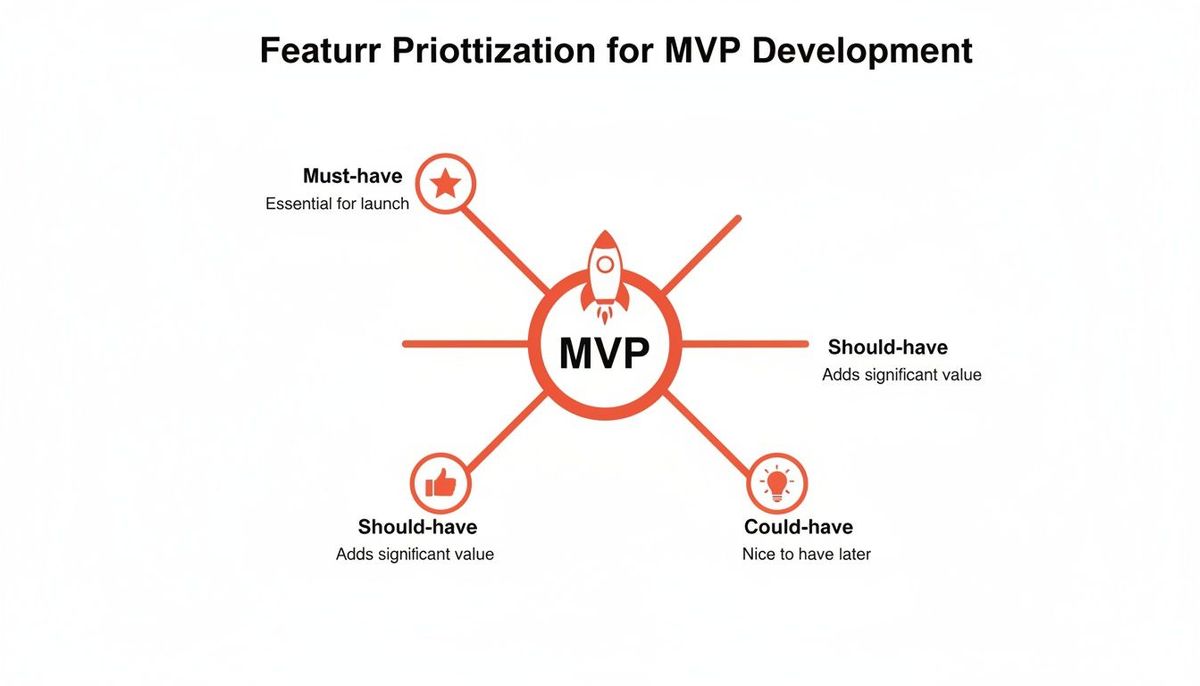
As you can see, your "must-have" features are the bedrock. They define the absolute essentials of your architecture. Everything else is built on top of that core, which is why getting it right from day one is so critical.
The Core Components of a Modern MVP Stack
A great MVP architecture isn’t just one technology; it’s a smart combination of tools that play well together. Each piece has a specific job, from the user interface to payment processing and data collection. Here’s a look at a powerful, modern stack that we’ve seen work time and again.
Client-Side with React Native
For the client—the actual mobile app on your users' phones—React Native is a game-changer. It lets you build a truly native-feeling experience for both iOS and Android from a single JavaScript codebase.
- Speed to Market: You write the code once, you deploy it everywhere. This simple fact can cut your core feature development time in half.
- Cost Efficiency: One codebase is just flat-out cheaper to maintain than managing two separate native development teams. It’s not even a close call.
- Rich Ecosystem: The community is massive, which means there's a huge library of pre-built components that can shave weeks off your timeline. For example, need a calendar view? There are several battle-tested libraries available, saving you from building one from scratch.
Backend Services and API Layer
The backend is your app’s brain. For an MVP, we almost always recommend a serverless approach using services like AWS Lambda or Google Cloud Functions, connected to a managed database like PostgreSQL or MongoDB. The benefits here are massive for a startup.
A serverless backend is incredibly capital-efficient. You literally only pay for the compute time you use. When traffic is low, your costs are near zero. When you get that big press hit and user signups spike, it scales automatically.
This strategy keeps your burn rate low while giving you the confidence to handle a successful launch. Tying it all together is a well-designed API, which acts as the messenger between your app and the backend. If you're new to this, it's worth understanding the role of an API for microservices.
Integrating Payments and Analytics From Day One
You can't have a "revenue-ready" MVP without the "revenue" part. Payments and analytics aren't nice-to-haves; they are the fundamental feedback loops that tell you if you actually have a business.
Payment Gateways
Don't reinvent the wheel here. Integrating a trusted payment provider is non-negotiable.
- For subscriptions: A tool like **RevenueCat** is indispensable. It abstracts away the nightmare of managing in-app purchases and subscriptions across the Apple App Store and Google Play Store.
- For one-time payments: **Stripe** remains the gold standard. Their APIs and documentation are best-in-class, making it surprisingly straightforward to get secure payments up and running.
Analytics and Instrumentation
If you can't measure it, you can't improve it. Period. You need an analytics tool integrated from the very first line of code to see what users are actually doing.
- Platforms like **Amplitude or Mixpanel** are perfect for this. They help you track user journeys, see where people get stuck, and measure crucial metrics like retention and feature adoption.
- Specifically, you need to instrument your app to track Monthly Recurring Revenue (MRR) and retention from the moment your first user signs up. This hard data is what will guide your iteration, not guesswork. An actionable insight here would be setting up a "user_activated" event that fires only when a new user completes the single most important action in your app for the first time. This gives you a clear signal of who is "getting it."
Executing Your 10-20 Week Delivery Plan
Okay, you've validated the idea, nailed down the core features, and have a solid architecture in mind. Now for the fun part: execution. This is where strategy turns into shipped code. We run our MVP builds on a tight 10 to 20-week delivery plan, broken down into clean, two-week sprints.
This isn't just about managing developers; it's about managing risk. A sprinted roadmap gives everyone—founders, investors, the team—a transparent, predictable path to launch. It answers the one question every founder has on their mind: "Are we on track?" The rhythm of building, testing, and deploying creates a flywheel of progress that gets your product into users' hands, fast.
That speed is your biggest weapon. Startups that take an MVP approach see an average of 35% faster time-to-market. That means you're capturing early users and revenue while competitors are still stuck in planning meetings. You can discover more insights about how MVPs accelerate startup growth and improve financial outcomes.
The First Four Weeks: Laying The Foundation
The first two sprints aren’t about shipping flashy features. They're about pouring the concrete foundation for everything that comes next. Get this right, and development speed accelerates exponentially later on.
- Sprint 1 (Weeks 1-2): Project Setup & CI/CD. This sprint is pure infrastructure. The team gets the code repositories set up, configures the development environment, and—most critically—builds the Continuous Integration/Continuous Deployment (CI/CD) pipeline. A rock-solid CI/CD pipeline automates builds, testing, and deployments, turning future releases into a reliable, push-button process. This means a developer can merge code and an updated version of the app is automatically sent to internal testers minutes later, without manual intervention.
- Sprint 2 (Weeks 3-4): Authentication & Core Data Models. Now we build the first piece of user-facing logic: signing up, logging in, and managing an account. At the same time, the team defines and implements the core data models that will power your "Must-have" features. This is the skeleton of your application.
Weeks 5-14: The Core Build Sprints
With the foundation set, the next five sprints are all about bringing your core value proposition to life. This is where your MoSCoW prioritization really pays off. The team is heads-down, knocking out the "Must-have" feature list, one sprint at a time.
Each sprint targets a specific, self-contained piece of functionality. For a wellness app, one sprint might be dedicated entirely to the mood-tracking feature. The next sprint might tackle the basic reporting dashboard. This focused approach means that at the end of every two-week cycle, you have a tangible, working piece of software to see and touch.
We always run informal User Acceptance Testing (UAT) with a small group of trusted beta testers during this phase. As soon as a major feature is complete, we get it into their hands. Their immediate feedback is gold for catching obvious usability flaws before we build more on top of a shaky foundation.
Weeks 15-20: Hardening and Pre-Launch Prep
The final sprints are less about building new things and more about polishing what you've already built. We call this the hardening phase. It’s all about making sure the app is stable, secure, and ready for a real-world audience.
Here’s what happens in those final weeks:
- Comprehensive Testing: The team shifts focus to writing automated tests, running end-to-end QA, and crushing any bugs found by the QA team or UAT testers.
- Performance Optimization: We hunt down any slow-loading screens or clunky backend queries to make sure the user experience feels snappy and smooth. For example, we might analyze network calls and add caching to prevent the app from re-downloading the same data unnecessarily.
- Analytics Verification: We triple-check that every analytics event is firing correctly. You have to be confident that from day one, you’re capturing accurate data on user behavior, retention, and revenue.
This structured plan turns the chaos of software development into a manageable, predictable journey. It gives you the confidence that your MVP will land on time, on spec, and ready to make an impact.
Launch, Learn, And Iterate Towards Product-Market Fit
Getting your MVP into the App Store isn't the finish line. It’s the starting gun.
The real work starts now. This is where you trade assumptions for data and start listening to what real users do, not just what they say they'll do. You've built the engine; now you learn how to fly it.
With analytics wired in from day one, you finally have a direct line of sight into what’s working and what’s getting ignored. You’re no longer guessing. You’re watching the data roll in, turning clicks and taps into a brutally honest roadmap for what to build next.
From Raw Data to Actionable Insights
Your first job is to translate all those screen views and button clicks into a coherent story about your users. Forget vanity metrics like total downloads—they feel good but tell you nothing about value. The only numbers that matter now are signals of real engagement.
Metrics you should be obsessing over:
- User Activation Rate: What percentage of people who sign up actually complete the one core action that delivers the "aha!" moment? For a wellness app, this might be logging their first mood entry. If this number is low, your onboarding is broken.
- Day 1-7 Retention: How many users come back the day after signing up? A week later? Awful early retention is a massive red flag. It means your core loop isn't compelling enough to build a habit around.
- Feature Adoption: Which features are people actually using? If a feature you labeled a "Should-have" is getting all the attention, it might be more critical than you thought.
A classic rookie mistake is tracking everything. Don't. Pick the one or two metrics that best prove a user is getting real value from your product. This is your North Star Metric. Your only job is to push that number up and to the right.
Running High-Impact Growth Experiments
Once you have a baseline for user behavior, you can start running simple experiments to move the needle on your key metrics. We're not talking about a massive R&D project; we're talking about small, informed changes that produce measurable results. All you need is a little curiosity and discipline.
A few practical experiments to get you started:
- A/B Test Your Onboarding: Is that slick, multi-screen tutorial scaring people away? Pit it against a single, interactive prompt and measure which version leads to a higher activation rate.
- Play with Pricing Tiers: If you’re running on subscriptions, try offering different price points or feature bundles to new cohorts of users. Track which combo drives the highest trial-to-paid conversion rate.
Planning a Structured Handoff
As your MVP gets traction and the metrics start climbing, you'll eventually need to bring development in-house. A chaotic handoff can kill your momentum and create months of confusion. A smooth, structured process ensures your new team can grab the baton and run with it.
This is more than just emailing a link to a GitHub repo. It means delivering comprehensive documentation, a clear product roadmap with a prioritized backlog, and dedicated knowledge-transfer sessions. This documentation needs to cover everything from the architecture and deployment process to the why behind key business decisions.
It’s about empowering your team to build, maintain, and scale the product with confidence, not leaving them to reverse-engineer your vision.
At Vermillion, we don't just build revenue-ready products; we make sure the transition to your in-house team is seamless. We provide the senior technical leadership to not only ship your MVP but to set it on a path for long-term success. Learn how we can be your technical growth partner at https://vermillion.agency.