Vermillion Insights
January 29, 2026 · Ken Vermeille · 19 min read
How to Build a Marketplace App That Actually Succeeds
Learn how to build a marketplace app with our expert guide. We cover idea validation, tech stacks, monetization, and scaling strategies for real-world success.
Building a marketplace app isn't just about code; it's about creating a living, breathing ecosystem where buyers and sellers can connect and transact with confidence.
You've got to validate your niche, nail down the core features like listings and payments, pick a smart tech stack, and then launch a lean Minimum Viable Product (MVP) that's ready to bring in revenue from day one. This guide is a founder's playbook, designed to walk you through exactly how to build a marketplace app that actually drives business.

Why Building a Marketplace Is a Smart Move Today
Marketplaces like Airbnb, Uber, and Etsy have completely reshaped how we find places to stay, get around, and buy unique goods. They've succeeded because they create immense value for two different groups - providers and consumers - while acting as a trusted middleman. The opportunity here is still massive.
The numbers don't lie. The global mobile app market is on a trajectory to hit an eye-watering USD 1,230.23 billion by 2035, growing at a 14.04% CAGR, according to a report from Precedence Research. That kind of growth is exactly why so many founders are jumping in.
But a great idea is just the entry ticket. Execution is everything. This guide is designed to cut through the noise and give you a clear, actionable plan.
Before we dive deep, let's take a high-level look at the journey from concept to a scalable, revenue-generating app.
Core Marketplace App Development Phases
| Phase | Key Focus | Primary Outcome |
|---|---|---|
| Discovery & Validation | Proving market demand and defining the problem. | A validated concept and a clear business case. |
| Core Mechanics & Design | Defining essential features and user experience. | Wireframes, prototypes, and a defined feature set. |
| Architecture & Tech Stack | Choosing the right tools for speed and scale. | A technical blueprint for development. |
| MVP Development & Launch | Building and launching a lean, functional product. | A revenue-ready app live in the app stores. |
| Growth & Monetization | Implementing revenue models and growth tools. | Early traction and a path to profitability. |
| Scale & Handoff | Optimizing for growth and transitioning in-house. | A scalable platform and a self-sufficient team. |
Each of these phases builds on the last, ensuring you're making smart, strategic decisions that align with a startup's need for speed and a clear return on investment.
What This Guide Covers
We're going to cover the entire journey, from that first spark of an idea all the way to a scalable operation ready for an in-house team. Here’s a quick look at what’s ahead:
- Discovery and Validation: How to prove your concept is a winner before you spend a dime on code.
- Core Mechanics: Defining the non-negotiable features that make your marketplace work.
- Tech and Architecture: Picking a tech stack that lets you launch fast but won't hold you back later.
- MVP Roadmap: Scoping a lean product you can realistically ship in 10–20 weeks.
- Monetization and Growth: Weaving in revenue streams and growth loops from the very beginning.
- Scaling and Handoff: The strategy for transitioning from a development partner to your own powerhouse team.
A successful marketplace doesn’t just connect users; it builds a community around a shared need. Your app is the platform, but trust and value are the products you're really selling.
Our goal is simple: to give you a founder's playbook for turning a vision into a revenue-generating asset. If you're just getting started, our guide on app development for startups is another great resource to check out.
First Things First: Prove Your Marketplace Idea Before You Build Anything

Here's one of the most expensive mistakes a founder can make: diving straight into development. Before a single line of code gets written, you have to prove - not just assume - that there's a real, burning problem on both sides of your market. A beautiful app that solves a problem nobody has is a fast-track to failure.
This discovery phase is all about gathering cold, hard evidence. The goal isn't just to see if people will use your platform, but if they'll actually pay for the value it provides. Without that proof, you're just building on a hunch. And hunches get very expensive, very quickly.
Tackling the Chicken-and-Egg Problem From Day One
Every marketplace founder hits this wall. How do you get buyers without sellers? And how do you get sellers without buyers?
The trick is to figure out which side is harder to win over and pour all your initial energy there. This group is your "golden goose," the one that makes your platform valuable to everyone else.
Actionable Insight: For a marketplace for freelance illustrators, top-tier artists are the scarce resource. Your first move is to onboard a curated group of 10-15 amazing illustrators. You can find them on Behance or Dribbble and personally invite them, perhaps offering a zero-commission period for the first six months. Their killer portfolios then become the magnet that pulls in businesses desperate for talent.
But for a local dog-walking marketplace? The dog owners are likely the tougher crowd. Your strategy would be to get a critical mass of 50 pet owners signed up in a specific neighborhood before you even start recruiting walkers. You could achieve this with hyper-local Facebook ads or by partnering with local vets and pet stores.
The side of the marketplace that delivers the core value is always the side you secure first. For Uber, it was drivers. For Airbnb, it was hosts with interesting places to stay. Solve their problems first, and you create the inventory that makes the other side show up.
The "Concierge MVP": Your Fastest Path to Validation
One of the best ways to test demand is by becoming a manual "concierge." This just means you connect buyers and sellers yourself, using simple tools like spreadsheets and phone calls, to prove the model works before you automate a single thing. It’s a low-cost way to get priceless insights.
Actionable Example: Let's say you want to build an app that connects homeowners with trusted local plumbers. Forget the app for a minute. Here’s what you do instead:
- Throw Up a Simple Landing Page: Use a tool like Carrd or Webflow to create a one-page site. The headline should be a clear promise, like "Find a Vetted Plumber in the Annex in 24 Hours."
- Drive Hyper-Targeted Traffic: Run a $100 geo-fenced ad campaign on Facebook targeting homeowners in one specific suburb. Your entire goal is to get 5-10 real service requests.
- Handle Requests Manually: When a lead comes through your form, you personally call the homeowner. You listen to their problem, then you start calling plumbers from a list you've already put together in a Google Sheet.
- Connect and Learn: You make the introduction, handle the payment with a simple Stripe link (taking a 10% cut), and then you follow up with both the homeowner and the plumber to get raw, unfiltered feedback.
This manual grind validates everything. Are homeowners actually willing to use a service like this? What are they most worried about? What do plumbers need to make this worth their time? You'll learn more in two weeks of doing this than you would in six months of just planning.
If you want to go deeper on this hands-on approach, we’ve laid out the whole playbook in our guide on how to validate your startup idea.
This is the real research that helps you nail your value proposition and map out user journeys that solve actual frustrations - not just the ones you dreamed up.
Drawing the Blueprint for Your Marketplace Experience
You’ve got a validated idea - now the real work begins. It's time to translate that concept into a living, breathing user experience. This is where we design the core mechanics, the engine that powers every interaction between your buyers and sellers. Get this right, and you've got a platform that feels intuitive and drives business. Get it wrong, and even the best idea will fall flat.
I like to think of a great marketplace as having five essential pillars: listings, matching, transactions, communication, and reputation. A weakness in any one of these can bring the whole structure down. This is where all that research you did earlier pays off, guiding you to build features that people will actually use because they solve a real problem.
Make Listings and Discovery Effortless
The absolute foundation of your marketplace is how sellers present what they're offering and how buyers find it. If this feels like a chore, you’ve lost them before a single dollar can be exchanged.
For your sellers, the process of creating a listing needs to be dead simple. Guide them, prompt them, and make it almost impossible for them to create a bad listing.
- Practical Example (Freelance Platform): For a freelance graphic design platform, the listing isn't just a text block. It's a dynamic portfolio. Your app needs to support high-res image uploads, detailed case studies, and clear pricing tiers like a "$500 logo package" vs. a "$2,500 full brand identity kit." Use prompts like, "Showcase your best logo design" to guide them.
- Practical Example (Services Platform): For a pet-sitting marketplace, the listing is all about building trust. Prompt sitters for friendly photos, details on their experience with specific breeds (e.g., "Experience with anxious dogs?"), certifications, and specifics about their home, like whether they have a fenced yard or other pets.
For buyers, discovery has to be a breeze. A powerful search bar paired with smart, intuitive filtering isn't a "nice-to-have" - it's non-negotiable. Put yourself in their shoes. Are they searching by price? Location? Availability? Specific skills? A well-designed system lets them slice and dice hundreds of options down to the perfect few in seconds.
Nail the Matching and Booking Flow
Okay, so a buyer has found someone or something they're interested in. What happens next? This booking workflow needs to be completely tailored to the kind of transaction your marketplace is built for.
One size does not fit all. For example:
- Instant Booking: Think food delivery via DoorDash. There's no back-and-forth. Users find what they want, add it to a cart, and pay. The entire flow is built for speed and immediacy.
- Request to Book: This is the classic Airbnb model. A guest sends a request, the host has to approve it within 24 hours, and then payment is processed. It gives the seller control over the transaction.
- Custom Quotes: For something complex like a home renovation project on Thumbtack, the journey starts with a request for a quote. The workflow must support detailed project descriptions, photo uploads, and a system for contractors to submit proposals or bids.
The goal here is to map out the exact steps for your marketplace. A clunky, confusing booking process is one of the fastest ways to kill your conversion rate.
Build Rock-Solid Transactions and Payments
Money is where trust is truly tested. Your payment system has to be secure, reliable, and completely transparent. Don't even think about building this yourself. Integrating a proven, third-party payment gateway like **Stripe Connect** is almost always the right call. They handle the security, compliance, and complex payout logic so you don't have to.
The transaction model you choose will dictate the features you need:
- Simple Purchases: If you're selling physical goods, a standard e-commerce checkout flow works perfectly.
- Escrow Services: For high-value services (e.g., a $5,000 web design project), an escrow system is a must. It protects both parties by holding the buyer's payment until the work is completed to their satisfaction.
- Split Payments & Commissions: Your system needs to automatically calculate your platform's 15% commission, subtract it from a $1,000 transaction, and send $850 to the seller without anyone lifting a finger.
Don't underestimate how critical a smooth payment experience is. The global e-commerce app market is set to hit a staggering USD 5.07 trillion by 2031. This explosive growth is fueled by mobile commerce, where apps convert a whopping 3x better than mobile browsers. Why? A big part of it is seamless, one-click payment systems. To get a deeper dive, you can explore detailed findings on the e-commerce app market.
Cultivate Trust with Communication and Reputation
At the end of a day, a marketplace is a community. And strong communities are built on a foundation of trust. You create this through two key features: clear communication channels and a bulletproof reputation system.
In-app messaging is absolutely essential. It keeps conversations happening on your platform, which is critical. This lets you monitor for fraudulent activity, step in if a dispute arises, and - let's be honest - it prevents users from taking their business off-platform to dodge your fees.
Your review system is the bedrock of your marketplace. It’s the social proof that gives new users the confidence to transact with strangers. Make it prominent, easy to use, and fair to both sides.
But a great reputation system is more than just star ratings. For a pet-sitting app like Rover, you might feature verified background checks as a badge right on a sitter's profile. On a freelance platform like Upwork, you could offer skill assessments or certifications that your team verifies. These are the trust signals that turn a hesitant browser into a confident buyer.
Choosing a Tech Stack for Speed and Scale
The technology choices you make today will dictate your app's future. I’ve seen this play out time and again. Picking the right stack isn't about chasing the latest trend; it's about making pragmatic decisions that get you to market fast while leaving the door open for massive growth.
A smart choice here saves you money, gets you revenue sooner, and helps you avoid the kind of technical debt that can sink a startup before it even gets going. The goal is a perfect balance: speed for your launch and flexibility for what comes next.
The Power of a Single Codebase with React Native
One of the first forks in the road is deciding between building separate native apps for iOS and Android or using a cross-platform framework. For almost every founder I work with, this is an easy call.
A single-codebase framework like React Native is the undisputed winner for marketplace MVPs. You write the code once, and it runs on both iPhones and Android devices. This isn't just a minor efficiency; it's a game-changer. It can slash development time and costs by as much as 40%. Think about that - instead of managing and paying for two separate development teams, you have one streamlined process. That's a massive advantage when you’re racing to get your first users.
Architecting Your Backend for Growth
Your backend is the engine of your marketplace. It handles user accounts, listings, transactions - everything. Here, you have to decide between a traditional monolith and a more modern microservices architecture.
- Monolithic Architecture: This is the classic approach where your entire app is built as a single, unified system. For an MVP, this is almost always the fastest path to launch. It keeps development simple and deployment straightforward.
- Microservices Architecture: This breaks your app into a collection of smaller, independent services. For instance, you might have separate services for user profiles, search, and payments. It's more complex upfront but offers incredible flexibility and scalability down the road.
Actionable Insight: Start with a well-organized monolith. It will get you launched faster and cheaper. As your marketplace grows and certain features (like your matching algorithm or messaging system) start getting heavy traffic, you can strategically break them out into their own microservices. For example, once you hit 10,000 daily active users, your search functionality might slow down the whole app. That's the signal to refactor search into its own dedicated service.
Don't over-engineer your MVP. A clean, monolithic backend built on a scalable service like Firebase or AWS is more than enough to handle your first thousand users. You can let revenue and data tell you when it's time to evolve your architecture.
Why You Should Never Build What You Can Buy
Here's a hard-earned lesson: focus your engineering talent only on what makes your marketplace unique. For everything else - payments, analytics, messaging, subscriptions - using a third-party API is non-negotiable.
Building these systems from scratch is a huge waste of time and money. There is zero upside. Why spend six months building a payment system when Stripe has already perfected it?
This is the exact philosophy we use when building MVPs. Below is a rundown of the go-to technologies that let us build robust, scalable marketplaces efficiently.
Recommended Tech Stack for a Scalable Marketplace MVP
| Component | Technology | Why It's a Good Fit |
|---|---|---|
| Cross-Platform App | [React Native](https://reactnative.dev/) | Build for both iOS & Android with one team, saving significant time and money. |
| Backend Services | [Firebase](https://firebase.google.com/) or [AWS Amplify](https://aws.amazon.com/amplify/) | Offers a scalable, serverless backend with a database, authentication, and file storage out of the box, reducing initial setup complexity. |
| Payments | [Stripe Connect](https://stripe.com/connect) | The industry standard for marketplaces, handling complex payouts, commissions, and compliance so you don't have to. |
| Subscription Management | [RevenueCat](https://www.revenuecat.com/) | Simplifies in-app purchases and subscriptions across iOS and Android, providing a unified dashboard for tracking revenue. |
| Analytics | [Mixpanel](https://mixpanel.com/) or [Amplitude](https://amplitude.com/) | Provides deep insights into user behavior, helping you understand your funnels, track retention, and make data-driven decisions. |
By plugging in these specialized tools, you're not just saving development time; you're standing on the shoulders of giants.
These companies have poured millions into perfecting their services. Integrating them gives your app enterprise-grade functionality from day one, without the enterprise-grade price tag. This strategic use of APIs is a cornerstone of building a marketplace that can compete right out of the gate.
Launching Your MVP with a Monetization Strategy
An MVP, or Minimum Viable Product, is your fastest way to get real-world validation. It’s not a buggy, half-baked version of your final app. Think of it as a polished, focused product that does one thing perfectly for one specific user group. Trying to build everything for everyone is the quickest way to burn through your time and money before you even launch.
The entire philosophy behind an MVP is about learning. You get a functional app into the hands of real users as fast as possible to see what they actually do, not just what they say they’ll do. That feedback is gold, guiding your next steps with hard data instead of just guesswork.
Scoping a Lean MVP That Solves a Core Problem
Feature creep is the silent killer of startups. I've seen it happen time and time again. It starts with one small "nice-to-have" and quickly snowballs into a bloated, delayed project. Your MVP must be ruthlessly focused on solving the single biggest pain point you found during your research.
Actionable Example: Let's say you're building a marketplace for private chefs. The core problem is connecting people who want a unique dining experience with talented chefs available for hire. Your MVP needs to nail just that.
- Essential MVP Features: A simple way for chefs to create a profile and list sample menus, a search function for users to find chefs by cuisine or date, basic in-app messaging, and a secure way to book and pay via Stripe.
- Features to Delay (Post-MVP): Advanced meal planning tools, subscription packages for recurring dinners, integrated ingredient delivery partnerships, or a complex review-gating system.
This flow shows exactly how to take your idea from a tight scope to a monetized product out in the wild.
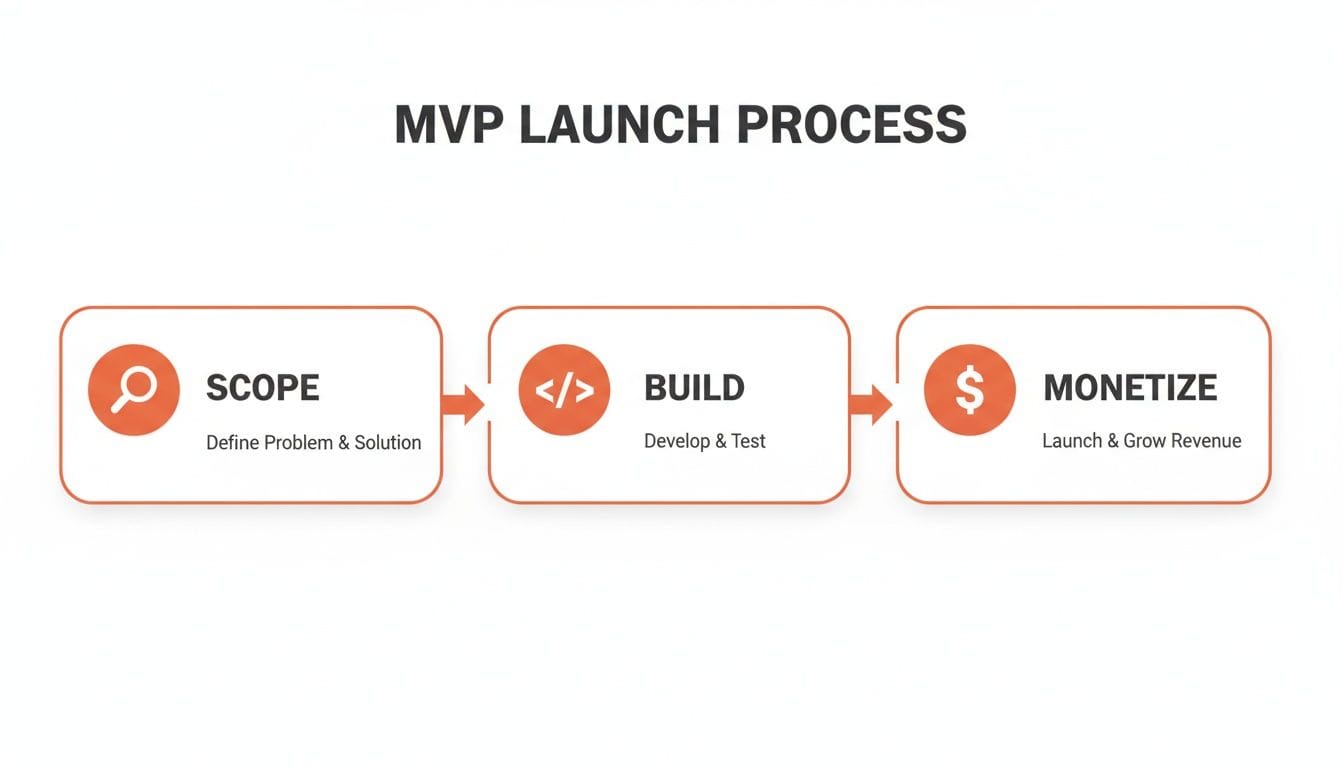
The key insight here? Monetization isn't an afterthought you tack on later. It's a core component you build in from the start, making sure your app is revenue-ready on day one.
Integrating Monetization from Day One
You have to build your monetization model directly into your MVP. Waiting to figure out how you'll make money is a critical mistake because it directly impacts your app's architecture and user experience. It also delays your ability to test your pricing and prove your business model actually works.
There are a few proven models for marketplaces:
- Commission Fees: Taking a percentage of each transaction (think Airbnb or Uber). This is the most common starting point.
- Listing Fees: Charging sellers to post their goods or services (like Craigslist does for job postings). Best for categories with high-value listings.
- Subscriptions: Offering premium features to sellers for a recurring fee (like LinkedIn Premium for recruiters). This works well when sellers need tools to manage their business on your platform.
For most new marketplaces, a commission model is the most founder-friendly place to start. It perfectly aligns your success with your users' success - you only make money when they do. Tools like RevenueCat are essential here; they handle the complexities of managing in-app subscriptions and purchases across both iOS and Android so you don't have to.
Embedding Essential Growth Tooling
Finally, your MVP needs the right tools to measure performance and engage users from the moment you launch. You can't improve what you don't measure. Integrating analytics and communication tools isn't optional; it's fundamental to learning and growing your user base.
An MVP without analytics is like flying blind. You’ll see that people are using your app, but you won't know who they are, what they’re doing, or why they’re leaving.
Your MVP launch stack absolutely must include:
- Product Analytics: A tool like Mixpanel is crucial for tracking user journeys. For a rental marketplace, you would track the percentage of users who search, view a listing, contact the owner, and complete a booking. This funnel data shows you exactly where users drop off.
- Push Notifications: A service like Firebase Cloud Messaging is vital for re-engaging users. If a buyer messages a seller, an instant push notification can increase response time by 50%, leading to a better user experience and more completed transactions.
The broader market data paints a clear picture. Global e-commerce revenue is projected to hit US$3.89 trillion in 2026, and consumer spend already reached $40 billion in Q1 2025. But success hinges on engagement. With app downloads peaking at 136 billion in 2024 (a 1% YoY decrease), the focus has officially shifted from acquisition to retention. This proves that building an app people keep coming back to is what really drives revenue. To get your product out the door effectively, learn more about how to build a SaaS MVP and launch your product faster.
Scaling Your Marketplace After the Big Launch
Getting your app into the store isn't crossing the finish line; it’s just the starting gun for the real race. From this point forward, every single decision has to be backed by data.
Sustainable growth isn’t about guesswork or sticking to your initial assumptions. It comes from a relentless focus on optimizing your marketplace based on how real people are actually using it. This is where you shift from just building features to fine-tuning the economic engine of your business.
Stop Guessing and Start Measuring: The KPIs That Matter
It's easy to get distracted by vanity metrics like total downloads. They feel good, but they don't pay the bills. To scale a healthy business, you need to be obsessed with the key performance indicators (KPIs) that directly reflect your platform's health and financial viability.
These are the numbers that actually move the needle:
- Gross Merchandise Volume (GMV): The total value of all sales on your platform. If you process 100 sales at an average of $50, your GMV is $5,000.
- Customer Acquisition Cost (CAC): How much it costs to get a new buyer or seller. If you spend $1,000 on ads and get 100 new transacting users, your CAC is $10.
- Lifetime Value (LTV): The total profit you expect from an average customer. If a user makes 5 purchases with a $10 profit each, their LTV is $50.
- Cohort Retention Rate: Of the people who signed up in January, what percentage are still active in March? This tells you if your platform has staying power.
For your marketplace to be sustainable, let alone scalable, you absolutely must nail the LTV:CAC ratio. A healthy marketplace should see an LTV that is at least 3x its CAC. If your LTV is $50 and your CAC is $10, your ratio is 5:1, which is fantastic. If your CAC is $20, your ratio is 2.5:1, signaling you are paying too much for unprofitable users and need to fix your marketing or pricing.
The Handoff: Transitioning to an In-House Team
As your marketplace finds its footing and starts to show real product-market fit, your needs will change. The agency or dev partner who got you to launch did exactly what you hired them for. But now, it’s time to build your most important long-term asset: your own in-house product and engineering team.
This is a make-or-break moment. You're taking full ownership of your technology, your roadmap, and your destiny. A sloppy handoff can kill your momentum, but a structured one sets you up for the next stage of growth.
A great development partner doesn't just build your app; they help build your initial team. Their final job is to make themselves obsolete by creating a self-sufficient product team that knows the codebase inside and out.
Actionable Insight: This isn’t a one-day event where they just email you a zip file of the code. A proper handoff is a gradual transfer of knowledge over 4-6 weeks. Your development partner should help you recruit, interview, and onboard your first key hires - maybe a lead engineer or a product manager. These new team members then work alongside the agency’s team for several sprints, absorbing all that institutional knowledge and taking over feature development before the final handover.
This approach ensures you don't drop the baton. It turns your initial development cost from a one-time expense into a self-sustaining asset, giving you the control you need to scale with confidence.
Questions Founders Ask Before Building a Marketplace
When founders come to us with a marketplace idea, the conversation almost always boils down to a few critical questions. They need to understand the real cost, the biggest roadblocks, and how fast they can actually get to market. Let's break down what we tell them.
How Much Will a Marketplace App Really Cost?
For a solid, revenue-ready marketplace MVP, you should budget somewhere between $150,000 and $750,000. The final number really depends on the moving parts - the complexity of your features, how deep the backend needs to go, and who you partner with to build it.
Practical Example: A simple platform connecting local artisans with buyers (basic profiles, listings, messaging, and payments) will lean toward the lower end of that range. But if you’re building something like a marketplace for accredited financial advisors that needs sophisticated escrow payments, multi-factor verification for sellers, and a custom matching algorithm, you're naturally looking at a bigger investment.
One of the most practical ways we keep costs in check is by building with a cross-platform solution like React Native. It lets us build for both iOS and Android from a single codebase, which is a massive efficiency win.
What's the Single Biggest Challenge I'll Face?
Hands down, it's the "chicken-and-egg" problem. You can't get buyers without sellers, but you can't convince sellers to join if there are no buyers. It's a classic startup paradox.
The strategy that works is figuring out which side of your marketplace creates the most value and then pouring all your initial energy into recruiting them.
Actionable Example: Let's say you're building a platform to connect homeowners with interior designers. Your first move isn't a big marketing splash for homeowners. Instead, you manually find and onboard a small, curated group of 10 incredible designers from Instagram or design blogs. Their high-quality portfolios become the bait. Once you have that supply-side value, attracting paying clients becomes infinitely easier.
The secret is creating standalone value for one side of the market before the other side even shows up. It’s usually a manual, unscalable grind at first, but that effort is what seeds the entire ecosystem and gives everyone else a reason to join.
Realistically, How Long Until We Can Launch?
If you're disciplined about the scope of your MVP and work with a team that's done this before, you can get a revenue-ready marketplace designed, built, and launched in 10 to 20 weeks.
This timeline is entirely dependent on one thing: fighting "feature creep." The temptation to add just one more thing is huge, but it's a trap. Launching quickly with a core set of features that solves one problem well is the goal. It gets you out of the world of assumptions and into the world of real user data, which is where the real learning begins.
Ready to build a marketplace that actually makes money? Vermillion partners with startups to prove traction, retention, and revenue fast. We deliver fully-featured React Native apps in 10-20 weeks and give you a structured handoff so your in-house team can take over and scale.
Keep reading
See all →
March 22, 2026
Unlocking Revenue Your Guide to Price Tier Strategy
March 21, 2026
Your Guide to Flawless Stripe Subscription Management

May 14, 2026
Fractional Mobile Engineering vs. Full-Time Hiring in 2026
The mobile engineering talent market has shifted dramatically over the past two years. Budgets are tighter, AI tools have changed what a sin...
March 20, 2026
Recurring Billing With Stripe a Guide for Subscription Apps
Master recurring billing with Stripe. This guide covers everything from setup and server logic to webhooks and churn reduction for subscript...
March 19, 2026
Unlocking Growth with Mobile App Retention Metrics
Discover the mobile app retention metrics that directly fuel MRR growth. This founder's guide offers actionable strategies to track, analyze...