Your Playbook for Building a Scalable Hospitality Mobile App
Think of a hospitality mobile app as your digital front desk, concierge, and direct line to every guest—all neatly packaged in their pocket. This isn't just a nice-to-have anymore; it's a fundamental tool for hotels, restaurants, and travel companies trying to keep up with guests who expect instant, personalized service on their own terms.
Why Your Business Needs a Mobile App Now
Let's be blunt: a mobile app has moved from being an impressive gimmick to a core part of a hospitality business's strategy. Your modern traveler and diner lives on their phone. They expect to book, order, and communicate digitally. An app isn't just another touchpoint; it becomes the central hub for their entire experience, directly impacting guest satisfaction and, more importantly, your bottom line.
The New Standard in Guest Experience
The customer journey starts on a smartphone, long before a guest ever steps through your door. A dedicated app lets you own that journey from the very beginning. Instead of paying commissions to third-party aggregators and losing control of the relationship, you create a branded ecosystem that builds real loyalty and gives you priceless data.
Here’s what that actually looks like in practice:
- Direct Bookings and Communication: Guests book rooms, reserve tables, or schedule spa treatments right in your app. This means you sidestep the hefty commission fees from OTAs and own the customer relationship. Actionable insight: Promote a "book direct" bonus exclusively within the app, like a complimentary drink or late checkout, to train users to bypass third-party sites.
- Personalized Service: The app becomes your engine for personalization. You can push targeted promotions, offer room upgrades, and suggest local experiences based on a guest's past behavior and stated preferences. Actionable insight: If a guest previously ordered a gluten-free meal, your app can proactively highlight gluten-free options on the menu during their next visit, demonstrating attentive service.
- Operational Efficiency: Think about the time saved by automating check-in, room service orders, and simple support requests. This frees up your staff to handle the complex, high-touch interactions that truly define a premium guest experience. Actionable insight: Implement a "request housekeeping" button in the app. This creates a digital queue for staff, eliminating phone calls and allowing them to service rooms more efficiently based on real-time demand.
Capturing Direct Revenue and Building Loyalty
The financial case for an app is undeniable. The market has already shifted. A stunning 61% of travelers globally now prefer using apps to book their flights and hotels. This behavior is driving insane growth in the travel and tourism app market, which is on track to hit USD 3,552.7 billion by 2034. The numbers don't lie.
An app isn't just a piece of technology. It's a direct revenue channel and the most powerful loyalty engine you can build. By owning the guest relationship from start to finish, you can drive repeat business and increase lifetime value far more effectively than with any other tool.
This guide is a founder's playbook, designed to help you build an app that meets this demand head-on and scales with your business. To really nail it, you need to be up-to-date on the latest hospitality industry trends and what your guests actually want. You might also be interested in how this tech is already reshaping high-end travel—check out our insights on the digital concierge revolution. We'll walk through the entire process, from defining essential features to choosing the right tech stack, making sure you sidestep the common mistakes that sink promising projects.
Figuring Out Your App's Must-Have Features
A great hospitality app isn't just a random pile of features. It’s a tool, carefully designed to solve real problems for your guests and, just as importantly, for your business. The right features feel invisible to the user, smoothing out rough spots in their experience, while also driving revenue and making your operations run like a well-oiled machine.
But here’s the thing: the features a hotel needs are worlds apart from what a restaurant or a travel marketplace requires.
Your job isn’t to build everything under the sun right out of the gate. That's a recipe for disaster. Instead, you need to lock in on the core functions that deliver the most immediate value to your specific audience. Think of it like opening a new restaurant: you don't launch with a 100-item menu. You start with a few killer signature dishes that get people in the door.
Core Features for Hotel Apps
For hotels, the game is all about elevating the guest's stay, making everything from booking to checkout feel effortless and personal. Your app needs to be their digital concierge, putting total control right in their pocket.
The absolute starting point is mobile check-in and check-out. This one feature attacks the single biggest headache in travel: waiting in line at the front desk. Guests can handle the formalities on their phone, get their room number, and walk straight to their door the moment they arrive.
This flows naturally into the next game-changer: the digital key.
- How it works: Using Bluetooth or NFC, the guest’s own smartphone becomes their room key. No more flimsy plastic cards to lose.
- A real-world example: The Hilton Honors app lets members pick their exact room from a digital floor plan, check in, and unlock the door, all without ever speaking to a soul at the front desk. This isn't just about convenience; it frees up your staff to handle more meaningful guest interactions instead of processing queues.
Finally, in-app service requests are a must. This lets guests order room service, ask for more towels, or book a spa appointment with a few quick taps. Actionable insight: Instead of a generic "request" button, create specific, one-tap options like "More Coffee Pods" or "Extra Pillows." This structures the data for your staff and makes the guest's experience faster and more intuitive.
Essential Features for Restaurant Apps
When it comes to restaurants, your app has two primary jobs: drive orders and build loyalty. Every feature must be laser-focused on speed, convenience, and getting people to come back again and again. The undisputed king here is a dead-simple online ordering system for both takeout and delivery.
A restaurant app that makes ordering a chore is worse than having no app at all. Your goal is to be faster and easier than picking up the phone or getting lost in a third-party delivery app.
This means remembering past orders for one-tap reordering, keeping payment info securely on file, and showing real-time order tracking. No guesswork.
A slick reservation management tool is another non-negotiable. It needs to let users see what times are available, book a table, and get instant confirmation without ever leaving your app. This direct line to your customer helps you dodge commission fees from platforms like OpenTable and gives you ownership of that precious customer data.
But what turns a first-time customer into a regular? A built-in loyalty and rewards program.
- How it works: Customers collect points for every dollar they spend, which they can cash in for free food or discounts. It's simple, but it works.
- A real-world example: The Starbucks app is the gold standard here. It brilliantly fuses mobile ordering with a gamified rewards system. Earning "Stars" feels like progress, creating a powerful loop that keeps people coming back, often daily. It's one of the most successful loyalty engines ever built.
Must-Have Features for Travel Marketplaces
Travel marketplaces like Airbnb or Vrbo have a unique challenge: they serve two different masters, the traveler and the host. The app's features have to build trust and make communication between these two groups seamless. The absolute foundation for this is a powerful search and filtering system.
Users need to slice and dice listings by location, dates, price, amenities—you name it. If they can’t find what they’re looking for quickly and easily, they’re gone. The experience has to be lightning-fast and intuitive, delivering perfect results without making the user feel overwhelmed. Actionable insight: Don't just offer standard filters. Add niche, experience-based filters like "Good for remote work" (testing for Wi-Fi speed) or "Pet-friendly with a fenced yard" to solve specific user pain points and differentiate your platform.
Just as critical is a secure and reliable messaging system. Every conversation, from the first question to the final check-in instructions, must happen inside the app. This creates a record, protects both parties, and keeps your platform at the center of the entire transaction.
And finally, a transparent review and rating system is the glue that holds it all together. Trust is the only currency that matters in a marketplace. A solid system where both guests and hosts can leave honest, verified reviews is the only way to build credibility. It helps future users make good decisions and keeps everyone on the platform honest.
Essential App Features by Hospitality Vertical
To help you prioritize, here’s a quick comparison of the must-have features across different hospitality sectors. This should give you a clearer picture of where to focus your MVP scope depending on who you're building for.
| Feature | Hotels | Restaurants | Marketplaces |
|---|---|---|---|
| **Mobile Check-in/out** | ✅ **Must-Have** | ❌ N/A | ❌ N/A |
| **Digital Key** | ✅ **Must-Have** | ❌ N/A | ❌ N/A |
| **In-App Service Requests** | ✅ **Must-Have** | 🟡 Nice-to-Have | 🟡 Nice-to-Have |
| **Online Ordering** | 🟡 Nice-to-Have | ✅ **Must-Have** | ❌ N/A |
| **Reservation Management** | ✅ **Must-Have** | ✅ **Must-Have** | ❌ N/A |
| **Loyalty & Rewards** | 🟡 Nice-to-Have | ✅ **Must-Have** | 🟡 Nice-to-Have |
| **Advanced Search & Filters** | 🟡 Nice-to-Have | 🟡 Nice-to-Have | ✅ **Must-Have** |
| **Secure In-App Messaging** | 🟡 Nice-to-Have | ❌ N/A | ✅ **Must-Have** |
| **Reviews & Ratings** | ✅ **Must-Have** | ✅ **Must-Have** | ✅ **Must-Have** |
As you can see, while some features like Reviews are universally important, others are highly specific to the business model. Use this as a starting point to define what "essential" truly means for your app.
Choosing a Tech Stack Built for Growth
Picking the tech stack for your hospitality app is like choosing the foundation, plumbing, and electrical wiring for a new hotel. If you get it wrong, it doesn't matter how beautiful the lobby is—you’re just setting yourself up for catastrophic failures down the road. This isn’t just a nerdy list of programming languages; it's the architectural blueprint that decides whether your app can handle 10,000 bookings at once or just crashes during the holiday rush.
Making the right technical choices upfront is the single best way to avoid the six-figure rewrites that plague so many promising projects. The goal is a rock-solid system that grows with your business, not one you have to tear down and rebuild the moment you start getting traction.
The Cross-Platform Advantage with React Native
One of the first big forks in the road is deciding whether to build separate native apps for iOS and Android or go with a cross-platform framework. For most startups, this is a no-brainer. Building two apps means managing two codebases, hiring two distinct teams, and basically doubling your development costs.
This is where a framework like React Native gives you a massive strategic edge. It lets you write your app's code once and run it on both iOS and Android, which is a game-changer for a few reasons:
- Speed to Market: You launch on both platforms at the same time. Instantly, your app is available to the entire mobile market, not just half of it.
- Cost Efficiency: A single codebase is dramatically cheaper to build and, just as importantly, cheaper to maintain over the long haul.
- Consistent User Experience: Your app looks and feels the same on every device, which builds a stronger, more recognizable brand.
Mobile apps are the new front desk of hospitality, and the market’s projected growth to USD 864.5 billion by 2031 proves it. With iOS alone commanding 52.95% of app revenue, you simply can't afford to ignore either platform. Cross-platform isn't just a shortcut; it's a smart business decision. You can explore the mobile application market report for a closer look at the numbers.
Building a Scalable Backend Architecture
While your users only see the "front end"—the buttons they tap and the menus they scroll through—the backend is the real engine of your app. This is where all the heavy lifting gets done, from processing payments to managing reservations and syncing calendars. A weak backend will absolutely cripple even the most beautifully designed app.
This is why a microservices architecture is almost always the right call for a hospitality app built for growth.
Think of a traditional "monolithic" backend as one giant, interconnected machine. If one part breaks—say, the payment processor—the whole thing grinds to a halt. Microservices are different. It's like having separate, specialized engines for each job: one for bookings, one for user profiles, another for payments.
This approach gives you incredible flexibility. If your booking engine suddenly gets slammed with traffic, you can scale just that one service without touching the rest of the app. It also makes the entire system much easier to update and maintain, since your team can work on individual components without risking the entire platform. This modular design is the key to handling growth without constant growing pains. For a deeper dive, check out our guide on how to choose a tech stack.
Essential Third-Party Integrations
You don't have to—and definitely shouldn't—build every single piece of your app from scratch. Smart founders know to integrate best-in-class third-party services to handle the complex, non-core functions. This lets your team focus on the unique business logic that actually makes your app special.
Here are the non-negotiable integrations for any serious hospitality app:
- Payment Processing (e.g., Stripe): Handling money is incredibly complex and comes with strict security and compliance rules. A service like **Stripe** handles all of it, from securely storing credit card details to processing multi-currency transactions. Trying to build this yourself is a one-way ticket to security breaches and legal nightmares.
- Push Notifications (e.g., Firebase Cloud Messaging): Push notifications are your direct line to your users. They're absolutely essential for sending booking confirmations, check-in reminders, and special offers. A platform like **Firebase** provides a reliable, scalable infrastructure to make sure your messages actually get delivered.
- Analytics (e.g., Mixpanel or Amplitude): You can't improve what you can't measure. Analytics tools are vital for understanding what users are actually doing inside your app. They help you track key metrics like user retention, conversion rates, and feature adoption, giving you the hard data you need to make smart product decisions instead of just guessing.
By carefully selecting your framework, designing a backend that can scale, and integrating trusted third-party services, you build a technical foundation that not only works on day one but is ready for the challenges of tomorrow.
Your 20-Week Roadmap From Idea to Launch
Turning a great idea for a hospitality app into a real, market-ready product isn't magic. It requires a clear, strategic plan. This 20-week roadmap is more than a timeline; it's a founder's playbook for making smart tradeoffs, focusing on what truly matters, and launching efficiently without cutting the corners that'll bite you later.
Think of this process like building a boutique hotel. You wouldn't start hanging artwork before the foundation is poured and the walls are up. In the same way, a successful app launch follows a logical sequence—from deep research to rigorous testing and, finally, a well-executed debut.
This timeline shows how your app will grow, starting with a solid foundation and eventually scaling up for long-term success.
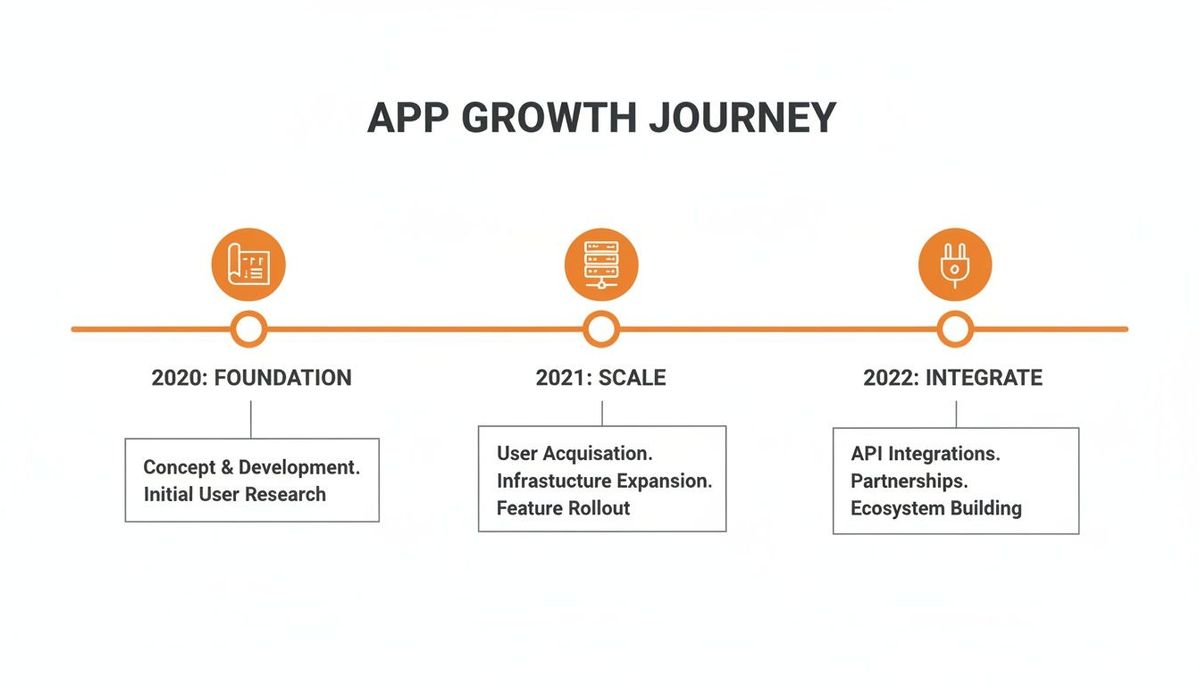
The key takeaway here is that each phase builds on the last. Get one wrong, and the whole structure becomes wobbly. Get them right, and you'll have a stable, expandable product ready for whatever comes next.
Weeks 1-4: Discovery and Validation
The first month is all about stopping, listening, and learning. The single biggest mistake founders make is building something nobody actually wants. This phase is your insurance policy against that expensive error. Your goal is simple: validate your core idea and define a razor-sharp MVP feature set that solves a real, painful problem for a specific group of people.
This means doing deep user research. I'm not talking about Mailchimp surveys. I'm talking about one-on-one interviews with potential users like hotel managers, frequent diners, or vacation rental hosts. Get on the phone. Buy them a coffee.
- Real-world example: If you're building an app for independent hotels, go interview five general managers. Ask them about their biggest operational headaches with guest communication. You might discover that managing housekeeping requests via walkie-talkie and post-it notes is their main bottleneck. That's a real problem your app can solve.
By the end of week four, you should have a concise Product Requirements Document (PRD). This isn't a wish list. It's a disciplined, stripped-down list of the absolute must-have features needed to solve that core problem at launch.
Weeks 5-14: Design and Development
With a validated plan in hand, it's time to actually build the thing. This ten-week block is the heart of the project, typically broken down into two-week agile sprints. It kicks off with creating an intuitive and clean user interface (UI) and user experience (UX) based directly on what you learned in your research.
Next, your engineering team starts architecting the backend—the engine that powers everything. This is where critical integrations with systems like a Property Management System (PMS) for hotels or a Point of Sale (POS) for restaurants are mapped out and built. Be warned: this is almost always the most complex part of the build.
The quality of your backend and the reliability of your integrations will define your app's success far more than a flashy UI. A beautiful app that double-books a room is a failure. Prioritize a stable, secure, and scalable foundation above all else.
Throughout this phase, regular sprint demos are non-negotiable. They ensure what's being built actually aligns with the vision and let you make quick course corrections before small issues become giant, expensive problems.
Weeks 15-18: Testing and Hardening
Your app is now "feature complete," but it's nowhere near ready for the public. This four-week phase is all about trying to break it. You need to find and fix every bug, security hole, and performance issue you can. Think of it as hardening the app so it’s rock-solid from day one.
This is not just a quick check. It’s a multi-layered attack on your own product:
- Quality Assurance (QA) Testing: A dedicated QA team tests every feature on various devices, trying to break the app in ways your developers never imagined.
- Security Audits: You must check for vulnerabilities, especially around user data and payment processing. This is critical for complying with standards like PCI for payments.
- Load Testing: This simulates a flood of users to see how the app performs under pressure. Can it handle a thousand guests trying to check in at the same time on a holiday weekend?
Skipping this phase to launch a few weeks faster is a classic rookie mistake. It’s a recipe for disaster that leads to a firehose of bad reviews and a damaged reputation that’s incredibly hard to repair.
Weeks 19-20: Launch and Feedback
The final two weeks are all about getting your app into the hands of real users and preparing to learn from them. This starts with submitting the app to the Apple App Store and Google Play Store, a process that requires carefully crafting your listings, screenshots, and descriptions.
Once you’re live, your initial marketing push begins. This doesn't need to be a massive, expensive campaign. It can be a highly targeted effort aimed at the exact same user group you interviewed back in phase one. They’re your first believers.
The most critical part of this phase is ensuring your analytics are properly configured from the very first minute. You need to be tracking user behavior to understand what’s working, where users are dropping off, and which features they actually love. This feedback loop is the lifeblood of your next development cycle.
Smart Monetization and Retention Strategies
An app without a clear path to revenue is just an expensive hobby. To turn your platform into a real business, your monetization model can't be an afterthought—it needs to be woven directly into the user experience. For a hospitality app, this means creating value that guests are genuinely happy to pay for.
When you get it right, the features that convince a user to spend money are the exact same ones that make them loyal to your brand. Think of monetization and retention as two sides of the same coin. Great service drives revenue, and that revenue funds an even better experience. It’s a powerful cycle.
Choosing Your Revenue Model
Your app’s business model has to feel like a natural extension of the service you provide. A hotel app’s revenue streams will look totally different from a restaurant loyalty platform. The key is to avoid friction.
Here are three proven models that work wonders in hospitality:
- Commission-Based: The classic model for marketplaces and booking platforms. You take a small percentage of each transaction, whether it's a direct hotel booking or a food delivery order. This works when your app consistently delivers high-value customers to your partners.
- Subscription Tiers: This is perfect for apps offering ongoing value, like an analytics dashboard for restaurant owners or a premium travel club for frequent flyers. A free tier gets them in the door, while paid tiers unlock advanced tools, exclusive content, or special member perks.
- In-App Purchases (IAP) & Upsells: This model is all about ancillary revenue. Guests purchase one-off services or upgrades directly through the app. It's incredibly powerful for hotels, letting them sell late check-outs, room upgrades, or spa packages with a single tap.
Connecting Monetization to Retention
Simply asking for money isn't a strategy. You need a system that encourages repeat business and boosts the lifetime value (LTV) of every user. This is where smart retention tactics become your most important revenue driver.
A well-designed loyalty program is the perfect example. By rewarding guests with points for direct bookings or in-app spending, you create a massive incentive for them to skip the third-party aggregators and engage directly with your brand.
The core idea is simple: make the app the single best way to experience your brand. When guests know they get the best price, earn rewards, and receive personalized service through the app, they have zero reason to book anywhere else.
This gets even more powerful when you add personalization into the mix. Today, 70% of hospitality apps use AI features to make the experience better. In travel specifically, AI-powered recommendations are driving a 32% lift in in-app bookings. It’s no longer a nice-to-have; it's essential for boosting conversions.
Practical Examples of Revenue-Driving Retention
Let's get practical. A smart hospitality app uses data to create moments that not only delight guests but also directly drive revenue.
Actionable Example: The AI-Powered Upsell
Imagine a guest who has stayed at your hotel twice and ordered the same pricey bottle of Cabernet through room service both times.
- The Play: Two days before their next stay, your app sends a push notification: "Welcome back, Sarah! We have your favorite Cabernet Sauvignon ready. Would you like it waiting in your room upon arrival?"
- The Result: With one tap, Sarah confirms. You just secured an easy, high-margin sale while making her feel seen and valued. This is how a simple feature becomes a retention machine.
To pull this off, you need tools that can create real-time personalized offers. These systems automate the kind of personal outreach that turns good service into guaranteed revenue. To go even deeper, check out our guide on effective mobile app retention strategies to keep your users engaged for the long haul.
Some Questions You’re Probably Asking About Your Hospitality App
If you're thinking about building a hospitality app, you've probably got a few big questions swirling around. Getting straight, practical answers is the difference between a smart investment and a costly mistake. Let's cut through the noise and tackle the questions I hear most often from founders.
How Much Does It Cost to Build a Hospitality Mobile App?
The honest answer? It ranges from $50,000 for a stripped-down MVP to well over $250,000 for a complex platform loaded with features. But here’s the thing most people miss: the biggest cost driver isn't the number of features. It's the architecture.
You can't afford to cheap out on the technical foundation. I've seen it happen time and time again—a cheap initial build almost always forces an expensive, time-consuming rewrite down the road. Investing in a scalable foundation from day one is, without a doubt, the smartest way to save money in the long run.
Should I Build for iOS or Android First?
For most startups, this is the wrong question to ask. The smart move is to use a cross-platform framework like React Native. This lets you build for both iOS and Android at the same time, from a single codebase.
Why does this matter? You instantly double your market reach without doubling your development budget. It's the fastest, most efficient way to get your app into users' hands and start collecting feedback from the entire mobile ecosystem.
What Is the Biggest Mistake Founders Make?
Easy. They obsess over flashy frontend features while completely neglecting the backend architecture. Founders naturally focus on what the user sees, and often settle for a cheap, flimsy backend that can't handle any real growth.
The app starts to get some traction, and then it happens: it becomes slow, unreliable, and insecure. This forces a complete and painful rebuild from scratch, killing all momentum. A scalable foundation isn’t a nice-to-have; it's the most critical investment you will make.
How Do I Integrate with Hotel or Restaurant Systems?
This is where things get serious. Connecting your app to existing systems—like a hotel's Property Management System (PMS) or a restaurant's Point of Sale (POS)—is done using APIs (Application Programming Interfaces). This is not a job for junior developers.
It's a complex process of mapping data, securing authentication, and handling errors so nothing breaks. One mistake can lead to double bookings or lost orders, which will instantly destroy the trust you've worked so hard to build. You need an experienced engineering team for this, period.
Building a hospitality app that's secure, scalable, and successful takes more than just writing code; it demands expert technical judgment. Vermillion doesn't just build products; we act as a technical growth partner, helping you build a foundation that survives what comes next. Learn how we help founders build with confidence.