Difference: difference between react native and react js for startups
At its core, the difference between React Native and React JS comes down to one simple question: Are you building for a web browser or a mobile phone?
For a founder, getting this right from day one is everything. Choose React JS for a web-first product. Choose React Native for a mobile-first one. It’s that fundamental.
React JS vs React Native: A Founder's Quick Guide

Both technologies came out of Facebook and share the same DNA—the component-based architecture of React. But they solve completely different problems. Internalizing this distinction is the first step toward a sound technical strategy.
React JS (or just "React") is the original. It’s a JavaScript library built specifically to create fast, interactive, and complex user interfaces for websites. When you use the web version of Netflix or Airbnb, you're seeing the power of React JS in action.
- Practical Example: Imagine building an online dashboard for a SaaS product. With React JS, you can create a component for a chart that updates in real-time as new data streams in. This component can be reused on multiple pages without rewriting any code.
- Actionable Insight: If your primary user acquisition channel is organic search (SEO), React JS is your non-negotiable choice. It builds crawlable web pages that Google can index, directly driving traffic to your product.
React Native, on the other hand, takes those same principles and applies them to mobile apps. Instead of rendering web elements like <div> in a browser, it renders true native UI components—the same building blocks an app written in Swift (for iOS) or Kotlin (for Android) would use. This is its superpower: you build one app that feels genuinely native on both iPhones and Android devices.
- Practical Example: A startup wants to build a social media app like Instagram. Using React Native, they can write the code for the photo feed, comments section, and user profiles once. This single codebase will then power both the iOS and Android versions of the app, saving immense time and money.
- Actionable Insight: If your app's core feature relies on the phone's hardware, like accessing the camera for a photo-sharing app or using GPS for a delivery service, React Native provides the APIs to do this from a single JavaScript codebase.
Key Differences At a Glance
To make this crystal clear, let's put them side-by-side. The table below cuts through the noise and summarizes the core attributes of each technology. Think of this as your cheat sheet for aligning your tech stack with your business goals.
| Attribute | React JS (Web) | React Native (Mobile) |
|---|---|---|
| **Primary Platform** | Web Browsers (Chrome, Firefox, Safari) | Mobile Operating Systems (iOS & Android) |
| **Rendering Engine** | Uses a Virtual DOM to render HTML components in a browser. | Uses a "bridge" to communicate with native APIs, rendering platform-specific UI components. |
| **Typical Product** | Single-Page Applications, complex web dashboards, e-commerce sites. | Cross-platform mobile apps, like Instagram or Uber Eats. |
| **Styling Method** | Standard CSS, CSS-in-JS libraries. | A JavaScript-based, CSS-like stylesheet system (no direct CSS). |
Ultimately, your choice isn't just about technology; it's about where your users are. React JS brings your product to the open web, accessible by anyone with a browser. React Native puts your product directly into your users' pockets, living on their home screen.
Comparing Performance and Architecture

This is where the rubber meets the road. The technical guts of React and React Native directly shape how fast your app feels, how well it scales, and what kind of experience your users get. They might share a component philosophy, but they’re built for two totally different worlds: the web browser and the mobile OS.
Getting this distinction right is key. It aligns your tech with your long-term product goals, preventing painful rewrites down the line.
React.js is king in the browser, and its secret weapon is the Virtual DOM. Manipulating the browser's actual DOM is notoriously slow and clunky. Instead of touching it for every little change, React builds a lightweight copy in memory. It figures out the most efficient way to update the UI, then makes those changes in one quick, optimized batch.
The result is an exceptionally fast and responsive web application.
The Power of the Virtual DOM
- Practical Example: Imagine a complex dashboard like a stock trading platform, where prices are ticking up and down every second. Without a Virtual DOM, the entire page would have to re-render constantly, making it feel sluggish and unusable. React JS, however, identifies only the specific price number that changed and updates just that tiny piece of the DOM.
- Actionable Insight: For web applications where user interaction is constant and data changes frequently (think Google Sheets or Figma), the Virtual DOM is what makes a smooth, desktop-like experience possible in a browser. This is a massive competitive advantage.
React Native’s Bridge to the Native World
React Native, on the other hand, isn't talking to a DOM. It's talking to the native components of a phone's operating system. Historically, it did this using the "bridge," an asynchronous channel that translates your JavaScript commands into native code for iOS and Android. This is how your app gets to use genuine native UI elements, giving it that authentic look and feel.
The core architectural trade-off is simple: React JS optimizes for the browser's DOM, delivering a blazing-fast web experience. React Native optimizes for cross-platform native UI, using a bridge (or its modern equivalent) to command the underlying mobile OS.
This bridge architecture works great, but it does come with a potential performance footnote. The communication between the JavaScript thread (your app's brain) and the native UI thread (what the user sees) isn't instant—it's asynchronous. For most apps like social feeds or e-commerce shops, you'll never notice it.
- Practical Example: If a user is swiping through a complex, animation-heavy carousel in a React Native app, the JavaScript thread is sending "move this item" commands across the bridge to the UI thread. If too many commands are sent at once, it can create a slight stutter.
- Actionable Insight: To mitigate this, developers can use libraries like
react-native-reanimated, which allows animations to run directly on the native UI thread, bypassing the bridge for smoother, 60 FPS performance. This is a critical optimization for apps where fluidity is paramount. The good news is that React Native's newer "Fabric" architecture is actively closing this gap by allowing for more direct, synchronous communication, making it a non-issue for an even wider range of demanding applications.
Developer Experience And Talent Pool
Let's talk brass tacks: the practical reality of building and maintaining your product hinges on your team. The developer experience and the available talent pool are where the difference between React Native and React JS becomes incredibly stark, influencing everything from how fast you can hire to how quickly you can ship features.
For web development, React JS is the undisputed king. It offers a mature, buttery-smooth experience. Developers tap into a massive ecosystem of libraries and incredibly powerful tools like Next.js that handle complex jobs like server-side rendering right out of the box. This support system isn't just a nice-to-have; it dramatically speeds up building web apps.
React Native, on the other hand, operates in a unique, mobile-first world. Tools like Expo have done wonders to simplify the initial setup, abstracting away a lot of the gnarly native configuration. But eventually, your developers will have to get their hands dirty with native modules and platform-specific quirks. It's an unavoidable part of the game, and it introduces a steeper learning curve than pure web dev.
Hiring Strategy And Skillset Overlap
The "learn once, write anywhere" philosophy is the killer app for React Native. A seasoned React JS developer can pivot to mobile development surprisingly fast because the core principles—components, state, props—are exactly the same.
- Practical Example: A startup has a web app built with React JS and now needs a mobile app. Instead of hiring two new mobile developers (one for iOS, one for Android), they can train one of their existing React JS developers. That developer can start building the React Native app in weeks, leveraging their knowledge of component structure and state management.
- Actionable Insight: When posting a job for a React Native developer, specifically mention that candidates with strong React JS experience are encouraged to apply. This widens your talent pool significantly and allows you to tap into the much larger pool of web developers.
For hiring managers, the key trade-off is volume versus versatility. The React JS talent pool is vast, making it easier to fill web roles. React Native developers are more specialized, but they bring the high-impact ability to build for both iOS and Android from a single codebase.
The numbers tell the story. React.js is a behemoth in web development, holding a 42.62% market share among JavaScript frameworks and powering over 11.2 million websites. React Native, while a leader in the cross-platform mobile space at 42%, is still far more niche. This is reflected in developer adoption, where 41.6% of professionals use React.js compared to just 9.14% for React Native.
When it comes to building out your team, you've got options. Exploring different hiring models can give you flexibility. For more on that, it's worth reading about Why More Companies Are Turning To IT Contractors. Ultimately, finding and keeping the right people is critical, so understanding different strategies for hiring skilled mobile app developers can be a real competitive edge.
Budgeting, Time to Market, and the All-Mighty Code Reusability
For any startup, speed is everything. It's your single greatest competitive advantage. The decision between React and React Native isn't just about tech; it's about your launch timeline, your budget, and your long-term burn rate. This choice is a financial one, dictating how fast you can turn investment into a product that’s actually in the market.
At its core, the difference between React Native and React JS here comes down to one word: leverage.
React Native’s entire value proposition hinges on its incredible code reusability. You write one JavaScript codebase and get a real, genuine native app on both iOS and Android. For founders watching every dollar, this is a total game-changer.
The Financial Impact of a Single Codebase
- Practical Example: A startup is quoted $100,000 to build a native iOS app and another $100,000 for a native Android app. By choosing React Native, they could potentially build both apps with a single team for around $120,000, effectively getting two apps for slightly more than the price of one.
- Actionable Insight: When budgeting for a mobile app, calculate the total cost of ownership. React Native not only reduces initial development costs but also halves the cost of maintenance and feature updates, as you only need to update one codebase instead of two.
With React Native, a single team builds for both platforms. This isn't just theory; we see it every day. Teams routinely hit up to 85% code reuse, which essentially cuts the engineering effort for a cross-platform launch in half. This radically shortens your time to market, getting you in front of users and collecting feedback faster. We break down exactly how this works in our guide on how React Native can speed up mobile app development.
React Native lets you adapt existing web skills for mobile development, which can slash development costs by up to 40%. With the framework projected to grow at a 16.7% CAGR through 2033, it's a strategic move for startups needing to make their runway last as long as possible.
Projecting Your Long-Term Costs
Look, React is undeniably cost-effective for building a powerful web app. Its ecosystem is massive, and the talent pool is deep, making web development incredibly efficient. But founders have to think a few moves ahead. If a mobile app is even a blip on your future roadmap, starting with React means you're just pushing a massive future investment down the road.
The strategic trade-off is pretty stark:
- React JS: Lower initial cost for a web-only product. The catch? You’ll need a separate, full-scale development effort to crack the mobile market later.
- React Native: A higher initial investment than a simple website, for sure. But it delivers two mobile apps for roughly the price of one, securing your spot in the app stores from day one.
To get a jump start and streamline the process even further, using a React Native boilerplate can seriously cut down on initial setup and ongoing development time. It gives your team a pre-built foundation, letting them focus on what makes your app unique instead of reinventing the wheel. The ability to share 70-85% of code across platforms is why React Native now powers 42% of the cross-platform mobile market.
A Decision Framework for Your Startup
Alright, let's move from theory to action. For any startup, picking between React and React Native isn't just a technical debate—it’s a core business decision. This choice ripples through your product strategy, your budget, and how fast you can get to market. The right answer is never universal; it depends entirely on your context.
To cut through the noise, I’ve found it helps to boil the decision down to four critical, business-focused questions. Answering them honestly will point you down the right path and clarify the real difference between React Native and React JS for your specific goals.
Primary Platform and Monetization Model
First things first: where are your users, and how are you going to make money? This is the most important question you'll answer.
- Web-First Products: If you're building a B2B SaaS platform, a media site that lives and dies by SEO, or an e-commerce store, React JS is the clear winner. Its entire world is building fast, search-engine-friendly web experiences that pull in organic traffic.
- Actionable Insight: Use a framework like Next.js with React JS. This enables server-side rendering (SSR), which dramatically improves your site's initial load time and SEO performance, directly impacting your user acquisition.
- Mobile-First Products: Is your app built around mobile-native features like push notifications, camera access, or in-app purchases (IAP)? Then React Native is your tool. It's designed for the app store ecosystem, where direct engagement and mobile-specific monetization are everything.
- Actionable Insight: Plan your monetization strategy early. If you rely on in-app subscriptions, use a library like
react-native-iapto handle the complexities of App Store and Google Play billing from a single, unified API.
This decision tree gives you a visual shortcut for that initial choice, depending on whether you're targeting the web, mobile, or both.
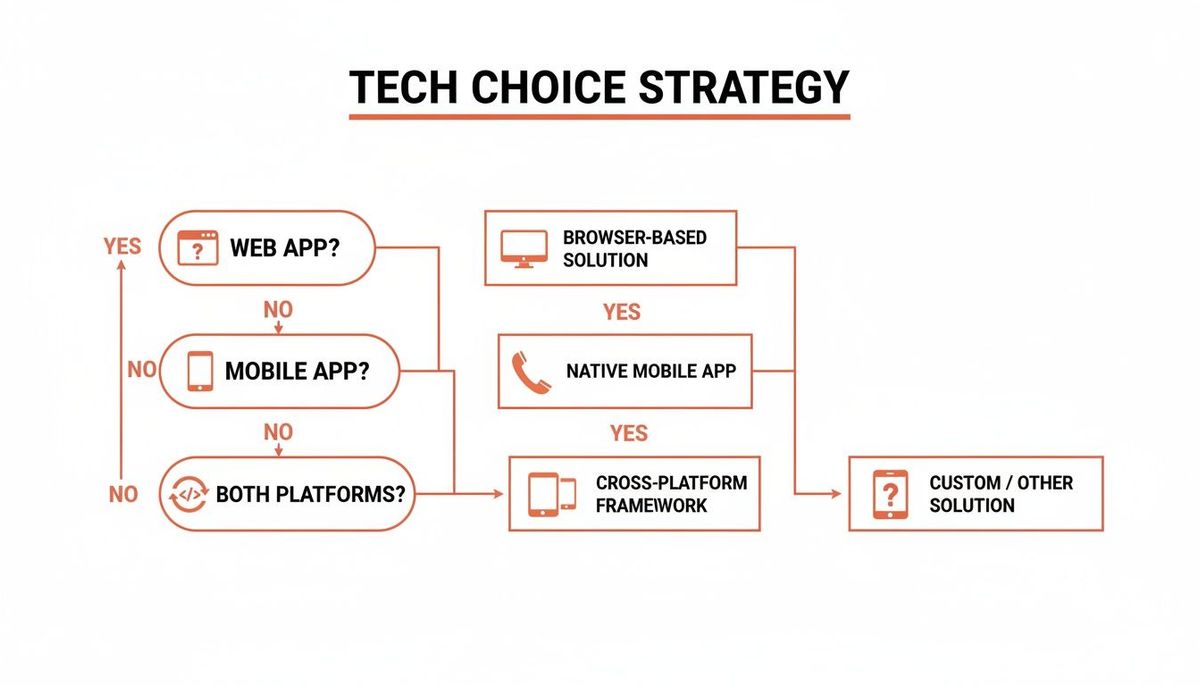
As the flow shows, while web and mobile often start on separate tracks, the conversation almost always leads to code reuse down the line.
Core Features and Team Skills
Next up, what does your app actually do, and who’s going to build it?
Your product's killer feature often makes the decision for you. An SEO-driven blog needs React JS, period. A social app that depends on constant push notifications to keep users engaged absolutely requires React Native.
Just as important is your team's current skillset. If you have a squad of web developers who are wizards with React JS, they can pick up React Native with a relatively gentle learning curve. That makes the mobile route much more accessible. Starting from scratch, however, gives you more flexibility. For a deeper look at this, check out these 3 factors when choosing an app development framework.
Choose React JS for a B2B SaaS where desktop access and search visibility are paramount. Choose React Native for a consumer social app where mobile engagement and camera access are key to user retention.
Finally, remember you don't always have to pick just one. A hybrid strategy is often the smartest play. Use React JS for your marketing site and web dashboard, and build your mobile experience with React Native. This approach gives you a presence on every platform your customers use while letting you share business logic between them for a serious efficiency boost.
Common Questions We Hear
Even with a solid plan, a few key questions always pop up right before a final decision. We've heard them all from founders trying to decide between React and React Native. Here are the straight answers to clear up any final confusion.
Our goal here is simple: give you the clarity you need to move forward, fast.
Can I Reuse My React Web Code for a React Native App?
This is the big one. The short answer is no, you can't reuse the visual parts, but you can absolutely share the logic. It’s a critical distinction.
React JS uses web tags like <div>, while React Native needs its own native components like <View>. Think of it like this: the "skin" of your app needs to be built specifically for mobile. However, the "brain"—all your state management (like Redux or Zustand), data fetching logic, and business rules—can often be shared directly.
- Actionable Insight: Structure your project using a monorepo (with tools like Nx or Turborepo). Create a shared
corepackage that contains all your business logic. Your React JS web app and React Native mobile app can both import this package, ensuring that when you update a core function, it's updated everywhere simultaneously.
Is React Native Good Enough for High-Performance Apps?
Yes. For the vast majority of apps you see and use every day—social media feeds, e-commerce stores, productivity tools—React Native's performance is indistinguishable from a fully native app. It’s built for modern, UI-heavy applications where a smooth user experience is everything.
But what about the really demanding stuff, like complex augmented reality or intense background processing? React Native has an escape hatch. You can write custom native modules in Swift or Kotlin for just those specific features.
- Practical Example: A meditation app needs to play audio in the background even when the phone is locked. This is a perfect use case for a custom native module. The UI for the app is built in React Native for speed, but the background audio service is written in native code to ensure it runs reliably.
- Actionable Insight: Don't view this as a failure of React Native. View it as a strategic advantage. You can build 95% of your app at high speed and low cost, then hire a specialized native developer for a short contract to build the one or two hyper-specific, performance-critical modules you need.
Which One Is Better for SEO?
This one's not even a contest. React JS is the only choice here.
It builds websites that search engines like Google can crawl and index. When you pair it with a framework like Next.js for server-side rendering (SSR), you can build incredibly fast, SEO-friendly web applications that rank well and drive organic traffic.
- Actionable Insight: If you need both a mobile app and a marketing website, build the app in React Native and the website in React JS with Next.js. Use deep linking to connect them. A user who discovers your brand via a Google search on their phone can click a link on your website and be taken directly to the relevant screen in your installed mobile app, creating a seamless user journey.
React Native builds mobile apps. They live in the Apple App Store and Google Play Store. Their visibility comes from App Store Optimization (ASO), not web crawlers. If organic search is a pillar of your growth strategy, you need a web presence built with React JS. Period.
When Should I Just Go Fully Native Instead of React Native?
Only consider pure native development (Swift for iOS, Kotlin for Android) when your app's core value proposition is absolutely dependent on bleeding-edge OS features or uncompromising, raw performance. This is a very small, specific list of apps:
- Graphically Intense Mobile Games: We're talking high-frame-rate 3D rendering that pushes the hardware to its limits.
- Complex Video Editing Apps: Anything requiring deep, constant access to hardware encoders and processors.
- Platform-Specific Utilities: Apps that need to use brand-new, OS-level APIs the moment they're announced at WWDC or Google I/O.
For most founders building marketplaces, social platforms, or B2B tools, the strategic advantages of React Native—faster time-to-market and significantly lower costs—are simply too great to ignore for the marginal gains of going fully native.
Ready to build a mobile app that proves traction and delivers ROI? The team at Vermillion specializes in creating revenue-ready React Native products for funded startups, complete with payments, analytics, and growth tooling. We align our success with your business outcomes. Learn more about our performance-based model and see how we can ship your app in as little as 10 weeks.