Creating a Music App A Founder's Guide to Monetization
Building a music app is about more than just slick playlists; it’s about launching a real business in a market worth billions. This guide is your blueprint for getting a revenue-ready app to market fast. We’re skipping the fluff to focus on what actually matters from day one: monetization, licensing, and scalable tech.
Your Blueprint From Idea to a Profitable App
Jumping into the music app world means fighting for attention in a field that's both crowded and incredibly lucrative. Winning isn't just about a cool interface or a huge song library. It’s about finding a real gap in the market and executing a business plan that brings in revenue—quickly.
Think of this guide as a founder's roadmap. We’ll focus on the critical decisions that lead to a profitable, scalable product that investors will actually notice. The path is pretty clear: start with a solid idea, build a lean version to test it, and then launch with a smart growth strategy.
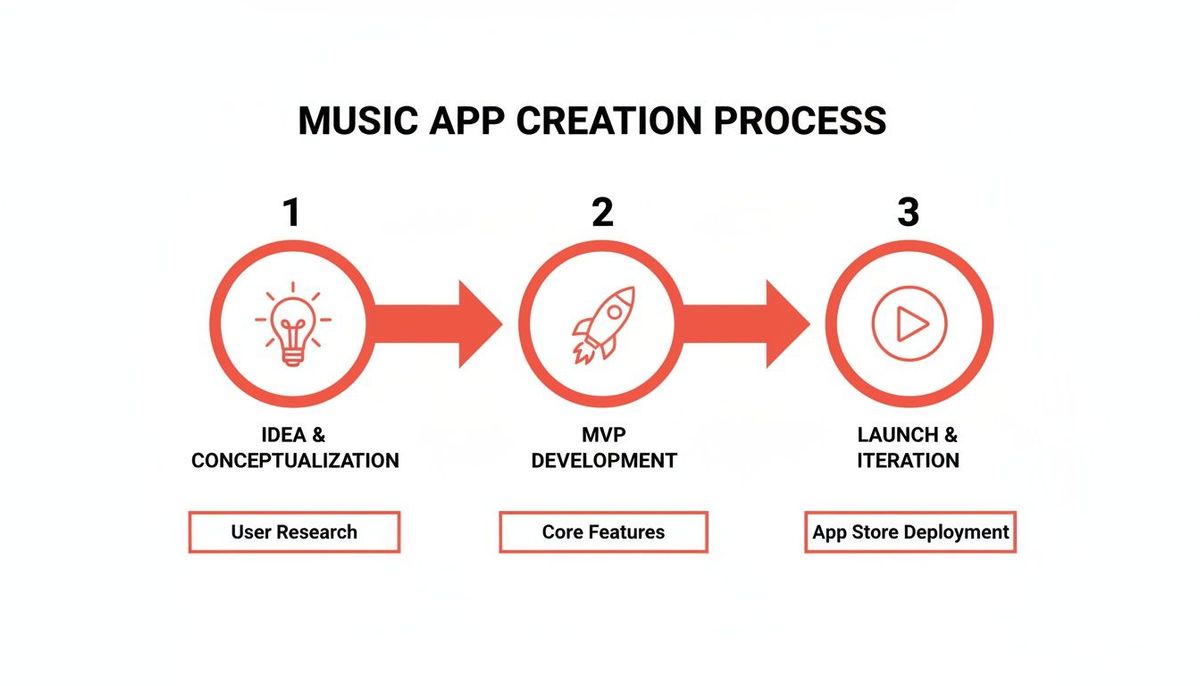
This isn’t just a theoretical exercise. It’s a proven flow that gets you from a concept on a napkin to a product in the hands of users.
Understanding the Market Opportunity
The global music streaming market is massive—valued at $27.71 billion and still climbing. That growth is fueled by things we now take for granted, like 91% smartphone penetration in the U.S. and cheap data plans that make on-demand music a daily habit.
But here’s the reality check: giants like Spotify and Apple Music already own over 60% of the market. That data comes straight from market reports on the music streaming industry.
This doesn't mean the door is closed. It just means you can't go head-to-head. You have to be smarter. Successful newcomers find a niche the big players ignore.
For example, instead of a general streaming service, you could build:
- An app for die-hard fans of a specific electronic genre, like Drum & Bass, featuring exclusive mixes and artist interviews.
- A platform built for independent artists to connect directly with their superfans through ticket sales and exclusive content.
- A music discovery app that uses a "Tinder-style" swipe mechanic to help users find new songs quickly.
The opportunities are in the margins.
A successful music app isn't a Spotify-killer; it's a product that solves a unique problem for a specific audience. Your goal is to own a niche, not the entire market.
From Concept to Investment-Ready Product
This guide is built for founders who need to show traction and get a return on their investment. We're moving past the basics to dig into the real mechanics of building a business, not just a cool piece of software.
Here’s a taste of what we’ll cover:
- Defining a Monetizable MVP: We'll pinpoint the core features users will actually open their wallets for, so you can launch faster and with less waste.
- Navigating Licensing: The world of music rights is a confusing mess. We’ll break it down and give you practical strategies for getting your initial library legally sorted.
- Building a Scalable Tech Stack: It’s crucial to choose the right tools for the job—ones that deliver performance, security, and won't buckle when you start to grow.
This journey demands a clear view of the entire product lifecycle, a hurdle we see trip up a lot of founders in app development for startups. We're giving you the structured plan you need to walk confidently from a simple idea to a profitable app that’s ready for its next round of funding.
Defining a Minimum Viable Product That Sells
Your Minimum Viable Product (MVP) is your app’s first real-world test. The single biggest mistake I see founders make is trying to build a Spotify clone right out of the gate.
A successful MVP isn’t about cramming in every feature you’ve ever imagined. It's about solving one specific problem, for one specific audience, exceptionally well.
Instead of a generic music player, get laser-focused. Are you building an AI discovery tool for deep house fanatics? Or maybe a social playlist app for friends who work out together? This narrow scope lets you prove your core idea works before you burn through hundreds of thousands of dollars on features nobody actually asked for.
From Big Ideas to a Lean Feature Set
The secret to a lean MVP is brutal prioritization. My favorite tool for this is user story mapping. It’s a simple process that forces you to walk through the user's entire journey, step-by-step, and decide what’s absolutely essential for that first valuable experience.
Here's a practical example: For a social workout music app, the core user journey isn't just "play a song." It's "My friend and I want to listen to the same high-energy playlist during our gym session."
This leads to a focused, non-negotiable journey: A user opens the app, creates a new "Workout Mix," adds three songs, and shares a link with a friend so they can listen simultaneously.
That’s it. Everything else is a distraction for your initial launch.
This discipline translates into an MVP feature list that is short, powerful, and achievable:
- Basic Audio Playback: The absolute core. It needs to be rock-solid, with play, pause, and skip controls that just work.
- Simple Search: Users have to find music. A basic search by artist and track title is all you need to get started.
- User Profiles & Authentication: This is the foundation for personalization, letting users save their music and playlists.
- Playlist Creation & Sharing: The ability to save a list of songs and send it to someone is fundamental. It’s what brings people back.
Forget advanced social sharing, offline downloads, or complex recommendation algorithms for now. A focused MVP like this can get you to market in as little as 10-20 weeks, giving you real-world feedback before you commit to a bigger budget.
Validating Your Core Hypothesis
At its heart, an MVP is a learning tool. Its only job is to answer the most critical question you have: Will people actually use this and, eventually, pay for it?
Don't build an app to prove you're right. Build an MVP to find out if you're right. Every feature should be a test of a core assumption about what your users need.
Let’s make this practical. Say your big idea is "AI-generated playlists that match your mood." Your MVP shouldn't try to detect every subtle human emotion. That's a recipe for failure.
Instead, start with just three moods: Focus, Relax, and Energy.
Your core hypothesis is that users want mood-based playlists. By launching with just these three options, you can measure engagement directly. Your actionable insight comes from the data:
- Track this metric: What percentage of daily active users create a mood playlist?
- Ask this question: If the "Focus" playlist is used 10x more than "Relax," should you double down on music for productivity instead of building out more wellness features?
The data you get from this simple test is infinitely more valuable than a dozen unproven features. This lean strategy ensures you build what the market actually wants, turning your initial investment into a validated, monetizable product.
Choosing Your Architecture and Tech Stack
Your technical foundation is everything. Get it right, and you’re building on solid ground. Get it wrong, and you’re building on sand. The choices you make here will dictate how fast you can launch, how much it’ll cost to run, and whether your app can handle success when it comes.
This isn’t just about picking cool technologies; it's a core business decision. We're aiming for a secure, high-performance stack that can grow with your user base without breaking the bank.
Frontend Frameworks: The Cross-Platform Advantage
When it comes to the part of the app users actually see and touch, you have two main options: build two separate, native apps (one for iOS, one for Android), or use a cross-platform framework.
For nearly every startup I've worked with, the second path is the clear winner.
Frameworks like React Native let your team write the code once and deploy it on both iPhones and Android devices. This is a huge deal. Actionable insight: this approach doesn't just save money; it creates development velocity. When you need to push a critical bug fix or a new feature, you do it once, and it goes live for all your users, regardless of their device. This can realistically cut your development time and costs by nearly 50%, a massive leg up when you're trying to get an MVP out the door.

The "learn once, write anywhere" approach means you can tap into a massive pool of web developers to build a truly native-feeling mobile experience. If you're weighing your options, digging into the key factors when choosing an app development framework is a great next step to make sure your decision aligns with where you want to be in two years, not just two months.
Backend Architecture: Monolith vs. Microservices
If the frontend is the car's interior, the backend is the engine. It handles everything from user accounts and playlists to the logic that streams the right song to the right person. The single biggest decision here is whether to build a monolith or go with microservices.
- Monolithic Architecture: This is the classic, all-in-one approach. Your entire backend is a single, unified system. It's almost always faster to get an MVP built this way. The trade-off? As you add features and users, it can become a tangled mess that’s slow to update and tricky to scale.
- Microservices Architecture: This newer approach breaks your backend into a collection of small, independent services. You might have one service just for managing user profiles, another for handling playlists, and a third for song recommendations. It’s more complex to set up initially, but it’s far more resilient and easier to scale individual parts of your app as they grow.
So, which one is right? For most music app MVPs, starting with a well-structured monolith is the smart move. Practical example: Your initial monolith can handle users, playlists, and search. If your search feature suddenly gets extremely popular, it might slow down the entire app. With a microservices architecture, you could scale up just the search service to handle the load without impacting user logins or playlist creation. This whole system will live on a cloud provider like Amazon Web Services (AWS) or Google Cloud, which give you the pay-as-you-go infrastructure needed to grow.
Choosing your initial architecture is a balancing act between speed and future scale. A monolith gets you to market faster. Microservices prepare you for Spotify-level growth. Start with a monolith, but design it to be broken apart later.
The Non-Negotiables for Music Streaming
Beyond the frontend and backend, two pieces of technology are absolutely critical for a music app. You simply cannot build without them.
First is a Content Delivery Network (CDN). A CDN is a global network of servers that caches your music files in locations all over the world. Actionable insight: This isn't just a "nice-to-have." Without a CDN, a user in London streaming a song from your main server in Virginia might experience a 2-3 second delay. With a CDN, that file is served from a server in London, and the delay drops to milliseconds. This tiny detail makes a world of difference, slashing load times and eliminating buffering. A smooth, instant playback experience is make-or-break for user retention.
Second, and just as important, is Digital Rights Management (DRM). This is what keeps the record labels happy and protects their music from piracy. Labels will not license their catalogs to you without proof that you have strong DRM in place to encrypt tracks and prevent unauthorized downloading and sharing. Services like Google Widevine, Apple FairPlay, and Microsoft PlayReady are the industry standards. Trying to launch a music app without DRM is a non-starter.
Tackling Music Licensing and Legal Hurdles
This is where a lot of promising music app ideas hit a brick wall. Music licensing feels like a maze, designed to be confusing. But once you understand the basic pieces, it becomes something you can actually navigate. You absolutely have to get this right before you write a single line of code, because it impacts your features, your budget, and your entire business model.
At its core, every single song has two copyrights. You need to secure licenses for both before you can legally stream it. Getting this wrong isn't a small mistake—it's the fastest way to get shut down.
The Two Halves of Music Copyright
Think of every track as two separate pieces, and you need a license for each one.
First, you have the sound recording license, often called the "master license." This is for the actual recording you hear—the performance captured in the audio file. These are almost always owned by record labels. Think Sony, Universal Music Group, Warner Music Group, and thousands of indie labels.
Second is the musical composition license. This covers the song itself—the melody and the lyrics written by the songwriter. Music publishers manage these rights, and to use them, you’ll work with Performance Rights Organizations (PROs).
Here's who you're dealing with:
- For Sound Recordings: You’ll need deals with the major labels, indie labels, or music distributors.
- For Musical Compositions: You’ll need public performance licenses from PROs like ASCAP, BMI, SESAC, and GMR in the US.
Smart Licensing Strategies for Your MVP
Let's be real: as a startup, going directly to the major labels for your launch is a non-starter. It’s incredibly expensive, takes forever, and they won't even talk to you without proven user numbers.
Luckily, there are much smarter ways to get your MVP off the ground.
One of the most effective routes is to use a third-party licensing provider. Companies like 7digital and BMAT have already done the hard work. They have existing deals with labels and publishers, offering you access to huge catalogs through a single API. This simplifies everything and lets you populate your app with music fast.
Another solid strategy is to start with a niche catalog and avoid the majors entirely. For example:
- Building an app for emerging DJs? Partner with 50 independent electronic artists and offer them a higher revenue share in exchange for exclusivity. This gives you a unique, curated library that can't be found anywhere else.
- Creating a wellness app with guided meditations? Use royalty-free libraries from platforms like Epidemic Sound or Artlist. This gets high-quality, pre-cleared music into your app while you prove your concept.
Your goal with an MVP isn't to get every song in the world. It’s to get the right music to prove your idea works and attract your first users.
How Licensing Shapes Your Business Model
Your licensing strategy and your business model are completely intertwined. The market data tells a clear story: analysts predict the streaming market will grow by $53.49 billion by 2029, with a compound annual growth rate of nearly 19%. Subscriptions are the engine here, making up over 75% of all U.S. music revenue. This is why having a bulletproof legal foundation is so critical—you need it to grab a piece of that growth. You can dig into more of these insights from Technavio's music streaming market report.
Actionable insight: The cost structure of your licensing deal directly impacts what features you can offer. For instance, if your licensing provider charges you a higher rate for offline downloads, you must reserve that feature exclusively for your highest-paying subscription tier to ensure profitability. You have to build this reality into your pricing from day one.
Implementing Monetization Models That Work
A free app isn't going to pay your licensing fees or your developers. Your monetization strategy can't be an afterthought; it needs to be baked into your product from day one. Getting this right is absolutely critical, as it directly shapes the user experience, your growth potential, and whether you’ll even have a business in a year.
The numbers tell a pretty clear story here. Premium subscriptions are the undisputed champion in the music industry, driving the vast majority of revenue. Listeners have proven they're willing to pay for a better experience—things like ad-free listening, offline downloads, and higher-quality audio. This makes a subscription-first mindset a powerful place to start.
Choosing Your Core Monetization Model
While subscriptions are king, you have three primary models to consider. The right choice depends entirely on your target audience and what makes your app special.
- Premium Subscriptions: This is the Spotify and Apple Music model. Users pay a recurring fee (monthly or annually) for all-access. It creates predictable, stable revenue, but it's a big ask upfront. Example: An app for professional DJs that provides high-fidelity stems for remixing could justify a subscription-only model because its tools offer clear professional value.
- Ad-Supported (Free Tier): This model gives users free access to basic features, and you make money by playing audio or showing visual ads. It’s a fantastic way to attract a massive user base quickly, but the revenue per user is typically very low, and let's be honest, ads can really kill the vibe.
- Hybrid (Freemium): This is the sweet spot and probably the most effective strategy for a new music app. You use a free, ad-supported tier as a massive funnel to acquire users, then constantly nudge them to upgrade to the paid subscription for a premium experience.
The freemium model is a powerful engine for growth. It lowers the barrier to entry, lets users experience your app's core value, and then presents the subscription as the solution to their biggest pain points—like ads and limited skips.
You have to understand the market you're walking into. Building a music app is all about user growth, especially as the industry is projected to jump from $8.04 billion to $13 billion by 2029. That growth is fueled by on-demand streaming. Globally, streaming now makes up 69% of all recorded music revenues. The data shows strong growth in subscriptions while ad-supported revenue lags behind, proving paid tiers are where the real money is made. You can dig into more of this data on the mobile music app market growth on ResearchAndMarkets.com.
Comparison of Music App Monetization Models
To make the choice clearer, here's a breakdown of how these models stack up for a startup just getting off the ground.
| Monetization Model | Pros for Startups | Cons and Challenges | Best For |
|---|---|---|---|
| **Premium Subscriptions** | High, predictable revenue per user. Attracts high-intent users who see value in your product. | High barrier to entry; very difficult to acquire users without a free option. Intense competition with established players. | Niche apps with a highly specific, valuable feature set that a dedicated audience will pay for immediately. **Example:** A high-resolution audio app for audiophiles. |
| **Ad-Supported (Free)** | Excellent for rapid user acquisition and building a large audience. Low barrier to entry. | Very low revenue per user. Ads can negatively impact the user experience, leading to high churn. Requires massive scale to be profitable. | Apps focused on mass-market appeal where the primary goal is user growth and data collection, not immediate revenue. **Example:** A radio-style app with limited interactivity. |
| **Hybrid (Freemium)** | The best of both worlds: use the free tier for acquisition and the premium tier for revenue. Allows users to "try before they buy." | Requires careful balancing of free vs. paid features to incentivize upgrades without crippling the free experience. More complex to manage. | Most new music apps. It provides a clear path from a free user to a paying customer. **Example:** Offer ad-supported streaming for free but put offline listening and unlimited skips behind a paywall. |
Ultimately, the hybrid model gives new apps the most flexibility to grow an audience while building a sustainable revenue stream.
Making Payments and Subscriptions Seamless
Once you've picked a model, the implementation has to be flawless. A clunky, confusing payment process will absolutely destroy your conversion rates. The goal is to make subscribing feel like a natural, effortless next step.
This is where you bring in the specialists. A service like **RevenueCat** is a lifesaver for managing in-app purchases. Actionable insight: Instead of building and maintaining separate billing logic for Apple and Google, your developers implement one SDK. RevenueCat then gives you a unified dashboard to track key metrics like Monthly Recurring Revenue (MRR) and churn rate across both platforms, saving you dozens of engineering hours. You can learn more in our detailed guide on the best app monetization strategies.
On the backend, a rock-solid payment gateway is non-negotiable. **Stripe** is the industry standard for a reason. Its APIs are clean, powerful, and make it simple to handle everything from accepting payments and managing subscription plans to setting up free trials and different pricing tiers.
By integrating these tools, you're not just adding a payment button; you're building a frictionless system designed to turn casual listeners into loyal, paying subscribers.
Launching Your App and Planning for Scale
Getting your app approved and live on the app stores is a massive win. But it’s the starting line, not the finish. The real work begins now, as the focus shifts from just building a product to actually building a business.
This next phase is all about nailing the launch, planning for growth, and—most importantly—making sure your company can stand on its own two feet. It's the transition from relying on an external dev partner to building a self-sufficient in-house team, and frankly, it's where a lot of startups get tripped up.
A successful launch isn't just about getting a spike in downloads. It's about turning that initial investment into a sustainable, scalable asset that your own team can own, understand, and improve upon.
Submitting to the App Stores
Getting ready for your App Store and Google Play debut takes more than just a bug-free build. Both platforms have notoriously strict guidelines, and a rejection can easily set you back weeks. You need compelling marketing assets that tell your app's story in a single glance.
This means investing in high-quality screenshots, writing a concise, benefit-driven description, and creating a preview video that shows the app in action. Actionable insight: Don't just show screens. Your preview video should demonstrate the app's core value proposition in the first 5 seconds. For a social playlist app, show two friends adding songs to a shared list and listening in sync. This immediately communicates what makes your app different. To really get an edge right out of the gate, looking into viral video marketing strategies for the music industry can make a huge difference in capturing initial attention and driving early growth.
The Art of the Handoff
This is, without a doubt, the most critical part of this entire stage. The handoff from your development partner to your new in-house team can make or break your momentum. A sloppy transition is a recipe for disaster. For anyone serious about building a music app that lasts, a structured handoff is non-negotiable.
Think of it less like a single event and more like a gradual transfer of ownership. It has to include a few key components:
- Comprehensive Documentation: This is the literal instruction manual for your app. It needs to cover the entire codebase, architecture diagrams, API endpoints, and the full deployment process. No shortcuts here.
- Knowledge Transfer Sessions: These are dedicated meetings where your external developers walk your new hires through the code. Practical example: During these sessions, the lead developer should demonstrate a real-world task, like how to add a new API endpoint for a "favorite artist" feature, from coding to deployment.
- A Clear Future Roadmap: The handoff isn't complete without a prioritized list of features, bug fixes, and technical debt that your new team needs to tackle over the next three to six months.
A great development partner doesn't just build the app and disappear. They should be actively helping you recruit, vet, and train your first one or two engineers. This is how you set your team up for success from day one, instead of leaving them to drown while trying to decipher a complex system on their own.
The ultimate goal of a partnership is to make itself obsolete. A successful handoff means your in-house team feels confident and fully equipped to take ownership of the product's future.
This structured transition is the only way to ensure your initial investment keeps paying off. It's how you transform the app from a project built by consultants into a core asset managed by a team that's completely aligned with your long-term vision. This is how you truly scale.
Frequently Asked Questions
When you're building a music app from the ground up, a lot of questions come up. It's a big undertaking. Below are the most common ones we hear from founders, with the straight answers you need to move forward.
How Much Does It Cost to Build a Music App?
For a solid, well-built MVP, you should budget between $150,000 and $350,000. That number covers the entire process: strategy, design, and full-stack development for both iOS and Android, typically using a cross-platform framework like React Native.
This isn't just for writing code. That investment includes critical infrastructure like your backend servers, database setup, and plugging into essential services for payments and user analytics.
Of course, the price goes up with complexity. For example:
- Lower end (~$150k): A niche app for creating and sharing workout playlists with basic search and playback.
- Higher end (~$350k): An app with an AI recommendation engine, offline downloads, and basic social features.
Think of your MVP budget as an investment in market validation. The goal is to spend just enough to build a product that can prove its core value and start generating revenue, which then funds future development.
How Long Does It Take to Launch an MVP?
A focused, well-managed MVP build usually takes between 10 to 20 weeks to get from the kickoff meeting to being live in the app stores. This timeline works if you have a clear product strategy and you're ruthless about keeping the feature set lean—focusing only on core functions like playback, search, and basic playlists.
We usually see the timeline break down like this:
- Strategy & Design (2-4 weeks): This is where we map out user flows, create wireframes, and lock in the final visual design.
- Development (6-12 weeks): The heavy lifting. This is building the frontend, the backend, and integrating all the necessary APIs.
- Testing & Deployment (2-4 weeks): All about quality assurance. We hunt for bugs, fix them, and get everything ready for submission to Apple and Google.
Sticking to this timeline requires discipline. Actionable insight: Create a "Not-Doing" list for your MVP. For every feature you add, explicitly list two you are not building. This forces prioritization and keeps the project on schedule. The temptation to add "just one more feature" is a classic trap that burns through cash and delays the most important thing you need: real feedback from the market.
Can I Launch Without Music Licenses?
No. You absolutely cannot launch a music app with copyrighted commercial music without securing the proper licenses first. If you try, you'll face immediate legal action and get booted from the app stores. It’s a non-starter.
However, you can launch an MVP without striking deals with the major labels. There are smart, legally-sound ways to get your app live with a solid content library.
- Royalty-Free Music: Partner with libraries like Epidemic Sound or Artlist. Perfect for: Meditation, fitness, or focus apps.
- Independent Artists: Build a platform that allows unsigned artists to upload and share their own tracks. Perfect for: A "SoundCloud-style" discovery app.
- Public Domain Content: Use music where the copyright has expired. Perfect for: A classical music or vintage jazz app.
This approach lets you build and test your app's technology and user experience while you work on your long-term, big-label licensing strategy.
Ready to turn your idea into a revenue-generating music app? At Vermillion, we specialize in building monetizable, scalable mobile products that deliver ROI. Let’s build your app in 10-20 weeks. Schedule a call with us today.