Create a Music App Your Startup Roadmap to Launch
To build a music app that actually gets traction, you have to start with a rock-solid strategy. This isn't just about a cool idea; it's about connecting that vision to what the market actually wants. The first step is always the same: define your unique angle and then be absolutely ruthless in prioritizing a Minimum Viable Product (MVP) to prove your core concept fast. Get this foundation right, and you're set up to build something people will pay for.
Building Your Revenue-Ready Music App Strategy

Before a single line of code gets written, your first job is to get crystal clear on what you're building and who you're building it for. A vague concept is a death sentence—it won't attract users, and it definitely won't attract investors. You need a sharp, focused idea that solves a real problem or serves a specific community. This clarity becomes your North Star for every decision that follows.
And the opportunity is massive. The global music streaming market exploded from $34.5 billion in 2022 to an estimated $46.7 billion by early 2025. That's not just growth; it's a testament to an enormous and highly active user base.
With the number of global subscribers hitting 667 million in 2023 and projected to climb to 1.21 billion by 2030, there's plenty of room for new players who can carve out a unique space. Dive into the latest music streaming market growth data to really grasp the scale here.
Defining Your Unique Value Proposition
Your unique value proposition (UVP) is your secret weapon. It’s the simple, compelling answer to the question: "Why should anyone use your app instead of Spotify or Apple Music?" A powerful UVP isn't about cramming in more features; it's about doing one thing exceptionally well.
Here are some practical examples of strong UVPs:
- Hyper-Niche Focus: Instead of competing with everyone, dominate a specific niche. Example: An app called "Indie Rising" that only features unsigned indie pop artists, using curators to build exclusive playlists. Your target user is a music blogger or A&R scout looking for the next big thing.
- Audiophile Quality: Target the high-end market. Example: An app named "Acoustic Pure" that streams exclusively in lossless FLAC format and partners with high-end headphone manufacturers like Sennheiser for co-marketing. The value is pristine sound quality.
- True Social Integration: Go beyond a 'share' button. Example: "Playlist Party," an app where friends can join a real-time collaborative playlist for a road trip or party. Everyone can add songs, and the host can veto tracks, creating a live, shared experience.
A classic startup mistake is trying to be everything to everyone. Find a passionate, underserved audience and build the perfect product just for them. Once you've won them over, you can think about expanding.
Prioritizing Your MVP Features
With a sharp UVP in hand, you can define your Minimum Viable Product (MVP). The goal here is simple: validate your core idea with the least amount of time and money. Your MVP should only include the absolute essential features needed to solve that one primary problem for your target user. Anything else is a distraction.
Here's a high-level look at how to think about feature prioritization for your initial launch versus what can wait until you have traction.
Music App MVP Feature Prioritization
| Feature Category | MVP Must-Haves (Validate Core Loop) | Post-Launch Enhancements (Drive Retention) |
|---|---|---|
| **Core Functionality** | User signup/login, basic search (artist/song), seamless audio playback (play, pause, skip), and simple playlist creation. | Offline downloads, advanced search filters, crossfade, equalizers, and Chromecast/AirPlay support. |
| **User Experience** | Clean and intuitive UI, album art display, and a persistent player bar. The core experience must feel stable and reliable. | Personalized recommendations (AI-driven), artist radio stations, lyrics integration, and sleep timers. |
| **Social & Community** | Basic profile creation and the ability to view other users' public playlists. | Collaborative playlists, friend activity feeds, direct messaging, and social sharing to other platforms. |
| **Monetization** | A single, straightforward subscription plan (e.g., monthly premium) to validate willingness to pay. | Tiered subscription plans (e.g., student, family), annual discounts, and potential freemium ad-supported models. |
For a music app MVP, this usually boils down to a few key areas:
- Rock-Solid Playback: Can a user find a song and play it? Is the experience seamless and reliable? This is table stakes.
- Simple User Accounts: A basic way for people to sign up, log in, and manage their profile.
- Playlist Basics: The ability to create a playlist, name it, and add songs. This is the core of user investment.
- Functional Discovery: A search bar that actually works for finding artists, tracks, and albums.
Anything beyond this—offline downloads, complex social features, personalized radio stations—needs to be pushed to a later version. Your only goal right now is to get a working product into the hands of real users and prove that people want what you're building. This focused approach is what sets the stage for a successful launch.
Choosing a Modern Tech Stack for Your App
The technology you choose is the literal foundation of your music app. Every decision you make here will echo for years, directly impacting how fast you can build, what it’s going to cost, and whether your app can handle thousands—or millions—of users down the line.
For a startup, getting this right isn't just a technical detail; it's a massive competitive advantage.
Your goal is to strike a critical balance between speed and stability. You absolutely need to get to market quickly to see if your idea has legs. But you also need a platform that won't crumble the second you start getting traction. This means picking a modern, efficient, and well-supported stack from day one.
Why Cross-Platform Development Is a Startup Game-Changer
When you decide to create a music app, one of the first forks in the road is whether to build separate native apps for iOS (Swift) and Android (Kotlin) or go with a cross-platform framework. Honestly, for most startups, this isn't much of a choice.
Building two entirely separate apps means two codebases, two development teams, and double the maintenance headaches. It's incredibly slow and expensive.
A framework like React Native, on the other hand, lets you write your code once and deploy it on both iOS and Android. This single-codebase approach can slash development costs by 30-50% and dramatically accelerate your timeline. If you want to dive deeper, we have a whole guide on what is cross-platform app development.
A cross-platform approach isn't a compromise on quality; it's a strategic decision to maximize your resources. For an MVP, the speed and efficiency gained are invaluable for testing your market fit without burning through your entire budget.
Architecting a Scalable Backend
Your mobile app is just the tip of the iceberg. The real magic—and the real work—happens on the backend. This is what manages user profiles, serves up music files, and processes payments. A poorly designed backend is a guaranteed bottleneck that will cripple your app's performance as you grow.
Here’s a look at a modern, production-ready backend stack we often use:
- API Layer: Node.js with the Express.js framework is our go-to for a reason. It's built for speed and can handle tons of simultaneous connections, which is non-negotiable for a streaming application. This is the layer your frontend app will talk to.
- Database: PostgreSQL (or "Postgres") is a phenomenal open-source relational database. It's rock-solid, scales beautifully, and is perfect for storing structured data like user profiles, playlists, and track metadata.
- Cloud Hosting: You need somewhere to run all this. Amazon Web Services (AWS) and Google Cloud Platform (GCP) are the industry titans. They let you pay as you go and scale automatically as your user base expands, so you're not paying for servers you don't need.
This combination gives you a backend that's powerful enough to support a large user base and flexible enough to evolve as you add new features.
Handling Core App Functions with Third-Party Services
Don't fall into the trap of building everything from scratch. Smart founders integrate proven third-party services to handle complex but common functions. This move alone can save hundreds of development hours, letting your team focus on the unique features that make your app special.
Think about plugging these essential services into your music app:
- Authentication & Notifications: Firebase (from Google) is a beast for this. It gives you secure, easy-to-implement user sign-up and login (including social logins with Google, Apple, etc.) and is a super reliable way to send push notifications to keep users coming back. Actionable Insight: Use Firebase Authentication's pre-built UI for sign-in to launch faster, and then trigger a welcome push notification via Firebase Cloud Messaging as soon as a user registers to immediately drive engagement.
- Audio Streaming & Delivery: This is the most critical piece of the puzzle. Just serving audio files from your main server is a recipe for disaster—it'll be slow and unreliable at any real scale. You need a dedicated solution.
- Media Server: A service like Wowza can manage the heavy lifting of adaptive bitrate streaming. This ensures users get smooth playback even on a spotty cellular connection.
- Content Delivery Network (CDN): A CDN like Cloudflare or Amazon CloudFront is non-negotiable. It caches your music files on servers across the globe, so when a user in another country hits play, the song streams from a nearby server. This crushes latency and buffering.
By thoughtfully combining a cross-platform frontend, a scalable backend, and strategic third-party services, you assemble a tech stack that’s built for both speed and long-term growth. This is the technical blueprint that turns a great idea into a high-performance, market-ready music app.
Navigating Music Licensing and Content Delivery
For any startup building a music app, this is where the dream meets a wall of reality. Getting the rights to play music and then delivering it flawlessly to users are the two pillars holding up your entire business. If either one crumbles, your app is dead on arrival.
Let's be clear: the world of music rights is a minefield. It's notoriously complex, but it really boils down to two core licenses you absolutely cannot launch without. Trying to "wing it" or skip this step is the fastest way to get hit with crippling lawsuits that will bankrupt you before you even find product-market fit.
The Two Licenses Every Music App Needs
First up is the sound recording license. This is the right to use a specific recording of a song. Think of it as the license for the master track you actually hear, performed by the artist. These rights are almost always controlled by the major record labels—Universal, Sony, Warner, and the like.
Second, you need a musical composition license. This one covers the song itself—the underlying melody and lyrics penned by songwriters. These rights are managed by publishers and collected through Performance Rights Organizations (PROs), like ASCAP, BMI, and SESAC here in the US.
A word of warning: attempting to negotiate directly with thousands of individual labels and publishers is a non-starter for a startup. It's an incredibly expensive, time-consuming black hole that requires specialized legal teams. You'll burn through your entire runway before you stream a single song.
The only sane path forward is to partner with a B2B music-as-a-service provider. Companies like 7digital or Audible Magic have already done the heavy lifting. They offer massive, pre-licensed catalogs that you can tap into with a simple API. This is the single biggest shortcut to launching a legal music app.
Optimizing Your Content Delivery Pipeline
Once you’ve secured legal access to the music, the next battle is purely technical: getting those tracks to your users' devices quickly and reliably. This is your content delivery pipeline.
Poor streaming performance—constant buffering, slow start times, shoddy quality—will kill your user retention just as quickly as a weak music library. Your technical choices here are directly tied to your legal obligations and your ability to scale, so a deep dive into understanding music licensing and revenue implications is time well spent.
Here are the technical pieces you have to nail:
- Smart Audio Encoding: You're constantly balancing audio quality against file size. Bloated files mean higher bandwidth costs for you and more buffering for users on shaky connections. Formats like AAC (Advanced Audio Coding) or Opus are the industry standard for a reason—they deliver excellent sound at efficient bitrates. Actionable Insight: For your free tier, encode at 128kbps AAC to save on bandwidth costs. For premium, offer a 320kbps AAC option. This creates a tangible quality difference that helps justify the upgrade.
- Scalable File Storage: All those encoded audio files need a home. Using a service like Amazon S3 (Simple Storage Service) is the default choice for virtually everyone. It’s cheap, incredibly durable, and built to handle petabytes of data without breaking a sweat.
- A Global Content Delivery Network (CDN): A CDN is absolutely non-negotiable. Services like Amazon CloudFront or Cloudflare are essential. They work by caching copies of your audio files on servers all over the globe. When a user in Tokyo hits play, the song streams from a server in Asia, not one in North America. This simple change dramatically slashes latency and ensures a fast, smooth playback experience for everyone, everywhere.
Protecting Content with Digital Rights Management
Finally, your licensing agreements will almost certainly force your hand on this one. You will be required to protect the music from being illegally copied and distributed. This is where Digital Rights Management (DRM) enters the picture.
DRM technologies encrypt your audio files so they can only be played within your app by a legitimate, subscribed user. It's a technical headache, but implementing a DRM solution like Google Widevine, Apple FairPlay, or Microsoft PlayReady is a mandatory part of the deal to comply with label requirements and protect artists' work.
It's a complex but essential piece of the puzzle. For a broader look at the legal framework around mobile apps, check out our guide on mobile app legal and IP protection.
By weaving together a smart licensing strategy with a rock-solid technical delivery system, you build a foundation that is both legally sound and capable of delivering a world-class user experience.
Implementing a Powerful Monetization Engine
A slick design and a massive music library are fantastic, but without a clear path to revenue, they're just expensive hobbies. To build a music app that actually succeeds as a business, you need a monetization engine that’s built to convert users, maximize their lifetime value (LTV), and keep your cash flow healthy.
This means moving beyond just hoping people will pay. It’s about building a strategic system from day one.
The most proven strategy in this space is the freemium model, with subscriptions as the main revenue driver. This approach lets you attract a huge user base with a free, slightly limited experience, then offers compelling reasons for your most engaged listeners to upgrade.
Structuring Your Subscription Tiers
A common mistake I see is founders either offering too little in the free tier (scaring users away) or way too much (giving them no reason to pay). The sweet spot is making the free experience good enough to hook them, but intentionally limited enough to make the premium offering feel like a necessary upgrade.
Here’s a practical way to structure your tiers:
- Free Tier (The Hook): This is your user acquisition engine. Offer ad-supported, on-demand streaming for your full catalog. But, you need to introduce strategic limits: lower audio quality (128kbps AAC), a set number of song skips per hour, and absolutely no offline downloads. The goal is to let them fall in love with the core service.
- Premium Tier (The Core Product): This is where you make your money. It should obliterate all the limitations of the free tier. Key selling points are unlimited skips, zero ads, high-quality audio streaming (320kbps or lossless), and of course, offline downloads.
- Family/Duo Plans (The Expansion Play): Once you have some traction, plans for multiple users under one discounted bill are incredibly powerful retention tools. They make your app stickier and dramatically reduce the odds of a household churning.
The freemium model works because it aligns with user behavior. Let users experience the core value risk-free, and they'll be far more likely to see the benefit of paying for an even better, uninterrupted experience.
Integrating Payments and Subscriptions
Managing payments—especially cross-platform subscriptions—is a beast. You have to juggle Apple's App Store, Google's Play Store, and web payments, each with its own rules, fee structures, and technical quirks. Honestly, building this logic from scratch is a massive and unnecessary drain on your resources.
This is where a tool like **RevenueCat** becomes indispensable. Think of it as a wrapper around Apple and Google's native in-app purchase (IAP) APIs. It gives you a single, unified system to manage subscriptions. You can track renewals, handle grace periods, view analytics, and manage who gets what features, all without writing piles of platform-specific code. It genuinely simplifies one of the hardest parts of building a monetizable app.
For any web-based payments, **Stripe is the undisputed leader. Integrating Stripe lets you capture users who find you on the web, letting you sidestep the 15-30%** fee that Apple and Google skim off IAP revenue. This dual-platform approach—RevenueCat for mobile, Stripe for web—is the industry standard for a reason.
Because music apps deal with subscriptions and digital content, securing reliable payment processing from the get-go is vital. It's often worth exploring specialized high-risk merchant account solutions to make sure your payment infrastructure is rock-solid from day one.
Tracking the Metrics That Matter
You can't optimize what you don't measure. A strong monetization engine requires an obsessive focus on a few key performance indicators (KPIs). These are the numbers that tell you if your strategy is actually working or if it's time to pivot.
The data overwhelmingly supports a subscription-first model. Paid subscriptions generated a staggering $3.2 billion in the United States during the first half of 2025 alone, with global streaming revenues hitting $4.68 billion in the same period. This trend shows that when you create a music app, your financial viability hinges on converting free users into paying subscribers. Discover more insights about these recorded music revenue trends on RIAA.com.
Your dashboard should be laser-focused on these four metrics:
- Monthly Recurring Revenue (MRR): The lifeblood of your business. This is the predictable revenue you can expect every single month from your subscribers.
- Churn Rate: The percentage of subscribers who cancel in a given period. A high churn rate is a massive red flag that your premium offering isn't delivering enough value.
- Free-to-Paid Conversion Rate: The percentage of active free users who upgrade to a paid plan. This metric directly measures how effective your paywalls and premium features are.
- Customer Lifetime Value (LTV): The total revenue you can expect from a single customer over their entire time with you. The simple goal is to make sure your LTV is way higher than your Customer Acquisition Cost (CAC).
By combining a smart freemium model, robust payment tools, and a data-driven approach to analytics, you build more than just a payment system; you build a growth engine. For a deeper dive, check out our guide on how to monetize your mobile app. This foundation ensures your app is not only loved by users but is also a sustainable, profitable business.
Your MVP Launch and Growth Playbook
Launching your Minimum Viable Product (MVP) is where the real work begins. It’s the moment your idea stops being a private project and becomes a public product, ready to be tested, scrutinized, and—hopefully—loved by real users. This is where you trade guesswork for data and start building a real business.
Too many founders see the launch as the finish line. That’s a huge mistake. The launch is the starting pistol. The entire point of an MVP is to get a functional, focused version of your app into the market as fast as possible to see if your core idea actually has legs.
Charting Your MVP Timeline
When you set out to build a music app, a realistic timeline is your best friend. It’s the single best defense against scope creep and keeps your team laser-focused on the only thing that matters: shipping. From kickoff to app store submission, a well-managed MVP build should take somewhere between 10 to 20 weeks.
That timeline breaks down into a few distinct sprints:
- Discovery and Strategy (Weeks 1-2): This is where you lock down the MVP feature set for good. You'll define the core user experience, map out the technical architecture, and decide on the key performance indicators (KPIs) that will tell you if you're winning or losing.
- Design Sprints (Weeks 3-4): Your design team gets to work, creating wireframes, high-fidelity mockups, and a clickable prototype. This visual blueprint gets everyone on the same page before a single line of code is written.
- Core Development (Weeks 5-14): The longest phase, by far. Your engineers will be building the frontend with React Native, setting up the backend infrastructure, plugging in the APIs for music and payments, and getting the core loop of your app functional.
- Testing and QA (Weeks 15-17): Time to be ruthless. The team will squash bugs, test performance across a range of devices, and do everything they can to break the app so your first users don't have to.
- Submission and Launch (Weeks 18-20): You’ll prepare the app store listings, submit the build to Apple and Google for review (and cross your fingers), and get your go-to-market plan ready for launch day.
The point of a compressed timeline isn't to cut corners; it's to enforce discipline. Every single feature must justify its existence. If it doesn't directly help you validate your core hypothesis, it gets kicked to the post-launch backlog. Period.
Embedding Analytics from Day One
You absolutely cannot afford to fly blind after launch. Integrating a powerful analytics tool from the very first build isn't a "nice-to-have"—it's non-negotiable. This isn’t an afterthought; it’s the foundation of your entire growth engine.
Tools like **Mixpanel** or **Amplitude** were built for this. They go way beyond vanity metrics like download counts and show you exactly what people are doing inside your app. From the moment you launch, you need to be tracking critical user events.
- Onboarding Funnel: Where are new users bailing during signup? Is it the email verification step? The profile setup? Actionable Insight: If you see a 50% drop-off when users are asked to create a username, test an alternative that auto-suggests one or uses their email prefix.
- Feature Adoption: Are people actually creating playlists, or is that feature a ghost town? Which features are they completely ignoring? Actionable Insight: If only 5% of users create a playlist in their first week, it's a sign the feature is either hard to find or not compelling. Test a pop-up tutorial after their first 10 song plays prompting them to save a track to a new playlist.
- Search Behavior: What artists, songs, or genres are users searching for most? This is free, direct feedback on what content they crave.
- Retention Cohorts: Of the users who signed up in the first week, how many are still active a month later? This is the ultimate health metric.
This data is the lifeblood of your iteration cycle. It tells you what to fix, what to build next, and where your biggest opportunities are hiding. Without it, you’re just making expensive guesses.
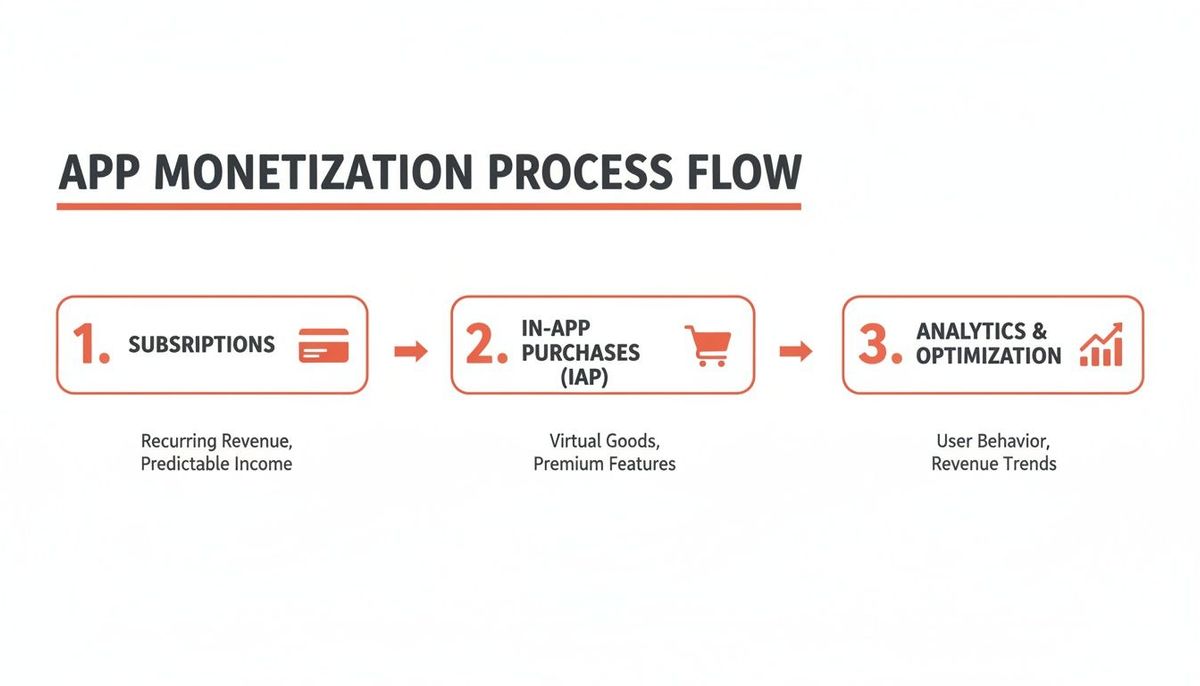
As this flow shows, monetization is a feedback loop. Subscriptions generate revenue and data, and analyzing that data tells you how to improve the app to attract even more paying customers.
Post-Launch Strategy and Key Metrics
Once your app is live on the stores, your job shifts from building to learning and optimizing. If you worked with a development partner to get here, this is also when you plan for a smooth handoff. A good partner won’t just dump the code on you; they’ll help you recruit, train, and transition to your own in-house team, making sure you have full ownership of your product's destiny.
From here on out, your success is measured by a handful of cold, hard numbers that prove you have real traction.
Your growth dashboard should revolve around these core metrics:
- Customer Acquisition Cost (CAC): How much do you have to spend in marketing to get one new user?
- Lifetime Value (LTV): How much revenue do you expect to generate from a single user over their entire time with your app? A healthy business needs LTV to be at least 3x higher than CAC.
- Retention Rate: What percentage of users come back week after week, month after month? This is the purest signal of product-market fit.
Tracking these metrics lets you make data-driven decisions that systematically grow your business. And the opportunity for growth is massive. The Asia Pacific region, for instance, is projected to see its music streaming market explode at a compound annual growth rate of around 14%. This is driven by rocketing smartphone adoption and rising incomes in countries like India and China.
Meanwhile, the more mature North American market, set to grow from $16.52 billion in 2024 to $44.14 billion by 2033, offers a proven playbook on monetization tactics you can adapt. You can read more about these compelling music streaming market projections on Technavio.com. A smart strategy is often a hybrid one: target high-growth regions for user acquisition while applying proven monetization patterns from established markets to maximize LTV.
Common Questions About Building a Music App
When founders decide to jump into the music streaming world, a few big, daunting questions always come up first. Tackling the costs, licensing, and technology can feel like staring up at a mountain, but getting straight answers is the only way to build a real business.
Let’s cut through the noise and address the most common concerns. Getting these right turns major roadblocks into manageable next steps and gives you a clear picture of the investment and strategy required to win.
How Much Does It Really Cost to Build a Music App MVP?
Let’s be direct: building a quality music app isn't cheap. The final price tag is a moving target based on feature complexity, platform choices, and who you hire to build it. It’s a serious financial commitment.
For a high-quality Minimum Viable Product built with a specialized US-based partner, you should be prepared for an investment between $150,000 and $750,000. This isn't just for code; this range typically covers the entire process of getting a revenue-ready product to market:
- Strategy & Validation: Nailing down the core user journey, figuring out what features are truly essential, and defining how you'll make money.
- UI/UX Design: Crafting an interface that feels intuitive and looks polished enough to compete.
- Full-Stack Development: This is the heavy lifting—building the frontend in React Native for both iOS and Android, plus the entire backend to power it.
- Key Integrations: Plumbing in the essentials like payment systems, analytics, and, of course, the music licensing APIs.
You’ll definitely see lower quotes from offshore teams, but a partner focused on business outcomes will get you to a monetizable product much faster. A great partner can also help with R&D tax credit documentation, which can sometimes slice 20-40% off the effective development cost.
What's the Fastest Way to Get Licensed Music?
Trying to negotiate directly with thousands of individual record labels and publishers is a non-starter for a startup. It's a logistical and financial black hole that will drain your runway before you write a single line of code.
The only practical approach is to partner with a B2B music-as-a-service provider. These companies offer APIs that plug you into massive, pre-licensed music catalogs.
This is the single biggest shortcut for a music startup. Instead of spending years and millions on legal fees, you integrate a fully legal, massive music library with a single API call. It's a game-changer for speed.
Companies like **7digital**, **Soundtrack Your Brand**, or **Audible Magic** have already done all the painful work. They manage the complex licensing deals, handle the reporting, and make sure royalties get paid. This frees you up to focus on the one thing that matters: building an incredible user experience.
Why Is React Native a Smart Choice for a Music App?
Choosing your tech stack isn't just a technical decision; it’s a business decision that directly impacts your budget, timeline, and ability to grow. For startups, React Native is almost always the right call.
The biggest win? You build for both iOS and Android from a single codebase. That efficiency is a massive strategic advantage right out of the gate.
Here’s why it’s such a good fit for a music app MVP:
- Cost and Speed: Building one app instead of two can slash your development time and costs by as much as 40-50%. You get to market faster on a smaller budget. It's that simple.
- Great Performance: For a modern streaming app, React Native’s performance is more than enough to deliver the smooth, native-like feel that users demand. The days of clunky cross-platform apps are long gone.
- Massive Ecosystem: The framework is backed by a huge community and a ton of third-party libraries. This means there are ready-made tools for audio playback, in-app purchases (like wrappers for RevenueCat), and backend integrations that seriously speed up development.
For any founder focused on getting the most out of every dollar and reaching the biggest possible audience with an MVP, React Native offers a clear competitive edge.
At Vermillion, we build revenue-ready mobile apps that prove traction and deliver ROI. Our performance-based model means our success is tied to your key metrics—we're not just developers, we're your product partner. Learn more about how we help funded startups launch and scale their mobile products.