The Real Costs of Making an App a Founder's Guide

So, what's the real number? How much does it actually cost to build an app?
The honest answer is that building a mobile app can cost anywhere from $40,000 for a lean MVP to well over $400,000 for a complex, market-defining product. It's a spectrum, and where you land depends entirely on your vision, your feature list, and—critically—the quality of the team you hire to build it.
What Are the Real Costs of Making an App?
Figuring out the true investment for your app is one of the first, most critical hurdles any founder has to clear. There’s no simple, one-size-fits-all answer because every single app is a unique beast.
Think of it like building a house. A straightforward, single-story office building has a vastly different budget than a custom-designed skyscraper with biometric security. In the same way, a basic content-delivery app is a fraction of the cost of a fintech platform that needs to handle real-time data, ironclad security, and regulatory compliance.
This is where so many early-stage founders get tripped up. Those generic online "app cost calculators" are notorious for spitting out misleadingly low numbers. They can't possibly account for the nuance of your business logic, the polish of your user experience, or the need to build something that can actually scale. They give you a number, but they don't give you a strategy.
Understanding the Investment Spectrum
To get your financial footing, you need to think in terms of complexity. Here’s a general breakdown based on what we see in the market:
- Simple MVP / Basic App: Typically falls between $40,000 and $100,000.
- Moderately Complex App: This range is usually $100,000 to $200,000.
- Highly Complex / Enterprise-Grade App: Prepare for an investment of $200,000 to $400,000+.
These are serious numbers, representing a huge capital outlay for any startup. To get a handle on how founders cover these expenses, it’s worth exploring the different startup funding sources available. The key is aligning your product roadmap with a smart funding strategy from day one.
App Complexity and Typical Investment Ranges
To give you a clearer picture, here’s a table that breaks down what you can generally expect at different levels of investment. It's a quick reference to help you benchmark your own project.
| App Complexity Level | Key Features | Typical Cost Range | Estimated Timeline |
|---|---|---|---|
| **Simple MVP** | Basic user login, static content display, simple navigation, single core feature. | **$40K - $100K** | 2-4 Months |
| **Moderate Complexity** | User profiles, social sharing, payment integrations, push notifications, basic admin panel. | **$100K - $200K** | 4-7 Months |
| **High Complexity** | Real-time data sync, custom animations, advanced security, third-party API integrations, complex backend. | **$200K - $400K+** | 7-12+ Months |
This table isn't gospel, but it's a solid starting point for conversations with potential development partners and investors. It helps ground your vision in financial reality.
Why a Realistic Budget Is Everything
Under-budgeting is one of the most common—and fatal—mistakes a founder can make. It can sink a brilliant idea before it ever has a chance to find product-market fit.
Getting your financial forecast right from the start allows you to:
- Align your roadmap with your runway. You can build the features that actually matter for validating your idea and attracting users, without running out of cash halfway through.
- Avoid cutting corners on quality. A rushed, underfunded app is a recipe for a terrible user experience, glaring security holes, and a mountain of technical debt you'll have to pay down later.
- *Plan for what comes after launch.* A smart budget doesn't just cover the initial build. It accounts for marketing, maintenance, server costs, and the next round of features.
The goal isn't just to launch an app; it's to launch a business. Your initial budget needs to reflect the investment required to build a stable, scalable, and ultimately profitable product that people will actually want to use.
When you start with a clear-eyed view of the potential costs, you empower yourself to make better decisions from day one. If you want to get a bit more hands-on, you can play around with our interactive app development cost calculator to see how different features impact the bottom line.
Decoding the Core Drivers of Your Development Budget
Every feature you want, every screen you sketch out, and every third-party service you plug in adds to the final bill. Getting a handle on these cost drivers is one of the most important things a founder can do.
Think of it like building a house. Are you using a standard blueprint and off-the-shelf materials? Or are you hiring a famous architect to design a custom masterpiece with imported marble and a full smart-home system? The choices you make at every stage—from the first wireframe to the final server architecture—compound.
Your job is to spot the "expensive" items on your roadmap early on. This lets you make smart trade-offs, ensuring your cash is going toward features that actually test your business model and deliver a real return.
The Foundation: UI/UX Design
Before anyone writes a single line of code, the user experience (UI/UX) design sets the stage for everything. This isn't just about making things look nice; it's about crafting an intuitive, logical journey for your users.
A complex design with custom icons, slick animations, and different paths for multiple user types is going to take a lot more time from senior designers.
For example, a simple, three-screen onboarding flow is pretty straightforward. But what if you want a dynamic, personalized onboarding that adapts to user input, complete with custom Lottie animations and variations for A/B testing? That can easily double or triple the design budget. The more bespoke and polished you go, the higher the upfront cost.
Building the Experience: Frontend Development
The frontend is everything the user actually sees and touches—the buttons, the layouts, the flow. This is where the design comes to life, and its cost is all about complexity and custom work.
- Standard vs. Custom: Using the built-in components from iOS, Android, or a framework like React Native is the most cost-effective route. If you want custom interactive charts, unique gesture controls, or complex data visualizations, you're going to need specialists and more hours.
- Animations and Transitions: Simple screen fades are quick. Physics-based animations that react to a user's touch or an intricate loading sequence? That's a different story, adding significant time and expense.
- Device and OS Support: Supporting the latest two versions of iOS and Android is standard practice. But if you need to support older operating systems or a huge range of screen sizes (especially on Android), the testing and development time shoots up.
This chart gives you a sense of how different feature sets scale the overall cost.
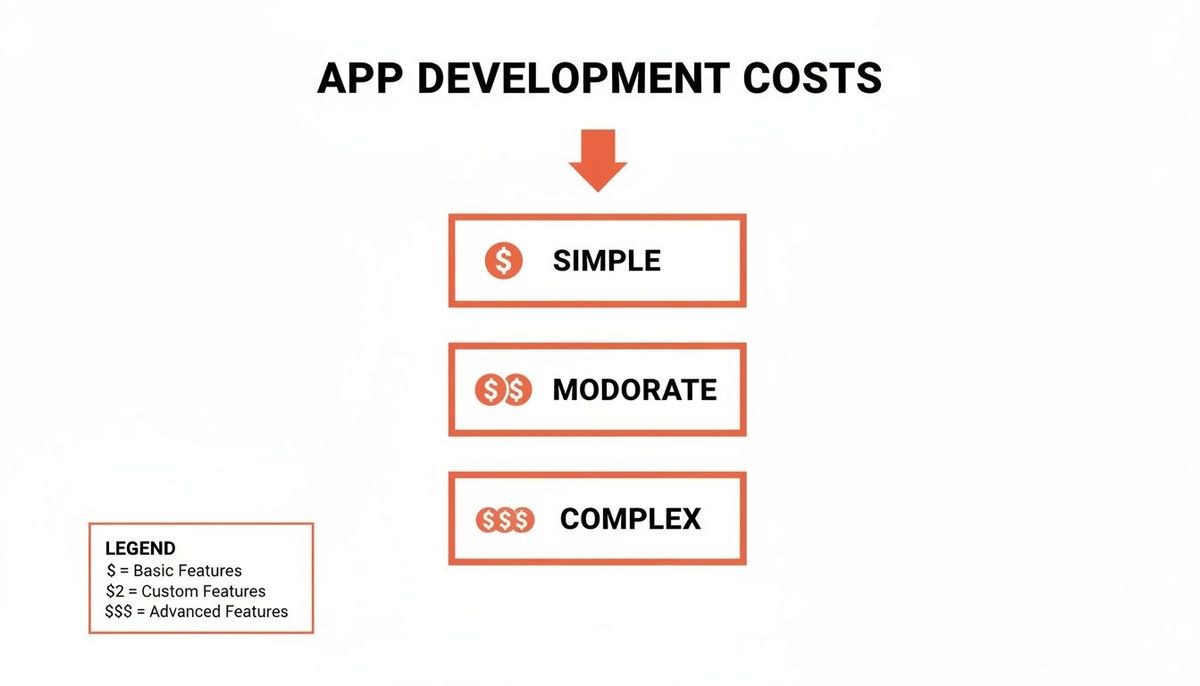
As you can see, the jump from a simple app to a complex one isn't just one or two big features. It's about layering on capabilities that require much more sophisticated engineering.
The Engine Room: Backend Architecture
The backend is the invisible engine that makes your app work. It manages user data, runs the business logic, and handles security and scale. A solid backend is non-negotiable for any app with ambitions to grow, and its complexity is a massive cost driver.
Think about user logins. A basic email and password system is relatively simple. But if your roadmap includes social sign-ins (Google, Apple), multi-factor authentication (MFA), and passwordless options, the backend logic gets way more complicated and expensive to build securely.
Backend complexity is often where unforeseen costs hide. A feature that seems simple on the surface, like real-time chat, requires a sophisticated backend infrastructure to handle messaging, presence indicators, and history, dramatically increasing the scope and budget.
Other backend factors that drive up the cost include:
- Custom APIs: Building your own APIs for your unique business logic is always more expensive than integrating with an existing third-party service that already does the job.
- Database Complexity: The way you structure your database can range from simple to mind-bendingly complex. If your app has intricate relationships between different pieces of data, expect the cost to reflect that.
- Admin Panels: A basic admin panel to manage users is standard. A feature-rich dashboard with analytics, content management systems, and moderation tools is practically a separate project in itself.
Uncovering the Hidden Costs Beyond the Initial Build
Launching your app is a milestone, not the finish line. That initial development budget gets you to day one, but the real financial commitment kicks in the moment your app is live. These recurring, and frankly, often underestimated expenses are what truly define the total cost of ownership.
Think of it like buying a high-performance car. The sticker price is just the first part of the story. To actually drive it, you’ve got to budget for fuel, insurance, regular maintenance, and the inevitable unexpected repairs. Ignoring these ongoing costs is a surefire way to run out of gas just when you're starting to pick up speed.

Planning for App Maintenance and Updates
Your app isn't a static product; it's a living thing that needs constant care. Operating systems evolve, new security holes are discovered, and third-party services push updates to their APIs. Without regular maintenance, your app will slowly degrade, break, and eventually become obsolete.
A solid rule of thumb is to budget *15-20% of your initial development cost annually* just for maintenance. For a $200,000 initial build, that means setting aside another $30,000 to $40,000 every single year. Over a typical 3-year product lifecycle, that initial $200k app could easily cost another $90,000 to $120,000** in maintenance alone.
This budget usually covers the essentials:
- OS Updates: Making sure your app doesn't break with new iOS and Android releases.
- Bug Fixes: Stomping out the issues that inevitably pop up as more users get their hands on your app.
- Dependency Management: Updating all the third-party libraries and frameworks your app relies on to stay secure and functional.
The Scaling Costs of Infrastructure
As your user base grows, so do your operational bills. The server setup that worked fine for your first 1,000 users will absolutely buckle under the load of 100,000. These are the "good problems" to have, but they come with a very real price tag.
Take the social portfolio app Cara, for example. It cost them about $2,000 per month to run before going viral. After a sudden user surge, their infrastructure bill from a single provider skyrocketed to $100,000 for just one week. That's how fast success can scale your expenses.
Your main infrastructure costs will include:
- Hosting: Monthly fees for cloud services like AWS, Google Cloud, or Vercel.
- Database Management: The cost to store and manage a growing mountain of user data.
- Content Delivery Network (CDN): Services that speed up image and video delivery to users around the world.
The most successful apps plan for growth from the start. Your financial model must account for infrastructure costs that scale directly with user activity, otherwise your own success could become your biggest liability.
Third-Party Services and API Subscriptions
Modern apps are rarely built in a vacuum. They're usually pieced together using a suite of specialized third-party services, and each one comes with its own recurring subscription fee. These tools save an immense amount of development time but add up to a significant monthly operational expense.
Here are a few common ones you'll run into:
- Payment Processing: Stripe takes a cut of every transaction.
- Mapping Services: Google Maps API bills you based on usage (map loads, route requests).
- Transactional Emails: Services like SendGrid or Postmark charge based on email volume.
- Push Notifications: Platforms like OneSignal have tiered pricing based on how many subscribers you have.
And it doesn't stop there. As you grow, unexpected compliance requirements can add even more to the bill. For instance, if you want to land enterprise clients, they’ll demand stringent security certifications like SOC 2. A founder needs to be aware of the costs involved, and this comprehensive guide on SOC 2 audit costs breaks it down. These are exactly the kind of hidden costs that can catch you by surprise if you haven't planned for them.
To illustrate these ongoing expenses, here’s a look at what you can expect to budget for annually after your app is live.
Typical Post-Launch Annual Operating Costs
| Expense Category | Estimated Annual Cost (as % of Initial Build) | Examples |
|---|---|---|
| **Maintenance & Updates** | **15-20%** | OS compatibility updates, bug fixes, security patches |
| **Cloud Infrastructure** | **5-10%** | AWS, Google Cloud, Vercel for servers, databases |
| **Third-Party APIs** | **3-7%** | Stripe, Google Maps, SendGrid, Twilio |
| **Monitoring & Analytics** | **2-4%** | Datadog, Mixpanel, Sentry for performance & user tracking |
| **Compliance & Security** | **1-5%** | Security audits (SOC 2, HIPAA), legal reviews |
These percentages show how quickly post-launch costs can stack up, often reaching 25-45% of your initial investment each year.
By building a financial model that reflects the entire product lifecycle, you're setting your startup up to navigate these recurring costs and build a truly sustainable business—not just a one-hit wonder.
Choosing Your Development Partnership Model
The partner you choose is just as important as the tech you build on. The way you structure that relationship—the engagement model—will fundamentally shape your project's outcome, budget, and timeline. It dictates how you handle changes, who shoulders the risk, and whether your incentives are truly aligned.
For a founder, getting this right is non-negotiable. The wrong model can drain your runway with disputes and misaligned goals. The right one accelerates your path to product-market fit. Understanding the trade-offs is the first step to building a partnership that actually works.
The Fixed-Price Model
The fixed-price contract always feels like the safest bet. You get a single number for a predefined scope of work, which seems perfect for budgeting. The deal is simple: you agree on a detailed feature list, and the development partner promises to deliver it for a set cost.
But that rigidity is its greatest weakness, especially for a startup. It forces you to know everything your app needs to be before a single line of code is written. In the real world, you learn from users and need to pivot. Any change to the original plan demands a formal change order—which means more negotiations, more money, and serious delays.
A fixed-price model incentivizes the development partner to deliver the exact feature list as quickly as possible—not necessarily to build the right product that achieves your business goals. This creates a natural tension when market feedback demands a change in direction.
The Time and Materials Model
A much more flexible approach is the time and materials (T&M) model. In this setup, you pay for the actual hours the development team puts in. This structure is built for agile development, allowing you to iterate, shift priorities, and adapt your product roadmap based on what you learn.
It's a model that fosters true collaboration. The development team becomes an extension of your own, working in sprints to build, test, and refine features. You have total control over the scope and can direct resources where they’re needed most.
The trade-off? Budget uncertainty. Without a fixed scope, the total cost isn't guaranteed, which can be nerve-wracking for a founder managing a tight runway. This model requires a high degree of trust and transparent communication with your partner to ensure every hour is spent effectively. For a deeper dive, check out our guide on how to hire mobile app developers and vet potential partners.
The Performance-Based Partnership
A performance-based model ties your partner’s success directly to your business outcomes. Instead of just paying for hours or features, a portion of their compensation is linked to hitting specific Key Performance Indicators (KPIs). For a growth-focused startup, this is the most strategically aligned model you can get.
Imagine your primary goal is to increase user retention by 20% in the first six months. In a performance-based model, your development partner shares in the upside if that goal is met or exceeded.
This completely transforms the relationship from a vendor-client dynamic to a true partnership. Your partner is no longer just building features from a list; they are actively invested in:
- Driving User Retention: Suggesting and building features that create a sticky user experience.
- Increasing Revenue: Optimizing the monetization funnel, whether through subscriptions or in-app purchases.
- Boosting Engagement: Focusing on core loops that keep users coming back.
This model ensures every decision is made with the end business goal in mind, making it a powerful choice for founders who need a partner focused on ROI, not just code.
Smart Strategies to Reduce App Development Costs
Building a high-quality app doesn't mean you have to burn through your entire seed round. The goal is capital efficiency—making every dollar work harder to prove your model and get you to the next milestone.
With a few strategic moves, you can seriously lower your build cost without touching the quality or scalability of your product. This isn't about building cheap; it's about building smart.

Embrace Cross-Platform Development
Building native apps means running two separate projects—one team writing Swift for iOS, another writing Kotlin for Android. You're effectively doubling your engineering payroll from day one. It's a huge cash drain.
Frameworks like React Native completely change the game. You build from a single codebase that runs on both platforms. This move alone can slash your platform-specific engineering costs by 40-50%.
This isn't just about the initial build, either. A single codebase means updates, bug fixes, and new features roll out everywhere at once. Your long-term maintenance overhead drops dramatically, letting a lean team keep pace with much larger competitors.
Launch with a Phased Rollout
Too many founders try to build their entire five-year roadmap for the version 1.0 launch. It’s a classic, costly mistake. The smarter, more capital-efficient path is a phased rollout that starts with a laser-focused Minimum Viable Product (MVP).
An MVP solves one core problem for one specific user, and it does it exceptionally well. This gets you to market months faster, lets you start collecting real user data, and stops you from sinking cash into features your customers might not even want.
- Actionable Example: Let's say you're building an e-commerce app. Instead of pouring months and money into a complex, AI-driven recommendation engine, launch with a simple, manually curated "Featured Products" section. See how users engage. The data you collect will tell you if a fancy algorithm is actually worth the investment. It’s all about de-risking your spend.
Use Off-the-Shelf Solutions Strategically
Not every line of code needs to be a custom-built masterpiece. For standard features, plugging into an existing third-party service is almost always faster, cheaper, and more reliable than building from scratch.
Think of it this way: you wouldn't build a power plant to run your office; you'd just plug into the grid. The same logic applies here.
Here's a quick guide on when to build vs. when to buy:
- Chat Functionality: Building real-time chat is a nightmare. Integrate a service like Sendbird or Twilio and have it working in days, not months.
- Authentication: Don't even think about building your own login and security system. Use proven, secure platforms like Auth0 or Firebase Authentication.
- Content Management: A custom admin panel is a time sink. Use a headless CMS like Sanity or Contentful to manage in-app content and get back to building what makes your product unique.
Maximize Financial Incentives
Beyond the tech stack, there are powerful financial levers you can pull. Many startups completely overlook government programs designed to reward innovation.
For instance, many countries offer generous tax incentives for R&D activities. If you're solving tough technical problems and can document the process, you could qualify for a substantial tax credit. We've seen this reduce a company's net development cost by 20-40%, putting cash right back on the balance sheet. To see if your project qualifies, you can learn more about R&D tax credits for software development. It's free money that extends your runway.
Common Questions About App Development Costs
Every founder wrestling with a new app idea eventually lands on the same set of questions about money. Getting straight answers is the only way to build a realistic budget and a roadmap that doesn't fall apart six weeks in. Let's tackle the big ones we hear all the time.
How Much Does an MVP App Cost to Build?
You can expect a Minimum Viable Product (MVP) to land somewhere between $75,000 and $200,000. The final number hangs on one critical question: what does "viable" actually mean for your business? An MVP isn't about being cheap; it's about being capital-efficient.
A $75,000 MVP is laser-focused. It might have simple user accounts and one core feature executed flawlessly. Think of a social app that only lets you create a profile and post one type of content. The goal here isn't to build a business; it's to prove a single, critical assumption without any distractions.
Pushing toward $200,000 means your MVP needs to test the business model itself, not just a feature. This usually involves more complexity—like secure payment processing with Stripe, a key third-party API integration, and a much more polished UI to make sure early adopters stick around. You're building the leanest possible version of your product that can actually start winning over your first real users.
A poorly built MVP can do more harm than good by giving you false negatives. Investing just enough to make the app stable, secure, and genuinely usable is the only way to get accurate feedback from the market.
Why Do App Development Quotes Vary So Much?
It's not uncommon to see quotes for the exact same project vary by a factor of five or more. It’s confusing, but the massive difference usually comes down to three things: who is doing the work, where they are, and what’s actually included in the proposal.
A low-ball quote might feel like a win, but it’s often a trap. These bids are notorious for leaving out critical services like project management, dedicated quality assurance (QA) testing, or any strategic guidance after launch. You end up with a parade of unexpected invoices and painful delays.
When you lay quotes side-by-side, you have to look past the final number. A premium partner’s quote is higher because it reflects a complete, battle-tested process.
- Location & Experience: A senior team in a major tech hub costs more than an offshore team for a reason. You're paying for market experience, which helps you avoid the costly mistakes they've already seen other companies make.
- Included Services: The higher number almost always bundles in product strategy, UI/UX design, full-stack development, and rigorous QA. It’s a plan for launch and beyond, not just a pile of code.
A higher initial quote that gets a revenue-ready product to market faster and more reliably almost always delivers a better long-term return.
Should I Get a Fixed Price for My App Project?
A fixed-price contract sounds safe, but for an innovative startup, it's usually a cage. To fix the price, you have to fix the scope—down to the last detail. This leaves zero room to pivot or adapt, which is the one thing a startup must be able to do.
The early days of a product are all about learning. What you think users want on day one is rarely what they actually need on day ninety. In a fixed-price world, every single change—no matter how small or critical—requires a formal change order. That means more paperwork, more delays, and more cost, effectively penalizing you for listening to your customers.
A more flexible model, like a retainer or a performance-aligned partnership, is almost always a better fit. It keeps the team focused on building what the market is asking for, not just checking boxes on a feature list that was obsolete a month after it was written.
How Does React Native Reduce Development Costs?
React Native is a massive lever for cost reduction because it lets you write your code once and deploy it on both iOS and Android. This "single codebase" approach basically cuts the platform-specific engineering work in half compared to building two separate native apps (one in Swift for iOS, another in Kotlin for Android).
The savings show up at two critical moments:
- The Initial Build: You avoid paying two different engineering teams to build the same features twice. This dramatically lowers your upfront cost and gets you on both app stores at the same time.
- Long-Term Maintenance: The efficiency continues long after launch. Bug fixes, updates, and new features only need to be written once, which means your ongoing maintenance costs are lower and a leaner team can manage the product.
For any founder managing a tight runway, this isn't just a small optimization. It's a strategic advantage that lets you reach your entire audience from day one without doubling your engineering budget.
Ready to build an app that drives real business outcomes? At Vermillion, we partner with funded startups to deliver revenue-ready mobile products fast. Our performance-based model ensures our incentives are aligned with your KPIs—like revenue, retention, and growth—so you get more than just code. Learn more at https://vermillion.agency.