Vermillion Insights
January 28, 2026 · Ken Vermeille · 19 min read
Decoding the Cost to Produce an App for Startup Founders
What's the real cost to produce an app? Our guide breaks down development costs, timelines, and smart budgeting strategies to maximize your startup's ROI.
So, what's the real cost to produce an app? If you're looking for a market-ready first version, you should plan for a budget somewhere between $80,000 and $250,000+.
Forget those simplistic online cost calculators. They’re notorious for missing the hidden complexities that really drive the final price tag. The best way to approach this is to stop thinking of it as a cost and start seeing it as an investment in a revenue-generating asset. That mental shift is the first step toward building something that lasts.
Understanding The Financial Snapshot of App Production
Thinking about the cost to produce an app is a lot like planning a construction project.
A simple, single-function app? That’s like building a garden shed. It serves a basic purpose with a minimal investment. But creating a scalable, feature-rich product is more like constructing a commercial building - it has to be designed for heavy traffic, top-notch security, and future expansion. Each one requires a completely different level of planning, materials, and expertise, which directly shapes the budget.
This overview gives you a clear financial snapshot of what to expect based on your project's scope.
App Costs By Complexity
Industry data consistently shows that the investment grows right alongside an app's complexity. For a startup looking to launch a revenue-ready app - complete with a backend, payment processing, and essential features like push notifications - you're typically looking at a 4-9 month timeline. This puts it squarely in the mid-complexity range.
Recent analyses put these projects anywhere from $80,000 to $250,000 for the first version. That figure isn't just for coding; it includes the crucial phases of strategy, design, and testing that make or break a product.
This bar chart gives you a quick visual of the typical starting costs.
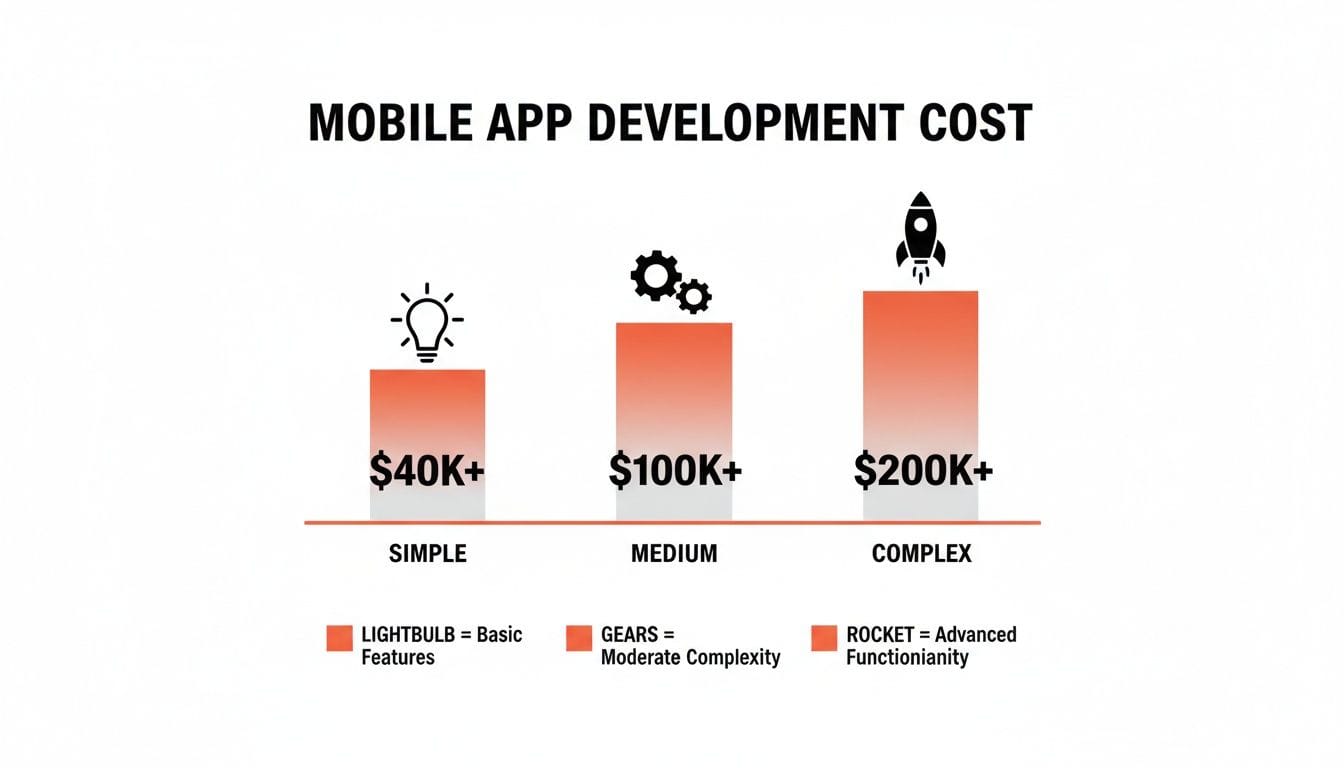
As you can see, the financial leap from a simple proof-of-concept to a complex, scalable product is substantial. This is exactly why a detailed, realistic budget is non-negotiable from day one.
To help you get a clearer picture, here’s a table breaking down what you can expect at different levels of complexity.
App Production Cost and Timeline by Complexity
| App Complexity | Typical Cost Range | Estimated Timeline | Example Features |
|---|---|---|---|
| Simple (MVP) | $40,000 - $80,000 | 2-4 Months | Basic user login, simple profiles, static content display, single-function focus. |
| Medium (Market-Ready) | $80,000 - $250,000 | 4-9 Months | API integrations, payment processing, push notifications, user-generated content, admin panel. |
| Complex (Enterprise-Grade) | $250,000+ | 9+ Months | Real-time data sync, machine learning features, custom analytics, multi-role access, advanced security. |
This table highlights how features directly translate into time and money. The more sophisticated the app, the more resources it will require to build, test, and launch successfully.
Actionable Insight: Budget an additional 15-20% of your initial development cost as a contingency fund. I can't stress this enough. If your budget is $100,000, set aside an extra $15,000. This buffer is your safety net for unexpected scope changes, technical hurdles, or market feedback that forces a quick pivot.
And remember, the initial build is only part of the financial story. Post-launch maintenance - covering bug fixes, OS updates, and quality assurance - will typically cost you 15-25% of the original production cost, year after year. For a $150,000 app, that means planning for an additional $22,500 to $37,500 annually just to keep it running smoothly.
For a more granular breakdown of where that money goes, check out our guide on the average cost to develop an app.
The Five Key Factors Driving Your App Development Cost
Now that we've got a ballpark financial range, let's pull back the curtain on why those numbers are what they are. The final cost to produce an app isn't just a number pulled out of thin air; it’s a direct result of the choices you make across five critical areas.
Getting a handle on these factors is the key to making smart, strategic decisions that line up with both your budget and your ultimate business goals.
Think of it like building a car. A basic sedan will absolutely get you from point A to point B. But once you start adding a high-performance engine, a luxury leather interior, and advanced self-driving features, the price tag is going to climb - fast. App development is no different. Every single choice has a direct impact on the final invoice.
1. Feature Complexity and Scope
Without a doubt, the single biggest driver of your app's cost is the complexity of its features. A "simple" feature and a "complex" one might sound similar on paper, but the difference in development hours can be astronomical.
For instance, building a basic blog feed that just shows static text and images is pretty straightforward. But what about a real-time chat function? One with media sharing, read receipts, and end-to-end encrypted messaging? That requires a massive amount of engineering effort, which translates directly into higher costs.
Here’s a practical way to think about it:
- Simple Feature: A user profile page where someone can edit a few text fields. (Est. 20-40 hours of work)
- Complex Feature: A social feed powered by a custom algorithm that personalizes content for every single user. (Est. 200-400+ hours of work)
Actionable Insight: When defining your MVP, use the "one-job" rule. Does this feature help the user accomplish their primary goal? If not, move it to the "Phase 2" list. This ruthless prioritization is the best way to control costs.
2. Platform and Technology Stack
Your choice of technology has huge financial implications, not just for the initial build but for the long haul of maintenance and updates. The biggest decision you'll make here is whether to build "natively" for each platform (one app for iOS, a separate one for Android) or to use a cross-platform framework.
Building native apps means your team is writing two completely separate codebases. You're essentially paying to build the app twice. While this can squeeze out every last drop of performance, it's rarely the most efficient path for a startup trying to get off the ground.
A cross-platform framework like **React Native lets developers write the code once and deploy it on both iOS and Android. This approach can slash initial development costs by up to 40%** by sharing a single codebase, which also gets your product to market much faster.
This is a massive strategic lever for founders. Choosing something like React Native means you can launch on both the App Store and Google Play faster and with a much more manageable budget - a critical advantage when you need to validate your idea in the real world.
3. Design and User Experience (UI/UX)
Exceptional design is what separates an app people tolerate from an app people love, but that quality comes at a price. The level of polish and customization you want for your user interface (UI) and user experience (UX) is a direct line item on the project budget.
A template-based design uses pre-built components and layouts. It's a fast and affordable option, perfect for an early-stage MVP. On the other hand, a fully custom design with unique animations, perfectly crafted user flows, and a distinct brand identity requires specialized design talent and a lot more time on the clock.
Practical Example: For an MVP fitness app, using a standard UI kit for buttons and menus might cost $5,000. Designing custom, animated progress charts and a unique gamified interface could easily cost $25,000+. The custom route can boost engagement, but you must validate that it's worth the initial investment.
4. Backend Infrastructure
The backend is the engine of your app. It's everything that happens behind the scenes - data storage, user authentication, payment processing, and all the server-side logic that makes the magic happen. The complexity and scalability of this infrastructure are major cost factors.
A simple backend might just need to handle a basic user login system. Contrast that with a scalable backend for a marketplace app, which has to juggle thousands of simultaneous users, process payments securely, and manage incredibly complex database interactions without breaking a sweat.
Practical Example: A recipe app that only displays static content might use a simple, low-cost backend service. But a ride-sharing app needs a highly complex backend that tracks user locations in real-time, calculates fares, and manages driver availability - a significantly larger and more expensive undertaking.
5. Team Composition and Location
Finally, the who and where of your development team play a massive role in the final price. A solo freelancer working out of a region with a lower cost of living will charge dramatically less than a specialized, US-based agency that comes with a full team of project managers, designers, and engineers.
Here’s a rough breakdown of how the options stack up based on a typical project:
- Freelancers ($15-$75/hr): Most affordable, but you're now the project manager. High risk if the scope is complex.
- Small Agencies ($75-$150/hr): A great balance of cost and expertise. They offer a team and a process without the enterprise price tag.
- Large Agencies ($150-$300+/hr): Highest cost, but they offer a comprehensive, battle-tested process for large-scale projects.
Actionable Insight: When evaluating agencies, ask for their team's average "blended rate." This single number, which averages the cost of designers, developers, and project managers, makes it much easier to compare the true cost of different partners apples-to-apples.
Breaking Down Costs from MVP to Full-Scale Product
One of the biggest questions founders have is, "What will this app actually cost?" The truth is, it’s not a single number. It’s a journey. You don’t pay for a finished app upfront any more than you'd pay for a fully-built house before anyone has even poured the foundation.
Building an app is a phased investment that grows as your idea matures from a lean, focused Minimum Viable Product (MVP) into a full-scale, feature-rich product. Understanding these phases demystifies the budget and gives you a real financial roadmap.
The Four Core Phases of App Production
Think of it like building that house. You start with blueprints, lay a solid foundation, do the construction, and finish with inspections and walkthroughs. App development follows a nearly identical path, ensuring you don't waste time or money building something that's unstable or that no one wants.
Here’s how the investment typically breaks down at each stage:
- Discovery and Strategy ($10,000 - $25,000): This is your blueprint phase. It’s where you dig into market research, size up the competition, define your ideal user, and lock down the core feature set. Skipping this is like building without a plan - it almost always leads to expensive changes and delays down the road.
- UI/UX Design ($10,000 - $35,000): With a clear strategy, designers get to work creating the app's look, feel, and flow. This isn't just about pretty colors; it's about building an intuitive experience through wireframes, mockups, and clickable prototypes. This is where you figure out if the app is actually easy to use before a single line of code is written.
- Development and Engineering ($50,000 - $140,000+): This is the heavy lifting - the actual construction. It's the longest and most expensive phase where developers build the frontend (what users see and touch) and the backend (the servers, databases, and APIs that make it all work). The cost here is a direct reflection of your feature complexity.
- Testing and Deployment ($10,000 - $35,000): Before you pop the champagne, the app goes through rigorous Quality Assurance (QA). Testers hunt down bugs, fix crashes, and ensure everything is stable, secure, and fast. Only then is it submitted to the Apple App Store and Google Play Store.
Uncovering the Hidden Costs
So many founders get blindsided by this. The upfront development cost feels like the finish line, but it’s really just the starting gun. The ongoing costs that come after launch are just as important for your app's long-term health and success.
Crucial Insight: Your post-launch budget is just as important as your development budget. A good rule of thumb is to plan for annual maintenance and operational costs to be 15-25% of your initial build investment. For a $150,000 app, that means setting aside $22,500 to $37,500 every year.
What are you paying for? It's not just sitting there. Ongoing costs usually include:
- Third-Party API Fees: Using services like Google Maps for location features, Stripe for payments, or Twilio for messaging isn't free. They come with monthly subscriptions or usage-based fees.
- Server and Hosting Costs: Your backend needs a home. Services like AWS or Google Cloud host your app's brain, and as your user base grows, so will these costs.
- Post-Launch Maintenance: This is non-negotiable. It covers fixing bugs that pop up, updating the app for new iOS and Android versions, patching security holes, and just generally keeping the lights on.
From a $150K MVP to a $400K Full-Scale Product
Let’s put this into practice with a hypothetical wellness app. The founders have a great idea and a starting budget of $150,000. That’s enough to build a solid MVP with the essentials: user accounts, a library of guided meditations, and a simple subscription system.
They launch, get traction, and prove the concept. Now they’ve secured another round of funding to build out their full vision. The budget expands to $400,000+. This new investment goes toward advanced features like personalized workout plans, live-streaming classes with instructors, community forums, and integrating with wearables like the Apple Watch.
Want to play with the numbers for your own idea? Our app development cost calculator can help you model a few different scenarios.
The cost to build a serious app, especially one with complex features like AI, is a reflection of the hundreds - often thousands - of expert hours required. It's not uncommon for AI-powered mobile apps to cost between $80,000 and $350,000+ and take 6-12 months to build. That investment isn't just for code; it's for the strategy, design, and engineering that turns a simple idea into a valuable, scalable business. This phased approach lets you prove your concept and gather real feedback before you go all-in, investing in growth with confidence.
Choosing the Right Development Pricing Model

Picking the right engagement model with your development partner is one of the most important decisions you'll make. This isn't just about how you'll pay for code; it's about structuring a partnership that either drives you forward or holds you back.
The wrong model creates friction, misaligned goals, and budget nightmares. The right one? It builds a relationship where everyone is pulling in the same direction. Your partner's success becomes tied to your success.
Let's break down the three main ways these deals are structured so you can figure out what makes sense for your startup.
The Fixed Price Model
A Fixed Price model is exactly what it sounds like. You agree on a single, locked-in price for a very specific scope of work. Think of it like commissioning a custom table. You and the woodworker agree on the exact design, materials, and final price before a single piece of wood is cut.
This approach gives you total budget predictability, which is a huge relief for founders watching every dollar. But its greatest strength is also its biggest weakness: it’s incredibly rigid. If you get feedback from early users and need to change a feature, you’re looking at a formal change request and more money. It kills your ability to adapt.
The Time and Materials Model
With a Time and Materials (T&M) model, you pay for the actual hours your development team works, plus any direct costs for tools or services. It’s like hiring a contractor to renovate your kitchen at an hourly rate. You have complete freedom to change the design on the fly, but you won't know the final cost until the job is done.
T&M gives you maximum flexibility, which is perfect for projects that need to evolve based on real-world feedback. The catch is the budget risk. Without obsessive management, costs can easily spiral. The model also incentivizes billable hours, not necessarily efficient results.
The Performance-Based Model
The Performance-Based model is a modern approach that ties a chunk of the development cost to hitting specific business goals - Key Performance Indicators (KPIs). Instead of just paying for a list of features, you’re paying for actual outcomes. This model makes your development agency a true partner in your success.
Imagine an agency where part of their pay is tied to your app hitting a 20% user retention rate three months after launch. Or maybe they get a bonus when you reach $15,000 in Monthly Recurring Revenue (MRR). Their entire focus shifts from just shipping code to building a product that actually works in the market.
Practical Example: A startup building a subscription meditation app could tie a performance deal to Customer Lifetime Value (LTV). The development partner might take a lower upfront fee, but earn a significant bonus if the app achieves an average LTV of $100 within six months. This pushes them to build features that not only attract new users but keep them subscribed for the long haul.
So, how do you decide? Each model offers a different balance of risk and reward. This table lays out the core trade-offs.
Comparison of App Development Engagement Models
| Model | Budget Predictability | Scope Flexibility | Incentive Alignment | Best For |
|---|---|---|---|---|
| Fixed Price | High | Low | Misaligned (Incentivizes speed over quality) | Small, well-defined projects with zero ambiguity. |
| Time & Materials | Low | High | Neutral (Incentivizes hours over outcomes) | Agile projects with evolving requirements. |
| Performance-Based | Medium | High | Aligned (Incentivizes business results) | Startups focused on traction, ROI, and growth. |
Ultimately, choosing the right model is about balancing your need for a predictable budget against your need to stay flexible and adapt to the market. While the old-school models have their place, a performance-based partnership offers a serious edge for startups where user growth and market validation are everything.
Finding the right mobile app developers who are confident enough to share the risk and align their incentives with yours can be an absolute game-changer for your startup.
Smart Ways to Lower Your App Production Costs
Figuring out how much an app costs is only half the battle. The other half is making your budget work harder for you. For any founder, every dollar is precious. Making the right calls early on can dramatically cut your burn rate without sacrificing the quality of your final product.
Forget about cutting corners on mission-critical stuff like design or security. The truly smart approach is to focus on high-impact strategies that optimize for efficiency. We've found that three areas, in particular, deliver the biggest savings: choosing the right tech stack, taking advantage of financial incentives, and adopting a smarter development lifecycle.
Embrace Cross-Platform Development
One of the single most effective ways to get your budget under control is to build with a cross-platform framework like React Native. This approach lets your team write one codebase that runs beautifully on both iOS and Android. You're essentially building two apps for the price of one. It’s a massive win that immediately slashes your development timeline and costs.
To put it in perspective, building two separate native apps could easily push your budget into the $100,000 to $250,000+ range - for each platform. In contrast, a cross-platform build for a complete, revenue-ready MVP typically lands somewhere between $20,000 and $150,000, according to recent industry analysis. The efficiency gain means you can launch faster, test your idea on a much wider market, and save your capital for growth.
Claim R&D Tax Credits
This is a big one that so many startups miss. R&D tax credits are a powerful financial tool that can directly refund a chunk of your app production cost. Many countries offer these government incentives to encourage innovation. If your app involves solving unique technical hurdles or creating new technology - and most do - a huge portion of your development expenses could qualify.
These credits can slash your effective development cost by 20-40%. For a $150,000 project, that’s a $30,000 to $60,000 cash refund or tax reduction. That's game-changing, non-dilutive funding for any startup.
Actionable Insight: Start documenting from day one. Create a dedicated folder in your project management tool for "R&D Evidence." Each week, have your lead developer write a short paragraph outlining the technical challenges they faced and how they experimented to solve them. This creates an invaluable paper trail when it's time to file.
Prioritize Phased Development with an MVP
Finally, the most successful founders I've worked with don’t try to build their entire grand vision from day one. They start with a laser-focused Minimum Viable Product (MVP). An MVP isn't a cheap or half-baked version of your app; it's a strategic weapon designed to test your core business assumption with the smallest possible investment.
This phased approach has some serious financial upsides:
- Reduces Initial Outlay: You pour your entire budget into the one or two features that deliver real value to your very first users. Nothing more.
- Validates Your Idea: It lets you get real-world feedback from actual users before you sink a bigger budget into features nobody actually wants.
- Attracts Investment: A successful MVP with proven user traction is the single most compelling asset you can walk into a VC pitch with.
By starting small and building incrementally based on real data, you make sure that every single dollar you spend is moving you closer to a product the market truly needs. And once you're live, remember that **mastering cloud cost management** is another key piece of the puzzle for controlling your ongoing expenses and staying profitable.
Your Checklist for Budgeting and Selecting a Partner
Turning an app idea into a real, market-ready product comes down to careful planning and picking the right team. This isn't just about code; it's about making a smart investment that lines up with your business goals. Think of this checklist as your roadmap.
Follow these steps. They’ll bring clarity to the real cost of building an app and help you find a partner who can actually deliver.
Creating Your Budget
Before you even think about talking to development shops, you need to get your own house in order. That means understanding your requirements and, just as importantly, your financial limits. A huge part of this is getting your projections right; a solid grasp of software development cost estimation will save you from nasty surprises down the road.
It all starts with defining what winning looks like for you.
- Define Clear Business Goals: What’s the point of this app? Seriously. Is it to hit $10,000 in Monthly Recurring Revenue (MRR) in six months? Is it to get 50,000 users in the first year? Or is it simply to validate a core concept so you can raise your next round of funding? Your goals drive your priorities.
- Create a Prioritized Feature List: This isn't a wish list. It's a strategic document that focuses your money where it matters most. Split your features into two buckets:
- Must-Haves: These are the absolute, non-negotiable features for your MVP. If you're building a meditation app, this is user accounts, a library of audio files, and a basic way to subscribe. That's it.
- Nice-to-Haves: These are the features you can build in phase two. Think live sessions, community forums, or advanced analytics. Pushing these down the road is one of the single best cost-saving moves you can make.
Vetting Potential Partners
Okay, with a clear plan in hand, you’re ready to find the team to build it. It's time to ask the questions that get you past the slick sales pitch and show you how a partner really works.
- Process and Communication: How do they run their projects? Ask what tools they use - Jira, Slack, Asana? More importantly, how often will you see progress and get updates? A good partner will offer weekly demos and a shared channel for communication. You want transparency, not radio silence.
- Pricing and Engagement Models: Are they stuck on a rigid Fixed Price model, or are they willing to explore a more flexible partnership, like a Performance-Based model? Ask them point-blank how their incentives align with your business goals.
Key Question: "Can you share a case study of a past client where your work directly led to a measurable business outcome, like a 30% increase in user retention or hitting a specific revenue target?"
- Past Work and Expertise: Don't just glance at their portfolio. Ask to see apps they've built that are live right now on the App Store or Google Play. Look for real experience in your industry or with the specific tech you need, like React Native if you're aiming for a cross-platform build.
Still Have Questions About App Costs?
Even with the best plan in the world, a few key questions always seem to pop up once the initial numbers are on the table. Founders need straight answers to the real-world financial questions that come up during the build. Let's tackle the ones we hear the most.
How Much Is This Going to Cost Me After Launch?
Here’s a hard truth many founders learn too late: launching your app is the starting line, not the finish line. One of the biggest mistakes you can make is forgetting to budget for what comes next. Ongoing maintenance isn't optional - it's what keeps your app secure, working on new phones, and compatible with the latest OS updates.
A solid rule of thumb is to budget 15-25% of your initial development cost, per year, for maintenance. If you spent $150,000 to build your app, you should plan on spending $22,500 to $37,500 annually to keep it healthy.
Practical Example: This annual budget covers server costs (e.g., $500/month on AWS), third-party API fees (e.g., $200/month for map services), and a retainer for your developers (e.g., 20 hours/month) to fix bugs and deploy critical OS updates. It's an operational expense, just like rent.
Can I Actually Build a Real App for Under $50,000?
Yes, you absolutely can. But you have to be ruthlessly strategic. A budget under $50,000 puts you squarely in Minimum Viable Product (MVP) territory. You can build a sharp, focused app that solves one core problem for one specific type of user.
Actionable Insight: To hit this budget, focus on a single platform (like iOS first), use a template-based UI design, and leverage off-the-shelf backend services instead of building a custom one. This approach gets you to market fast to prove your concept before investing more heavily.
How Much Does Adding AI Jack Up the Price?
Strap in, because integrating artificial intelligence or machine learning will significantly increase your build cost. It's not just code; it's a whole different discipline that requires highly specialized - and very expensive - engineers. You also need a more robust backend and the infrastructure to handle all that data.
Adding a feature like a recommendation engine, a chatbot that understands natural language, or image recognition can easily add $50,000 to $150,000+ to your total. The price tag grows with the complexity of the AI model and how much data you need to feed it to make it smart.
Why Do People Say a React Native App Is Cheaper?
React Native is a game-changer for cost control because it lets developers build your app from a single codebase that works on both iOS and Android. Instead of paying one team to build an iPhone app and another team to build an Android app, you pay one team to build one app.
This "write once, deploy anywhere" model can slash your initial development costs by up to 40%. The savings don't stop there, either. Every time you need to push an update, you're only managing one set of code, which saves a ton of time and money over the entire life of the app.
At Vermillion, we don't just build apps - we build revenue-ready products designed to prove traction and deliver ROI. Our performance-based model means we only win when you do. Let's talk about building your app.
Keep reading
See all →
March 22, 2026
Unlocking Revenue Your Guide to Price Tier Strategy

March 21, 2026
Your Guide to Flawless Stripe Subscription Management

May 14, 2026
Fractional Mobile Engineering vs. Full-Time Hiring in 2026
The mobile engineering talent market has shifted dramatically over the past two years. Budgets are tighter, AI tools have changed what a sin...
March 20, 2026
Recurring Billing With Stripe a Guide for Subscription Apps
Master recurring billing with Stripe. This guide covers everything from setup and server logic to webhooks and churn reduction for subscript...
March 19, 2026
Unlocking Growth with Mobile App Retention Metrics
Discover the mobile app retention metrics that directly fuel MRR growth. This founder's guide offers actionable strategies to track, analyze...