Vermillion Insights
January 11, 2026 · Ken Vermeille · 18 min read
App Development Project Management: A Practical Founder's Guide
Master app development project management with a founder-friendly guide. Learn practical tips on scoping, sprints, KPIs, and a successful app launch.
App development project management is really just a structured way of taking an idea and turning it into a real, live application without the wheels falling off. It's about getting everyone on the same page, defining what you're actually building, managing your team, and dodging the curveballs that will inevitably come your way - all while staying on time and on budget.
A disciplined kickoff and discovery phase is where you win or lose the game before it even starts.
Laying the Groundwork for a Successful Launch
The first couple of weeks on any app project are everything. A strong start doesn't just set the tone; it builds the foundation for the entire build. Forget the generic advice - this phase is about turning a brilliant idea into a concrete plan that gets every single stakeholder, from the CEO down to the junior engineer, laser-focused on the same business goals.
We call this the kickoff and discovery phase, and it’s where you prevent future disasters like scope creep, blown budgets, and missed deadlines. This is where the magic happens, turning a vision into a set of technical requirements your team can actually execute on. Done right, you’ll have a single source of truth that guides every single decision from here on out.
Aligning on Core Business Objectives
Before anyone even thinks about writing a line of code, you have to define what a "win" looks like in pure business terms. We need to move past fuzzy goals like "increase user engagement" and get brutally specific.
For instance, a health tech startup we worked with defined success as hitting a 15% Day 30 user retention rate and a Lifetime Value (LTV) of $50 within six months of launch. That kind of clarity is gold. It informs every single decision that follows, from which features get prioritized to how the UX is designed.
Actionable Insight: Frame every feature discussion around your core metric. When someone suggests adding a social sharing feature, the immediate question should be: "Based on our data and user research, how will this directly contribute to increasing our 15% Day 30 retention?" This forces objective, data-driven conversations.
Running Practical Discovery Workshops
To get everyone aligned, you need structured workshops. These aren't just fluffy brainstorming sessions; they're focused exercises designed to pull out critical information and build a shared understanding.
Two workshops I never skip are:
- User Persona Workshops: Stop guessing who your users are. Build them. For a music discovery app, you might define "Alex the Casual Listener," who just wants a great playlist for his commute, and "Chloe the Power User," who craves deep analytics on emerging artists. These personas become the lens through which you see every feature.
- User Journey Mapping: This is basically storyboarding the main path a user takes. For Alex, the journey might be: Open App → Tap 'Daily Mix' → Save Song to Library. This simple flow instantly tells you the absolute core functionality needed for an MVP. Before you go too deep here, make sure you've already figured out how to validate your startup idea to confirm you're building something people actually want.
This flowchart gives you a high-level view of how we move from that initial discovery into design and then into the actual development sprints.
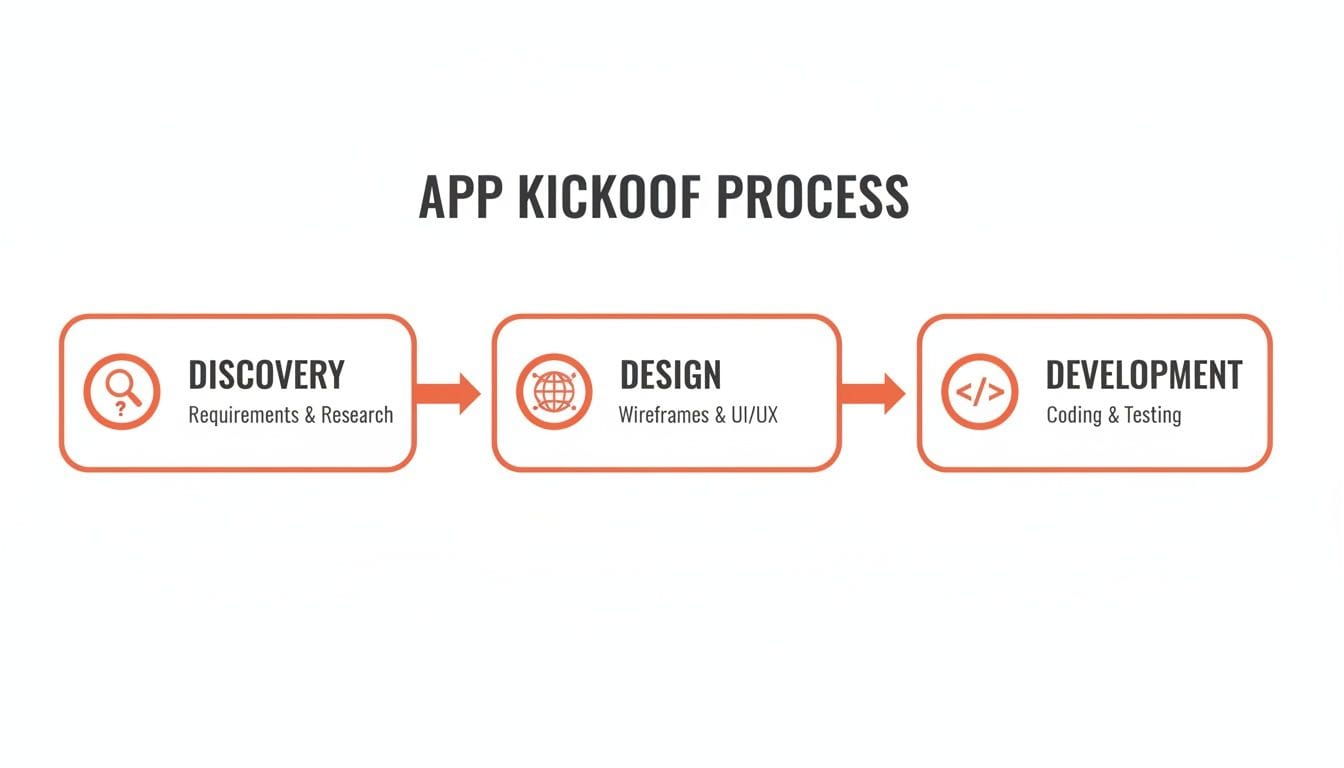
You can see how each phase logically builds on the last. That's why a thorough discovery is non-negotiable if you want a smooth development cycle.
Creating Your Single Source of Truth
The outputs from these workshops - the personas, user journeys, and hard business goals - all get compiled into a Product Requirements Document (PRD). This document becomes the constitution for your project.
A well-crafted PRD is your ultimate weapon against scope creep. It’s the objective reference point you can pull up when a shiny new idea emerges, forcing the team to ask, "Does this feature directly help us hit our $50 LTV goal?"
Laying this foundation properly means asking the right questions from day one, which includes thinking about quality assurance early. It's worth reviewing some essential questions for QA when kicking off a new project to get your head in the right space.
Based on our experience across hundreds of projects, a realistic timeline for a well-planned mobile app looks something like this: Discovery & Planning takes 2-3 weeks, Design & Architecture spans 4-6 weeks, and core Development for a solid MVP takes about 12-16 weeks, followed by 4-6 weeks of Testing & Refinement. This puts you in the 22-31 week range from concept to a polished launch.
Defining Your MVP to Prove Market Traction
For any startup, the race to market is relentless. I've seen countless founders fall into the same trap: trying to build their perfect, feature-complete dream app right out of the gate. It's a noble ambition, but it burns through cash and time, often leading to a product that does a lot of things okay but nothing exceptionally well.
This is where disciplined app development project management isn't just a process; it's a survival strategy.
The solution is the Minimum Viable Product (MVP). But let's be clear: an MVP isn't a cheap or buggy version of your app. It's a strategic weapon designed to validate your core business idea with the least amount of capital. It exists to answer one brutal, essential question: "Have I built something people will actually pay for?"
This process forces you to make tough calls. You have to separate the absolute, revenue-generating essentials from the "nice-to-haves" that can wait for V2. Getting this right is the difference between proving market traction in a few months and running out of runway before you even get off the ground.
The Value vs. Effort Matrix
To get from a sprawling list of ideas to a laser-focused MVP scope, you need an objective framework. The Value vs. Effort matrix is a simple but incredibly powerful tool for this. You just map every potential feature against two axes: the business value it delivers and the technical effort required to build it.
- High Value, Low Effort: These are your quick wins. They form the absolute core of your MVP because they deliver maximum impact for minimal investment.
- High Value, High Effort: These are your big, strategic features. You'll likely need one or two in your MVP to solve the core problem, but you have to be ruthlessly selective.
- Low Value, Low Effort: These are tempting because they're easy, but they just add clutter and distraction. Push them to the backlog.
- Low Value, High Effort: These are the features that kill startups. Avoid them like the plague.
A Real-World Example: A Subscription Marketplace App
Let's say you're building a marketplace connecting users with curated subscription boxes. Your initial brainstorm is probably a mile long: a complex recommendation algorithm, social sharing, user reviews, a personalized onboarding quiz... the works.
This is where the Value vs. Effort matrix brings immediate clarity. What is the single most critical thing a user needs to do? They need to discover a box, sign up for a subscription, and pay for it. Period. Everything else is secondary to proving that core transaction works and people want it.
Here’s a practical way to visualize this decision-making process.
MVP Feature Prioritization Matrix Example
| Feature | Business Value (1-5) | Development Effort (1-5) | Decision (Include in MVP?) |
|---|---|---|---|
| User Authentication (Email/Pass) | 5 | 2 | Yes (Quick Win) |
| Browse & Search Boxes | 5 | 3 | Yes (Core Epic) |
| Stripe Subscription Checkout | 5 | 4 | Yes (Core Epic) |
| AI-Powered Recommendations | 4 | 5 | No (Postpone) |
| User Reviews & Ratings | 3 | 3 | No (Postpone) |
| Social Media Sharing | 2 | 2 | No (Tempting but low value) |
This simple chart makes the path forward obvious. Your MVP is focused on just three things: authentication, browsing, and payments. These are the absolute essentials for generating revenue and validating your idea.
Of course, estimating development effort and cost is a challenge in itself. To get a clearer picture of the resources required for each feature, you can find more detail by using an app development cost calculator. It helps turn those abstract "effort" scores into tangible budget estimates.
Your Core MVP Feature Checklist
Following this disciplined approach, your initial feature set should be lean and purposeful. The goal is to get a functional product that solves a core problem into the hands of real users as fast as humanly possible.
Your MVP isn't about the number of features you launch with. It's about how quickly you can start the feedback loop with your target market. Get the product into their hands, measure what they do, and learn.
Here’s a practical checklist that applies to most consumer apps:
- Secure User Authentication: Users have to be able to sign up and log in securely. This is non-negotiable.
- One Critical User Flow: The single most important journey a user takes to get value. Think booking a session, making a purchase, or creating a post.
- Payment Integration: If your model relies on revenue, you must be able to accept payments from day one. Services like Stripe or RevenueCat are the standard here.
- Basic Analytics: You need to track key events and user behavior. Without data, you're just guessing if your core assumptions are correct.
Running Sprints That Actually Deliver Results
Once you've defined a lean, high-impact MVP, the game shifts entirely to execution. This is where the rubber meets the road, turning your prioritized feature list into tangible, working software through a disciplined rhythm known as a sprint. Real app development project management isn't about rigid, top-down commands; it's about creating a predictable cadence that empowers your engineering team to ship consistently.
For most startups we work with, a two-week sprint is the sweet spot. It’s just long enough for engineers to build meaningful functionality but short enough that you can adapt to feedback without derailing the project. This cycle is a structured process with clear ceremonies designed to maximize focus and accountability, pushing your project forward in measurable chunks.
The Anatomy of an Effective Sprint
Each two-week cycle is framed by a few key meetings, or ceremonies, that give it structure. Think of these not as status updates, but as critical touchpoints that keep the entire team aligned and rowing in the same direction.
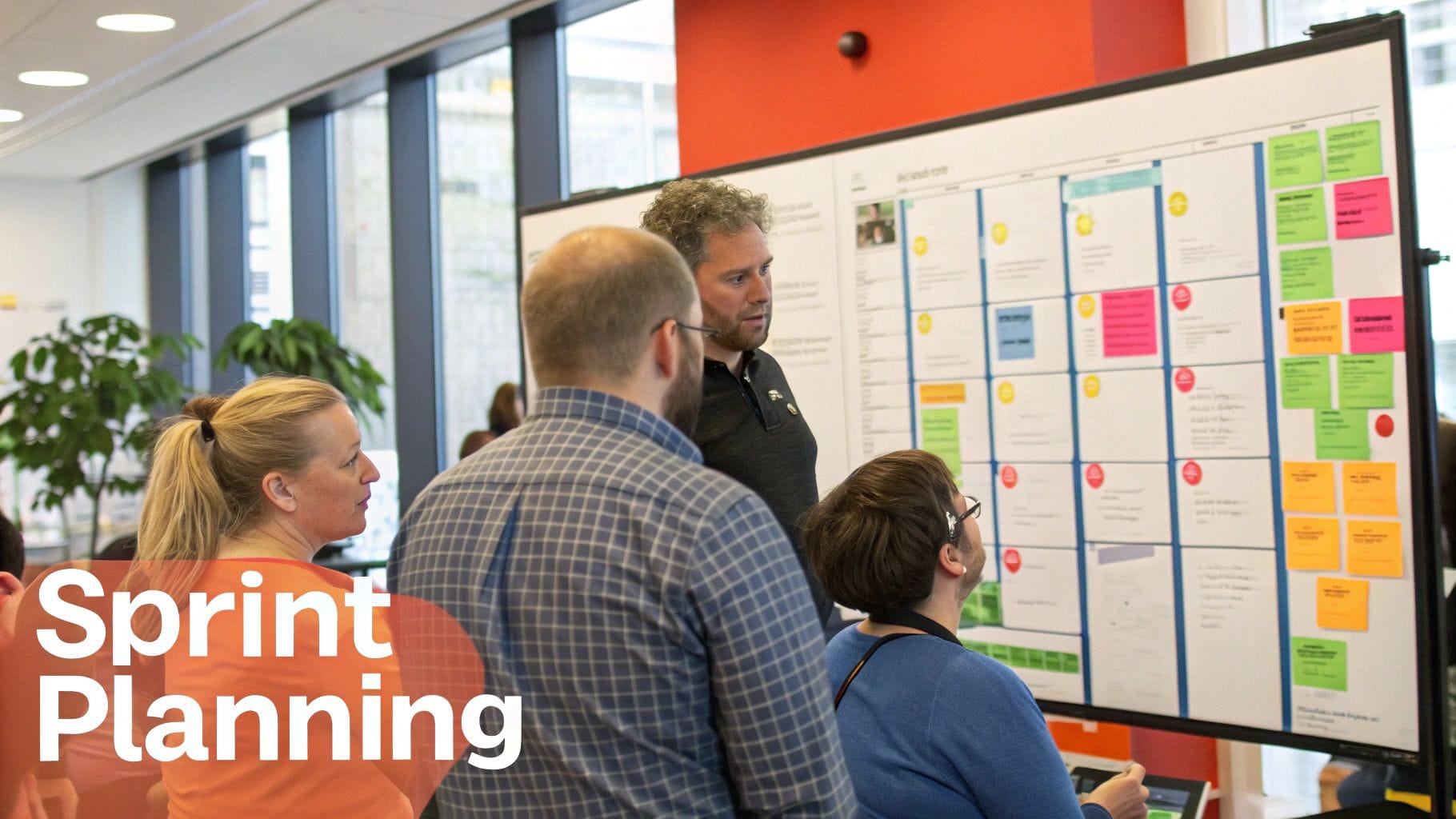
- Sprint Planning: This is where the team commits to a chunk of work for the next two weeks. You'll review the prioritized backlog and pull in a realistic number of user stories. The output is a clear sprint goal and a set of tasks everyone has bought into.
- Daily Stand-ups: A quick, 15-minute daily check-in. Each person answers three questions: What did I do yesterday? What will I do today? Is anything blocking me? This isn't for solving problems on the spot; it's for surfacing roadblocks fast.
- Sprint Retrospective: At the sprint's end, the team reflects on what went well, what didn't, and what can be improved. This continuous feedback loop is the secret sauce that makes agile teams so effective over time.
Writing User Stories That Eliminate Ambiguity
One of the biggest failure points in any sprint is a poorly defined task. Engineers can't build what they don't understand. A well-written user story is the antidote, translating a business need into a crystal-clear technical requirement.
A common format is: "As a [type of user], I want [an action] so that [a benefit]."
But the story itself is only half the battle. The other half is the acceptance criteria - a simple checklist of conditions that must be met for the story to be considered "done."
Practical Example: User Story
Let’s imagine you're building a feature for a subscription marketplace app that allows users to save a box to their "favorites."
- User Story: "As a logged-in user, I want to tap a 'heart' icon on a product detail page so that I can save it to my favorites list for later."
- Acceptance Criteria:
- When I tap the heart icon, it must change from an outline to a solid color.
- The favorited box must immediately appear on my "Favorites" screen.
- If I tap the solid heart icon again, it must revert to an outline, and the item must be removed from my "Favorites" screen.
- The action must work when I am online and offline (syncing when I reconnect).
This level of detail leaves zero room for interpretation. Your engineer knows exactly what to build, and your QA tester knows exactly what to test. To make this process even smoother, mastering your project management tools is a must. Digging into some Jira best practices for high-performing teams can make a world of difference here.
Integrating QA from Day One
Quality Assurance (QA) isn't something you bolt on at the end of a project. It’s a continuous process that runs in parallel with development. For every user story an engineer is building, a QA analyst should be writing test cases based on the acceptance criteria.
A sprint isn't "done" when the code is written. A sprint is done when the code is written, tested, and confirmed to meet the acceptance criteria without introducing new bugs.
This integrated approach combines two critical testing methods:
- Automated Testing: Engineers write code that automatically tests other code. This is your safety net, catching regressions and ensuring core functionality doesn't break with new changes. Practical Example: An automated test could simulate a user login with an incorrect password and verify that the correct error message ("Invalid password") is displayed, running this check every time new code is added.
- Manual Testing: A QA analyst manually goes through the app, testing new features and trying to break things in all the creative ways a real user might. Practical Example: A QA tester might try to purchase a subscription using an expired credit card, then immediately turn their phone to airplane mode to see if the app handles the connection loss gracefully.
By combining this disciplined rhythm with clear communication, your sprints transform from a chaotic scramble into a reliable engine for progress.
Instrumenting Your App for Data-Driven Growth
Launching an app without analytics is like flying a plane blindfolded. Sure, you’re moving, but you have no idea if you're heading in the right direction, gaining altitude, or about to nosedive. The single most common mistake I see founders make is pushing analytics to a "post-launch" phase. That's a surefire way to burn through time and cash.
Effective app development project management weaves data instrumentation into the very first sprint. If you aren’t measuring, you’re just guessing. Building in analytics from day one means you're making informed, data-backed decisions instead of just going with your gut.
This changes how your team operates. Engineers aren't just building features; they're building measurable features. Every critical user action - from signing up to making a purchase - absolutely must be tracked as an event.
Identifying KPIs That Actually Matter
Let's be blunt: investors and stakeholders don't care about vanity metrics like total downloads. They want to see a clear path to a sustainable business, and that comes down to a few core key performance indicators (KPIs).
Your entire analytics setup should be laser-focused on tracking these three metrics:
- User Retention: What percentage of users come back to your app after one day, seven days, and thirty days? High retention is the clearest signal of product-market fit.
- Lifetime Value (LTV): How much revenue does the average user bring in over their entire time with your app? This number has to be higher than your customer acquisition cost (CAC) for the business to work.
- Monthly Recurring Revenue (MRR): For any subscription app, this is your lifeblood. It's the predictable revenue you can count on every single month.
Centering your analytics on these three pillars gives you an objective, unfiltered view of your app's health and its real potential for growth.
Building Your Modern Growth Stack
A "growth stack" is just a fancy term for a few specialized tools that work together to help you get, understand, and keep users. You don't need a dozen different platforms to get going; a few well-chosen ones will give you a massive advantage.
For most startups, a powerful and common stack looks like this:
- A Data Hub (like Segment): Think of this as the central nervous system for your user data. You track an event once (e.g.,
user_signed_up), and Segment can pipe that data out to all your other tools. This saves a staggering amount of engineering time. - A Product Analytics Tool (like Amplitude): This is where you dig in and actually analyze user behavior. You can build funnels, look at retention cohorts, and pinpoint exactly where users are dropping off.
- A Messaging Platform (like OneSignal): This lets you send targeted push notifications and in-app messages based on what users do, helping you pull them back in and guide them toward valuable actions.
Waiting to implement analytics is like building a car and only deciding to add a speedometer and fuel gauge after you've already started a cross-country road trip. You're guaranteeing you'll run out of gas in the middle of nowhere.
Practical Example: Setting Up a Core Funnel
Let’s say you’re building a fitness app with a subscription model. Your most critical user journey is getting a new person to start their first workout and then convert to a paid plan.
Your project manager would work with the engineers to define and implement event tracking for every single step of this funnel:
- `event: signed_up` - Captures when a user creates their account.
- `event: completed_onboarding` - Tracks when they finish the initial setup.
- `event: started_workout` - Fires the moment they begin their first session.
- `event: viewed_subscription_page` - Shows clear intent to purchase.
- `event: started_trial` - The ultimate conversion goal for this funnel.
Once these events are flowing into a tool like Amplitude, you can build a funnel report. You might discover that 70% of users who complete onboarding also start a workout, but only 5% of those who start a workout ever even see the subscription page.
That data gives you a precise, actionable insight: you need to improve how you prompt users to upgrade after they’ve experienced the app's core value - the workout itself. Actionable Insight: Based on this data, you could create a new user story for the next sprint: "As a user who has just completed their first workout, I want to see a non-intrusive popup offering a 7-day free trial so that I can explore premium features while I feel most engaged." This is how analytics directly drives your product roadmap.
Picking the right platform is what makes these insights possible. To go deeper, check out our guide on the best analytics tools for mobile apps to see which solutions fit your specific needs. This is the data-driven approach that separates apps that grow from those that just stagnate.
Managing Risk and Planning for the Future
Getting your app launched is a massive win, but it’s the starting pistol, not the finish line. Real app development project management is about what comes next. It’s about managing the realities of product ownership so your initial investment pays off for months and years, not just on launch day.
This means looking ahead and planning for the curveballs. You'll have technical debt to manage. Apple or Google will drop a surprise OS update that breaks something. A forward-looking strategy is what separates the apps that thrive from the ones that fizzle out.
Handling Unexpected Scope Changes
No matter how airtight your plan is, scope changes are going to happen. It's inevitable. A competitor might ship a killer feature, or your first batch of user feedback could uncover a massive opportunity you missed. The goal isn't to prevent change - it's to manage it so you don't blow up your timeline and budget.
This is where a disciplined change request process saves you. When a new idea pops up, it can't just jump to the front of the line. It needs to be scrutinized with the same intensity as your original MVP features.
Here’s how we handle it:
- Document the Request: What’s the feature? More importantly, what business problem does it solve? Get it in writing.
- Estimate the Effort: The dev team gives a rough estimate of the time and cost. No need for a deep dive, just a ballpark figure.
- Assess Business Impact: The product manager weighs the idea against core KPIs. Will this move the needle on retention? Will it increase LTV?
- Prioritize or Kill It: Based on the value vs. effort, you make a conscious call. Add it to the roadmap, punt it to a later quarter, or kill the idea outright.
Practical Example: Imagine your fitness app users are clamoring for a "dark mode."
- Request: Add a dark mode theme to the app to reduce eye strain.
- Effort: Dev team estimates it's a "medium" effort - about 30 hours of work.
- Impact: Product manager notes it's a common user request but unlikely to directly increase trial conversions or retention in a measurable way. It's a "nice-to-have."
- Decision: The request is added to the backlog but prioritized below the feature for improving the post-workout upgrade prompt, because that feature has a direct, measurable link to revenue.
This structure stops you from making knee-jerk decisions and keeps the team focused on work that actually delivers value.
Planning a Seamless Handoff
If you're working with an outside team like Vermillion, a structured handoff to your in-house team is one of the most critical final steps. I’ve seen sloppy transitions completely undermine months of incredible work, leaving the new team confused, frustrated, and unable to build on the momentum.
A great handoff isn't about dumping a bunch of code in someone's lap. It's about transferring knowledge, context, and ownership. The goal is to empower your in-house team to hit the ground running from day one.
A solid handoff playbook always includes a few key things:
- Comprehensive Documentation: This is more than just code comments. Think architectural diagrams, API documentation, and a guide to getting the development environment set up from scratch.
- Knowledge Transfer Sessions: Get your new engineers on a call with the old team. Have them walk through the codebase, explain the tough technical decisions, and cover the "why" behind the architecture.
- A Clear Product Roadmap: Give the new team a 6-12 month roadmap that shows where the product is headed. This provides immediate direction and purpose, preventing them from just drifting into bug-fixing mode.
This kind of proactive planning ensures a smooth transition and sets your team up to win long-term. The need for structured processes is clear when you look at the market; the global project management software market was valued at $7.24 billion in 2025 and is expected to hit $12.02 billion by 2030. Yet, shockingly, only 23% of organizations actually use dedicated project management software. You can read more about these project management software trends to see just how big the gap is between best practices and what most companies are actually doing.
Common Questions We Hear from Founders
Walking into the world of app development can feel like learning a new language overnight. As a founder, you're suddenly expected to make huge calls on things that affect your timeline, budget, and whether your product lives or dies.
We've built apps for dozens of startups, and we hear the same questions over and over. These aren't abstract, academic answers. This is what we've learned from being in the trenches, designed to give you clarity and the confidence to make the right moves.
What’s the Biggest Mistake Founders Make?
Hands down, the most common and expensive mistake is a fuzzy, undefined scope. So many founders come to us wanting to build their entire dream app - every single feature they've ever imagined - in version one. It's a natural impulse, but it's almost always fatal to the project.
This "build everything now" mentality blows up budgets, stretches timelines until they snap, and creates a product that does a dozen things poorly instead of one thing exceptionally well.
Good project management is really just disciplined decision-making. It’s about forcing yourself (and your team) to focus the initial build on solving a single, core user problem and proving you can make money doing it. Everything else is a distraction.
The whole point of a Minimum Viable Product (MVP) is to learn. It's about validating your most critical assumptions with the least amount of code and cash possible. Resisting the temptation to add "just one more feature" is what separates the projects that launch from the ones that never see the light of day.
How Do I Pick the Right Project Management Tools?
The best tool is the one your team actually uses. Every single day.
For a startup, simplicity and a low learning curve are everything. Don't get tangled up in some massive, enterprise-grade software that needs a full-time admin just to keep it running.
For most early-stage teams, a simple and effective stack looks something like this:
- Project Tracking: A tool like **Jira or Linear** is non-negotiable for running sprints, writing user stories, and squashing bugs. They are built specifically for how modern software teams work.
- Documentation Hub: You need a single source of truth. A tool like **Notion or Confluence** is perfect for housing your Product Requirements Document (PRD), meeting notes, and technical specs.
- Communication: **Slack** is still the king for a reason. It handles daily updates and quick collaboration, cutting through the noise of endless email chains.
- Design Handoff: **Figma** has become the standard here. It creates a seamless bridge between designers and developers, letting engineers inspect designs and pull assets directly.
The tool itself isn't the point. The goal is clarity, visibility, and less friction in communication. Start simple. Only add more complex tools when you feel a real, undeniable pain point.
How Can I Be Sure My Development Partner Is Actually Aligned With My Goals?
Real alignment boils down to two things: how they get paid and how they communicate.
Traditional agency models - hourly billing, monthly retainers - create a fundamental conflict of interest. They are incentivized by time spent, not by the business results you get. This is where you see projects drag on with no real sense of urgency.
You need a partner whose success is directly wired to your business KPIs. Think user retention, revenue growth, or conversion rates. When you're vetting potential partners, get past the tech-speak and ask them how they measure their own success. If the answer is just "shipping code," run.
A true partner will challenge your assumptions. They'll push back. They should be able to clearly explain why building Feature A will have a bigger impact on your LTV than Feature B. That's the difference between a hired gun and a strategic advisor.
The other piece is radically transparent communication. Insist on weekly check-ins that are more than just a status update on development tasks. These meetings need to track progress against your product roadmap and your most important business metrics. This is how you ensure everyone is rowing in the same direction, toward the same definition of success.
At Vermillion, our entire model is built on this kind of alignment. We tie our success to your KPIs, which means we're laser-focused on shipping a revenue-ready product that proves traction and delivers ROI - fast. Find out how we can help you build and launch your app in as little as 10–20 weeks at https://vermillion.agency.
Keep reading
See all →
March 22, 2026
Unlocking Revenue Your Guide to Price Tier Strategy

March 21, 2026
Your Guide to Flawless Stripe Subscription Management

May 14, 2026
Fractional Mobile Engineering vs. Full-Time Hiring in 2026
The mobile engineering talent market has shifted dramatically over the past two years. Budgets are tighter, AI tools have changed what a sin...
March 20, 2026
Recurring Billing With Stripe a Guide for Subscription Apps
Master recurring billing with Stripe. This guide covers everything from setup and server logic to webhooks and churn reduction for subscript...
March 19, 2026
Unlocking Growth with Mobile App Retention Metrics
Discover the mobile app retention metrics that directly fuel MRR growth. This founder's guide offers actionable strategies to track, analyze...