App Development Cost Calculator: Estimate Your MVP Budget
Before you even touch an app development cost calculator, you need a mental baseline. A simple app might start around $50,000, but a feature-rich, revenue-focused product can easily sail past $150,000. The final number always comes down to the complexity of the features, security needs, and what you’re actually trying to achieve in the market.
What Really Goes Into Your App Development Cost

Any good calculator gives you a starting point, but the real budget gets shaped by a handful of critical variables. It’s not just about counting features; it's about seeing how each decision you make impacts engineering hours, technical complexity, and the long-term cost of keeping the lights on. Thinking about this stuff upfront is how you avoid those nasty, expensive surprises later.
A fintech app built for secure transactions and regulatory compliance, for instance, has a completely different cost DNA than a simple content app. The first demands heavy backend logic, encryption, and obsessive testing. The other might just need a slick UI and fast content delivery. Each path has its own technical mountains to climb and a price tag to match.
From MVP to a Revenue-Generating Machine
A Minimum Viable Product (MVP) is all about one thing: testing a core idea with the fewest features possible to keep that initial investment low. It’s a lean way to see if you're onto something without betting the farm. But an app built for real growth and monetization? That needs a much stronger foundation from day one.
Think about the journey in these stages:
- Simple MVP: This is your bare-bones version. User login, a basic dashboard, and one core feature. It's built to get you that first round of crucial user feedback.
- Feature-Rich App: Now we're talking. This level brings in payment gateways, push notifications, analytics, and connections to other services.
- Complex Platform: This is the deep end. We’re often dealing with advanced tech like AI, real-time data syncing, or heavy-duty backend processing.
Before we dive deeper, here's a quick look at how these tiers translate into potential costs and timelines. This should give you a solid frame of reference.
Quick Guide to App Complexity and Estimated Costs
| App Complexity Tier | Core Features Example | Estimated Cost Range | Typical Timeline |
|---|---|---|---|
| **Simple MVP** | User login, basic profile, one core function (e.g., a single calculator or checklist). | **$25,000 – $75,000** | **10–16 weeks** |
| **Feature-Rich App** | Social login, payment processing, push notifications, user-generated content. | **$75,000 – $150,000** | **4–6 months** |
| **Complex Platform** | AI/ML features, real-time sync, custom analytics dashboard, third-party integrations. | **$150,000+** | **6–9+ months** |
These numbers are a solid industry benchmark. The financial leap between these stages is significant, and it’s important to understand why.
Data for 2025 shows the average cost to build a custom mobile app lands around $171,450. While you see some simple MVPs get off the ground for as little as $5,000, most apps with monetization features quickly jump into the $45,000–$150,000 range. For the really advanced stuff, budgets start at $150,000 and can easily top $350,000. You can explore more data on mobile app development costs to get a broader view.
Adopting a Value-Driven Approach
Instead of just adding up development hours, a value-driven approach ties every dollar you spend to a real business outcome. This completely changes the conversation from "How much does this feature cost?" to "How will this feature drive user retention or boost our Monthly Recurring Revenue (MRR)?"
A successful app isn't just a collection of features; it's a tool designed to achieve specific business goals. By linking your budget directly to Key Performance Indicators (KPIs), you ensure that your investment generates a clear and measurable return.
Practical Example: Let’s say you’re building a wellness app. A generic feature is "user profiles." A value-driven feature is "progress tracking within profiles to show a 7-day streak." The first is just a feature. The second is a tool designed to increase user retention, a key KPI. Actionable Insight: Before adding any feature to your scope, write down which specific KPI it is designed to improve. If you can't, cut it from the MVP.
Nailing Down the Core Inputs for a Real-World Budget
Any app development cost calculator is just a machine—garbage in, garbage out. Vague ideas will always spit back vague, unreliable numbers. If you want a budget you can actually take to the bank, you need to define the scope of your project with surgical precision. This isn't busywork; it's the process of making critical decisions that build your financial roadmap.
Platforms: The First Big Cost Driver
Your first major decision is the platform. Are you building for iOS, Android, or both? This isn't just a technical question; it's a strategic one based on where your customers live. Choosing to build natively for both iOS and Android is like running two separate construction projects side-by-side—it effectively doubles your engineering costs.
This is where a cross-platform approach like React Native becomes a massive budget-saver. Using a single codebase lets you launch on both platforms at once, often slashing development costs by 30-50%. We break down the numbers in more detail here: https://vermillion.agency/insights/react-native-app-development-cost/.
Your Feature Set: Where the Costs Really Add Up
With your platform strategy locked in, it's time to map out every single feature. This is where the bulk of your cost lives. A simple user sign-up flow is one thing, but a complex payment gateway with subscription tiers is an entirely different beast in terms of development hours.
Let's imagine you're building a subscription fitness app. A basic feature breakdown might look like this:
- User Onboarding: Simple email/password sign-up, plus social logins (Google, Apple).
- Subscription Management: Integration with a service like RevenueCat to manage App Store and Google Play subscriptions, free trials, and plan changes.
- Content Delivery: A backend system to host and stream workout videos, which requires an API for the app to pull from.
- User Profiles: Basic profile showing workout history, progress tracking, and saved favorite videos.
- Push Notifications: Reminders for scheduled workouts or new content alerts, likely through a service like Firebase Cloud Messaging.
Each of these bullet points is a "cost layer." The social login adds API integration work. Subscription management needs meticulous setup and testing across both stores. Video streaming demands a robust backend and maybe even a Content Delivery Network (CDN) to make sure playback is smooth for everyone.
Mapping Third-Party Integrations
Modern apps are rarely built in a vacuum. They plug into a whole web of third-party services to get functionality without building everything from scratch. These integrations are fantastic for speed, but each one adds another layer of complexity and cost.
For a marketplace app, you might need:
- Payment Processing: Stripe Connect to handle payments between your buyers and sellers.
- Messaging: Twilio for in-app chat.
- Mapping: Google Maps API for location services and showing listings.
- Analytics: Mixpanel or Amplitude for tracking user behavior.
Defining these integrations upfront is non-negotiable for a realistic budget. Every API has its own documentation, quirks, and potential subscription fees that have to be factored into your financial plan.
A critical, but often overlooked, part of setting an accurate budget is establishing systems for effective business expense tracking. This ensures that both direct development costs and those recurring third-party service fees are properly accounted for, preventing nasty surprises down the line.
Your Essential Scoping Checklist
To pull all this together, you need a detailed project scope document. This becomes the blueprint for your budget and the key to getting a meaningful number from any cost calculator. Use this checklist to make sure you've covered all your bases.
Project Scope Documentation Checklist:
- Platform Choice:
- \[ ] iOS Native
- \[ ] Android Native
- \[ ] React Native (Cross-Platform)
- Core Feature List (User Stories):
- \[ ] User Authentication (Email, Social Login)
- \[ ] Profile Management
- \[ ] Main Dashboard / Home Screen
- \[ ] List every other core feature here...
- Third-Party Integrations:
- \[ ] Payment Gateway (e.g., Stripe, Braintree)
- \[ ] Analytics Service (e.g., Mixpanel, Google Analytics)
- \[ ] Messaging/Push Notifications (e.g., Twilio, Firebase)
- \[ ] Mapping Service (e.g., Google Maps, Mapbox)
- Backend Requirements:
- \[ ] Custom Backend vs. Backend-as-a-Service (BaaS)
- \[ ] Database Type (e.g., SQL, NoSQL)
- \[ ] Admin Panel for Content Management
- Compliance and Security:
- \[ ] Data encryption requirements
- \[ ] Compliance needs (e.g., HIPAA for healthtech, PCI for fintech)
By working through this list, you transform your app idea from a concept into a well-defined set of technical requirements. This is the level of detail you need to get an actionable estimate and start your project on solid financial ground.
How to Calculate Costs for Each Development Phase
Thinking about building an app as one giant expense is a classic founder mistake. It's overwhelming and, frankly, inaccurate. A much smarter way to budget is to see it as a series of distinct phases, each with its own costs and deliverables.
This approach gives you a clear map of where every dollar is going. It makes it easier to allocate resources, track your burn rate, and see how a decision made today—like adding a complex feature—will ripple through the entire timeline and budget. Getting this granular view is essential for anyone serious about mastering software development cost estimation and actually shipping a product on budget.
This flowchart shows the basic decision tree that drives cost. Your choices on platform, features, and integrations are the first dominoes to fall, setting the stage for everything that follows.
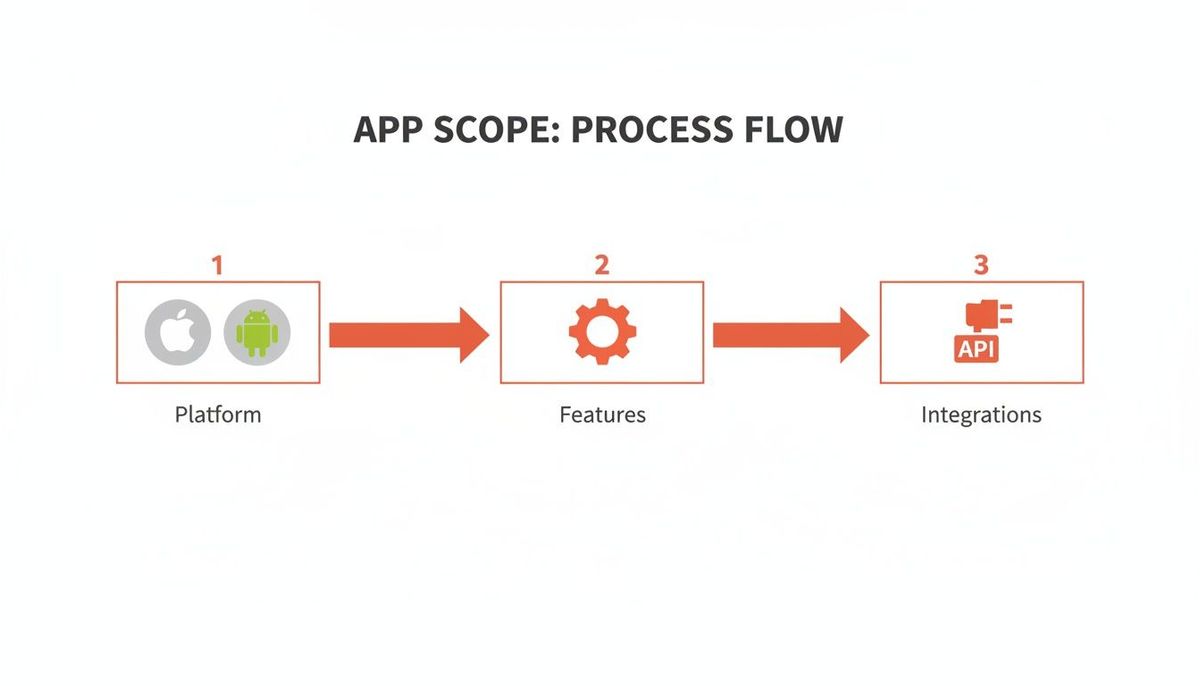
As you can see, early calls on platforms and core features have a direct impact on the complexity and cost of later stages like API integrations and building out the backend.
UI/UX Design: The Foundation
Before anyone writes a single line of code, the UI/UX design phase creates the blueprint for how your app will look, feel, and function. This isn't just about picking colors and fonts; it's about architecting an intuitive, engaging journey for your users.
The cost here is driven by the depth of user research, the complexity of the user flows you need, and the sheer number of unique screens. For a medium-complexity app, you're looking at a range of $5,000 to $25,000. This gets you:
- User Research & Personas: Figuring out who your users are and what they actually need.
- Wireframing: Low-fidelity skeletons of each screen to map out functionality.
- High-Fidelity Mockups: The final look and feel—colors, typography, and branding.
- Interactive Prototypes: A clickable model of the app to test user flows before a developer even sees it.
Skimping on design is a fatal error. A clunky, confusing app leads to frustrated users and terrible retention, making any money you saved upfront incredibly expensive in the long run.
Backend Engineering: The Engine Room
The backend is the unseen powerhouse of your application. It’s where the server-side logic, databases, and APIs live. It’s all the behind-the-scenes work that makes the pretty screens on the user's phone actually do something.
This is often the most time-consuming and expensive piece of the puzzle, with costs for a medium app running from $15,000 to $60,000 or more.
Your backend architecture determines your app's ability to scale. A solid backend can handle thousands of users seamlessly, while a weak one will crumble under pressure, leading to crashes and a poor user experience.
Practical Example: A social media app needs a backend that can handle millions of image uploads and real-time feed updates. This requires a scalable cloud architecture (like microservices) and a robust database, significantly increasing cost. In contrast, a simple utility app might only need a basic backend to store user preferences, which is far cheaper. Actionable Insight: Ask potential development partners how their proposed backend architecture will handle 10x your expected launch user base. Their answer will reveal if they're planning for long-term success or just a quick launch.
Frontend and Cross-Platform Development
This is where the design mockups get turned into a living, breathing application. For founders and CTOs, the big decision here is whether to build separate native apps for iOS and Android or go with a cross-platform framework like React Native.
This choice has massive budget implications. Using a single codebase with React Native can slash your mobile development costs by 30–50% compared to building two separate native apps. For a medium-complexity app, this can mean the difference between a $60K–$150K project and one that balloons past $250K.
Quality Assurance and Testing: The Safety Net
Quality Assurance (QA) is the process of hunting down and fixing bugs before your users find them. This isn't something you tack on at the end; it should run in parallel with development from day one. Underfunding QA is a recipe for disaster, leading to a flood of one-star reviews and a brand reputation that's dead on arrival.
A good rule of thumb is to budget 15-25% of your total development cost for QA. This covers a whole range of testing activities:
- Functional Testing: Does every button and feature do what it's supposed to do?
- Usability Testing: Is the app actually intuitive for a real person to use?
- Performance Testing: How does the app handle slow connections or older devices? Does it drain the battery?
- Security Testing: Are there vulnerabilities that could expose user data?
Breaking your project into these phases turns an abstract "app cost" into a concrete, actionable budget. You can see exactly where the money goes, making trade-off decisions much clearer. This is especially vital if you're starting lean with an MVP; understanding these phases is the first step to figuring out how much a Minimum Viable Product costs.
Phase-by-Phase App Development Cost Breakdown
To give you a clearer picture of how a budget is allocated, here's a detailed look at the typical cost distribution for a medium-complexity project with a total budget of around $150,000. This breakdown shows how different stages command different shares of the investment.
| Development Phase | Percentage of Total Budget | Typical Cost Range (for $150K Project) | Key Deliverables |
|---|---|---|---|
| **Discovery & Design** | **10–15%** | **$15,000 – $22,500** | User Personas, Wireframes, High-Fidelity Mockups, Interactive Prototype |
| **Backend Development** | **30–40%** | **$45,000 – $60,000** | Server Setup, Database Architecture, API Endpoints, Admin Panel |
| **Frontend Development** | **25–35%** | **$37,500 – $52,500** | Coded UI/UX, Feature Implementation, API Integration |
| **Quality Assurance** | **15–20%** | **$22,500 – $30,000** | Test Cases, Bug Reports, Performance Analysis, Security Audits |
| **Deployment & Launch** | **5%** | **$7,500** | App Store Submission, Server Configuration, Launch Marketing Prep |
This table illustrates that the bulk of the cost lies in the actual engineering (Backend and Frontend), which makes sense. However, it also highlights that the foundational work in design and the critical safety net of QA are significant investments that shouldn't be overlooked. Every phase builds upon the last, and underfunding one part of the process inevitably creates expensive problems down the line.
Planning for Post-Launch Costs and Long-Term Success
Getting your app launched is a huge milestone. But here’s the thing—it’s the starting line, not the finish. A common mistake I see sink otherwise promising apps is the failure to budget for what comes after the big day. The real work of building a great product starts when it's in the hands of your users, and that journey has its own price tag.
Any decent app cost calculator will help you map out the initial build, but smart founders play the long game. Think of it like buying a car; the sticker price gets you out of the dealership, but you still have to pay for gas, insurance, and tune-ups to keep it on the road.
The True Cost of Keeping Your App Alive
Ongoing maintenance isn’t just about fixing things when they break. It’s a proactive plan to keep your app secure, functional, and relevant in a market that never stands still. This is where a lot of budgets completely fall apart.
As a solid rule of thumb, you should plan to budget 15-25% of your initial development cost annually for maintenance. If you spent $150,000 on the build, that means setting aside another $22,500 to $37,500 per year just to keep the lights on.
Post-launch costs are not a sign of a poorly built product; they are a sign of a living product. This budget covers everything from essential updates for new operating systems to squashing bugs your first users inevitably discover.
This isn’t just an expense; it’s an investment that protects your initial one. Without it, even the most brilliantly designed app will slowly degrade as technology marches on, eventually becoming obsolete or, even worse, a security risk.

What Your Maintenance Budget Actually Covers
So, where does that money go? It's not just a rainy-day fund. It’s a strategic reserve earmarked for critical operations that keep your app healthy and growing.
Your ongoing expenses will typically include:
- Server and Hosting Fees: Your backend needs a place to live. As your user base grows, so does your data storage and traffic, which will drive up your monthly server costs.
- Third-Party Service Subscriptions: Most apps lean on APIs for things like payments (Stripe), messaging (Twilio), or analytics (Mixpanel). These services all come with recurring fees.
- Bug Fixes and Performance Tweaks: No app is perfect from day one. Your team will need to jump on bugs reported by users and optimize performance to keep the experience snappy.
- OS and Device Updates: Apple and Google roll out major OS updates every year. Your app has to be updated to stay compatible, or it will simply break on new devices.
- Feature Enhancements: Staying competitive means evolving. You’ll need to add new features based on what your users are asking for and what the market demands.
Managing these expenses is all about foresight. For more on this, check out our guide on how to use your development budget efficiently to keep recurring costs in check without cutting corners on quality.
Smart Financial Planning Beyond the Build
Beyond just planning for maintenance, there are ways to be smarter with your money. One of the most powerful but overlooked tools is the R&D tax credit. In many countries, the work that goes into building new software can qualify for significant tax incentives, which could slash your effective cost by 20–40%. The key is to meticulously document your development process from day one.
Another piece of the long-term puzzle is ownership. The traditional agency model often creates dependency, leaving you chained to them for every single update. At Vermillion, we do things differently. We build your app and then implement a structured handoff, helping you recruit, train, and transition to your own in-house team. This gives you total control over your product's future and your long-term costs, turning that initial investment into an asset you truly own.
Why Performance-Based Pricing Is a Founder's Best Friend
The traditional agency model—billing by the hour—is fundamentally broken for startups. It creates a painful conflict of interest: the agency profits from spending more time, not from delivering results. This approach rewards slow work and turns what should be a strategic partnership into a simple, transactional relationship where the founder shoulders all the risk.
It's an outdated model that just doesn't make sense when you're trying to build a business, not just a pile of code.
A performance-based model completely flips the script. Instead of paying for hours logged in a timesheet, you're paying for real, tangible business outcomes. This move aligns your development partner's financial success directly with your own, making them a true stakeholder in your company's growth.
Tying Development Costs to Real Business Goals
Imagine linking your development fees to the Key Performance Indicators (KPIs) that actually matter to your investors and your bottom line. This isn't just a nice idea; it's a practical way to ensure every dollar you spend is laser-focused on moving the needle. It completely changes the conversation from, "How long will this take?" to "How will this feature actually impact our user retention?"
Here’s what that looks like in the real world:
- Monthly Recurring Revenue (MRR) Targets: A chunk of the development fee is tied to hitting a specific MRR milestone within six months of launch. If the target is $20,000 MRR and the app only hits $10,000, the partner’s success fee gets cut in half. Simple.
- User Retention Rate: Fees could be linked to nailing a certain Day 30 user retention percentage. This forces the entire team to think obsessively about user experience, onboarding, and the core value proposition—not just checking features off a list.
- Conversion Rate Improvement: For an app that's already live, the goal might be to boost the conversion rate from a free trial to a paid subscription from 2% to 5%. The partner's bonus is directly tied to closing that gap.
This model transforms your development team from code mercenaries into genuine strategic partners. They are now financially motivated to challenge your assumptions, suggest better solutions, and build a product that doesn't just work—it actually wins in the market.
This is an incredibly powerful way for any startup to de-risk a build. It guarantees you’re paying for a successful business, not just a functional piece of software. It’s a huge reason our clients have successfully raised over $27M in funding—they can walk into investor meetings with a product built on a foundation of shared risk and perfectly aligned goals.
Real-World Scenarios Where Aligned Incentives Win
We’ve seen this model deliver results time and time again. For one of our marketplace clients, the main goal was all about user acquisition and transaction volume. By tying our compensation directly to their Gross Merchandise Value (GMV), our team became obsessed with optimizing the checkout flow, removing friction for sellers, and building trust signals for buyers.
In another case, a healthtech startup had to prove user engagement to lock down their next funding round. Our success was directly tied to hitting a target number of "weekly active users." That singular focus led us to build features like personalized reminders and community challenges that dramatically boosted engagement, which ultimately secured their Series A.
The mobile app market is projected to be a massive $585.70 billion industry by 2025, but just having capital isn't enough to win. While iOS development often costs 15–20% more than Android, a smart partner using React Native can optimize that spend, typically landing full-stack product development in the $150K–$750K range. Our performance-based model, which focuses on metrics like MRR and Lifetime Value (LTV), has already led to three company exits and helped one of our top clients blow past $300K+ MRR. It's proof that shared incentives are the most powerful driver in this booming market. You can explore the latest mobile app cost trends and predictions to get a better sense of the landscape.
So when you’re evaluating partners, don't just ask for their hourly rate. Ask them how they plan to win with you. The right partner will have a clear, confident answer, showing you a path where your success is the only outcome that matters.
Common Questions About App Development Costs
Even with a detailed cost breakdown, I find that founders and product leaders always have a few more questions. That's a good thing. Budgeting for a new product is a high-stakes game, and it’s smart to challenge assumptions before you commit serious capital.
Let's tackle some of the most frequent—and critical—questions we hear. These are the details that separate a well-managed project from one that spirals out of control.
How Can I Reduce App Development Costs Without Sacrificing Quality?
This is the million-dollar question, isn't it? The good news is that cutting costs and improving quality aren't mutually exclusive. In fact, they often go hand-in-hand when you make smart, strategic decisions from day one.
The single most effective way to cut costs is to be absolutely ruthless with your MVP feature set. Your first launch should solve one core problem for one target user, and that's it. Every "nice-to-have" adds complexity and cost, so be disciplined and focus on proving people want what you're building.
Beyond that, here are a few practical moves we've seen work time and again:
- Go Cross-Platform From the Start: Building with a framework like React Native lets you ship on both iOS and Android from a single codebase. This isn't just a minor tweak; it can slash your development time and costs by 30-50% compared to building two separate native apps.
- Insist on Performance-Based Pricing: Find a partner whose success is tied to yours. This model forces every dollar to be spent on hitting business goals, not just burning through hourly retainers on features that don't move the needle.
- Don't Reinvent the Wheel: Instead of building everything from scratch, lean on best-in-class third-party APIs. Use Stripe for payments, Twilio for messaging, or Mixpanel for analytics. It's faster, cheaper, and often more reliable.
What Hidden Costs Should I Be Aware Of?
The number an app cost calculator spits out is for the build itself. But there are always other expenses lurking in the shadows that can catch you by surprise. Thinking about these upfront is what makes a budget realistic.
These "hidden" costs are often where budgets fall apart after launch.
A successful launch budget anticipates the entire product lifecycle, not just the initial sprint to the app store. Factoring in recurring fees, marketing, and legal expenses provides a complete picture of your true financial commitment.
Make sure you've got these line items in your financial plan:
- Third-Party Service Fees: Those APIs for maps, payments, and analytics? They almost always have monthly subscription costs that grow as your user base does.
- Hosting and Server Costs: Your backend infrastructure isn't a one-time purchase. You'll have recurring monthly fees for servers and databases from providers like AWS or Google Cloud.
- App Store Fees: Both Apple and Google take a cut. Apple's Developer Program is $99 per year, while Google Play has a $25 one-time registration fee.
- Ongoing Maintenance: This is the big one people forget. Plan to budget 15-25% of your initial development cost annually for bug fixes, OS updates, and security patches.
- Marketing and User Acquisition: You have to actually get people to download your app. Building it is just step one; you need a separate budget to drive adoption.
How Does Vermillion's Model Differ From a Standard Agency?
We built Vermillion to be a product partner, not just a hired team of coders. The fundamental difference is our performance-based pricing. It completely aligns our financial incentives with your business success.
Put simply, we only win when you hit your KPIs—like revenue growth, user retention, or conversion rates.
This approach changes the entire dynamic. We aren't motivated to drag out a project or rack up billable hours. Our entire focus is on shipping a revenue-ready React Native app in 10-20 weeks that delivers measurable results. Fast.
And our engagement doesn't just stop at launch. We provide a structured handoff where we help you recruit, train, and transition to your own in-house team. This process gives you long-term ownership of both the product and the talent, breaking the cycle of agency dependency and setting you up for sustainable, independent growth.
Ready to get a real-world estimate for your app idea? The Vermillion model is built for founders who need to prove traction and ROI fast. Let's build a budget that ties every dollar to your most important business goals.