App Creator Cost: Budgeting Your App for the app creator cost-Savvy Founder
The real app creator cost isn't just a number you plug into a spreadsheet; it's a direct investment in your business's future. For an app built to make money, that investment can start around $15,000 for a simple MVP and climb well past $150,000 for a complex, revenue-ready product designed for serious growth.
Understanding the True Cost of Building a Monetized App
When you’re building an app to actually generate revenue, the question quickly changes from "how much does it cost?" to "what investment do I need to hit my business goals?"
Framing the app creator cost in terms of user growth, monthly recurring revenue (MRR), and market validation turns your budget from an expense into a strategic weapon. This initial investment covers way more than just writing code. It's the entire process of turning your idea into a scalable, market-ready product that can pull in both users and investors.
The path you choose to build your app dramatically shapes the final bill. You could go with a DIY app builder for a low upfront cost, but you'll hit a wall on functionality fast. You could hire freelancers or a traditional agency, which have their own pros and cons.
But for funded startups focused on fast, sustainable growth, a performance-based partnership often delivers the most bang for your buck by tying the development cost directly to your business outcomes.
A Quick Guide to App Development Tiers
To make this more concrete, it helps to break projects down by complexity. An app with a few simple features is just not in the same ballpark as an enterprise-grade solution with a sophisticated backend and multiple integrations.
The chart below gives you a solid visual of the investment levels you can expect for simple, complex, and enterprise apps.
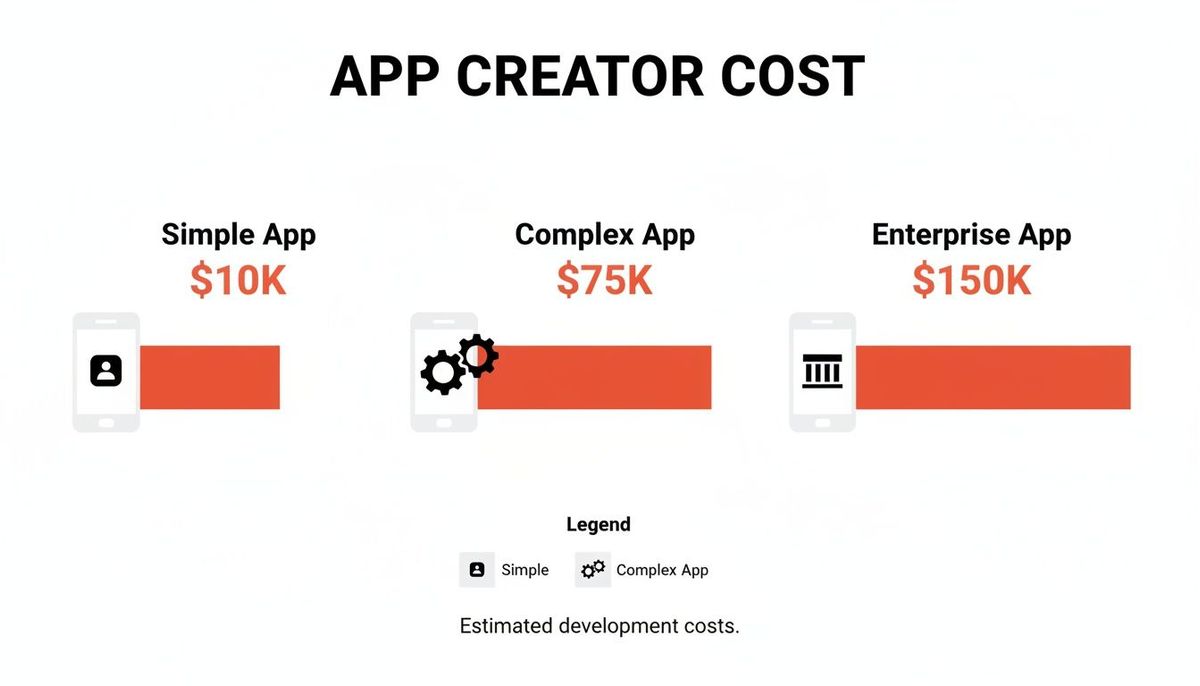
As you can see, the price tag grows quickly as you add features like payment gateways, user accounts, and third-party API connections. For any monetized app, getting the details right on these features is non-negotiable for accurate budgeting. For example, integrating reliable payment processing solutions is a critical piece that directly impacts your ability to even make money.
Key Takeaway: The first step to a smart investment is looking at your app budget through the lens of complexity and business goals. Your initial spend should line up directly with the level of market validation and revenue you're aiming for.
To put some hard numbers on this, here's a quick breakdown of what you can generally expect.
Quick Guide to App Development Costs and Timelines
This table provides a high-level look at what different tiers of app development entail, connecting cost to tangible features and realistic timelines. It's a great starting point for figuring out where your project might land.
| Complexity Tier | Estimated Cost Range | Typical Timeline | Example Features |
|---|---|---|---|
| **Simple / MVP** | **$10,000 - $50,000** | **2 - 4 Months** | Basic user login, static content display, simple forms, single API integration. |
| **Complex / Growth-Ready** | **$50,000 - $150,000** | **4 - 6 Months** | Social logins, payment processing, user profiles, real-time chat, multiple API integrations. |
| **Enterprise / Scale** | **$150,000+** | **6 - 9+ Months** | Advanced analytics, custom backend, multi-platform sync, machine learning features, enterprise security. |
These figures aren't set in stone, but they give you a realistic framework for planning your investment and aligning it with your launch strategy.
Industry data backs this up, showing that while a simple MVP might land between $10,000 and $50,000, enterprise-level apps easily push past $150,000. Adding things like AI or a full e-commerce setup will definitely increase the cost, but there's a flip side. For funded startups, a revenue-ready app built with a modern framework like React Native can often be launched in just 10-20 weeks—a fraction of traditional development timelines.
If you want to dive deeper, you can explore a full breakdown of what goes into the cost to produce an app in our other guide.
Unpacking the Core Drivers of Your App's Budget

Trying to understand the final price of an app is a lot like pricing a custom car. The base chassis is just your starting point. It’s the engine you choose, the leather for the interior, and the sound system you install that really determine the final cost and performance.
Your app is no different. The total app creator cost isn't some single, mysterious number. It's the sum of a dozen strategic decisions you'll make along the way, from scope and technology to the backend that powers it all.
Let's break down these core drivers. By dissecting what actually moves the needle on price, you can make informed trade-offs and ensure every dollar you spend is a direct investment in your business goals.
The Impact of App Scope and Complexity
By far, the single biggest factor dictating your budget is scope. And this isn't just about how many features you have, but how intricate they are. A simple content app with five static screens is an entirely different beast than an online marketplace with user roles, real-time messaging, and a dynamic review system.
Think about it this way:
- Practical Example A: Simple Fitness Tracker
- Scope: A user can log workouts from a pre-set list and see their history. That’s it. We're talking three core screens: Login, Workout Entry, and History.
- Complexity: Very low. This is basic data entry and display.
- Actionable Insight: For an app this simple, your primary cost will be in clean UI/UX design. You can keep the budget under $25,000 by using a simple, non-scalable backend and avoiding third-party integrations.
- Practical Example B: Social Fitness Platform
- Scope: Users build custom workout plans, track detailed analytics, follow friends, post to a social feed, and join group challenges. This could involve 15+ screens and multiple user roles (e.g., user vs. coach).
- Complexity: High. This requires a powerful backend, real-time data syncing, and multiple API integrations.
- Actionable Insight: The cost here is driven by the backend logic for social interactions and data analytics. Expect a budget of $150,000+. To manage costs, launch with only one social feature (like 'following friends') and add others based on user feedback.
That social fitness app? It could easily cost 5-10 times more than the simple tracker. Every additional screen, user interaction, and piece of logic adds hours of design, development, and crucial testing time.
Choosing Your Platform: iOS vs. Android vs. Cross-Platform
Your next major cost decision revolves around the platform. Are you targeting Apple's iOS, Google's Android, or both?
Building two separate, native apps from scratch is the most expensive route. You're essentially paying for the same app to be built twice by two different teams.
This is where cross-platform frameworks like React Native come in, offering a massive financial advantage. By using a single codebase for both iOS and Android, you can slash development costs—often by 30-40%—while still giving users an experience that feels completely native.
Actionable Insight: If your target audience is evenly split between iOS and Android (common for consumer apps), a cross-platform build is the most capital-efficient strategy. For a B2B app targeting corporate users who are primarily on iPhones, an iOS-only native build might be a smarter initial investment to perfect the experience on one platform before expanding.
This choice has a long-term impact on your app creator cost, too. A single codebase is far cheaper to maintain, update, and add features to down the line.
Backend Infrastructure and Third-Party Integrations
The backend is the engine of your app. It’s everything your users don’t see but completely depend on, like databases, server logic, and the APIs that make the magic happen. A simple blog app might just need to pull articles from a basic content management system.
An e-commerce app, on the other hand, needs a much more complex backend to handle user accounts, manage inventory, process orders, and securely take payments. That sophisticated server-side logic takes more development hours, which means a bigger budget.
Third-party integrations are another layer that adds to both cost and complexity. Each external service you connect to your app requires careful implementation and rigorous testing to make sure it doesn't break.
Common integrations that will bump up your budget include:
- Payment Processing: Integrating services like Stripe or Braintree to handle transactions.
- Analytics: Plugging in tools like Mixpanel or Amplitude to understand user behavior.
- Push Notifications: Using a service like OneSignal to keep users engaged.
- Social Logins: Allowing easy sign-up with Facebook, Google, or Apple accounts.
While these tools add incredible functionality, each one adds to the development timeline. To see how all these factors come together, play around with our detailed app development cost calculator to model a few different scenarios for your project.
Choosing the Right App Development Pricing Model
Picking a development partner is a lot like choosing a builder for your house. The way they price their work tells you everything about their priorities, where the risk falls, and ultimately, what kind of house you’re going to get. It’s not about finding the cheapest quote; it’s about finding a partner whose incentives are locked in with your own.
Get this wrong, and you’re in for budget overruns, missed deadlines, and a product that just doesn't perform. Here’s how the common models break down:
- DIY App Builders: This is the pre-fab home kit from a big box store. It’s cheap and fast for something incredibly basic, but you’re stuck with their templates. Forget about unique features or true scalability—it’s just not built for it.
- Freelancers: This is like hiring individual tradespeople—an electrician, a plumber, a roofer. You get specialized talent and flexibility, but you’re now the general contractor. Juggling everyone’s schedules, ensuring quality, and keeping the project on track becomes your full-time job.
- Traditional Agencies: This is your classic general contractor who bills you for every hour they and their crew are on-site. They manage the project, but their business model is simple: more hours mean more revenue. This creates a nasty conflict of interest where delays, rework, and scope creep actually benefit their bottom line, not yours.
- Performance-Based Partners: Think of this as a modern design-build firm whose payment is tied to the final value and livability of your home. They are all-in on building a high-quality, functional house as efficiently as possible because if you’re not happy with the result, they don’t get their full payout.
For any funded startup, a model that rewards business outcomes—not just hours logged—will almost always deliver a better return on your investment.
Comparison of App Development Engagement Models
The "billable hour" is one of the biggest traps a founder can fall into. Sure, you might see global developer rates that seem low, but North American agencies often charge $70-$180 per hour. A medium-complexity app can quickly spiral into the $50,000-$120,000 range. The backend alone can eat up anywhere from $30,000 to $150,000 of your budget over several months.
A performance-based partnership completely flips that script. Instead of paying for time, your investment is tied to hitting real business goals, like revenue targets, user retention rates, or key conversion milestones. This model gets rid of the fundamental misalignment where an agency can keep billing you for months without ever delivering a single dollar of ROI. To see how different services package their offerings, it can be helpful to review examples like Mintline's pricing page.
The Bottom Line: You get what you pay for. A model based on hourly billing incentivizes activity. A performance-based model incentivizes results. For a startup, results are the only thing that matters.
Let's put these models side-by-side to see how they really stack up in the areas that count.
| Model | Cost Structure | Incentive Alignment | Best For |
|---|---|---|---|
| **DIY Builder** | Low Monthly Subscription (**$300-$6K/year**) | Minimal. Provider is incentivized to keep you subscribed, not for your app to succeed. | Pre-launch experiments or internal tools with no need for custom features or scale. |
| **Freelancer** | Hourly or Per-Project Rate | Mixed. Good freelancers want to build a reputation, but are ultimately paid for time or tasks, not business outcomes. | Small, well-defined tasks or augmenting an existing team under strong internal management. |
| **Traditional Agency** | Time & Materials (Hourly Billing) | Low. The agency profits from hours billed, creating a conflict when projects face delays or scope changes. | Large enterprises with extensive internal oversight and well-defined, static project scopes. |
| **Performance Partner** | Fixed Investment Tied to KPIs | High. Success is shared. The partner's upside is directly linked to your app hitting revenue and growth targets. | Funded startups needing a revenue-ready MVP that demonstrates traction and ROI quickly. |
Ultimately, your choice here is a strategic one that will define your budget and shape your product’s entire future. Tying your partner's financial success directly to your own is the single best way to build an app that doesn’t just get launched, but actually wins.
Budgeting for Features That Drive Revenue and Retention
Alright, let's move past the basic build. The single most important part of your app creator cost is setting aside money for the features that actually make you money. This is where your app stops being a cool project and starts becoming a real business.
These aren't just bells and whistles. They’re the core infrastructure for growth, revenue, and keeping users around for the long haul.
Trying to save money by skipping these features is a classic, and often fatal, startup mistake. It’s like building a beautiful retail store but completely forgetting to install a cash register. For investors, seeing a clear path to monetization isn't a "nice-to-have"—it's an absolute deal-breaker.
In-App Purchases and Subscriptions
For most modern apps, recurring revenue is the lifeblood. But setting up a solid subscription or in-app purchase system is way more complicated than just slapping a "Buy Now" button on the screen. It means handling secure payments, managing different subscription tiers, dealing with renewals, and navigating the ever-changing rules from Apple and Google.
The industry-standard approach is to pair a powerhouse like Stripe for payment processing with a tool like RevenueCat to manage the entire subscription lifecycle. This combination gives your users a smooth experience while giving you the tools to track crucial metrics like Monthly Recurring Revenue (MRR) and customer Lifetime Value (LTV).
Practical Example: A meditation app offers a 7-day free trial for its premium content. A well-designed paywall, managed by RevenueCat, can automatically convert those trial users to a $9.99/month plan. This one feature can take the average LTV from just a few dollars to over $100 per user.
Budgeting for this kind of revenue engine typically adds $15,000 to $30,000 to your initial development cost. The ROI, however, is undeniable. It's the core of your entire business model. For a deeper dive, check out our guide on the best app monetization strategies successful startups are using right now.
Push Notifications for Engagement
So you've built an amazing app people are paying for. Great. But what good is it if they forget it exists after a week? A smart push notification system is your direct line to your users, proven to boost engagement by as much as 88%. These aren't just annoying, spammy alerts; they're targeted messages designed to pull people back in.
This requires a backend service to manage user segments and trigger the right message at the right time. Your budget should account for features like:
- Onboarding Nudges: Welcome new users and guide them to that "aha!" moment where they fall in love with your app.
- Re-engagement Alerts: Gently remind users who haven't opened the app in a while about new content or features.
- Transactional Notifications: Confirm a purchase or let a user know their subscription is about to renew.
Integrating a service like OneSignal and building the custom logic for these campaigns can add $5,000 to $15,000 to your cost. But when you look at its impact on user retention, it's one of the highest-leverage investments you can make.
Analytics Dashboards to Track KPIs
You can't grow what you don't measure. An analytics dashboard isn't a vanity project; it's your business's command center. It shows you the Key Performance Indicators (KPIs) that tell you, in no uncertain terms, whether you're winning or losing.
Without it, you’re flying blind. You have no idea where users are dropping off, which features they actually use, or if your monetization strategy is even working.
A custom dashboard built to track your specific business goals pulls data from various sources and presents it in a way you can actually act on. This usually involves integrating tools like Mixpanel or Amplitude and building a clean interface for your team. This tool is what allows you to answer the make-or-break questions:
- What's our trial-to-paid conversion rate?
- Which user acquisition channel brings in the highest LTV?
- Did that new feature we launched actually improve daily active users?
Building this essential visibility into your app's performance can cost anywhere from $10,000 to $25,000. This investment pays for itself by enabling data-driven decisions that directly boost your bottom line.
Smart Ways to Lower Your Real App Cost

The sticker price for building an app is just one number. The number that really matters is your effective app creator cost. By thinking like a CFO, not just a founder, you can pull some powerful financial levers and development tactics to make every dollar in your budget go further—without ever cutting corners on quality.
These aren't tricks or loopholes. They're about being strategic with your investment from day one to reduce your actual cash burn and boost your project’s return. Let's dig into some of the most effective ways to do this.
Turn Your Development Work into R&D Tax Credits
One of the biggest financial game-changers for startups is the Research and Development (R&D) tax credit, and it’s criminally underused. Most founders hear "R&D" and picture scientists in lab coats, but a huge amount of software development work actually qualifies.
If you're building something new, solving tough technical problems, or experimenting with different ways to create your app, there's a good chance you're conducting qualifying R&D. The secret is to meticulously document your process—from the initial technical sketches to testing out different algorithms and server setups.
Actionable Example: Imagine you're building a delivery app and spend 40 hours developing a novel algorithm to optimize driver routes. That specific work—the planning, coding, and testing—can be documented as R&D. When done correctly across the entire project, this documentation can result in a tax credit that effectively cuts your net project cost by 20-40%.
Let's make that real. Say your app development project costs $250,000. By working with a partner who understands how to document the R&D process, you could potentially get a tax credit between $50,000 and $100,000. This radically drops your actual out-of-pocket spend, freeing up cash you can pour back into marketing, hiring, or building the next set of features.
Launch in Phases with a Minimum Viable Product (MVP)
The classic startup blunder is trying to build the entire dream product all at once. It's a recipe for burning cash and time. A much savvier, capital-efficient strategy is to launch a phased Minimum Viable Product (MVP). This isn't about shipping something cheap or broken; it's about shipping something hyper-focused.
Your MVP is the first step, not the final destination. The goal is to build only the core features that solve one critical problem for your target user, proving they'll actually pay for your solution.
Here’s why this slashes your effective cost:
- It cuts your upfront risk. You validate the core business idea with a smaller check before committing to a six-figure budget.
- You get real user feedback. This helps you learn what users actually want, not what you think they want, preventing you from wasting money on features no one ever touches.
- It can generate early cash flow. A sharp MVP can start bringing in revenue almost immediately, which you can then use to fund the next phase of development.
Use Cross-Platform Tech to Your Advantage
Another huge cost-saver is hidden in your technology choice. If you decide to build separate, native apps for both iOS and Android, you're signing up to maintain two different codebases. That effectively doubles your development cost and every future update.
This is where cross-platform frameworks like React Native give you a massive financial edge. By using a single codebase to run both your iOS and Android apps, you unlock huge efficiencies. It doesn't just shrink the initial development bill; it also makes future updates, bug fixes, and new features far cheaper and faster, dramatically lowering your app's total cost of ownership for years to come.
Planning for Your App's Long-Term Ownership Costs
Launching your app is a huge milestone. But it's the starting line, not the finish line.
Too many founders breathe a sigh of relief once the initial build is done, thinking the hard part is over. In reality, the financial journey is just beginning. To build a sustainable business, you have to plan for the Total Cost of Ownership (TCO)—all the ongoing expenses that keep a successful app alive and kicking.
Think of it like buying a new car. You don't just pay the sticker price and drive off into the sunset forever. You've got to budget for gas, insurance, oil changes, and the occasional repair to keep it running safely. Your app is no different. It needs constant investment to stay functional, secure, and relevant.
The Unseen Costs of Keeping Your App Live
This is where a lot of founders get blindsided. These recurring costs can eat through a startup's runway if they aren't baked into the financial model from day one. The true cost of creating an app goes far beyond the initial development fees.
Here are the most common ongoing costs you absolutely need to anticipate:
- Server and Hosting Fees: This is the digital "rent" for your app's backend infrastructure. As your user base grows, so will these costs, often scaling from a few hundred to several thousand dollars per month.
- Third-Party API Subscriptions: Modern apps are stitched together with external services. Whether it's Stripe for payments, Google Maps for location features, or Mixpanel for analytics, each of these comes with its own monthly or usage-based price tag.
- Mandatory OS Updates: Apple and Google roll out major updates to iOS and Android every single year. If you don't update your app for compatibility, it will eventually break, perform poorly, or even get booted from the app stores. This isn't optional; it's the cost of admission.
- Bug Fixes and Performance Monitoring: No app is perfect. Users will uncover new bugs, and performance issues will pop up. You need a budget for ongoing technical support to keep the app stable and prevent user churn.
A Practical Rule for Post-Launch Budgeting
So, how much should you actually set aside? A reliable rule of thumb used across the industry is to budget 15-20% of your initial development cost for annual maintenance.
Actionable Example: If your initial app build cost $200,000, you should plan to spend an additional $30,000 to $40,000 every year just to keep it running. This covers the essential updates, bug fixes, and subscriptions—literally just keeping the lights on.
That number doesn't even account for adding new features or staying ahead of the competition. It's purely the cost of maintaining the status quo. This is a critical figure to have in your financial forecasts, especially when you're talking to investors.
Gaining Long-Term Technical Independence
This is where your choice of development partner becomes so important. Many traditional agencies will lock you into expensive, open-ended monthly retainers for this ongoing work. It creates a dependency that can drain your resources for years.
A better approach is a partnership that includes a structured handoff. This model doesn't just focus on building your app; it focuses on building your own technical team. By helping you recruit, train, and transition to a dedicated in-house team over 12-18 months, this strategy gives your startup true long-term independence.
You gain full control over your product's destiny, free from endless agency contracts and empowered to innovate on your own terms.
Still Have Questions About App Costs?
Figuring out the money side of app development can feel like you're trying to hit a moving target. But once you get clear answers to the big questions, you can stop worrying about the budget and start focusing on building a product that actually works.
Let's break down the most common questions we hear from founders, cutting through the noise to give you the real answers.
How Much Does a Simple App MVP Really Cost?
You can technically get a bare-bones Minimum Viable Product (MVP) built for somewhere between $15,000 and $50,000. But let's be honest: for a funded startup that needs to show real progress to investors, that kind of MVP is a waste of time.
A smarter investment is what we call a "revenue-ready" MVP. This version goes beyond the basics and includes the essentials you need to actually run a business, like user accounts, payment processing, and core analytics. This more strategic build typically lands in the $150,000 to $250,000 range.
Why the jump? Because it's built to generate revenue and track performance from day one—which is exactly what investors want to see.
Is It Cheaper to Hire Freelancers Than an Agency?
On paper, a freelancer's hourly rate looks tempting. In reality, it's often a mirage. Juggling multiple freelancers means you become the project manager, which eats up your time and focus. You also run a much higher risk of delays and end up with a disjointed product because there's no single, unified strategy. The "savings" almost always evaporate.
A performance-based partner changes the game entirely by tying their success directly to yours.
Their model isn't about billing hours; it's about hitting business goals like revenue growth and user retention. This approach builds a higher-quality, scalable product faster and delivers a far better long-term ROI.
How Can I Get an Accurate Estimate for My App?
An accurate estimate is impossible without a detailed scope. Those online app cost calculators are fun for a ballpark guess, but they can't account for the specific technical decisions that drive the real cost.
To get a real number, you need to define three key things:
- Platform Choice: Are you building for iOS, Android, or both? A cross-platform solution like React Native can be more efficient than building two separate native apps.
- Backend Complexity: How much heavy lifting does your server need to do? Think custom logic, database management, and API development.
- Third-Party Integrations: What tools will you plug in? This could be anything from payments with Stripe to analytics or social logins.
The best first step isn't a calculator; it's mapping out your core user journey and how you plan to make money. Once you have that, you can have a meaningful conversation with a development partner who can build a proposal based on your actual business goals.
What Are the Biggest Hidden Costs in App Development?
The monster hiding in the closet is almost always post-launch maintenance. Budget for it to be 15-20% of your initial development cost, every single year.
Other surprise bills come from recurring fees for third-party APIs and servers, mandatory OS updates that require code changes, and "scope creep"—the slow, unbudgeted addition of new features mid-project.
Working with a transparent partner who plans for life after launch helps you see these costs coming and manage them before they become a problem.
Ready to build an app that drives revenue and proves traction? Vermillion is a performance-based partner that delivers revenue-ready React Native apps designed for growth. Let's discuss how we can align our success with yours. Learn more about our approach.